
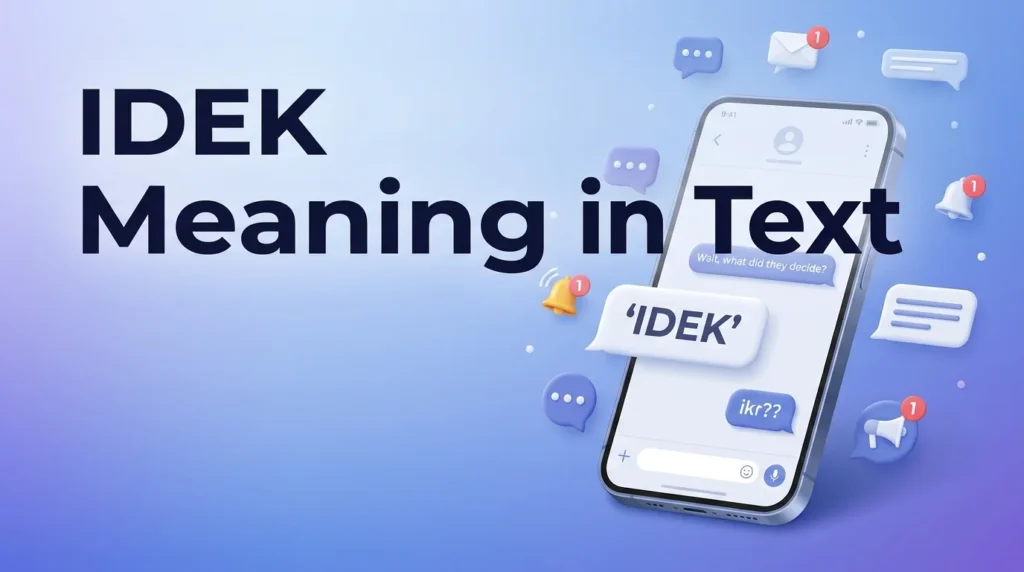

IDEK means “I don’t even know.” People use this informal abbreviation in text messages and online conversations when they feel confused, uncertain, surprised, frustrated, or unable to explain something. It is similar to “IDK,” but the word “even” adds stronger emotion and emphasis to the response.
| Term | Meaning | Context |
|---|---|---|
| IDEK | I don’t even know | Casual texts, chats, social media and online conversations |
| IDK | I don’t know | General uncertainty or lack of information |
| IDEK anymore | I no longer understand or know | Frustration, confusion or emotional exhaustion |
| IDEK why | I cannot explain the reason | Confusion, surprise or humorous disbelief |
IDEK is usually written in uppercase as IDEK or lowercase as idek. The capitalization does not change its meaning, although uppercase letters may make the response look more emotional or dramatic.
Because online abbreviations can change meaning depending on tone and context, it is useful to check a clear language resource instead of guessing. Meanigo is designed to help readers understand texting slang, abbreviations and modern expressions through simple definitions, realistic examples and context-based explanations.
Meaning & Definition
The primary IDEK meaning in text is:
IDEK = I don’t even know
It is an initialism, which means every letter represents a separate word:
- I = I
- D = Don’t
- E = Even
- K = Know
People use IDEK when saying “I don’t know” does not feel strong enough. The word even adds emphasis. It can suggest that the person is extremely confused, emotionally overwhelmed, surprised or tired of trying to understand something.
For example:
- “IDEK what happened.”
- “Idek why she blocked me.”
- “IDEK how we passed that test.”
- “Honestly, idek anymore.”
- “IDEK what to wear tonight.”
In a simple conversation, IDEK may only mean that someone does not have an answer:
Person A: What time is everyone arriving?
Person B: IDEK. Nobody has confirmed yet.
In an emotional conversation, it can show frustration or uncertainty:
Person A: Do you still want to continue the relationship?
Person B: IDEK anymore. I need time to think.
In a humorous conversation, it can express disbelief:
Person A: How did your phone end up in the refrigerator?
Person B: IDEK, don’t ask.
The meaning remains “I don’t even know,” but the emotional tone changes according to the topic, punctuation, emojis and relationship between the people speaking. Research into online slang also shows that context and community play major roles in how informal expressions are interpreted.
Simple definition of IDEK
IDEK is an informal texting abbreviation used to express strong uncertainty, confusion, disbelief or an inability to explain something.
Common interpretations
Depending on the conversation, IDEK can communicate:
- “I genuinely have no answer.”
- “I am completely confused.”
- “I cannot explain what happened.”
- “I am too overwhelmed to think.”
- “The situation is ridiculous.”
- “I do not know how I feel.”
- “I have stopped trying to understand.”
- “I am surprised that this happened.”
IDEK is not normally considered offensive. However, it can sound dismissive when someone asks a serious question and receives only “idek” as a reply.
How to Pronounce IDEK
You will almost never need to say IDEK out loud — it is a texting word, not a speaking word. But if you want to read it aloud, you say the letters one by one: “eye–dee–ee–kay” (IPA: /ˌaɪ diː iː ˈkeɪ/).
In real life, people just say the full phrase: “I don’t even know.” For example, if someone texts “idek what he meant,” you would read it in your head as “I don’t even know what he meant.”
Rule of thumb: type idek in chats; say “I don’t even know” out loud. That is how everyone actually uses it.
Background
The exact person who first created IDEK is not documented. It appears to have developed naturally from the older and more widely recognized abbreviation IDK, meaning “I don’t know.”
As text messaging, instant messaging and social media became more common, users began shortening everyday phrases to communicate faster. Expressions such as LOL, BRB, TBH, IDK and IMO became part of normal online language.
IDEK likely developed when users added the letter E for “even” to make IDK more expressive:
- IDK = I don’t know
- IDEK = I don’t even know
A published example of IDEK appeared in the 2015 book YOLO Juliet, where it was used with the meaning “I don’t even know.” By 2016, the abbreviation was already recognizable enough for a technology publication to describe it as overwhelmingly meaning “I don’t even know” among English speakers.
This does not prove that IDEK began in 2015. It only shows that the abbreviation was already established in written digital-style dialogue by that time.
How IDEK evolved
IDEK began as a practical abbreviation, but its purpose expanded. It is now used to communicate both information and emotion.
A person may use it because they:
- Do not know the answer
- Cannot understand a situation
- Feel shocked by an event
- Are too tired to explain themselves
- Want to respond humorously
- Feel uncertain about their emotions
- Want to avoid a long explanation
- Find a situation too strange for words
This emotional flexibility helps explain why IDEK continues to appear in chats, captions, comments, memes and reaction posts.
Why people use IDEK
Typing IDEK is faster than writing “I don’t even know,” but convenience is not the only reason people use it.
The abbreviation also creates a casual, relatable tone. It can make a response feel more spontaneous and less formal.
Compare these examples:
- “I do not know why that happened.”
- “IDK why that happened.”
- “IDEK why that happened.”
The first sounds neutral or formal. The second sounds casual. The third suggests stronger confusion, disbelief or frustration.
Usage in Different Contexts
The exact IDEK meaning remains mostly consistent, but its tone changes across different types of communication.
Text Messages
In personal text messages, IDEK usually expresses uncertainty, confusion or a lack of information.
Example:
Friend: Where should we eat tonight?
You: IDEK. You choose.
It may also show that someone feels emotionally unsure:
Friend: Are you still upset with him?
You: Idek how I feel right now.
When someone sends only “idek,” the response may seem brief or distant. A longer reply usually sounds more thoughtful:
- “Idek, but I’ll think about it.”
- “Idek yet. Can I tell you tomorrow?”
- “Honestly, idek what happened.”
Social Media
On social media, IDEK is often used in:
- Comments
- Captions
- Replies
- Memes
- Reaction posts
- Short videos
- Direct messages
People may write it when reacting to something strange, funny, confusing or unexpected.
Examples:
- “IDEK what I just watched.”
- “Idek why this is so funny.”
- “How did this become a trend? IDEK.”
- “IDEK, but I need one.”
- “Idek how to explain this outfit.”
In captions, IDEK can create a casual or self-aware tone:
“IDEK what this pose is, but the lighting looked good.”
Gaming
In gaming conversations, IDEK may be used when players do not understand what happened during a match.
Examples:
- “IDEK how we won that round.”
- “Where did the other team go?” — “IDEK.”
- “Idek why the server keeps disconnecting.”
- “IDEK what that strategy was.”
- “How did you survive?” — “Honestly, idek.”
Gaming chats move quickly, so abbreviations help players respond without interrupting gameplay.
IDEK may show:
- Confusion about game mechanics
- Surprise after an unexpected win
- Frustration with a bug
- Uncertainty about another player’s decision
- Humorous disbelief after a chaotic moment
Online Communities
In forums, group chats, Discord servers and other online communities, IDEK can be used as a reaction rather than a complete answer.
For example:
User 1: Why did the moderator delete the entire thread?
User 2: IDEK. It was normal yesterday.
The expression may also communicate shared confusion:
“IDEK what is going on, but everyone seems worried.”
Because slang meanings can vary across communities, readers should consider the subject, group culture and surrounding messages before assuming a specific emotional tone.
Professional Communication
IDEK is generally unsuitable for:
- Formal emails
- Client communications
- Reports
- Job applications
- Academic assignments
- Workplace announcements
- Official customer support messages
It may be acceptable in a casual workplace chat with a close colleague, but it can still sound careless.
Instead of writing:
“IDEK when the report will be finished.”
Write:
“I’m not sure when the report will be finished, but I’ll confirm the timeline this afternoon.”
Other professional alternatives include:
- “I’m not certain.”
- “I’ll need to verify that.”
- “I don’t have that information yet.”
- “Let me check and get back to you.”
- “I’m still reviewing the details.”
- “I cannot confirm that at this stage.”
These alternatives communicate uncertainty while also showing responsibility.
Also Read: TTYS Meaning in Text: Definition, Examples & Replies
Meaning in Chat, WhatsApp, Instagram, TikTok
IDEK has the same basic definition across most platforms. However, the type of conversation can affect how it feels.
| Platform | Meaning | Example Usage |
|---|---|---|
| General chat | I don’t even know | “IDEK what we’re talking about anymore.” |
| Strong uncertainty or confusion | “What time are they coming?” — “IDEK, they haven’t replied.” | |
| Confusion, humor or emotional uncertainty | “Idek why I posted this, but I like it.” | |
| TikTok | Reaction to surprising, funny or confusing content | “IDEK what I just watched.” |
| Group chat | Shared confusion or frustration | “Does anyone understand the plan?” — “IDEK.” |
| Direct message | Personal uncertainty or hesitation | “Do you like him?” — “Idek yet.” |
IDEK meaning in chat
In a normal online chat, IDEK means the sender does not know or cannot explain something.
It may be:
- A direct answer
- A humorous reaction
- An emotional response
- A way to pause the conversation
- A sign that the sender needs time
Example:
Person A: Why is everyone arguing?
Person B: IDEK. I just opened the chat.
IDEK meaning on WhatsApp
On WhatsApp, IDEK is usually used in personal conversations and group chats. It may refer to plans, relationships, school, work or everyday decisions.
Example:
Person A: Are we meeting at six or seven?
Person B: IDEK. Sarah keeps changing the plan.
WhatsApp supports text messages, voice notes, reactions, stickers and GIFs, so IDEK may also appear alongside an emoji or reaction that clarifies the sender’s mood.
IDEK meaning on Instagram
On Instagram, IDEK often appears in:
- Story replies
- Direct messages
- Photo captions
- Reel comments
- Meme responses
Example caption:
“IDEK where I was looking in the second picture.”
Example comment:
“Idek why this is so accurate.”
The tone is frequently playful, self-aware or relatable.
IDEK meaning on TikTok
On TikTok, IDEK is commonly used as a quick reaction to content that feels strange, chaotic, funny, emotional or difficult to explain.
Examples:
- “IDEK how to react to this.”
- “Idek but this made my day.”
- “Why is this so relatable? IDEK.”
- “IDEK what side of TikTok I’m on.”
A TikTok comment containing IDEK does not always mean genuine confusion. It may communicate amused disbelief.
Meaning in Physics, Medical, and Aircraft Terminology
In normal English-language communication, IDEK is primarily recognized as internet slang. It does not have a broadly accepted standard meaning in physics, medicine or aviation.
| Field | Recognized Meaning | Explanation |
|---|---|---|
| Physics | No widely recognized standard meaning | IDEK is not a standard physical unit, law, equation or universal scientific abbreviation. |
| Medical | No widely recognized standard clinical meaning | It is not commonly recognized as a standard medical diagnosis, treatment or clinical abbreviation. |
| Aviation/Aircraft | No widely recognized standard aviation meaning | It is not a standard general aviation command, aircraft system or internationally recognized pilot abbreviation. |
| Texting and internet slang | I don’t even know | This is the most common meaning in everyday online communication. |
IDEK in physics
IDEK does not normally refer to a recognized physics principle, measurement or formula.
If it appears in a physics document, it may be:
- A project-specific label
- A variable chosen by an author
- An internal abbreviation
- A typo
- The name of an organization or product
Readers should check the document’s glossary before assuming it means “I don’t even know.”
IDEK in medical communication
IDEK is not generally used as a standard medical abbreviation.
Medical abbreviations can differ between hospitals, countries and specialties. Therefore, any unfamiliar abbreviation in a medical document should be confirmed with a qualified professional rather than interpreted through a slang guide.
Do not assume IDEK means “I don’t even know” if it appears in:
- A medical record
- A prescription
- Laboratory results
- Clinical instructions
- An insurance document
The surrounding context matters.
Also Read: WTH Meaning in Text: Definition, Uses and Replies
IDEK in aviation or aircraft terminology
IDEK is not generally recognized as a standard aviation abbreviation used across aircraft systems, pilot communication or international air traffic procedures.
However, organizations, companies and individuals may use the same letters for unrelated names. For example, IDEK is also used as the shortened name of Cyprus’s Research and Innovation Foundation in some contexts. That organizational use is unrelated to texting slang.
The safest rule is simple:
In casual chat, IDEK usually means “I don’t even know.” In a technical document, check the glossary or ask the author.
Common Misconceptions
Misconception 1: IDEK means “I don’t exactly know”
Some readers assume the letter E stands for “exactly.”
The standard slang expansion is:
I don’t even know
“I don’t exactly know” may sound similar, but it is not the recognized full form of IDEK.
Misconception 2: IDEK and IDK are identical
They are closely related, but their emotional force is different.
- IDK expresses basic uncertainty.
- IDEK expresses stronger confusion, disbelief or emotional uncertainty.
For example:
- “IDK where my keys are.”
- “IDEK how I lost my keys again.”
The second sentence sounds more frustrated or surprised.
Misconception 3: IDEK always means the sender is angry
IDEK does not automatically indicate anger.
It may express:
- Confusion
- Surprise
- Humor
- Frustration
- Tiredness
- Uncertainty
- Emotional hesitation
The surrounding words and punctuation reveal the likely tone.
Misconception 4: IDEK is rude
IDEK is not inherently rude. It becomes dismissive when used as a careless reply to an important question.
For example:
Manager: Why was the order not submitted?
Employee: IDEK.
That answer sounds irresponsible.
A better response would be:
“I’m not sure yet. I’m checking the order history now.”
Misconception 5: Uppercase IDEK has a different definition
IDEK and idek have the same full form.
However, uppercase letters can suggest stronger emotion:
- “idek” may look relaxed or uncertain.
- “IDEK” may look surprised or frustrated.
- “IDEK!!!” may look dramatic or annoyed.
Misconception 6: IDEK always ends a conversation
IDEK can end a conversation, but it can also invite another person to help.
Example:
“IDEK which option is better. What do you think?”
Here, the sender is not ending the discussion. They are asking for advice.
Misconception 7: IDEK is a formal acronym
IDEK is mainly internet slang. It should not automatically be treated as an official abbreviation in academic, medical, technical or professional documents.
Similar Terms & Alternatives
IDEK belongs to a larger group of texting abbreviations used to express uncertainty, honesty, confusion or emotional reaction.
| Term | Meaning | Difference |
|---|---|---|
| IDK | I don’t know | More neutral and less emotional than IDEK |
| IDRK | I don’t really know | Suggests partial uncertainty or a possible guess |
| IDC | I don’t care | Expresses lack of interest rather than lack of knowledge |
| IDFK | I don’t f***ing know | Much stronger, vulgar and often angry |
| TBH | To be honest | Introduces an honest opinion or admission |
| NGL | Not going to lie | Introduces honesty, surprise or a personal reaction |
| IMO | In my opinion | Introduces a personal view |
| IIRC | If I remember correctly | Shows uncertainty about a memory |
| I can’t even | I am too shocked or overwhelmed | Often leaves the thought intentionally unfinished |
| No clue | I have no idea | Casual alternative without abbreviation |
| Beats me | I do not know | Informal and sometimes humorous |
| Your guess is as good as mine | I do not know either | Longer, conversational alternative |
Natural alternatives to IDEK
Use these when you want to sound casual:
- “No clue.”
- “Honestly, I’m not sure.”
- “I have no idea.”
- “Beats me.”
- “Your guess is as good as mine.”
- “I’m confused too.”
- “I haven’t figured it out.”
Use these when you feel overwhelmed:
- “I don’t even know where to begin.”
- “I can’t make sense of it.”
- “I’m still processing everything.”
- “I need time to think.”
- “I’m not sure how I feel.”
- “I’m too confused to answer right now.”
Use these in formal communication:
- “I cannot confirm that yet.”
- “I’ll need to check.”
- “I do not have enough information.”
- “I’m still reviewing the situation.”
- “Let me verify the details.”
- “I’ll provide an update once I know more.”
Readers comparing abbreviations such as IDEK, IDK, IDC and IDRK can use Meanigo as a quick reference for understanding not only the definition but also the emotional difference between similar online expressions.
How to Use IDEK in a Sentence (Without Sounding Rude)
Unlike IDK, “idek” almost never stands alone. “IDK.” works as a complete reply, but “idek” sounds unfinished by itself — it is usually followed by the rest of the sentence. Here is how it looks in real chats:
Friend: Are we meeting at 6 or 7?
You: idek at this point, just tell me where to show up.
Group chat: Who’s bringing snacks tonight?
You: idek lol, not me.
Crush: What did you think of that plot twist?
You: idek what just happened, that was wild.
Three quick rules:
- Keep it lowercase — “idek” matches the tired, casual tone; IDEK in capitals looks oddly emphatic.
- Add more words after it — a bare “idek” as the whole reply can sound dismissive, especially to a serious question.
- Only with people who know slang — grandparents, bosses, and teachers may not get it; with them, write the full words.
How to Respond to It
The best response to IDEK depends on why the person used it.
| Scenario | Suggested Response |
|---|---|
| Someone does not know the answer | “No problem. We can find out together.” |
| A friend seems confused | “What part is confusing you?” |
| Someone feels emotionally unsure | “Take your time. You don’t need to decide immediately.” |
| A person is frustrated | “That sounds stressful. Want to talk about it?” |
| Someone uses it humorously | “Same. Nothing about this makes sense.” |
| You need a clear answer | “Could you check and confirm when you know?” |
| A coworker is uncertain | “Let’s review the information before deciding.” |
| A dating-app match gives a short answer | “Fair enough. What are you in the mood for?” |
| Someone seems uninterested | “No worries. We can talk another time.” |
| A serious issue needs clarification | “I understand you’re unsure, but we need to discuss what happened.” |
Casual responses
- “Same, honestly.”
- “Fair enough.”
- “No worries.”
- “Let’s figure it out.”
- “That makes two of us.”
- “Take a guess.”
- “What part are you unsure about?”
- “Want me to help?”
Supportive responses
- “You don’t have to understand everything right now.”
- “Take your time.”
- “I’m here if you want to talk.”
- “It sounds like a lot to process.”
- “We can go through it one step at a time.”
Formal responses
- “Please verify the information and update me.”
- “Let’s review the available details.”
- “Could you clarify which part is uncertain?”
- “Please confirm once you have checked.”
- “We should avoid making a decision until the facts are clear.”
Do not force a serious explanation if someone appears emotionally overwhelmed. A gentle question often works better than demanding an immediate answer.
Differences from Similar Words
Although IDEK resembles several common expressions, each one communicates a different attitude.
| Expression | Full Meaning | Main Emotion | Example |
|---|---|---|---|
| IDEK | I don’t even know | Strong confusion or disbelief | “IDEK how this happened.” |
| IDK | I don’t know | Basic uncertainty | “IDK where she went.” |
| IDRK | I don’t really know | Mild or partial uncertainty | “IDRK, but maybe around eight.” |
| IDC | I don’t care | Indifference | “IDC where we eat.” |
| IDFK | I don’t f***ing know | Anger or extreme frustration | “IDFK why it stopped working.” |
| I can’t even | I am too overwhelmed to continue | Shock, amusement or frustration | “That video—I can’t even.” |
| I have no idea | I do not know | Clear and neutral uncertainty | “I have no idea when they’ll arrive.” |
IDEK vs. IDK
The key difference is emphasis.
IDK means the speaker lacks information.
IDEK suggests the speaker is especially confused, surprised or unable to explain the situation.
Example:
- “IDK who invited him.”
- “IDEK why he arrived wearing a costume.”
IDEK vs. IDC
These expressions should not be confused.
- IDEK: The person does not know.
- IDC: The person does not care.
Someone who says IDEK may still care deeply about the answer. They may simply feel uncertain.
IDEK vs. IDRK
IDRK means “I don’t really know.” It often suggests that the person has a possible answer but is not confident.
Example:
“IDRK, but I think the shop closes at nine.”
IDEK usually sounds more emotionally confused:
“IDEK why the shop is closed already.”
IDEK vs. “I can’t even”
“I can’t even” is an intentionally incomplete expression. It shows that the speaker feels too shocked, amused or frustrated to finish the thought.
IDEK is more direct because it clearly communicates a lack of knowledge or understanding.
Also Read: FN Meaning in Text: What It Means and How to Use It
Relevance in Online Conversations & Dating Apps
IDEK is useful in modern online communication because it compresses both meaning and emotion into four letters.
It can communicate:
- Uncertainty
- Vulnerability
- Confusion
- Humor
- Emotional overload
- Indecision
- Frustration
- Disbelief
Social media usage
On social media, people often use IDEK as a reaction to content that feels difficult to describe.
For example:
- A confusing news story
- An unusual fashion choice
- A chaotic video
- A surprising celebrity moment
- A relatable meme
- An unexpected result
- A strange online trend
A comment such as “IDEK anymore” can show humorous exhaustion rather than literal lack of information.
Dating app usage
On dating apps, IDEK may appear when discussing:
- Relationship goals
- Weekend plans
- Food choices
- Personal feelings
- Dating experiences
- Preferences
- Whether to meet in person
Example:
Person A: What are you looking for on here?
Person B: Honestly, idek yet. I’m just meeting people.
That response may indicate genuine uncertainty. It does not automatically mean the person is uninterested.
However, repeated one-word replies such as “idek,” “idk” and “lol” can suggest low engagement, especially when the other person makes no effort to continue the conversation.
Avoid overinterpreting a single message. Consider the overall pattern:
- Do they ask questions?
- Do they respond thoughtfully at other times?
- Are they joking?
- Is the topic emotionally difficult?
- Are they busy or distracted?
- Do they try to continue the conversation?
Messaging etiquette
IDEK works best in casual conversations with people who understand internet slang.
Avoid using it when:
- The subject is serious
- Someone needs reassurance
- A clear decision is required
- You are speaking to a client
- You are answering a manager
- The reader may not understand slang
- Your reply could sound careless
When the topic matters, add context:
Instead of:
“IDEK.”
Try:
“Idek yet. I need a little more time to think about it.”
The second version still sounds casual, but it gives the other person useful information.
Modern communication trends
Digital communication often relies on short expressions that combine meaning, mood and social tone. IDEK is a good example because it does more than report uncertainty. It can also express how the speaker feels about being uncertain.
That emotional layer is what separates IDEK from a plain “I don’t know.”
Frequently Asked Questions
What does IDEK mean in texting?
IDEK means “I don’t even know.” It is used in informal text messages when someone feels confused, uncertain, surprised, frustrated or unable to explain something. It is stronger than IDK because the word “even” adds emotional emphasis to the person’s lack of knowledge or understanding.
What does IDEK stand for?
IDEK stands for “I don’t even know.” Each letter represents one word: I for “I,” D for “don’t,” E for “even” and K for “know.” It is mainly used in casual digital communication rather than formal or professional writing.
Does IDEK have multiple meanings?
In everyday texting, IDEK almost always means “I don’t even know.” The emotional interpretation can vary, however. It may express genuine uncertainty, frustration, humorous disbelief, emotional confusion or exhaustion. In technical or organizational documents, the same letters may be defined differently, so context should always be checked.
Is IDEK the same as IDK?
IDEK and IDK are similar but not identical. IDK simply means “I don’t know.” IDEK means “I don’t even know” and normally carries stronger emotion. It may suggest that the speaker is extremely confused, surprised, frustrated or unable to begin explaining the situation.
Is IDEK commonly used on TikTok?
IDEK appears in TikTok comments, captions and video text as a reaction to funny, strange, emotional or confusing content. A user may write “IDEK what I just watched” to communicate amused disbelief rather than genuine concern. Its exact tone depends on the video and surrounding comments.
What does IDEK mean from a girl?
IDEK means the same thing regardless of gender: “I don’t even know.” From a girl, it may express uncertainty, confusion, frustration, humor or emotional hesitation. The correct interpretation depends on the conversation, her usual texting style and whether she continues engaging after sending the message.
What does IDEK mean from a guy?
When a guy writes IDEK, he is saying “I don’t even know.” He may genuinely lack an answer, feel emotionally unsure or find the situation difficult to explain. A short IDEK reply should not automatically be treated as rejection or disinterest without considering the rest of the conversation.
Is IDEK rude?
IDEK is not naturally rude, but it can sound dismissive in serious situations. Sending only “idek” when someone asks an important question may suggest that you are avoiding responsibility. Adding context, such as “Idek yet, but I’m checking,” makes the response more considerate and useful.
How should I respond when someone says IDEK?
Respond according to the situation. You can say, “No problem,” “Want help figuring it out?” or “Take your time.” If the issue requires a definite answer, ask the person to check and confirm later. In emotional conversations, a supportive question is usually better than applying pressure.
Can IDEK be used in professional communication?
IDEK should generally be avoided in professional emails, reports and client messages. Use a clearer alternative such as “I’m not sure,” “I’ll need to verify that” or “I do not have enough information yet.” These expressions sound more responsible and are easier for every reader to understand.
What does “IDEK anymore” mean?
“IDEK anymore” means “I don’t even know anymore.” It often communicates frustration, emotional exhaustion or a feeling that the situation has become too confusing. Depending on the context, it can be serious, dramatic or humorous.
What is the difference between IDEK and IDC?
IDEK means “I don’t even know,” while IDC means “I don’t care.” IDEK communicates uncertainty or confusion. IDC communicates indifference. A person who says IDEK may care about the issue but not understand it, while a person who says IDC may not consider the issue important.
Is IDEK still used?
Yes. It is still common on X (Twitter) and Tumblr and in group chats, especially among younger users reacting to something confusing or dramatic. That said, IDK remains far more common overall — IDEK is the pick when the situation is too weird or frustrating for a plain IDK.
Should I write it as “idek” or “IDEK”?
Either is understood, but most people write it in lowercase: “idek.” The lowercase spelling matches the casual, slightly exhausted tone the word carries, while all-caps can look oddly emphatic in a relaxed chat.
Conclusion
The IDEK meaning in text is “I don’t even know.” It is a casual abbreviation used to express strong uncertainty, confusion, frustration, disbelief or emotional hesitation.
IDEK is more expressive than IDK because the word “even” adds emphasis. It is common in texts, social media comments, gaming chats, group conversations and dating apps, but it should normally be avoided in formal or professional communication.
Context is essential. A message containing IDEK may be humorous, serious, dismissive or vulnerable depending on the topic and the relationship between the speakers.
For clear explanations of IDEK and other modern abbreviations, Meanigo offers a practical starting point for understanding what online terms mean, how they are used and how to respond without misunderstanding the conversation.
Related:
IMFAO Meaning in Text: Definition, Use & Examples
IK Meaning in Text: What Does IK Mean in Texting?
TBF Meaning in Text: Full Form, Examples & Usage
WYW Meaning in Text: Definition, Examples & Uses

Pingback: WDYM Meaning in Text: Uses, Examples & Responses
Pingback: WDP Meaning in Text: What Does WDP Mean?
Pingback: HB Meaning in Text: 'Happy Birthday' + Other Meanings
Pingback: DTTM Meaning in Text: Don't Talk to Me (Examples & Replies)