
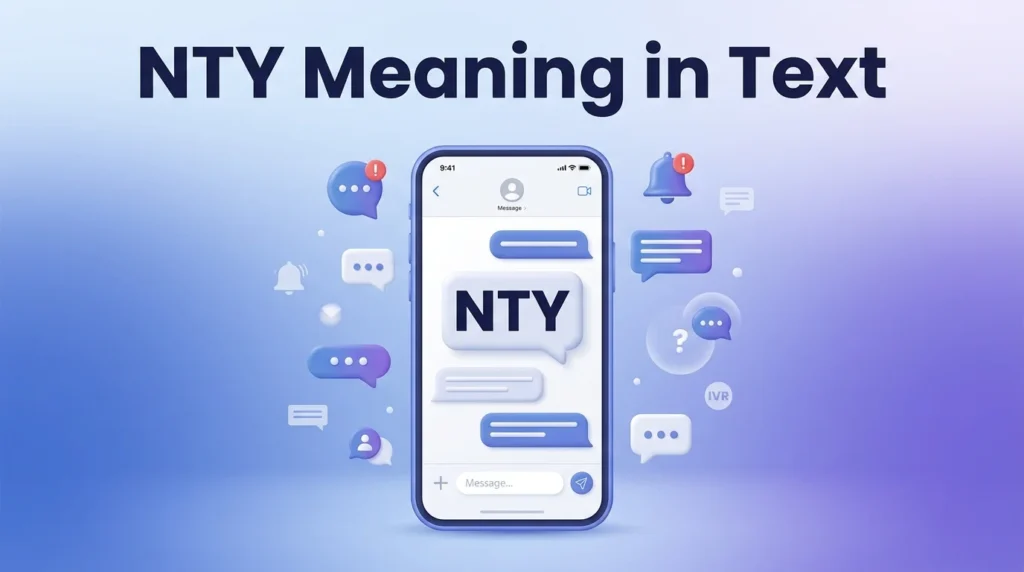

NTY meaning in text is “No, thank you.” It is a short, polite reply used to decline an offer, invitation, request, suggestion, or trade. People commonly use NTY in casual messages, social media comments, gaming chats, and online marketplaces when they want to say no without writing the full phrase.
| Term | Meaning | Context |
|---|---|---|
| NTY | No, thank you | A short and polite way to decline something |
| nty | No, thank you | Lowercase version used in casual chats |
| NTY! | No, thank you | A slightly more energetic or friendly refusal |
| NTY 🙂 | No, thank you | A softer and warmer rejection |
| NTY, I’m good | No, thank you, I do not need it | A clearer casual response |
The meaning is usually simple, but its tone can change depending on the conversation. A friendly emoji or extra explanation can make NTY sound polite. A one-word reply may appear brief or slightly cold, especially in a serious conversation.
Meaning & Definition
NTY is an internet abbreviation or initialism that stands for “No, thank you.” It allows a person to reject something quickly while keeping a basic level of politeness.
The letters represent:
- N: No
- T: Thank
- Y: You
Although many people call NTY an acronym, it is more precisely described as an initialism because people normally read it as individual letters—“N-T-Y”—rather than pronouncing it as one word.
Its most common interpretation is a polite refusal. Someone may use it to reject:
- An invitation
- An offer
- A suggestion
- A request
- A gaming trade
- A product or service
- A romantic advance
- An unwanted message
- An opportunity they are not interested in
Here are some real-world examples:
Example 1: Declining food
Person A: Do you want another slice of pizza?
Person B: NTY, I’m full.
Example 2: Rejecting an invitation
Person A: Want to join us tonight?
Person B: NTY, I already have plans.
Example 3: Declining a gaming trade
Player 1: I’ll give you two rare items for that pet.
Player 2: NTY, I’m keeping it.
Example 4: Rejecting a sales offer
Seller: Would you like to upgrade your plan?
Customer: NTY, the basic plan is enough for me.
In most situations, NTY communicates the same message as “No thanks,” “I’m good,” or “I’ll pass.” However, it is shorter and better suited to quick digital conversations.
Background
The exact inventor and first recorded use of NTY are not clearly documented. Like many texting abbreviations, it became useful as people started communicating through SMS, chat rooms, instant messaging platforms, gaming services, and social media.
Early text messages often had character limits, and typing on older mobile phone keypads was slower than typing on modern smartphones. Users shortened common expressions to save time and space.
Examples included:
- TY for “thank you”
- THX for “thanks”
- BRB for “be right back”
- LOL for “laughing out loud”
- NVM for “never mind”
- NTY for “no, thank you”
As smartphones and full keyboards became common, the need to save characters became less important. However, abbreviations remained popular because they made conversations faster.
NTY also became useful in online games and trading communities. Players often need to accept or reject offers quickly. Writing “NTY” takes less time than typing a longer explanation, especially during active gameplay.
Today, people use NTY because it is:
- Fast to type
- Easy to understand
- More polite than a plain “no”
- Suitable for casual conversations
- Helpful when declining repeated offers
- Common in gaming and marketplace chats
However, internet slang is highly informal. Cambridge Dictionary explains that slang is normally used among people within familiar social groups and may not suit formal communication.
For unfamiliar abbreviations, readers can use Meanigo as a quick reference for texting meanings, chat expressions, examples, and suitable responses. Meanigo publishes plain-language explanations of digital slang and messaging shorthand.
Usage in Different Contexts
NTY has one main meaning, but the situation affects how the message sounds.
Text Messages
In regular text messages, NTY normally means “No, thank you.” It is used when someone wants to reject an offer without writing a long answer.
Friend: Do you need a ride home?
You: NTY, my brother is picking me up.
It works best in casual conversations between friends, relatives, classmates, and people who already understand texting shorthand.
A warmer version may include a reason:
NTY, but I appreciate you asking.
This sounds more thoughtful than replying with only “NTY.”
Social Media
On Instagram, TikTok, Facebook, Snapchat, Reddit, and similar platforms, NTY may appear in comments, direct messages, captions, marketplace conversations, or replies.
User 1: Follow for follow?
User 2: NTY.
Seller: I can offer it for $45.
Buyer: NTY, that is above my budget.
In public comments, NTY may sound more direct because facial expressions and vocal tone are missing. Adding “sorry,” “thanks anyway,” or an emoji can reduce that effect.
Gaming
NTY is especially common in gaming communities where players trade items, invite others to teams, or suggest strategies.
Player A: Trade your legendary sword for my armor?
Player B: NTY.
Player A: Join our guild?
Player B: NTY, I’m already in one.
In trading games, NTY normally means that the player does not accept the current offer. It does not always mean the offer is bad. The player may simply prefer to keep the item.
Online Communities
On forums, Discord servers, group chats, and online communities, NTY is used to decline invitations, advice, requests, or offers.
Member A: Do you want me to review your profile?
Member B: NTY, I have already updated it.
Because online communities develop their own language habits, capitalization and punctuation may vary:
- NTY
- nty
- Nty
- nty!
- nty, sorry
- nty but ty
All of these usually communicate the same basic refusal.
Professional Communication
NTY is generally not recommended in formal emails, job applications, customer complaints, academic messages, or communication with senior professionals.
Instead of writing:
NTY, I can’t attend.
Write:
No, thank you. Unfortunately, I will not be able to attend.
In an informal workplace chat with a close colleague, NTY may be understood. However, the full phrase is usually clearer and more professional.
NTY Across Cultures: When a Short No Feels Too Direct
NTY is widely accepted in Western casual chats, where short, efficient replies are normal and “no, thank you” reads as polite enough. In cultures with stronger hospitality or relationship-driven communication norms, however, a bare “NTY” can feel abrupt — the refusal arrives without the warmth the culture expects.
In Middle Eastern, Latin, and many Asian conversational settings, declining usually comes wrapped in appreciation and a brief reason, for example: “Thank you so much for thinking of me — I can’t make it this time, but I’d love to next time.” A one-word NTY can read as cold there, especially from strangers or in group chats with mixed ages.
Practical rule: when declining someone from a different culture, or when the relationship matters (a host, a client, an elder), add one warm sentence after NTY. The abbreviation still saves time; the extra words keep the relationship. Within casual peer chats in texting-first cultures, NTY on its own is perfectly fine.
Meaning in Chat, WhatsApp, Instagram, TikTok
Across most messaging and social platforms, NTY means “No, thank you.” The main difference is not its definition but how people use it on each platform.
| Platform | Meaning | Example Usage |
|---|---|---|
| Chat | No, thank you | “Want to join the group?” “NTY.” |
| No, thank you | “Should I add you to the call?” “NTY, I’m busy.” | |
| No, thank you | “Interested in a promotion?” “NTY.” | |
| TikTok | No, thank you | “Try this challenge.” “NTY 😂” |
| Snapchat | No, thank you | “Send a snap back?” “NTY.” |
| Discord | No, thank you | “Join our server?” “NTY, I’m in too many.” |
| Facebook Marketplace | No, thank you | “I can offer $20.” “NTY, the price is firm.” |
| Gaming chat | No, thank you | “Trade this item?” “NTY.” |
| Dating app | No, thank you | “Want to meet tonight?” “NTY, but take care.” |
NTY Meaning in Chat
In a one-to-one chat, NTY is a quick rejection. It may be friendly, neutral, or cold depending on the previous messages.
Do you want help with that?
NTY, I’ve got it.
NTY Meaning on WhatsApp
On WhatsApp, NTY is commonly understood as a casual refusal. People may use it in private messages or group conversations.
Should we order something for you?
NTY, I already ate.
For workplace WhatsApp groups, writing the full phrase may be more appropriate.
NTY Meaning on Instagram
On Instagram, NTY may appear when someone rejects a collaboration, promotion, follow request, purchase offer, or direct message.
Would you like a paid promotion?
NTY, I’m not interested right now.
Business accounts should normally use complete sentences rather than a one-word abbreviation.
NTY Meaning on TikTok
TikTok users may write NTY in comments when they do not want to join a trend, agree with an opinion, buy a product, or follow a suggestion.
You need to try this trend.
NTY, I’ll just watch.
Emojis are often added to show humor or soften the reply.
Meaning in Physics, Medical, and Aircraft Terminology
NTY is mainly recognized as an internet slang term. It is not a broadly established general abbreviation in physics, medicine, or aviation.
| Field | Recognized Meaning | Explanation |
|---|---|---|
| Texting | No, thank you | The standard and most common online meaning |
| Physics | No widely recognized standard meaning | It may appear as a locally defined variable or label |
| Medical | No widely recognized general meaning | Do not interpret it medically without the document’s abbreviation key |
| Aviation | No widely recognized general meaning | It is not normally used as a standard pilot response |
| Aircraft engineering | Context-dependent, if used | It may be an internal code, identifier, or project label |
| General science | Context-dependent | Authors may define the same letters for a specific paper |
NTY Meaning in Physics
NTY does not have one standard definition used across general physics. A researcher may use the letters as a variable, code, sample label, or shortened project name, but the meaning would need to be defined in that document.
Capital letters can represent many different things in scientific writing. Therefore, readers should not automatically interpret NTY as “No, thank you” when it appears in an equation, chart, or research paper.
NTY Meaning in Medical Terminology
NTY is not a common universal medical abbreviation. If it appears in a medical document, prescription, laboratory record, or hospital system, it may be an internal code.
Medical abbreviations can have serious consequences when misunderstood. Patients should ask a qualified healthcare professional to explain any unclear term instead of relying only on a general slang definition.
NTY Meaning in Aviation or Aircraft Terminology
NTY is not generally recognized as a standard conversational abbreviation in aviation. Pilots, controllers, engineers, airlines, and manufacturers use controlled terminology to prevent misunderstandings.
If NTY appears in an aircraft record or technical manual, check:
- The document glossary
- The manufacturer’s abbreviation list
- The maintenance manual
- The airline’s internal coding system
- The relevant aviation authority’s terminology
In ordinary online conversation, however, NTY almost always means “No, thank you.”
Common Misconceptions
Because NTY contains only three letters, people sometimes confuse it with other terms.
Misconception 1: NTY Means “Not Yet”
Some readers assume NTY means “not yet.” However, its widely recognized texting meaning is “No, thank you.”
Compare:
“Are you ready?”
“Not yet.”
With:
“Would you like some coffee?”
“NTY.”
The second example is a refusal, not a statement about timing.
Misconception 2: NTY Is Always Rude
NTY is not automatically rude. It includes the idea of “thank you,” making it more polite than a plain “no.”
However, a brief answer can feel dismissive in an emotional or formal conversation. Tone depends on the relationship, topic, punctuation, and surrounding words.
A warmer version is:
NTY, but I really appreciate the offer.
Misconception 3: NTY Means “Nice Try”
In gaming, NT can mean “nice try.” NTY normally does not.
NT = Nice try
NTY = No, thank you
The extra “Y” usually represents “you.”
Misconception 4: NTY Is Only Used by Teenagers
Teenagers use many texting abbreviations, but NTY is not limited to one age group. Adults also use it in gaming chats, marketplace messages, direct messages, and casual conversations.
The important factor is familiarity with digital shorthand, not age.
Misconception 5: NTY Is Appropriate Everywhere
NTY works well in casual chats, but it may look careless in a professional email, job application, customer service message, or official response.
The full phrase “No, thank you” is safer when respect, clarity, or professionalism matters.
Misconception 6: Capitalization Changes the Meaning
NTY, nty, and Nty generally have the same meaning. Capitalization mainly changes visual emphasis.
- NTY: Clear and noticeable
- nty: Relaxed and casual
- NTY!: Energetic or firm
- nty…: Hesitant, awkward, or uncertain
Similar Terms & Alternatives
Several words and abbreviations express a refusal, but they differ in tone and politeness.
| Term | Meaning | Difference |
|---|---|---|
| NTY | No, thank you | Short, polite refusal |
| No thanks | No, thank you | Clearer and more natural in most contexts |
| I’m good | I do not need or want it | Friendly and conversational |
| Pass | I decline | Direct and sometimes firm |
| Nah | No | Very casual and less polite |
| Nope | No | Informal and playful or firm |
| Not interested | I do not want it | Clear but may sound direct |
| Maybe later | Not now | Leaves open a future possibility |
| TY | Thank you | Shows gratitude without saying no |
| THX | Thanks | Casual expression of gratitude |
| NT | No thanks or nice try | Meaning depends strongly on context |
| NVM | Never mind | Ends or withdraws a topic |
| IDC | I don’t care | Much more dismissive than NTY |
| No, but thanks | Polite rejection | Warmer and clearer than NTY |
| I’ll pass | I decline | Common polite alternative |
Use NTY when the conversation is casual and the other person understands abbreviations. Use “No, thank you” when you want maximum clarity.
Also Read: LBVS Meaning in Text Explained with Examples
How to Respond to It
The correct response to NTY depends on what you offered and how well you know the person.
| Scenario | Suggested Response |
|---|---|
| Someone declines food | “No problem!” |
| Someone rejects an invitation | “All good, maybe next time.” |
| A player rejects a trade | “Okay, thanks for considering it.” |
| A buyer rejects your price | “Understood. Let me know if you change your mind.” |
| Someone rejects help | “Sure, I’m here if you need anything.” |
| A person declines a date | “No worries. Take care.” |
| A customer rejects an upgrade | “Of course. Your current plan will remain active.” |
| Someone seems annoyed | “Understood—I didn’t mean to pressure you.” |
| A friend says NTY jokingly | “Fair enough 😂” |
| A colleague declines a request | “Understood. Thanks for letting me know.” |
Casual Responses
These work with friends, relatives, classmates, or gaming contacts:
- No worries.
- All good.
- Okay!
- Fair enough.
- Maybe next time.
- Got it.
- No problem.
- That’s fine.
- Sure thing.
- Thanks for replying.
Friendly Responses
Use these when you want to keep the conversation warm:
- No problem at all.
- That’s completely fine.
- Thanks for letting me know.
- I appreciate the honest answer.
- The offer is open if you change your mind.
- No worries—maybe another time.
Formal Responses
In professional communication, respond with a complete sentence:
- Understood. Thank you for your response.
- No problem. Please let me know if your needs change.
- Thank you for considering the offer.
- I understand and appreciate your time.
- Of course. We will not make any changes to your account.
- Thank you for confirming your decision.
Do not pressure the person after they say NTY. A polite refusal should normally be accepted without repeated questions.
Differences from Similar Words
NTY is easy to confuse with other short expressions. The following comparison shows the differences.
| Expression | Full Meaning | Tone | Main Purpose |
|---|---|---|---|
| NTY | No, thank you | Polite but brief | Declining an offer |
| TY | Thank you | Positive | Expressing gratitude |
| NT | No thanks or nice try | Context-dependent | Refusal or gaming encouragement |
| Nah | No | Very casual | Rejecting something |
| Nope | No | Casual | Clear rejection |
| NVM | Never mind | Neutral | Ending or withdrawing a request |
| NP | No problem | Friendly | Accepting thanks or reassuring |
| IDC | I don’t care | Blunt | Showing lack of concern |
| I’m good | No, thank you | Friendly | Declining without sounding harsh |
| Maybe later | Not at this time | Open-ended | Delaying a decision |
| Pass | I decline | Direct | Rejecting an option |
| No thanks | No, thank you | Polite and clear | Declining an offer |
NTY vs. TY
TY means “thank you,” while NTY means “no, thank you.”
TY for helping me.
NTY, I don’t need help right now.
The letter “N” changes the message from gratitude to polite refusal.
NTY vs. NT
NT can have different meanings. In gaming, it often means “nice try.” In other conversations, it may mean “no thanks.”
NTY is clearer because the final “Y” completes “thank you.”
NTY vs. “I’m Good”
Both expressions can reject an offer. “I’m good” often sounds friendlier and more natural in spoken conversation.
Want another drink?
I’m good, thanks.
NTY communicates the same decision but sounds more like digital shorthand.
NTY vs. “No”
“No” is direct. NTY adds politeness by including “thank you.”
No.
NTY.
The first can sound firm or unfriendly. The second acknowledges the offer while rejecting it.
NTY vs. “Maybe Later”
NTY normally means the person does not want the offer. “Maybe later” suggests that the person may accept at another time.
Do not assume someone who says NTY wants to be asked again.
Relevance in Online Conversations & Dating Apps
NTY reflects a wider trend in modern communication: people want to express complete ideas using fewer characters.
Online conversations move quickly. Users may receive several messages, offers, comments, invitations, and notifications at once. Short forms such as NTY help them reply without spending much time.
Social Media Usage
On social media, NTY can help users set simple boundaries.
For example:
Can I repost your photo?
NTY, I prefer to keep it here.
Want to promote your account on my page?
NTY.
The meaning is clear, but the second response may appear cold. Content creators and business accounts can sound more professional by adding context:
No, thank you. I’m not accepting promotional offers at the moment.
Dating App Usage
On dating apps, NTY may be used to decline:
- A date
- A phone call
- A request for personal information
- A suggestion to move to another app
- A romantic or sexual message
- Further conversation
Example:
Would you like to meet tonight?
NTY, I don’t think we’re the right match, but I wish you well.
A simple NTY is a valid rejection. Nobody is required to provide a long explanation. However, when the other person has been respectful, a complete sentence may feel kinder.
Messaging Etiquette
Good messaging etiquette means respecting the refusal and avoiding pressure.
After receiving NTY, do not respond with:
- Why not?
- Come on.
- Are you sure?
- Just give me one chance.
- You’ll regret it.
- I’ll keep asking.
- What’s wrong with my offer?
A better response is:
Understood. Take care.
The sender may choose to explain their decision, but they are not required to do so.
Modern Communication Trends
Digital language often removes unnecessary words while preserving the main intention. NTY is a good example because it combines two messages:
- “I am declining.”
- “I acknowledge your offer politely.”
This makes NTY useful in fast conversations, but tone remains important. Extra words, punctuation, emojis, and context determine whether the reply feels friendly, neutral, firm, or dismissive.
Also Read: HB Meaning in Text: What It Means and How to Reply
Frequently Asked Questions
What does NTY mean in texting?
NTY means “No, thank you” in texting. It is used to politely reject an offer, invitation, suggestion, request, or trade. The abbreviation is common in casual messages, gaming chats, social media comments, and online marketplaces. Its tone may feel friendly or brief depending on the surrounding words.
Does NTY have multiple meanings?
NTY has one widely recognized meaning in digital communication: “No, thank you.” A private group, company, game, or technical document could define the same letters differently. However, when NTY appears in a normal text message or social media reply, it almost always expresses a polite refusal.
Is NTY commonly used on TikTok?
NTY may be used in TikTok comments and direct messages to reject a suggestion, trend, offer, promotion, or request. It is understandable to users familiar with internet abbreviations, although “no thanks” may be clearer. Emojis are sometimes added to make the response sound humorous or friendly.
Is saying NTY rude?
NTY is not inherently rude because it stands for “No, thank you.” However, a one-word response may feel cold in a serious, emotional, or professional discussion. Adding a reason or friendly phrase—such as “NTY, but I appreciate the offer”—can make the refusal sound warmer and more respectful.
What does NTY mean in gaming?
In gaming, NTY usually means “No, thank you.” Players often use it to reject trades, team invitations, guild requests, or item offers. It is especially useful in fast-moving gaming chats. A rejected trade does not necessarily mean the offer was bad; the player may simply prefer another option.
What does NTY mean on WhatsApp?
On WhatsApp, NTY means “No, thank you.” It may be used to decline food, help, invitations, calls, group additions, purchases, or suggestions. It is appropriate for casual chats, but the complete phrase is better for professional groups, customer communication, or conversations where tone could be misunderstood.
What does NTY mean on Instagram?
On Instagram, NTY usually means “No, thank you.” People may use it to reject promotions, collaborations, follow requests, product offers, or unwanted direct messages. Personal accounts often use the abbreviation casually, while brands and creators should consider writing a complete, polite response to protect their professional image.
How should I reply when someone says NTY?
A simple reply such as “No problem,” “All good,” or “Thanks for letting me know” is usually enough. Accept the person’s decision without pressuring them to explain. In professional communication, respond with a complete sentence such as, “Understood. Thank you for considering the offer.”
What is the difference between NTY and TY?
TY means “thank you” and expresses gratitude. NTY means “no, thank you” and politely refuses something. The additional letter “N” changes the intention completely. For example, “TY for the invitation” shows appreciation, while “NTY, I already have plans” declines the invitation.
What is the difference between NTY and NT?
NTY clearly means “No, thank you.” NT can mean “no thanks,” but in gaming it often means “nice try.” Because NT has more than one common interpretation, context is important. NTY is usually the clearer option when someone wants to decline an offer politely.
Can NTY be used in a professional email?
NTY is not recommended in most professional emails because it is informal texting shorthand. Write “No, thank you,” followed by a brief explanation when appropriate. A complete response appears more respectful and reduces misunderstanding, especially when speaking with customers, employers, teachers, clients, or senior colleagues.
Can NTY mean “not yet”?
Some people may mistakenly read NTY as “not yet,” but that is not its standard texting meaning. NTY commonly stands for “No, thank you.” The surrounding sentence can confirm the meaning. If it follows an offer or invitation, it is almost certainly a polite refusal.
Why did someone reply with only NTY?
The person probably wanted to decline quickly without beginning a longer discussion. A short NTY does not always indicate anger. They may be busy, uninterested, uncomfortable, or simply accustomed to brief messages. Respect the refusal and avoid repeatedly asking them to reconsider unless they reopen the conversation.
Should NTY be written in uppercase or lowercase?
Both NTY and nty are acceptable in casual digital communication. Uppercase letters make the abbreviation easier to notice, while lowercase letters may feel more relaxed. Capitalization does not normally change the meaning, although all-capital messages can sometimes appear stronger depending on the conversation.
Is NTY a typo for NYT?
No, but the mix-up happens. NTY means “no, thank you,” while NYT usually means the New York Times — and “nyt” in lowercase is sometimes short for “good night.” On platforms like X (Twitter), where posts cannot be edited, an uppercase NTY can look like a mistyped NYT. The surrounding sentence is the best clue: if someone is declining an offer, it is NTY.
Conclusion
NTY means “No, thank you” in text messages, social media conversations, gaming chats, dating apps, and online communities. It provides a quick way to decline an offer while remaining more polite than a simple “no.”
The abbreviation is best suited to informal communication. In professional, sensitive, or serious conversations, writing “No, thank you” in full usually creates a clearer and more respectful tone.
Context is essential when interpreting short messages. Punctuation, emojis, previous messages, and the relationship between the speakers can all affect how NTY sounds. In most cases, however, it is simply a brief refusal and should not be treated as an insult.
For clear explanations of unfamiliar texting abbreviations, online slang, chat symbols, and modern messaging expressions, Meanigo is a useful reference to explore. It helps readers understand not only what a term means but also how it is used and how they can respond appropriately.
Related:
Also Read: BRB Meaning in Text: Full Form, Uses & Examples
Also Read: TTY Meaning in Text: Full Form and Usage
Also Read: ISO Meaning in Text, Chat, and Social Media


Pingback: DM Meaning in Text: What It Means in Chat & Social Media
Pingback: MIA Meaning in Text: 'Missing in Action' + Examples
Pingback: ETC Meaning in Text: What It Stands For + Examples
Pingback: HML Meaning in Text: Hit My Line or Hate My Life?
Pingback: Ionk Meaning in Text: I Don't Know, Explained