
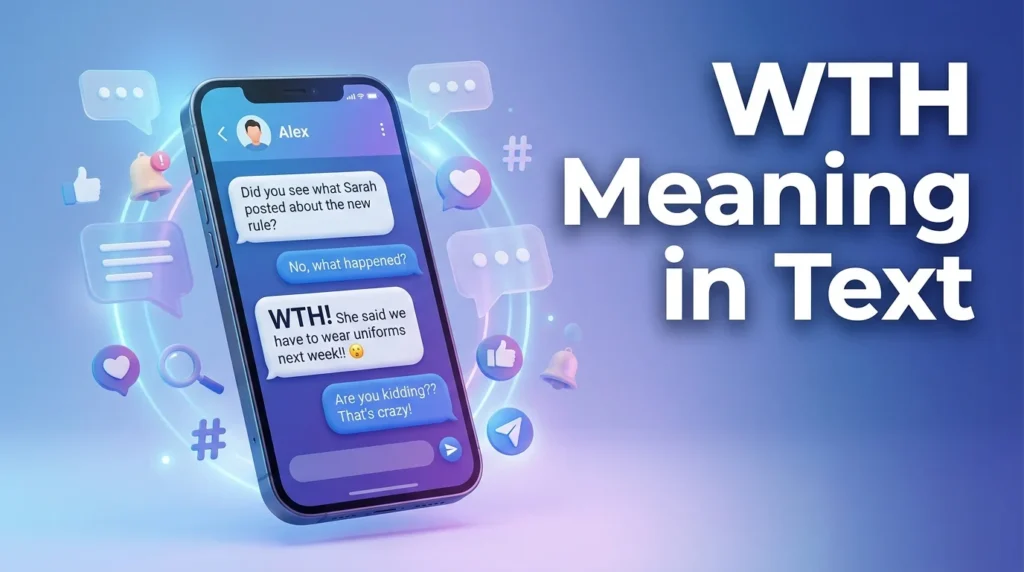

WTH meaning in text is usually “What the hell?” or the milder phrase “What the heck?” People use it to express surprise, confusion, disbelief, frustration, or annoyance. Its exact tone depends on the conversation, relationship, punctuation, and emojis surrounding it. It is mainly used in informal digital communication.
| Term | Meaning | Context |
|---|---|---|
| WTH | What the hell? | Surprise, anger, confusion, or disbelief |
| WTH | What the heck? | A softer and less offensive interpretation |
| wth | Same meaning in lowercase | Relaxed chats, comments, and social media |
| WTH?! | Strong surprise or frustration | Emotional or dramatic reactions |
| WTH 😂 | Playful disbelief | Jokes, memes, or funny situations |
WTH is an internet initialism. This means each letter represents the first letter of a word. Unlike words that are normally pronounced as one unit, people usually read WTH as individual letters or understand it silently while reading.
The phrase can sound playful, shocked, irritated, or rude. For that reason, you should always consider who sent it, what happened before it, and whether the message contains emojis, capital letters, or extra punctuation.
Meaning & Definition
WTH most commonly stands for “What the hell?” It may also be interpreted as “What the heck?”, especially when the sender wants to avoid stronger language.
Both versions communicate a similar reaction. However, “what the heck” sounds milder and is generally safer in family-friendly or polite conversations. “What the hell” has a stronger emotional effect and may sound rude in professional or respectful settings.
Dictionary sources classify WTH as a messaging or social media abbreviation used for “what the hell.” Other slang references also recognize “what the heck” as a softer expansion.
The most common emotions expressed by WTH include:
- Surprise
- Confusion
- Disbelief
- Frustration
- Irritation
- Shock
- Playful amazement
- Impatience
Here are some real-world examples:
“WTH happened to the lights?”
The sender is confused because the lights suddenly stopped working.
“You finished the entire project today? WTH!”
The sender is surprised or impressed.
“WTH, why didn’t you tell me earlier?”
The sender may feel frustrated or disappointed.
“WTH 😂 that video is hilarious.”
The laughing emoji changes the tone. The expression is playful rather than angry.
“WTH are you talking about?”
This sentence may sound challenging, confused, or rude depending on the relationship between the people.
WTH can appear at the beginning, middle, or end of a message:
- “WTH is going on?”
- “Why would he do that, WTH?”
- “I opened the box and WTH, it was empty.”
The abbreviation saves time while adding emotion. Text abbreviations are widely used because they make quick digital conversations shorter, although they work best when both people understand them.
Background
WTH developed as part of internet and text-message shorthand. Early online users often shortened common expressions because chat rooms, instant messages, mobile keypads, and character limits encouraged brief communication.
People began reducing longer phrases into initialisms such as:
- LOL for “laughing out loud”
- BRB for “be right back”
- BTW for “by the way”
- OMG for “oh my God”
- IDK for “I don’t know”
- WTH for “what the hell”
Internet slang has expanded alongside social networks, online forums, gaming communities, mobile messaging, and short-form video platforms. Research on digital slang shows that online communities regularly create, spread, and reshape non-standard expressions according to new social situations.
WTH likely became popular because it performs two jobs at once. It shortens a common reaction and hides part of the stronger phrase. Someone can express irritation or disbelief without writing the complete wording.
Its meaning has remained fairly stable, but its tone has become more flexible. It may now communicate genuine anger, light confusion, dramatic humor, or friendly teasing.
Compare these messages:
“WTH! You deleted my files.”
This message shows real frustration.
“WTH, you actually won 😂”
This message shows playful surprise.
“WTH is this supposed to be?”
This may communicate criticism or confusion.
“WTH, that was amazing!”
This can express positive amazement.
Capitalization also affects perception. “WTH” may look louder or stronger, while “wth” often looks more relaxed.
People continue using WTH because it is:
- Short and easy to type
- Widely understood online
- Emotionally expressive
- Suitable for quick reactions
- Less explicit than writing the complete phrase
- Flexible enough for serious and humorous situations
Usage in Different Contexts
The meaning of WTH remains similar across most digital spaces, but its tone changes according to the audience and situation.
Text Messages
In personal text messages, WTH commonly expresses immediate surprise or confusion.
Example:
“WTH, I thought we were meeting at 7.”
Here, the sender has discovered a misunderstanding.
Another example is:
“WTH happened last night?”
The sender wants an explanation about an unexpected event.
Among close friends, the abbreviation may sound casual. In a message to a parent, teacher, client, or manager, it may sound disrespectful.
Social Media
On social media, WTH often appears in captions, comments, reactions, and replies. It may respond to unusual news, a surprising video, a controversial opinion, or an unexpected result.
Examples:
- “WTH did I just watch?”
- “This ending made no sense. WTH?”
- “WTH, this recipe actually worked.”
- “WTH is happening in the comments?”
On public platforms, readers cannot always recognize sarcasm. Adding an emoji or a clearer sentence may prevent misunderstanding.
Gaming
Gamers often use WTH after an unexpected loss, technical problem, unusual move, or surprising event.
Examples:
- “WTH, how did that hit me?”
- “WTH happened to the server?”
- “That player appeared from nowhere. WTH?”
- “WTH was that strategy?”
Gaming conversations move quickly, so short reactions are common. However, repeatedly directing WTH at another player may seem hostile.
Online Communities
In forums, Discord servers, Reddit discussions, group chats, and community spaces, WTH can signal disagreement or confusion.
Example:
“WTH does this update change?”
This is usually a request for clarification.
Compare it with:
“WTH is wrong with the developers?”
The second example sounds more aggressive because it criticizes people rather than asking about the update.
Online communities may establish their own tone rules. A phrase accepted in a casual meme group may be inappropriate in a support community or educational forum.
Professional Communication
WTH is generally unsuitable for formal workplace communication. It can sound emotional, confrontational, or careless, even when the sender intends it as a joke.
Avoid messages such as:
- “WTH happened to the report?”
- “WTH did the client change?”
- “WTH is this invoice?”
Better professional alternatives include:
- “Could you explain what happened to the report?”
- “I noticed the client changed the requirements. Can you clarify the update?”
- “Could you help me understand this invoice?”
- “This result was unexpected. Can we review it?”
- “I may be missing some context. Could you provide more details?”
A useful rule is simple: use WTH with friends who understand your tone, but use direct and respectful language in professional communication.
Meaning in Chat, WhatsApp, Instagram, TikTok
WTH carries the same core definition across major platforms. However, the surrounding content affects how readers understand it.
| Platform | Meaning | Example Usage |
|---|---|---|
| General chat | What the hell or what the heck | “WTH are you doing?” |
| Surprise, confusion, or frustration | “WTH, you changed the group name again?” | |
| Reaction to a post, reel, story, or comment | “WTH, this transformation is amazing.” | |
| TikTok | Dramatic or humorous reaction to a video | “WTH did I just watch 😂” |
| Snapchat | Quick reaction to a snap or message | “WTH happened to your hair?” |
| Discord | Reaction during gaming or community chat | “WTH happened to the server?” |
| Response to a post, image, or discussion | “WTH is happening in this video?” |
On WhatsApp, WTH is usually part of a private or group conversation. Tone depends heavily on personal relationships. Close friends may see it as harmless, while older relatives or professional contacts may consider it rude.
On Instagram, the abbreviation frequently reacts to visual content. A comment such as “WTH 😍” may indicate positive amazement, while “WTH is wrong with this?” communicates criticism.
On TikTok, WTH often acts as a dramatic hook. Users write it in comments or captions to show that a video is confusing, unexpected, unbelievable, or funny.
On Snapchat, messages are usually brief and informal, so lowercase “wth” is common. It may react to a selfie, location, story, or unexpected update.
On Discord, WTH may appear during fast gaming conversations. It can also be used in community discussions when someone encounters a rule, announcement, or technical change they do not understand.
Emojis provide important tone signals:
- WTH 😂 — amused disbelief
- WTH 😭 — overwhelmed, embarrassed, or laughing hard
- WTH 😡 — anger
- WTH 😳 — shock
- WTH 🤔 — confusion
- WTH 😍 — positive amazement
- WTH 💀 — extreme amusement or disbelief
Because emojis can also have community-specific meanings, the full conversation remains the best guide.
Meaning in Physics, Medical, and Aircraft Terminology
WTH is mainly internet slang, but similar letter combinations may appear in technical material. Never assume that a technical abbreviation has the texting meaning.
| Field | Possible Meaning | Is It Standard? | Important Note |
|---|---|---|---|
| Physics | Sometimes mistaken for watt-hour | No; the standard symbol is Wh | WTH should not replace Wh |
| Engineering | May be used informally for width | Limited or context-specific | Check drawings, legends, or specifications |
| Medical | No single broadly standardized meaning | No | Ask the writer or check the local abbreviation list |
| Aviation | No common standard pilot-controller meaning | No | Use an official glossary or document legend |
| Texting | What the hell or what the heck | Yes, as informal slang | Used for surprise, confusion, or frustration |
WTH in Physics
WTH is not the standard scientific symbol for watt-hour. A watt-hour is a unit of energy, and its conventional symbol is Wh. Watts measure power, while watt-hours measure the amount of energy used or produced over time.
Some informal sources describe WTH as a rare abbreviation for watt-hour, but writers should avoid it because it can be confused with internet slang. Use Wh, kWh, or the complete term “watt-hour” instead.
WTH may also appear as an abbreviation for width in certain technical notes or dictionaries. Merriam-Webster recognizes “wth” as an abbreviation for width.
Therefore, in a technical drawing, a phrase such as “WTH: 20 mm” may refer to width rather than “what the hell.”
WTH in Medical Terminology
WTH does not have one widely accepted medical definition. Healthcare organizations often use local abbreviations, but an abbreviation may mean different things across hospitals, departments, or specialties.
Medical abbreviation ambiguity can create misunderstanding, which is why unclear shorthand should be confirmed rather than guessed. Research has documented interpretation problems involving abbreviations in healthcare communication.
If WTH appears in a report, chart, appointment message, or medical document:
- Read the surrounding sentence.
- Check the report’s abbreviation key.
- Contact the clinic or writer.
- Do not make a health decision based on an assumed expansion.
In a casual message from a doctor or patient, WTH might still mean “what the hell” or “what the heck.” In a clinical record, however, it could be local shorthand or even a typing error.
Also Read: TTY Meaning in Text: Full Form and Usage
WTH in Aircraft and Aviation Terminology
WTH is not a common standard abbreviation in everyday pilot-controller communication. Official aviation communication uses controlled terminology to reduce ambiguity, and users should consult the document’s glossary or the relevant aviation authority when an unfamiliar code appears.
WTH might appear in an aircraft maintenance note as local shorthand for width or another organization-specific phrase. It should not automatically be interpreted as internet slang.
The safest approach is to check:
- The maintenance manual
- The flight document legend
- The airline’s abbreviation list
- The manufacturer’s technical glossary
- The aviation authority’s official terminology
Context determines the correct meaning.
Common Misconceptions
Several misunderstandings surround the WTH abbreviation.
Misconception 1: WTH always means “what the heck”
WTH can mean “what the heck,” but many people understand it as “what the hell.” The second version is the common dictionary expansion, while the first is a softer substitute.
Misconception 2: WTH is always angry
WTH may show anger, but it can also express surprise, humor, admiration, disbelief, or confusion.
For example:
“WTH, that was incredible!”
This is positive.
“WTH did you break?”
This may sound annoyed.
Misconception 3: WTH and WTF have the same intensity
The expressions serve similar purposes, but WTF contains a much stronger and more offensive word. WTH is usually milder, though it may still sound impolite.
Misconception 4: Lowercase wth has a different definition
Capitalization normally changes the visual tone, not the meaning. “WTH” looks stronger, while “wth” may look casual or less emotional.
Misconception 5: It is appropriate in every conversation
WTH is informal. It may be acceptable among friends but inappropriate with clients, teachers, supervisors, customers, or people who dislike strong expressions.
Misconception 6: Punctuation does not matter
Punctuation can greatly change emotional intensity:
- “WTH” — basic reaction
- “WTH?” — confusion
- “WTH!” — shock or frustration
- “WTH?!” — strong disbelief
- “WTH…” — disappointment or uncertainty
Misconception 7: It has the same meaning in technical documents
In engineering, “wth” may refer to width. In scientific, medical, or aviation material, it may have a local meaning. Always check the context before interpreting it.
Misconception 8: WTH is suitable for formal writing
It should normally be avoided in reports, job applications, customer emails, academic assignments, and official documents.
Similar Terms & Alternatives
WTH belongs to a larger family of reaction abbreviations and conversational phrases.
| Term | Meaning | Difference |
|---|---|---|
| WTH | What the hell or what the heck | Shows surprise, confusion, or frustration |
| WTF | What the f— | Stronger and more offensive than WTH |
| WDYM | What do you mean? | Directly requests clarification |
| OMG | Oh my God or oh my gosh | Shows surprise without asking a question |
| SMH | Shaking my head | Shows disappointment or disbelief |
| HUH | A reaction of confusion | Simpler and usually less aggressive |
| WHY | A direct request for a reason | Clearer and more neutral |
| FR | For real | Questions or confirms whether something is true |
| SERIOUSLY? | Are you serious? | Expresses disbelief in complete wording |
| WHAT? | A basic reaction or request for repetition | Neutral unless written aggressively |
| WTAF | What the actual f— | Much stronger and more dramatic |
| TF | The f— | Often adds emphasis to a question |
| IDK | I don’t know | Expresses uncertainty rather than surprise |
| NANI | “What?” in Japanese | Often used humorously in anime-related communities |
Use WDYM when you genuinely want clarification:
“WDYM the event was canceled?”
Use OMG when you are surprised but not necessarily confused:
“OMG, you look amazing.”
Use SMH when you disapprove of something:
“He forgot the tickets again. SMH.”
Use WTH when surprise and confusion happen together:
“WTH, why is the door open?”
Readers who regularly need help decoding abbreviations can also explore Meanigo, a website focused on text meanings, online slang, chat expressions, and usage examples. Its existing coverage includes common terms used across texting and social platforms.
How to Respond to It
The best response to WTH depends on why the person wrote it.
| Scenario | Suggested Response |
|---|---|
| They are confused | “Let me explain what happened.” |
| They are surprised | “I know, I was surprised too!” |
| They seem angry | “I understand you’re upset. Here’s what happened.” |
| They misunderstood you | “That isn’t what I meant. Let me clarify.” |
| They are joking | “😂 I had the same reaction.” |
| They saw unusual news | “It sounds unbelievable, but here are the details.” |
| They react to your photo | “Haha, is that good or bad?” |
| They question your decision | “I had a reason. Do you want the full story?” |
| A coworker uses it | “Could you tell me which part concerns you?” |
| You do not understand the tone | “Are you surprised or upset?” |
Casual Responses
- “I know, right?”
- “That was my reaction too.”
- “Long story 😂”
- “Don’t ask.”
- “Wait, let me explain.”
- “It gets even stranger.”
- “Are you okay? 😂”
- “Good WTH or bad WTH?”
- “I honestly have no idea.”
- “You won’t believe what happened next.”
Calm Responses
- “I understand why that surprised you.”
- “There has been a misunderstanding.”
- “Let me give you the full context.”
- “I should have explained it earlier.”
- “Here is what actually happened.”
Formal Responses
- “I understand that the situation was unexpected.”
- “Let me clarify the reason for this change.”
- “I apologize for the confusion.”
- “Could you identify the part that needs clarification?”
- “I can provide additional context.”
Do not immediately copy the sender’s emotional tone. If someone writes “WTH is wrong with you?”, replying aggressively may make the argument worse.
A better response would be:
“I can see you’re upset. Tell me what bothered you, and I’ll explain.”
Differences from Similar Words
WTH is closely related to several other reactions, but each expression carries a different level of emotion and politeness.
| Expression | Main Purpose | Strength | Suitable for Work? |
|---|---|---|---|
| WTH | Surprise, confusion, or frustration | Medium | Usually no |
| What the heck? | Mild surprise or confusion | Mild to medium | Rarely |
| What the hell? | Strong surprise or annoyance | Medium to strong | No |
| WTF | Strong shock, anger, or disbelief | Very strong | No |
| What? | Request for repetition or reaction | Mild | Sometimes |
| Why? | Request for a reason | Mild | Yes |
| WDYM? | Request for clarification | Mild | In casual work chats only |
| Seriously? | Disbelief or doubt | Medium | Sometimes |
| OMG | Surprise or excitement | Medium | Rarely |
| Huh? | Confusion | Mild | Too casual for formal work |
| Could you clarify? | Polite request for explanation | Neutral | Yes |
WTH vs. WTF
WTH is generally less offensive. WTF contains explicit profanity and may create a much stronger negative impression.
WTH: “WTH happened here?”
WTF: “WTF happened here?”
Both show shock, but the second sounds more aggressive.
WTH vs. WDYM
WTH reacts emotionally, while WDYM asks for information.
WTH: “WTH are you saying?”
WDYM: “What do you mean?”
Use WDYM when your main goal is understanding rather than showing frustration.
WTH vs. OMG
WTH often includes confusion. OMG mainly communicates surprise, excitement, or alarm.
WTH: “WTH, why is the room empty?”
OMG: “OMG, you decorated the entire room!”
WTH vs. SMH
WTH shows surprise or confusion. SMH communicates disappointment, disapproval, or disbelief.
WTH: “WTH happened to the cake?”
SMH: “He forgot the cake again. SMH.”
WTH vs. HUH
“Huh?” is usually less intense. It often means the listener did not hear or understand something.
Huh?: “Huh? What did you say?”
WTH?: “WTH did you just say?”
The second version sounds more confrontational.
Also Read: YK Meaning in Text: Definition, Uses and Examples
Relevance in Online Conversations & Dating Apps
WTH remains relevant because online communication favors speed, emotional reactions, and informal language. A three-letter response can communicate surprise faster than a complete sentence.
On social media, WTH works as a reaction to:
- Unexpected news
- Viral videos
- Unusual trends
- Dramatic transformations
- Confusing opinions
- Plot twists
- Memes
- Public arguments
- Shocking sports results
- Strange product reviews
However, short expressions can lose tone when readers cannot hear the speaker’s voice. A playful “WTH” may be interpreted as criticism. Emojis, follow-up sentences, and punctuation help clarify intent.
In dating apps, WTH may appear during teasing, storytelling, flirting, disagreement, or surprise.
Consider this example:
Person A: “I’ve never watched a single superhero movie.”
Person B: “WTH 😂 how is that possible?”
The laughing emoji makes the response playful.
Now compare:
Person A: “I need to cancel tonight.”
Person B: “WTH?”
This may sound irritated because there is no softening language.
A more considerate response would be:
“Oh, is everything okay?”
Dating-app users should avoid WTH when discussing boundaries, rejection, appearance, personal history, or sensitive experiences. It can make the other person feel judged.
Poor example:
“WTH is wrong with your profile picture?”
Better example:
“Is there a story behind that profile picture?”
WTH can also be used flirtatiously:
- “WTH, how are you still single?”
- “WTH, you look amazing in that photo.”
- “WTH, we have the same favorite movie?”
- “WTH, are you always this funny?”
These messages can sound playful when the conversation is already comfortable. Sending them too early may seem overly familiar.
Good messaging etiquette includes:
- Reading the full conversation
- Avoiding aggressive capitalization
- Using emojis only when they improve clarity
- Respecting the other person’s communication style
- Replacing slang with direct language in sensitive discussions
- Asking for clarification before assuming bad intent
Modern communication trends favor abbreviations, reaction images, emojis, GIFs, and short replies. Even so, clear language remains more effective when trust, safety, work, or serious feelings are involved.
WTH in Memes and Reaction Culture
Beyond private chats, WTH has become a staple of meme and comment culture. On TikTok and Instagram, “WTH did I just watch?” is one of the most common comment reactions to surprising, confusing, or absurd videos. Meme captions pair WTH with reaction images to dramatize disbelief — the text does the emotional work so the reader feels the joke instantly.
Examples:
“WTH did I just watch 😂” — amused confusion at a strange video.
“WTH is happening in the comments?” — playful disbelief at a chaotic thread.
“WTH, this actually worked!” — shocked approval at an unexpected result.
In these public uses, WTH almost always reads as humorous rather than angry. Punctuation and emojis carry the tone: “WTH 😂” signals laughter, while a bare “WTH?!” leans toward genuine shock. Because meme readers cannot hear your voice, a clear emoji or follow-up sentence prevents the joke from being misread as criticism.
Frequently Asked Questions
What does WTH mean in texting?
WTH usually means “What the hell?” or the softer phrase “What the heck?” in texting. It expresses surprise, confusion, frustration, disbelief, or annoyance. The sender’s tone depends on the situation, punctuation, capitalization, relationship, and emojis used with the abbreviation.
Does WTH have multiple meanings?
Yes. In online conversations, WTH generally means “what the hell” or “what the heck.” In some technical documents, lowercase “wth” may mean width. It is not a standard substitute for watt-hour, which should normally be written as Wh. Always use context to identify the intended meaning.
Is WTH commonly used on TikTok?
Yes. TikTok users write WTH in comments, captions, and replies when a video seems surprising, confusing, funny, strange, or unbelievable. A comment such as “WTH did I just watch?” is common. Emojis often show whether the user is amused, shocked, angry, or genuinely confused.
Is WTH a bad word?
WTH is not a complete swear word, but it usually represents a phrase containing “hell.” Some people consider it mild, while others may find it rude or disrespectful. “What the heck” is the safer interpretation, but the abbreviation should still be avoided in formal or sensitive conversations.
What does WTH mean from a girl?
WTH has no gender-specific meaning. From a girl, it may express surprise, confusion, irritation, playful disbelief, or humor, just as it would from anyone else. Review the previous message, punctuation, and emojis instead of trying to determine the meaning based on the sender’s gender.
What does WTH mean from a guy?
WTH from a guy usually means “what the hell” or “what the heck.” It might show that he is confused, surprised, annoyed, impressed, or joking. A message such as “WTH 😂” is likely playful, while “WTH is wrong with you?” sounds confrontational.
What is the difference between WTH and WTF?
WTH is milder than WTF. Both can communicate surprise, disbelief, confusion, or frustration, but WTF includes stronger profanity. WTH may still sound impolite, yet it is generally considered less offensive and more suitable for casual conversations among friends.
Can WTH be positive?
Yes. WTH can express positive surprise or amazement. For example, “WTH, you look incredible!” is a compliment. Similarly, “WTH, we actually won!” communicates excitement. Positive meaning becomes clearer when the message includes praise, a laughing emoji, a heart, or an enthusiastic follow-up sentence.
How should I reply when someone says WTH?
First identify whether the sender is confused, surprised, joking, or angry. You can reply with “Let me explain,” “I know, right?”, “Good WTH or bad WTH?”, or “Are you upset?” In serious situations, respond calmly and provide context instead of matching an aggressive tone.
Is WTH appropriate at work?
WTH is usually inappropriate in professional emails, reports, meetings, and customer conversations. It can appear careless or confrontational. Replace it with phrases such as “Could you clarify?”, “This was unexpected,” “What caused this issue?”, or “Can we review what happened?”
What does lowercase wth mean?
Lowercase “wth” normally has the same meaning as uppercase “WTH.” The lowercase version often looks more casual, relaxed, or less dramatic. Uppercase letters may appear louder or more emotional, especially when combined with exclamation marks or question marks.
Where can I learn other text abbreviations?
You can use reliable dictionaries and dedicated meaning resources to understand unfamiliar slang. Meanigo is designed around definitions, examples, replies, and contextual explanations for text abbreviations used in chat, messaging apps, and social media. Always compare the suggested meaning with the sentence where the term appeared.
Is WTH still popular?
Yes. WTH remains common in texts, TikTok comments, memes, and gaming chats. Its meaning has stayed stable — surprise, confusion, or disbelief — while its tone has grown more flexible, covering everything from playful jokes to genuine frustration. Short reaction slang like WTH continues to thrive because quick, emotional replies fit the pace of modern messaging.
Conclusion
WTH meaning in text is primarily “What the hell?” or the milder “What the heck?” It is used to communicate surprise, confusion, disbelief, frustration, irritation, or playful amazement.
The abbreviation is common in text messages, WhatsApp chats, Instagram comments, TikTok reactions, gaming conversations, dating apps, and online communities. Its tone depends on context, punctuation, capitalization, emojis, and the relationship between the people.
Although WTH is useful for quick, informal reactions, it should usually be avoided in professional or sensitive communication. In technical documents, it may occasionally refer to width or local terminology, so the texting definition should never be assumed without context.
For other unclear abbreviations and modern messaging terms, resources such as Meanigo can help readers compare definitions, platform-specific uses, examples, and suitable replies. The safest method is always to examine the full sentence before deciding what an abbreviation means.
Related:
TF Meaning in Text: Definition, Uses & Examples

Pingback: TTYS Meaning in Text: Definition, Examples & Replies
Pingback: HB Meaning in Text: What It Means and How to Reply
Pingback: WDYM Meaning in Text: Uses, Examples & Responses
Pingback: GBTS Meaning in Text: 'Go Back to Sleep' + Replies