
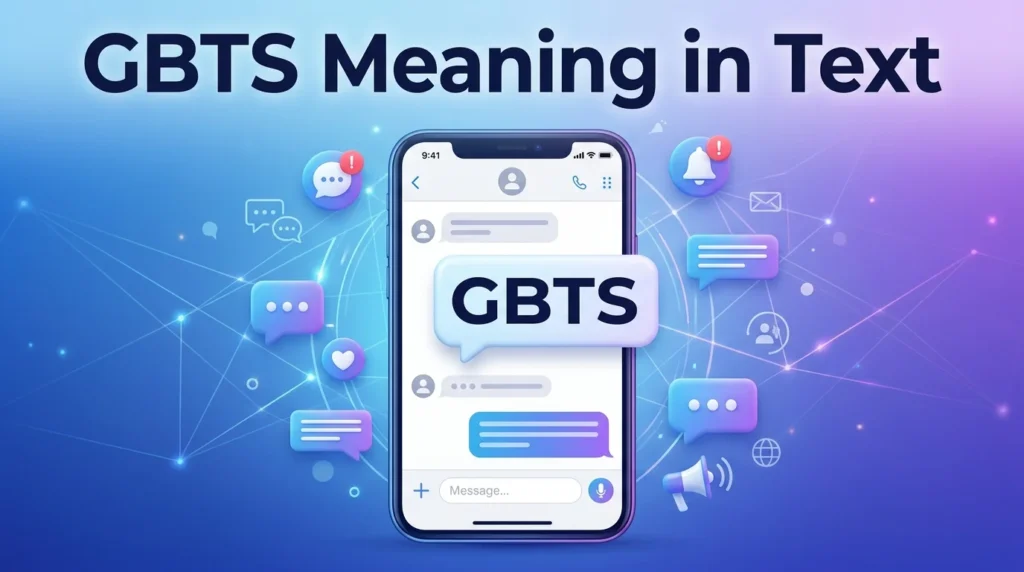

Learn the GBTS meaning in text, its full forms, examples, platform use, replies, misconceptions, and meanings in science, medicine, and aviation.
GBTS most commonly means “Go Back to Sleep” in casual texting. Some people also use it as “Going Back to Sleep.” The first version is a suggestion or command, while the second tells someone what the sender plans to do. Its meaning depends on the message, timing, tone, and surrounding conversation.
| Term | Meaning | Context |
|---|---|---|
| GBTS | Go Back to Sleep | Telling someone to rest or return to bed |
| GBTS | Going Back to Sleep | Saying that you are returning to sleep |
| GBTS | Go/Get Back to School | Rare, humorous, or sarcastic internet usage |
| GBTS | Specialized acronym | May have different meanings in science or aviation |
GBTS is not as common as LOL, BRB, or TTYL. Therefore, you should not assume that every reader will understand it immediately. A message such as “GBTS, it is only 5 a.m.” usually means “Go Back to Sleep.” However, “I am tired, GBTS” is more likely to mean “Going Back to Sleep.”
When an abbreviation has several possible meanings, the safest approach is to check the context rather than relying on a single definition. Meanigo is a useful reference for understanding texting slang, online abbreviations, word meanings, and context-based interpretations in simple language.
Meaning & Definition
The main GBTS meaning in text is “Go Back to Sleep.” It is normally used when someone wakes up too early, sends a late-night message, complains about being tired, or starts a conversation when others are still sleeping.
The phrase can sound caring, funny, sarcastic, or dismissive. The meaning remains connected to sleep, but the speaker’s attitude can change.
For example:
Person A: I woke up at 4:30 a.m. for no reason.
Person B: GBTS. You still have two hours before work.
Here, GBTS is friendly advice. Person B is telling Person A to return to bed.
It can also mean “Going Back to Sleep.” In that form, the sender is describing an action rather than giving advice.
Person A: Are you staying awake now?
Person B: No, GBTS. Talk later.
The grammar of the sentence helps you identify the intended full form:
- “You should GBTS” means “You should go back to sleep.”
- “I’m GBTS” usually means “I’m going back to sleep.”
- “GBTS, it’s too early” is a direct instruction.
- “Tired. GBTS now” is a personal status update.
GBTS can also be used as a playful dismissal. A friend may say something strange early in the morning, and another person might reply, “GBTS, you are not making sense yet.” In that situation, the phrase does not literally demand sleep. It humorously suggests that the person is too tired to think clearly.
A less common internet definition is “Go/Get Back to School.” This version may be used sarcastically after someone makes an obvious factual mistake. However, this interpretation is rare and should not be assumed unless the conversation is clearly about education, knowledge, or an incorrect statement.
Background
The exact origin of GBTS is not recorded in a major historical dictionary. Like many texting abbreviations, it appears to have developed through private messages, forums, online comments, and early social media conversations.
An Urban Dictionary entry published on August 16, 2010, defined GBTS as “Going Back To Sleep.” A second entry from 2012 recorded the less common “Go/Get Back to School” interpretation. These user-submitted records do not make either meaning an official dictionary definition, but they show that people have used the abbreviation for more than a decade.
Texting language often develops through convenience. Mobile users shorten common phrases because typing four letters is faster than writing a complete sentence. The same pattern produced widely recognized abbreviations such as:
- BRB for “Be Right Back”
- TTYL for “Talk to You Later”
- GTG for “Got to Go”
- GN for “Good Night”
- GBTW for “Get Back to Work”
GBTS follows the same structure, but it never became as universal as those terms. Its limited popularity is one reason people continue searching for “what does GBTS mean in text?”
The term also evolved because people began using commands as status updates. “Go back to sleep” addresses another person, while “going back to sleep” describes the sender. Since both phrases have the initials G-B-T-S, the same abbreviation can perform two different grammatical roles.
People use GBTS because it is:
- Quick to type
- Easy to understand in a sleep-related conversation
- Suitable for jokes and friendly teasing
- Useful during late-night or early-morning chats
- More expressive when paired with an emoji
However, it is best used with people who understand informal internet language. A focused word-meaning website such as Meanigo can help readers distinguish between the main definition, rare alternatives, and specialist uses of abbreviations like GBTS.
Usage in Different Contexts
The meaning of GBTS depends heavily on where it appears and what people are discussing. It does not have one universal interpretation across every community.
Text Messages
In personal text messages, GBTS usually means “Go Back to Sleep” or “Going Back to Sleep.”
“You have no class today. GBTS and get some rest.”
“I only woke up to drink water. GBTS now.”
The first example gives advice. The second describes what the sender plans to do.
People may also use it after receiving an unwanted early-morning message:
“Why are you texting me at 5 a.m.? GBTS.”
This reply can sound humorous between close friends. It may sound rude when sent to a stranger or someone expecting a serious answer.
Social Media
On Instagram, TikTok, Snapchat, or X, GBTS may appear in captions, comments, memes, or replies about sleep.
Examples include:
- “When the alarm rings but class is canceled: GBTS.”
- “Me checking my phone at 3 a.m. and deciding to GBTS.”
- “You woke up early on a Sunday? GBTS immediately.”
- “That opinion was written before coffee. GBTS.”
Social media users often add emojis such as 😴, 💤, 😂, or 🛌 to make the meaning clearer. Without context or an emoji, some followers may not recognize the abbreviation.
Gaming
GBTS may appear in a gaming chat when a player seems tired, performs poorly, or says they are leaving to sleep.
Player 1: I have missed every shot tonight.
Player 2: GBTS, bro. We will play tomorrow.
In this example, GBTS means “Go Back to Sleep” and suggests that the player needs rest.
A player leaving a late-night session might write:
“I can barely keep my eyes open. GBTS. Good game.”
Here, it means “Going Back to Sleep.”
GBTS is not a standard gaming command. Its meaning still comes from ordinary texting slang rather than game-specific terminology.
Online Communities
In forums, Discord servers, group chats, and other online communities, GBTS may be used as an inside joke. A group can also develop its own meaning for the letters.
For instance, members of a school community might use GBTS to mean “Get Back to Studying.” Another group might use it as the initials of an event, organization, or recurring joke.
When the sleep-related meaning does not fit, check:
- The topic being discussed
- Earlier messages in the conversation
- The sender’s usual language
- Capitalization and punctuation
- Emojis, images, or attached videos
If the meaning remains unclear, ask, “What do you mean by GBTS?” That is better than replying based on an incorrect assumption.
Professional Communication
GBTS is normally unsuitable for professional emails, customer messages, workplace reports, or formal school communication.
Instead of writing:
“You look tired. GBTS.”
Use a clear sentence:
“You may want to get some rest before we continue.”
Instead of:
“GBTS. I will answer tomorrow.”
Write:
“I am signing off for the evening and will respond tomorrow morning.”
Professional communication should favor clarity. An uncommon abbreviation can confuse a manager, client, teacher, or international colleague.
Also Read: FN Meaning in Text: What It Means and How to Use It
Meaning in Chat, WhatsApp, Instagram, TikTok
The basic GBTS meaning remains similar across most platforms. What changes is the way people use it and the amount of context available.
| Platform | Meaning | Example Usage |
|---|---|---|
| General chat | Go Back to Sleep | “It is still early. GBTS.” |
| Go Back to Sleep or Going Back to Sleep | “No work today, so GBTS.” | |
| Humorous comment about sleep | “You posted this at 4 a.m.? GBTS 😂” | |
| TikTok | Caption or reaction related to tiredness | “POV: The alarm was set by mistake. GBTS.” |
| Snapchat | Quick status update | “Just checked my snap. GBTS now.” |
| Discord | Advice to a tired community member | “You have been online all night. GBTS.” |
| Dating apps | Playful late-night message | “You sound sleepy. GBTS and text me tomorrow.” |
On WhatsApp, GBTS is likely to appear in private conversations or family and friendship groups. Because participants usually know one another, the phrase may sound caring rather than rude.
On Instagram, it often works as a short reaction. Someone may comment “GBTS” under a sleepy selfie, an early-morning post, or a video containing an obviously tired opinion.
On TikTok, the abbreviation can appear in a caption, on-screen text, or a comment. However, GBTS is not universally recognized TikTok slang. Writers should include enough context for viewers to understand it.
In ordinary chat, the position of GBTS in the sentence is important:
- At the beginning: Usually a command — “GBTS, it is too early.”
- After “I’m”: Usually a status — “I’m GBTS.”
- After an explanation: Often an action — “The meeting was canceled, so GBTS.”
- As a single reply: Meaning depends entirely on the previous message.
Meaning in Physics, Medical, and Aircraft Terminology
GBTS is not limited to texting. The same letters can appear in scientific, medical-research, and aviation documents. These meanings are unrelated to “Go Back to Sleep.”
| Field | Possible Meaning | Explanation |
|---|---|---|
| Physics and electronics | Graphene Base Transistors | “GBTs” can be the plural form of graphene base transistor |
| Medical terminology | No widely standardized general clinical meaning | GBTS is not a common patient-facing medical abbreviation |
| Genomics and biomedical research | Genotyping by Targeted Sequencing | A targeted method for examining selected genetic markers |
| Aviation and aircraft training | Ground Based Training System | A collection of simulators, training devices, courseware, and planning systems |
| Aviation infrastructure | Ground-Based Transceivers | “GBTs” may refer to multiple ground-based transceiver units |
Physics and Electronics Meaning
In physics, nanoelectronics, and semiconductor research, GBTs can mean graphene base transistors. In this case, the lowercase “s” often marks the plural rather than forming part of the acronym.
Researchers have studied graphene base transistors as hot-electron devices with potential high-frequency applications. Academic literature uses “GBT” for one graphene base transistor and “GBTs” for more than one.
Therefore, a sentence such as “The performance of the GBTs was measured” is about electronic devices, not sleeping.
Medical Meaning
GBTS does not appear to have one broadly accepted meaning in general clinical communication. Patients should not try to interpret it as a diagnosis, treatment, or disease name without asking a qualified healthcare professional.
However, in genomics and biological research, GBTS can mean genotyping by targeted sequencing. This process studies selected areas or markers in DNA rather than treating GBTS as a medical condition. Published research has used the abbreviation for targeted genotyping technology in genetic analysis.
In healthcare-related documents, always consider whether the text is discussing:
- DNA sequencing
- Genetic markers
- Laboratory testing
- Disease research
- Clinical records
- A hospital or organization’s internal system
An internal abbreviation may have a local meaning that is not recognized outside that institution.
Aircraft and Aviation Meaning
In aircraft training, GBTS can stand for Ground Based Training System. Leonardo describes it as a group of ground-based training and learning tools that may include full-mission simulators, flight training devices, interactive courseware, mission planning, and debriefing systems.
In other aviation documents, GBTs may also be the plural of ground-based transceiver. These are technical communication units associated with systems such as ADS-B. This usage should not be confused with the singular acronym “GBTS” for Ground Based Training System.
The subject provides the answer:
- A message from a sleepy friend: Go Back to Sleep
- A genetics paper: Genotyping by Targeted Sequencing
- An electronics study: Graphene Base Transistors
- A pilot-training document: Ground Based Training System
Common Misconceptions
Because GBTS is uncommon, readers often assign the wrong meaning to it.
Misconception 1: It always means “Go Back to Sleep”
“Go Back to Sleep” is the most useful interpretation in casual chat, but it is not the only one.
It may also mean:
- Going Back to Sleep
- Go/Get Back to School
- Ground Based Training System
- Genotyping by Targeted Sequencing
- The plural form of graphene base transistor
Always match the definition to the conversation.
Misconception 2: “Go Back to Sleep” and “Going Back to Sleep” are identical
They are closely related but grammatically different.
- Go Back to Sleep is an instruction directed at another person.
- Going Back to Sleep describes the sender’s next action.
Compare:
“You look exhausted. GBTS.”
“I have nothing planned this morning. GBTS.”
The first addresses “you.” The second refers to “I.”
Misconception 3: GBTS is widely understood
It is less familiar than common texting abbreviations such as LOL, OMG, BRB, or TTYL. Using it without context can create confusion.
A clearer alternative may be better:
- “Go back to sleep.”
- “I’m going back to sleep.”
- “Get some rest.”
- “Talk to you when you wake up.”
Misconception 4: It always has a romantic meaning
GBTS is not automatically affectionate or flirty. Its emotional meaning comes from the relationship and wording.
“GBTS, sleepyhead ❤️” may sound affectionate.
“GBTS. Stop messaging me.” sounds annoyed.
The letters alone do not prove romantic interest.
Misconception 5: It officially means “Gotta Be Totally Serious”
Some online pages assign GBTS expansions such as “Gotta Be Totally Serious.” That interpretation may exist in a limited group, but it is not strongly supported across established slang references. One page presents that meaning, while several other acronym and slang sources identify the sleep-related definition instead.
Treat unusual definitions as context-specific rather than universal.
Misconception 6: GBTS and GTS are the same
GTS commonly removes the word “back.” Depending on the conversation, it may mean “Go to Sleep” or “Going to Sleep.”
GBTS specifically adds the idea of returning to sleep after waking or being disturbed.
Similar Terms & Alternatives
Several abbreviations are related to sleep, leaving a conversation, or returning later.
| Term | Meaning | Difference |
|---|---|---|
| GBTS | Go Back to Sleep | Suggests returning to sleep |
| GBTS | Going Back to Sleep | Sender is returning to bed |
| GTS | Go to Sleep | Does not necessarily imply the person was already asleep |
| GN | Good Night | A polite way to end a nighttime conversation |
| NITE | Night or Good Night | Informal spelling rather than an acronym |
| BRB | Be Right Back | A temporary absence, not necessarily for sleep |
| TTYL | Talk to You Later | Ends or pauses a conversation |
| GTG | Got to Go | Says the sender must leave |
| GBTW | Get Back to Work | Tells someone to resume working |
| GBT | Go Back To | An incomplete phrase that needs an object |
| ZZZ | Sleeping or tiredness | A visual expression rather than a full phrase |
Use GBTS when returning to sleep is the central idea.
Use GN when ending the conversation politely for the night.
Use GTS when telling someone to sleep for the first time.
Use BRB when you expect to return soon.
Use TTYL when you will continue the conversation later but do not know exactly when.
Also Read: TTY Meaning in Text: Full Form and Usage
How to Respond to It
Your response should match the sender’s tone. A playful message can receive a playful answer, while a caring message deserves a polite response.
| Scenario | Suggested Response |
|---|---|
| A friend tells you to return to sleep | “Good idea. Talk to you later 😴” |
| Someone says they are going back to sleep | “Sleep well. Message me when you wake up.” |
| The message feels playful | “No chance. I am already awake 😂” |
| You have work or school soon | “I wish I could, but I have to get ready.” |
| You do not understand the abbreviation | “What does GBTS mean here?” |
| Someone sounds dismissive | “Are you joking, or do you want to talk later?” |
| A partner sends it affectionately | “Okay, sleepyhead. Sweet dreams.” |
| A coworker uses it in work chat | “Do you mean we should continue this tomorrow?” |
| The sender needs rest | “Yes, get some sleep. We can finish this later.” |
| You disagree with the suggestion | “I am fully awake now, but thanks.” |
Casual Responses
- “Okay, I’m going 😴”
- “Already under the blanket.”
- “Too late. I made coffee.”
- “You first.”
- “Fine, talk later.”
- “I wish I could.”
- “Best advice I’ve received today.”
Caring Responses
- “Get some proper rest. We can talk later.”
- “Sleep well and do not worry about replying now.”
- “Take care of yourself. Message me when you wake up.”
- “You sound exhausted. Rest first.”
Formal Alternatives
GBTS itself is informal, but you can express the same idea professionally:
- “Please get some rest, and we can continue tomorrow.”
- “There is no need to respond tonight.”
- “We can resume this conversation in the morning.”
- “Please take the time you need to rest.”
When the meaning is uncertain, asking for clarification is always acceptable. Meanigo’s context-first style of explaining slang can also help readers decide whether an abbreviation is being used literally, humorously, or as a specialized term.
Differences from Similar Words
The key difference between GBTS and similar phrases is the word “back.” It normally suggests that someone was sleeping, woke up, and may now return to sleep.
| Expression | Main Meaning | Typical Tone | Implies Previous Sleep? |
|---|---|---|---|
| GBTS | Go Back to Sleep | Caring, playful, or dismissive | Yes |
| GTS | Go to Sleep | Advice, command, or teasing | Not always |
| GN | Good Night | Polite or affectionate | No |
| Sleep well | Wish for restful sleep | Caring and polite | No |
| Get some rest | Advice to relax or recover | Supportive | No |
| BRB | Be Right Back | Temporary departure | No |
| TTYL | Talk to You Later | Conversation will continue later | No |
| I’m off to bed | Sender plans to sleep | Neutral and clear | No |
| Going back to bed | Sender is returning to bed | Clear status update | Usually |
GBTS vs. GTS: GBTS suggests returning to sleep, while GTS simply tells someone to sleep.
GBTS vs. GN: GBTS is advice or a status update. GN is a farewell.
GBTS vs. BRB: BRB normally suggests a brief absence. Sleeping may last several hours, so BRB can create the wrong expectation.
GBTS vs. TTYL: TTYL focuses on the next conversation. GBTS focuses on sleep.
GBTS vs. “sleep well”: “Sleep well” is clearer, warmer, and more suitable for people who may not know internet slang.
Relevance in Online Conversations & Dating Apps
GBTS fits modern online communication because it compresses a complete thought into four letters. However, its usefulness depends on shared understanding.
On social media, people often use short abbreviations to react quickly. GBTS works especially well with:
- Sleep-related memes
- Early-morning posts
- Late-night conversations
- Complaints about being tired
- Jokes about canceled plans
- Comments about confused or sleepy behavior
It can also act as gentle teasing. For example, a person might post an unusual opinion at 3 a.m., and a friend may reply, “GBTS before you post anything else.”
On dating apps, GBTS may appear during late-night conversations:
Person A: I can barely keep my eyes open.
Person B: GBTS. We can continue tomorrow.
This response may show consideration because the sender is not pressuring the other person to stay awake.
A more affectionate version might be:
“GBTS, sleepyhead. I will text you tomorrow ❤️”
However, GBTS is not a clear sign of flirting by itself. A person may simply be giving practical advice.
Tone matters on dating apps because the two people may not know each other well. A one-word reply such as “GBTS” can seem cold. Adding a complete sentence makes the intention clearer:
- “GBTS and get some rest. I enjoyed talking to you.”
- “You sound tired, so go back to sleep. We can chat tomorrow.”
- “Sleep well. Send me a message when you wake up.”
Good messaging etiquette includes considering whether the other person knows the abbreviation. When communicating with a new match, clearer language is usually better than niche slang.
Modern communication trends favor speed, but clarity remains important. An abbreviation saves only a few seconds. A confusing abbreviation can create a much longer misunderstanding.
Use GBTS when:
- The conversation is casual
- Sleep is already being discussed
- The other person understands texting slang
- Your tone is clearly friendly
- The surrounding message explains your intention
Avoid it when:
- Discussing serious personal concerns
- Messaging a client or manager
- Communicating with someone from a different language background
- Responding to an emergency
- The phrase could sound dismissive
- You are unsure how the person will interpret it
Also Read: LBVS Meaning in Text Explained with Examples
Frequently Asked Questions
What does GBTS mean in texting?
GBTS usually means “Go Back to Sleep” in texting. It tells someone to return to bed after waking up or being disturbed. It can also mean “Going Back to Sleep” when the sender is describing their own action. The sentence and previous messages reveal which version is intended.
Does GBTS have multiple meanings?
Yes. In casual conversation, GBTS can mean “Go Back to Sleep” or “Going Back to Sleep.” A rare slang definition is “Go/Get Back to School.” In specialist contexts, it may mean Ground Based Training System, Genotyping by Targeted Sequencing, or the plural form of graphene base transistor.
Is GBTS commonly used on TikTok?
GBTS may appear in TikTok comments, captions, and videos related to sleep, but it is not one of the platform’s most universally recognized abbreviations. Creators often add a sleepy emoji, joke, or complete sentence so viewers can understand that it means “Go Back to Sleep.”
What does GBTS mean on WhatsApp?
On WhatsApp, GBTS normally means “Go Back to Sleep.” It may be sent after someone wakes up early, receives a notification at night, or says they are tired. It can also mean “Going Back to Sleep” when the sender announces that they are ending the conversation and returning to bed.
What does GBTS mean from a girl?
When a girl sends GBTS, it usually has the same meaning it has from anyone else: “Go Back to Sleep” or “Going Back to Sleep.” It does not automatically indicate attraction. Look at her wording, emojis, relationship with you, and the earlier conversation before deciding whether the message is caring, playful, or dismissive.
What does GBTS mean from a guy?
When a guy writes GBTS, he is usually telling someone to return to sleep or saying that he is going back to sleep. The abbreviation does not have a special male meaning. A phrase such as “GBTS, we can talk tomorrow” is generally practical, while affectionate wording may sound more personal.
Is GBTS rude?
GBTS is not automatically rude, but it can sound dismissive when sent without explanation. “GBTS 😂, it is too early” sounds playful. “GBTS and stop bothering me” sounds annoyed. The relationship, punctuation, emojis, and conversation determine whether it feels friendly, caring, sarcastic, or impolite.
How should I reply when someone says GBTS?
You can reply, “Okay, sleep well,” “Good idea, talk later,” or “I wish I could, but I have work.” When you do not understand the abbreviation, ask, “Do you mean go back to sleep?” A direct clarification prevents confusion and helps you respond to the sender’s actual intention.
Is GBTS suitable for professional communication?
GBTS is generally not suitable for professional communication because many readers will not recognize it. In a workplace message, write, “Please get some rest,” “We can continue tomorrow,” or “I will respond in the morning.” Complete sentences are clearer and more respectful in emails, reports, and customer conversations.
Is GBTS the same as GTS?
No. GBTS usually means “Go Back to Sleep,” suggesting that a person was previously asleep. GTS generally means “Go to Sleep” or “Going to Sleep.” The word “back” is the main difference. It changes the message from starting sleep to returning to sleep after waking.
Can GBTS mean “Going Back to Sleep”?
Yes. “Going Back to Sleep” is one of the documented slang meanings of GBTS. It is especially likely when the sender writes about themselves, such as “I only woke up to check my phone, GBTS now.” In that sentence, GBTS describes the sender’s next action rather than instructing another person.
What does GBTS mean in aviation?
In aircraft training, GBTS can stand for Ground Based Training System. It refers to a group of ground-based learning and training tools, which may include flight simulators, training devices, interactive lessons, mission-planning tools, and debriefing systems. This technical meaning is unrelated to texting slang.
GBTS or GTS — which one should I use?
Use GTS (“Go to Sleep”) when telling someone to go to bed for the first time, and GBTS (“Go Back to Sleep”) when they woke up or were already sleeping and you’re telling them to return to it. In practice, the two get mixed up constantly and everyone understands either one.
GBTS Alternate Meanings You Might See
“Go Back to Sleep” and “Going Back to Sleep” are the dominant texting meanings, but GBTS has no single fixed definition, so context is everything. Students use “Got Back to School” (“Finally GBTS after summer vacation!”) and “Going Back to Study” (“Can’t chat now, GBTS for tomorrow’s test”) during exam season. Some people use it as “Gotta Be There Soon” (“Don’t start the movie yet, I’m GBTS!”). In professional settings it can even mean “Goal-Based Training System.” If the sleep meaning doesn’t fit the conversation, read the surrounding messages before guessing — and when in doubt, just ask what they meant.
Who Uses GBTS Most — and Is It Safe?
GBTS is mostly a Gen Z and teen abbreviation, popular with anyone deep in late-night texting culture — including gamers, who drop it on teammates staying online too late. It also pops up a lot in TikTok and Instagram comments and DMs when someone admits to endless late-night scrolling. The good news: GBTS is completely harmless and safe to use with family and friends in casual chats. Because it often lands as a lighthearted joke or a caring nudge rather than a serious command, people usually pair it with an emoji (😴😂) to keep the tone playful.
Conclusion
GBTS most often means “Go Back to Sleep” in text messages, chats, and social media conversations. It can also mean “Going Back to Sleep” when someone is describing their own plans. Its tone may be caring, humorous, sarcastic, or dismissive, so the surrounding conversation is essential.
The same letters can represent specialist concepts in aviation, electronics, and genomic research. Therefore, you should consider the platform, topic, grammar, and sender before choosing a definition.
When the message is about tiredness, waking early, or ending a late-night conversation, the sleep-related meaning is usually the best interpretation. When an unfamiliar abbreviation remains unclear, ask the sender directly or use a context-focused meaning resource such as Meanigo to compare its common, alternative, and technical definitions.
Related:
GTS Meaning in Text: Meaning, Examples & How to Reply

Pingback: WDYM Meaning in Text: 'What Do You Mean?' + Examples
Pingback: BRB Meaning in Text: 'Be Right Back' + Uses & Examples
Pingback: IDEK Meaning in Text: 'I Don't Even Know' + Examples
Pingback: DTTM Meaning in Text: Don't Talk to Me (Examples & Replies)
Pingback: OOTD Meaning in Text: Outfit of the Day Explained