
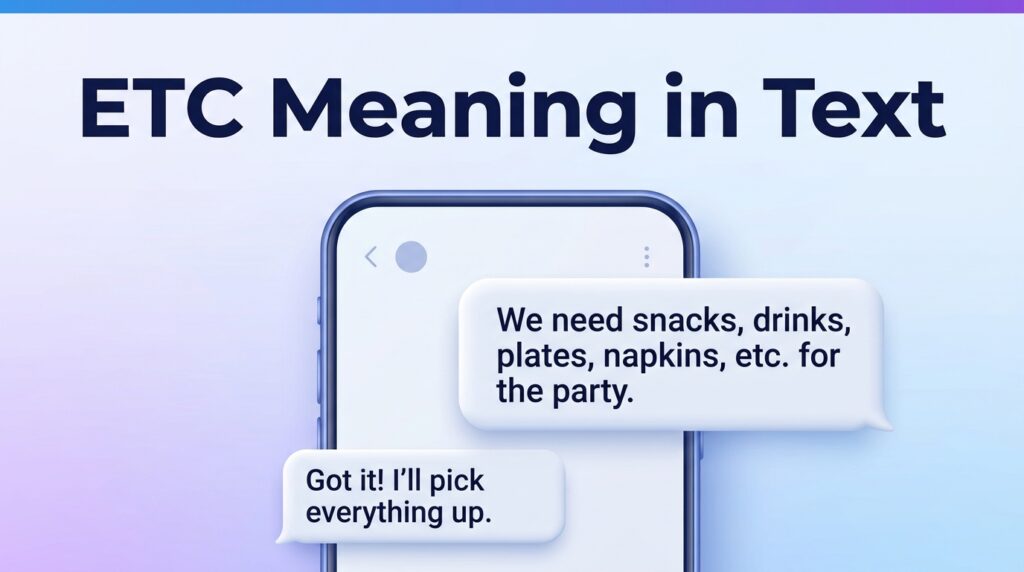

ETC meaning in text is “et cetera,” which means “and other similar things,” “and so on,” or “and the rest.” People place it at the end of an incomplete list when the remaining items are easy to understand. For example, “Bring water, snacks, sunscreen, etc.” means you may bring other similar essentials too.
| Term | Meaning | Context |
|---|---|---|
| etc. | Et cetera; and other similar things | Texts, chats, lists, emails, and general writing |
| ETC | Often the capitalized form of etc.; may also be a specialist acronym | Technical, medical, scientific, or aviation documents |
| etc. etc. | “And so on” with extra emphasis | Very informal chat or social media |
| &c. | An older alternative form of et cetera | Historical or traditional writing |
Meaning & Definition
The standard meaning of etc. is “et cetera.” It tells the reader that a list could continue with more people, objects, actions, or ideas of the same general type. Dictionaries define it as an abbreviation used instead of completing a list of similar things. is et cetera, a Latin expression. In everyday English, it is close in meaning to:
- And so on
- And the rest
- And other similar things
- And more of the same kind
- Among other things
Here are some simple examples:
- “We bought apples, oranges, bananas, etc.”
- “She uses Instagram, TikTok, Snapchat, etc.”
- “The game includes racing, missions, upgrades, etc.”
- “Please send your name, address, phone number, etc.”
In each sentence, the writer gives enough examples for the reader to understand the category. The word does not introduce a completely different idea.
For instance, if someone writes “pens, notebooks, folders, etc.,” the missing items might include paper, markers, or other stationery. It would not normally include unrelated things such as shoes or cooking oil.
The most common written form is etc. In many American style systems, the final period is part of the abbreviation because it comes from a Latin expression. Purdue OWL’s summary of APA abbreviation rules lists “etc.” among Latin abbreviations that take a period. ears at the end of a sentence, you do not need to add a second period.
Correct:
“Please bring pens, notebooks, folders, etc.”
Incorrect:
“Please bring pens, notebooks, folders, etc..”
Meanigo explains terms like this by separating the everyday meaning from specialist acronyms. That distinction matters because lowercase etc. in a message almost always means “and so on,” while uppercase ETC in a scientific document may stand for something else.
Background
“Et cetera” comes from Latin and has been used in English for centuries. Merriam-Webster notes that the expression has appeared in English since the early Middle Ages. Its purpose has remained simple: it saves space by showing that more examples of the same kind could be added. came especially useful in lists, records, letters, and later in printed documents. Instead of naming every item, a writer could provide a few clear examples and then use et cetera. The shortened form etc. made the expression faster to write and easier to fit into limited space.
Digital communication increased its everyday use. Text messages, comments, captions, group chats, and short-form posts reward brief wording. Typing “etc.” is quicker than writing “and other similar things.” However, the meaning itself did not change when communication moved online.
People mainly use etc. for three reasons:
- To save time: The complete list may be long.
- To avoid repetition: The remaining examples are predictable.
- To improve readability: Too many list items can distract from the main point.
The term can also affect tone. In a friendly message, it feels normal and relaxed. In a serious request, it may feel too vague.
For example, “Send the contract, invoice, etc.” leaves the recipient unsure about which other documents are required. A precise list is better when money, safety, work duties, health, travel, or legal requirements are involved.
Usage in Different Contexts
The meaning of etc. stays mostly consistent across general online settings, but its tone and purpose can change.
Text Messages
In text messages, etc. means “and so on” or “other similar things.” It helps someone finish a list quickly.
Example:
“I need milk, bread, eggs, etc.”
The sender does not expect the reader to guess random products. The omitted items should belong to the same shopping or grocery category.
Another example is:
“Pack shirts, trousers, socks, etc.”
This means the person should also pack other similar clothing items.
Social Media
On social media, people use etc. in captions, comments, bios, and replies. It may shorten a list of interests, topics, features, or examples.
Example:
“I post about skincare, makeup, fashion, etc.”
This means the account may cover other closely related beauty or lifestyle topics.
People also use it in comments:
“This phone has a good camera, fast charging, a bright display, etc.”
Here, the writer suggests that the phone has other useful features that have not been listed.
Gaming
ETC is not a universal gaming slang term with a special meaning. In most gaming chats, it still means “et cetera.”
Example:
“You can collect coins, skins, weapons, etc.”
The writer means the game includes those items and other similar rewards or resources.
Another gaming example is:
“We need a healer, tank, support player, etc.”
A game, server, clan, or technical guide could define uppercase ETC as its own acronym. However, that meaning should be explained within the game or document. Context is more reliable than capitalization alone.
Online Communities
Forums, Discord servers, discussion boards, and group chats use etc. to avoid listing every example.
Example:
“Follow the rules: no spam, harassment, scams, etc.”
The word suggests that similar harmful behavior is also forbidden. However, community rules should still be specific enough to enforce fairly.
A moderator might also write:
“Post guides, screenshots, updates, etc. in this channel.”
This means members can share those materials and other related content.
Professional Communication
In emails, reports, and workplace chats, etc. can be acceptable when the category is obvious and the missing details are unimportant.
Example:
“The dashboard tracks traffic, leads, conversions, etc.”
Most readers will understand that the dashboard may also track similar marketing or business metrics.
It is less suitable when a colleague must complete a precise task.
Vague request:
“Update the title, description, images, etc.”
Clearer request:
“Update the title, meta description, product images, price, and stock status.”
The clearer version reduces confusion and makes the task measurable.
Meaning in Chat, WhatsApp, Instagram, TikTok
Across chat apps and social platforms, etc. usually has the same core meaning: “and other similar things.” It is not normally a secret code, emotional signal, or platform-specific slang word.
| Platform | Meaning | Example Usage |
|---|---|---|
| Chat or SMS | And so on; similar items not listed | “Bring a charger, headphones, etc.” |
| Other related things or details | “Send the photos, videos, documents, etc.” | |
| More similar interests, topics, or content | “Fashion, beauty, travel, etc.” | |
| TikTok | Other videos, trends, sounds, or examples | “I make tutorials, reviews, tips, etc.” |
| Discord | Other related channels, rules, roles, or game items | “Use this channel for clips, screenshots, etc.” |
| Messenger | Additional similar plans, objects, or actions | “We can eat, shop, watch a movie, etc.” |
On WhatsApp, etc. often appears in practical lists. A family member may write:
“Get rice, flour, oil, etc.”
A coworker may write:
“Share the report, screenshots, links, etc.”
The second message may need clarification because “links” and “other things” could cover many files.
On Instagram and TikTok, creators often use etc. to compress a broad content category into a short bio or caption.
For example:
“Fitness, food, lifestyle, etc.”
This tells users that the account is not limited to one topic. It can be useful, but a clear description is usually stronger than a vague list when someone is building a professional profile.
In chat, “etc. etc.” or “etcetera, etcetera” may add emphasis. It can suggest that the list is long or that the speaker does not want to repeat familiar details.
Depending on the conversation, it may also sound impatient or dismissive.
Example:
“He made the same excuses—traffic, work, no battery, etc. etc.”
Here, the repeated form suggests the speaker has heard many similar excuses before.
Meaning in Physics, Medical, and Aircraft Terminology
The difference between etc. and ETC becomes important in technical content. Lowercase etc. usually remains the ordinary abbreviation for et cetera. Uppercase ETC may be a field-specific acronym.
| Field | Possible Meaning | Explanation |
|---|---|---|
| Physics | No single universal standard meaning | It may be defined locally in a paper, laboratory, instrument, or course |
| Medical and biology | Electron transport chain | A mitochondrial process involved in energy production |
| Aviation or aircraft | Et cetera in FAA contraction lists | FAA material lists ETC as a general contraction for “et cetera” |
| Other technical contexts | A document-specific acronym | The writer should define it when first used |
ETC Meaning in Physics
In physics, ETC does not have one widely accepted meaning that applies across the entire subject.
Physics uses many standard symbols and abbreviations, but an uppercase acronym may be defined differently by a research group, equipment manufacturer, textbook, experiment, or subfield.
Therefore, check the:
- Nearby sentence
- Document glossary
- Figure caption
- Abbreviation list
- Equipment manual
- Research paper introduction
Do not automatically treat every technical use of ETC as “et cetera.” The author may have assigned it a special meaning for that document.
However, when lowercase “etc.” appears after a list in a physics textbook, it still means “and so on.”
Example:
“The experiment measures temperature, pressure, voltage, etc.”
Here, etc. refers to other similar measurements.
ETC Meaning in Medical and Biological Terms
In medical, biological, and biochemistry writing, ETC commonly stands for electron transport chain.
The electron transport chain is a group of protein complexes and related carriers that transfer electrons and help create the gradient used to produce ATP in mitochondria. Medical and biochemistry references commonly introduce the phrase as “electron transport chain (ETC).” st meaning is very different from the ordinary texting meaning.
Texting example:
“Bring masks, gloves, sanitizer, etc.”
Biology example:
“The ETC supports oxidative phosphorylation.”
In the first sentence, ETC means “and other similar things.” In the second, it refers to a biological energy-producing system.
Medical abbreviations can have more than one interpretation. Readers should not use an abbreviation alone to understand a diagnosis, treatment, or medical instruction. The complete sentence and clinical context are essential.
ETC Meaning in Aviation or Aircraft Terminology
| The FAA’s official contraction material lists ETC as “et cetera” under general usage. It should not be confused with common aviation time abbreviations such as ETA, ETD, or ETE. rm | Meaning |
|---|---|
| ETC | Et cetera |
| ETA | Estimated time of arrival |
| ETD | Estimated time of departure |
| ETE | Estimated time en route |
| ETO | Estimated time over a significant point |
Aviation documents contain many specialized abbreviations. Pilots, students, engineers, and readers should use the glossary for the specific manual rather than guessing from the letters alone.
Common Misconceptions
Several misunderstandings appear when people search for ETC meaning in text.
ETC Is a New Internet Slang Term
ETC is not new social media slang. In ordinary messages, it is the long-established abbreviation of et cetera.
It was used in written English long before WhatsApp, Instagram, TikTok, or modern text messaging existed.
ETC Has a Secret Emotional Meaning
ETC normally does not express love, anger, rejection, attraction, or sarcasm by itself. Tone comes from the complete message.
For example:
“Okay, etc.”
This may sound dismissive, but that feeling comes from the short response and situation rather than from a hidden definition of etc.
ETC Means Extra
ETC and “extra” are not the same.
“Extra” can mean additional, excessive, or more than usual. “Etc.” means that other similar items could be added to a list.
Compare:
- “Bring extra water.” = Bring more water.
- “Bring water, juice, etc.” = Bring those drinks and other similar items.
ECT Is the Correct Spelling
The standard abbreviation is etc., not ect.
The common spelling error may come from the nonstandard pronunciation “ex-cetera.” Merriam-Webster identifies “ect.” as a form influenced by that pronunciation rather than the standard spelling. ntent, however, uppercase ECT may be a separate specialist acronym. Therefore, ETC and ECT should not be treated as interchangeable.
ETC Can Follow Any Example
The reader needs enough information to identify the category.
Unclear:
“Bring clothes, etc.”
Clearer:
“Bring shirts, trousers, socks, and other comfortable clothes.”
Using only one broad example before etc. can leave the reader unsure about what else is expected.
“For Example” and ETC Always Work Together
They can appear in the same sentence, but the wording may become repetitive.
“For example, pens, pencils, markers, etc.”
This is understandable, but the sentence may be cleaner as:
“Bring stationery such as pens, pencils, and markers.”
Use etc. only when the unfinished part of the list adds useful meaning.
ETC Has the Same Meaning in Every Subject
Capitalized acronyms depend on context.
In biochemistry, ETC may mean electron transport chain. In general FAA contraction lists, it means et cetera. In another organization or technical manual, it may have a locally defined meaning. rms & Alternatives
Several words and abbreviations look similar to etc., but they serve different purposes.
| Term | Meaning | Difference |
|---|---|---|
| etc. | And other similar things | Ends an incomplete list |
| and so on | More things following the same pattern | Plain-English alternative to etc. |
| and the rest | Remaining similar items | More conversational |
| among other things | Additional examples exist | Highlights only selected examples |
| e.g. | For example | Introduces examples rather than ending a list |
| i.e. | That is; in other words | Clarifies or restates a precise meaning |
| et al. | And others | Usually refers to additional people or authors |
| misc. | Miscellaneous | Labels a mixed category |
| yada yada | Unstated repetitive or unimportant details | Very informal and sometimes dismissive |
| and more | Additional items or benefits | Common in advertising and promotional writing |
A useful rule is:
- Use e.g. before examples.
- Use etc. after examples when similar items remain.
- Use i.e. when explaining exactly what you mean.
- Use et al. mainly for people, especially author names in academic references.
Examples:
“Try warm colors, e.g., red and orange.”
“Try red, orange, yellow, etc.”
“Use a warm color, i.e., a color associated with heat.”
“Ahmed et al. reported the result.”
Purdue OWL’s MLA abbreviation guidance distinguishes etc. as “and so forth” from et al. as “and others,” which is useful when deciding between lists of things and lists of people. pond to It
Most of the time, you do not need to respond to the word etc. itself. Respond to the main message.
Ask for clarification only when the omitted information affects what you must do.
| Scenario | Suggested Response |
|---|---|
| Friend: “Bring snacks, drinks, etc.” | “Sure. Is there anything specific you still need?” |
| Coworker: “Update the page title, images, etc.” | “I can do that. Please confirm the other fields you want updated.” |
| Manager: “Send the invoice, receipt, etc.” | “Could you list every required document so I don’t miss anything?” |
| Dating chat: “I like movies, music, travel, etc.” | “Nice—what kind of movies do you enjoy most?” |
| Group chat: “We’ll play games, eat, talk, etc.” | “Sounds good. What time should I arrive?” |
| Customer: “The product has scratches, marks, etc.” | “Please send clear photos of each issue so we can review them.” |
| Formal request: “Provide ID, address proof, etc.” | “Please share the complete document checklist.” |
Casual responses can be short:
- “Got it.”
- “Sounds good.”
- “Okay, what else should I bring?”
- “Which other items do you mean?”
Formal responses should remove uncertainty:
- “Please specify the remaining requirements.”
- “Could you provide the complete list of documents?”
- “To confirm the scope, which additional sections should be updated?”
- “Please identify all required files before submission.”
The best response depends on risk.
If the message concerns a casual plan, guessing may be harmless. If it concerns payment, health, safety, travel, compliance, or client work, request a complete list.
Differences from Similar Words
The easiest way to understand etc. is to compare its job in a sentence with nearby alternatives.
| Expression | Main Job | Example | Key Difference |
|---|---|---|---|
| etc. | Continues an obvious list | “Books, pens, folders, etc.” | Leaves similar items unstated |
| extra | Describes something additional | “Bring an extra pen.” | Refers to an added item |
| e.g. | Introduces examples | “Use a tool, e.g., a wrench.” | Starts examples |
| i.e. | Gives an exact restatement | “Come early, i.e., before 8.” | Narrows the meaning |
| et al. | Refers to other people | “Khan et al.” | Common in citations and names |
| and more | Promises additional items | “Templates, icons, and more” | Often promotional |
| such as | Introduces examples | “Tools such as hammers and drills” | Does not require etc. |
| or something | Shows uncertainty | “Let’s watch a movie or something.” | The speaker is unsure |
“Etc.” and “extra” are often confused because both suggest something additional. The difference is grammatical and practical.
“Extra” directly describes an added item or amount. “Etc.” replaces the unstated remainder of a recognizable list.
Compare:
- “Bring extra water.” = Bring more water.
- “Bring water, juice, etc.” = Bring water, juice, and other similar drinks.
- “I like football, cricket, etc.” = I like football, cricket, and similar sports.
- “I like football, i.e., soccer.” = I mean the sport called soccer.
These small differences help readers interpret messages accurately.
Relevance in Online Conversations & Dating Apps
Modern online communication favors short messages, so etc. remains useful. It lets people mention several interests or examples without producing a long list.
In a social profile, someone may write:
“Books, coffee, travel, photography, etc.”
On a dating app, this suggests that the profile includes only some of the person’s interests.
However, etc. provides less information than a specific detail. A profile that says “I like music, movies, etc.” is easy to understand but difficult to respond to.
A stronger version would be:
“I like live jazz, mystery films, weekend hikes, and trying new cafés.”
Specific interests create better conversation openings.
In dating chats, etc. has no standard hidden romantic meaning. It usually performs its normal list-ending role.
Example:
“I’m looking for honesty, humor, good communication, etc.”
This means the person values those qualities and other similar traits. It does not automatically imply a casual relationship, serious commitment, or any specific dating arrangement.
Messaging etiquette also matters. Repeatedly using etc. can make someone sound uninterested, especially after the other person asks a thoughtful question.
Less engaging:
“I work, go out, watch shows, etc.”
More engaging:
“I work in design, meet friends on weekends, and watch crime dramas.”
The second answer gives the other person something specific to discuss.
The same principle applies to professional networking and online communities. Use etc. when the omitted items are obvious and unimportant. Use precise wording when details help the reader understand, respond, decide, or act.
For people who regularly search for unfamiliar abbreviations, online slang, and platform-specific phrases, Meanigo can serve as a practical meaning guide. A helpful meaning page should do more than give a one-line definition. It should explain context, compare related terms, provide real examples, and warn readers when an uppercase acronym may have a technical definition.
Frequently Asked Questions
What does ETC mean in texting?
In texting, ETC means “et cetera,” or “and other similar things.” It appears at the end of an incomplete list when the sender believes the remaining examples are easy to guess. “Bring chips, drinks, cups, etc.” means to bring those items plus other related party supplies.
What is the full form of ETC?
The full form of ETC in ordinary writing is et cetera. It is a Latin expression used in English to mean “and so on,” “and the rest,” or “and other similar things.” In specialist documents, uppercase ETC may have another full form, so always check the subject and nearby context. have multiple meanings?
Yes. In everyday text, etc. means et cetera. In medicine and biology, ETC commonly means electron transport chain. An organization, product, system, or technical manual may also define ETC differently. Capitalization is a clue, but the surrounding sentence and document glossary provide the safest interpretation. mmonly used on TikTok?
Yes. People use etc. in TikTok captions, comments, and profile descriptions to shorten lists. For example, “I post recipes, kitchen tips, reviews, etc.” means the creator also posts similar content. It is ordinary written shorthand rather than a TikTok-only slang term.
What does ETC mean on WhatsApp?
On WhatsApp, etc. normally means “and so on” or “other similar things.” A message such as “Send photos, videos, PDFs, etc.” asks for those files and possibly other related materials. Ask the sender to clarify when the missing items affect the task.
Is it ETC or ECT?
The standard abbreviation is etc., based on et cetera. “Ect.” is a common spelling error, often linked to the nonstandard pronunciation “ex-cetera.” In medical contexts, however, uppercase ECT can separately stand for a technical term, so spelling and context both matter. ETC mean in medical terms?
In medical, biological, and biochemistry content, ETC often stands for electron transport chain. It refers to linked electron-transfer processes involved in mitochondrial energy production. This scientific acronym is unrelated to the everyday phrase “and so on.” ETC mean in aviation?
FAA contraction material lists ETC as the general contraction for et cetera. Aviation also uses related but different abbreviations such as ETA for estimated time of arrival, ETD for estimated time of departure, and ETE for estimated time en route. Readers should consult the exact manual’s glossary. rmal or informal?
Etc. can appear in both formal and informal writing. It is acceptable when the missing examples are obvious and not essential. In contracts, instructions, medical directions, project scopes, and official checklists, a complete list is usually better because etc. may create uncertainty.
Can ETC refer to people?
It can loosely suggest more members of a known group, but et al. or a phrase such as “and others” is often clearer for named people, especially in academic references. Etc. works best for things, actions, categories, or mixed examples rather than author lists. mean “extra”?
No. Etc. does not mean extra. It means that additional similar examples have not been written. “Bring extra chairs” means bring more chairs. “Bring chairs, tables, etc.” means bring chairs, tables, and other related items.
How do you pronounce et cetera?
Et cetera is commonly pronounced roughly as “et SET-er-uh.” A frequent nonstandard version begins with an “ex” sound, which may lead people to misspell the abbreviation as “ect.” The correct spelling remains et cetera and etc.
Do you need a comma before “etc.”?
Yes — put a comma before “etc.” in a list: “milk, bread, eggs, etc.” And never write “and etc.” — it’s redundant, because the “et” in “et cetera” already means “and.” Also remember “etc.” already ends with a period, so don’t add a second one at the end of a sentence.
How to Reply When Someone Uses “etc.” in a Text
When someone ends a message with “etc.”, they’re basically saying “you get the rest” — so most of the time, just react to the part they actually listed. A quick “Got it!” or “Haha, sounds like a busy day 😅” is all you need. No one expects you to guess every missing item.
If the missing part actually matters, ask casually instead of guessing: “Etc… what else?” works perfectly. Or play along and guess the rest yourself — “Snacks, movies, and a nap, etc.? 😉” — it keeps the chat fun and shows you caught the vibe.
Rule of thumb: if you already get the idea, reply to the idea. If you genuinely don’t know what’s hiding behind the “etc.”, ask — that’s way better than pretending and getting it wrong. Either way, don’t overthink it: “etc.” is just shorthand for “and the rest.”
The ETC meaning in text is usually simple: et cetera, meaning “and other similar things” or “and so on.” It saves time by shortening an obvious list in texts, WhatsApp messages, social media posts, gaming chats, and emails.
Context still matters. In medicine and biology, ETC may mean electron transport chain. In aviation material, it can appear as the official contraction for et cetera. In physics or other technical fields, it may be defined locally rather than having one universal meaning.
Use etc. when the missing examples are predictable and unimportant. Use a complete list when accuracy matters. Meanigo helps readers understand these differences by connecting each meaning with its real context, practical examples, related terms, and suitable responses.
Related:
PS Meaning in Text: What It Means in Chat and Online

Pingback: HML Meaning in Text: Uses, Examples & Replies
Pingback: XX Meaning in Text: Uses, Examples and Replies