
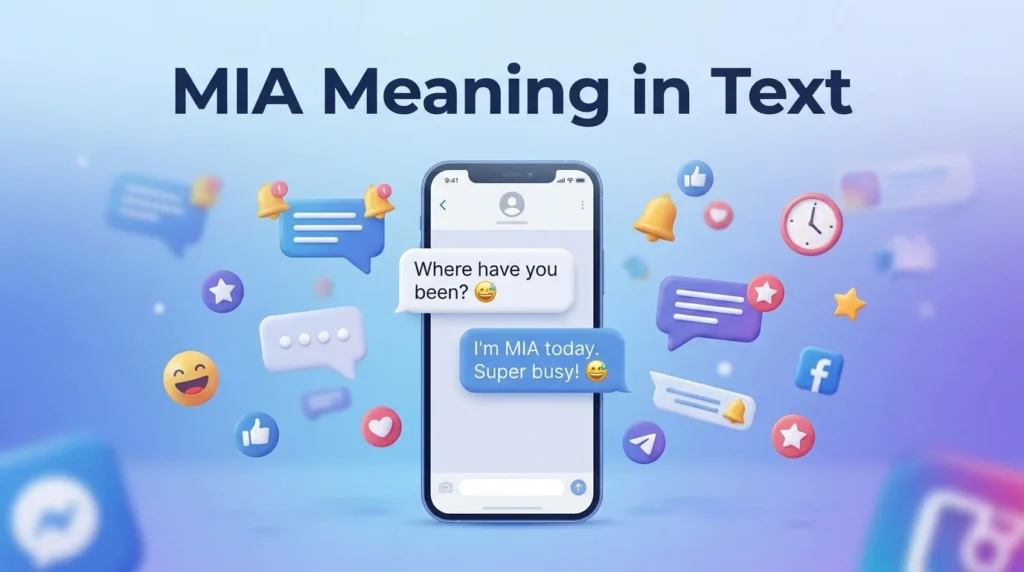

In text messages, MIA means “missing in action.” It is used informally when someone has disappeared, stopped replying, become inactive, or cannot be reached. For example, “You’ve been MIA all week” means the person has been absent from chats or social activities, not that they are literally missing during military service.
| Term | Meaning | Context |
|---|---|---|
| MIA | Missing in action | Someone is absent, unavailable, inactive, or not responding |
| Go MIA | Suddenly disappear | A person stops communicating without explanation |
| Been MIA | Has been absent | Someone has not appeared online or replied for some time |
| MIA again | Disappeared again | A person has repeated a pattern of becoming unreachable |
MIA is usually pronounced one letter at a time: “M-I-A.” Although people often call it an acronym, it is more accurately described as an initialism because each letter is spoken separately.
In modern conversations, the expression can sound playful, concerned, annoyed, or critical. Its exact tone depends on the relationship, the situation, and how long the person has been unavailable.
Meaning & Definition
The main MIA meaning in text is missing in action.
In everyday messaging, it describes a person who is unexpectedly absent or difficult to contact. The person may have stopped replying to messages, disappeared from social media, missed a group activity, or become inactive without giving an explanation.
Major English dictionaries also recognize the figurative use of MIA for someone or something that is unexpectedly missing, absent, inactive, or impossible to contact.
Full form of MIA
The full form of MIA is:
M — Missing
I — In
A — Action
The original phrase has a serious military meaning. However, texting and social media users usually use it figuratively.
Common interpretation in texting
When someone writes “You are MIA,” they normally mean:
- You have not replied recently.
- You have not been active in the group.
- Nobody has heard from you.
- You missed an event or conversation.
- You suddenly became unavailable.
- You disappeared without explaining why.
Real-world examples
Example 1:
“Where have you been? You’ve been MIA for three days.”
Meaning: The person has not replied or appeared for three days.
Example 2:
“Sorry I went MIA. Work has been stressful.”
Meaning: The speaker stopped communicating because they were busy or overwhelmed.
Example 3:
“Jake is MIA from the group chat again.”
Meaning: Jake has not participated in the group conversation.
Example 4:
“My headphones are MIA.”
Meaning: The headphones are missing and cannot be found.
MIA can therefore describe both people and objects. When it describes a person, it usually means absent or unreachable. When it describes an object, it means lost or missing.
Background
MIA began as a military abbreviation for missing in action.
In an official military context, it refers to a service member whose location is unknown after hostile action. A current U.S. military terminology guide describes an MIA casualty as a hostile casualty who is not at their duty location for apparently involuntary reasons and whose location remains unknown.
This original meaning is serious and should not be confused with its casual online use.
How the term evolved
Over time, people began using “missing in action” outside the military. The phrase became a figurative way to describe anyone or anything that had unexpectedly disappeared.
For example:
- A coworker who did not attend meetings might be called MIA.
- A friend who stopped answering calls might be described as MIA.
- A missing document could be called MIA.
- A player who stopped participating in a game could be labeled MIA.
As digital communication became more common, the shorter form “MIA” became useful in texts, chats, comments, and social media captions.
Why people use MIA
People use MIA because it communicates several ideas in only three letters.
It can suggest that someone is:
- Missing
- Inactive
- Silent
- Unreachable
- Offline
- Not responding
- Absent without explanation
It is also more expressive than simply saying “away.” Calling someone MIA often suggests that their absence is noticeable or unusual.
People searching for unfamiliar abbreviations can also use a texting-language resource such as Meaningo to check how slang terms are used in different online contexts.
Usage in Different Contexts
The meaning of MIA remains similar across most digital settings, but the reason for someone’s absence may change.
Text messages
In direct text messages, MIA usually means someone has stopped replying or has not contacted the sender recently.
Example:
“You went MIA after our last conversation. Is everything okay?”
This message may express concern rather than criticism.
Another example is:
“Sorry for being MIA. I needed a break from my phone.”
Here, the person explains that they intentionally stepped away from communication.
Social media
On social media, MIA often describes someone who has stopped posting, commenting, sharing stories, or interacting with followers.
Example:
“I’ve been MIA on social media, but I’m finally back.”
This means the person has not been active on their accounts.
Influencers and content creators may also say they have been MIA when they have not uploaded new content for several days or weeks.
Gaming
In gaming conversations, MIA may describe a player who:
- Left the game
- Stopped responding
- Is absent from the team
- Has not logged in recently
- Disappeared during an important match
Example:
“Our support player went MIA halfway through the match.”
This means the player stopped participating or could no longer be found.
However, some games have their own special alert systems or abbreviations. Players may use “missing,” “enemy missing,” or another game-specific signal instead of MIA.
Online communities
In forums, Discord servers, Reddit communities, and private groups, MIA can describe a member who has not posted or interacted for a long time.
Example:
“The moderator has been MIA since last month.”
The sentence suggests that the moderator has not been available to manage the community.
Professional communication
MIA is sometimes used in casual workplace conversations, especially between coworkers who know each other well.
Example:
“Ben has been MIA from the project channel today.”
However, it may sound too informal or critical in official emails, client messages, reports, or communication with senior management.
More professional alternatives include:
- Currently unavailable
- Out of the office
- Has not yet responded
- Unable to attend
- Temporarily unreachable
- Away from work
- Not active in the project channel
Instead of writing, “The client went MIA,” a professional sentence would be:
“We have not received a response from the client since Monday.”
This version is clearer, more neutral, and less likely to sound disrespectful.
Also Read: NTY Meaning in Text: Definition, Usage and Examples
Meaning in Chat, WhatsApp, Instagram, TikTok
MIA normally keeps the same basic meaning across chat and social media platforms: someone has disappeared, become inactive, or stopped replying.
| Platform | Meaning | Example Usage |
|---|---|---|
| Text messaging | Not replying or unavailable | “You’ve been MIA since yesterday.” |
| Not responding or inactive in chat | “Why are you MIA from the family group?” | |
| Not posting, viewing stories, or interacting | “I’ve been MIA on Instagram lately.” | |
| TikTok | Not uploading or engaging with content | “She went MIA after her last video.” |
| Snapchat | Not sending snaps or maintaining streaks | “He’s been MIA on Snap all week.” |
| Discord | Inactive in a server or voice channel | “Our admin is MIA again.” |
| Messenger | Not reading or answering messages | “You went MIA after I sent the details.” |
| Dating apps | Stopped messaging or disappeared from the app | “We matched, talked for days, and then he went MIA.” |
MIA meaning on WhatsApp
On WhatsApp, MIA usually means that someone has not replied to private messages or has stopped participating in a group.
A person may still appear online but be described as MIA if they are ignoring a particular conversation.
Example:
“Sara is online, but she’s MIA from the project group.”
MIA meaning on Instagram
On Instagram, MIA often refers to a break from posting or interacting.
Example:
“Sorry I’ve been MIA. I took some time away from social media.”
It can also refer to someone who suddenly stopped answering direct messages.
MIA meaning on TikTok
On TikTok, MIA may describe a creator who has not uploaded content recently.
Example:
“Why has this creator been MIA for a month?”
The expression does not have a unique TikTok definition. It still means absent, inactive, or difficult to reach.
MIA meaning in chat
In general chat conversations, MIA usually signals a noticeable period of silence.
The phrase may be friendly:
“Hey stranger, why have you been MIA?”
It may also sound annoyed:
“You can’t keep going MIA whenever we need an answer.”
Tone, punctuation, and relationship context determine how the message is likely to be understood.
Meaning in Physics, Medical, and Aircraft Terminology
MIA can have specialized meanings outside texting. These meanings are not interchangeable.
| Field | Possible meaning | Explanation |
|---|---|---|
| Texting | Missing in action | Someone is absent, inactive, or not replying |
| Physics | No single universal meaning | MIA may appear as a study-specific acronym, but it is not a standard basic physics term |
| Medical | Minimally invasive adenocarcinoma | A term used in lung cancer pathology |
| Aviation | Minimum IFR altitude | An FAA term for minimum altitude during instrument flight operations |
| Airport terminology | Miami International Airport | MIA is the commonly used airport code for Miami International Airport |
| Military | Missing in action | A service member is missing after hostile action and their location is unknown |
MIA meaning in physics
There is no single, widely accepted definition of MIA across all areas of physics.
A research paper, laboratory, computer model, or technical project may create its own meaning for the letters. Therefore, readers should check the abbreviation list, glossary, caption, or surrounding paragraph before interpreting it.
In a normal physics lesson, MIA should not automatically be read as “missing in action.”
MIA meaning in medical terminology
In medical and cancer-related writing, MIA can mean minimally invasive adenocarcinoma.
This abbreviation is especially associated with lung pathology. National Cancer Institute research materials use MIA for minimally invasive adenocarcinoma when discussing stages or types of lung adenocarcinoma.
Medical abbreviations can have more than one meaning, so patients should never interpret MIA from a report without considering the full sentence and consulting a qualified healthcare professional.
MIA meaning in aviation
In FAA terminology, MIA can mean minimum IFR altitude. IFR stands for instrument flight rules.
The FAA defines minimum IFR altitudes as minimum altitudes prescribed for instrument flight operations. These altitudes may be shown on aeronautical charts and established under applicable aviation regulations.
MIA is also the code commonly associated with Miami International Airport. The airport itself uses “MIA” in its official name and public information.
Therefore, the correct aviation meaning depends on context:
- “MIA chart” may refer to a minimum IFR altitude chart.
- “Flight to MIA” refers to a flight to Miami International Airport.
- “Pilot reported MIA” could mean something else depending on the sentence.
Common Misconceptions
MIA is simple, but readers sometimes misunderstand its tone or confuse it with similar expressions.
| What people assume | What it actually means |
|---|---|
| The person is literally missing | In casual text, the person is usually only inactive or not replying |
| MIA always means ghosting | Ghosting is intentional relationship withdrawal; MIA may have an innocent reason |
| MIA means “Miami” in every context | Miami is one aviation or location-related meaning, not the general texting meaning |
| MIA is always rude | It can be playful, concerned, neutral, or critical |
| MIA means the person blocked you | They may simply be busy, offline, traveling, or taking a break |
| MIA has one meaning in every industry | Medical and aviation contexts may use different definitions |
| MIA is a formal business term | It is usually too casual for official communication |
| MIA only describes people | Objects, files, products, and information can also be described as MIA |
MIA does not always mean ghosting
Someone who is MIA may return and explain the absence.
For example:
“Sorry I went MIA. My phone broke.”
Ghosting normally involves intentionally ending communication without explanation, especially in dating or personal relationships. Being MIA only describes the absence; it does not prove why the person disappeared.
MIA is not always negative
Friends often use MIA humorously.
“Look who finally returned after being MIA!”
This may be friendly teasing rather than an accusation.
However, the same phrase may feel negative when someone has missed an important responsibility:
“You went MIA when the team needed your approval.”
The context changes the emotional meaning.
Similar Terms & Alternatives
Several texting expressions are related to MIA, but they do not mean exactly the same thing.
| Term | Meaning | Difference |
|---|---|---|
| AFK | Away from keyboard | Usually a temporary absence during gaming or computer use |
| BRB | Be right back | The person plans to return soon |
| Offline | Not connected to the internet | Describes connection status rather than unexplained absence |
| Ghosting | Ending communication without explanation | Usually more intentional and relationship-focused |
| Radio silent | Completely stopped communicating | Emphasizes silence rather than physical absence |
| Inactive | Not currently participating | More neutral and less emotional than MIA |
| Unavailable | Cannot be contacted or participate | More professional and direct |
| AWOL | Absent without leave | Often jokingly describes an unexplained absence but has a military origin |
| Disappeared | Cannot be seen or contacted | A general word rather than an abbreviation |
| Lurking | Watching without actively participating | The person may still be present but silent |
| OOO | Out of office | A planned professional absence |
| Left on read | Read a message without replying | The person saw a specific message but did not answer |
MIA versus AFK
AFK usually signals a short and temporary break.
“AFK for five minutes.”
MIA suggests a longer, more noticeable, or unexplained absence.
“He has been MIA from the server for two weeks.”
MIA versus radio silent
Radio silent focuses on a lack of communication.
MIA can include communication silence, physical absence, online inactivity, or missing participation.
Someone may be called radio silent after not answering messages, while someone may be called MIA after missing messages, events, meetings, and online activity.
MIA versus unavailable
Unavailable is neutral and professional.
MIA is more informal and often carries emotion, humor, surprise, or criticism.
Compare:
“The manager is currently unavailable.”
“The manager has gone MIA.”
The second sentence sounds more casual and may suggest that the absence is unexpected or frustrating.
How to Respond to It
Your response should match the sender’s tone and the reason for your absence.
| Scenario | Suggested Response |
|---|---|
| You were busy | “Sorry I’ve been MIA. Work has been extremely busy this week.” |
| You needed personal space | “I needed some time offline, but I appreciate you checking in.” |
| Your phone was unavailable | “My phone was not working, so I could not reply.” |
| You forgot to respond | “Sorry, I saw your message and forgot to answer.” |
| You were traveling | “I’ve been traveling with limited internet access.” |
| A friend is teasing you | “I know! I disappeared for a while, but I’m back now.” |
| Someone sounds concerned | “I’m okay. I’ve just had a lot happening recently.” |
| A coworker asks professionally | “Apologies for the delayed response. I was unavailable yesterday.” |
| You do not want to share details | “I had some personal matters to handle, but everything is fine.” |
| You are still unavailable | “I’m safe, but I need a little more time before I can properly catch up.” |
Casual responses
- “I know, I’ve been MIA lately!”
- “I’m back now. What did I miss?”
- “Life got busy, but I’m okay.”
- “My social battery needed a break.”
- “Sorry! I did not mean to disappear.”
Formal responses
- “I apologize for my delayed response.”
- “I was unavailable due to personal commitments.”
- “Thank you for your patience while I was away.”
- “I was unable to access my messages during that period.”
- “I have now returned and will review the outstanding items.”
When someone else has gone MIA, avoid assuming the worst immediately. A respectful message is usually better than an accusation.
For example:
“I have not heard from you recently. I hope everything is okay.”
This sounds more considerate than:
“Why are you ignoring me?”
Differences from Similar Words
The most important difference is that MIA describes a person’s absence, while many related words describe the cause, duration, or intention behind that absence.
| Expression | Expected duration | Intentional? | Common setting |
|---|---|---|---|
| MIA | Unclear or extended | Unknown | Texting, social media, groups |
| BRB | Very short | Yes | Live chat and gaming |
| AFK | Usually short | Yes | Gaming and computer chat |
| Ghosting | Often permanent | Usually yes | Dating and relationships |
| Offline | Any duration | Not necessarily | General internet use |
| OOO | Planned work period | Yes | Professional communication |
| Radio silent | Unclear | Unknown or intentional | Personal and professional chat |
| Inactive | Usually extended | Unknown | Accounts, communities, and apps |
MIA and ghosting
MIA is a description of what happened: the person became absent.
Ghosting is an interpretation of behavior: the person intentionally ended communication without explanation.
Someone can be temporarily MIA without ghosting anyone.
MIA and BRB
BRB gives reassurance that the person will return soon.
MIA does not provide a return time.
If someone writes “BRB,” you may expect them back within minutes. If someone has been MIA, you may not know when they will reply.
MIA and AWOL
Both terms come from military language and are often used figuratively.
However, AWOL means absent without leave, while MIA means missing in action.
In casual speech, AWOL may suggest that a person abandoned a duty or left without permission. MIA simply emphasizes that the person cannot be found or contacted.
Relevance in Online Conversations & Dating Apps
MIA remains relevant because modern communication creates an expectation of quick replies.
Messaging apps show online status, read receipts, typing indicators, activity timestamps, and story views. As a result, people notice when someone suddenly stops interacting.
Social media usage
On social media, people may describe themselves as MIA after taking a digital break.
Common reasons include:
- Work pressure
- Exams
- Travel
- Family responsibilities
- Burnout
- Privacy concerns
- Mental rest
- Reduced screen time
- Content creation breaks
A caption may say:
“I’ve been a little MIA, but I’m ready to start posting again.”
This lets followers know that the absence was temporary.
Dating app usage
On dating apps, MIA often means that a match suddenly stopped replying or disappeared after regular conversation.
Example:
“We talked every day, but she has been MIA since the weekend.”
This could indicate ghosting, but it does not prove it. The person may be busy, may have deleted the app, may have lost interest, or may be dealing with a personal situation.
A single polite follow-up is normally more appropriate than sending repeated messages.
For example:
“Hey, I enjoyed our conversation. Let me know if you would still like to keep in touch.”
If there is no response, it is usually best to respect the silence and move forward.
Messaging etiquette
When you expect to be unavailable for a long time, a brief message can prevent confusion.
Examples include:
- “I’ll be offline this weekend.”
- “Work is busy, so my replies may be slow.”
- “I’m taking a break from social media.”
- “I may not have internet access while traveling.”
- “I need some personal time, but I’ll check in soon.”
These messages reduce the chance that friends, partners, or coworkers will think you have gone MIA.
Modern communication trends
MIA reflects how online availability has become part of everyday relationships.
In the past, delayed responses were normal because people were not constantly connected. Today, a sudden change in online behavior may be noticed quickly.
However, online status does not always show a person’s real situation. Someone may open an app without having the time or energy to hold a conversation.
For this reason, MIA should be interpreted carefully. Absence does not automatically mean rejection, disrespect, or lack of interest.
Also Read: ISO Meaning in Text, Chat, and Social Media
When NOT to Use MIA
MIA is playful in casual chat, but some situations call for plain language instead.
Serious disappearances: If someone is genuinely missing and people are worried, calling them “MIA” can sound insensitive — it turns a scary situation into a joke. Say “we haven’t heard from them” instead.
Formal communication: In work emails, client messages, or school writing, “MIA” can read as careless or critical. “Unavailable” or “has not responded” is clearer and more respectful.
Sensitive friends: Some people experience anxiety around being ignored or abandoned. Teasing them with “you went MIA again” can genuinely hurt. A kinder check-in — “I haven’t heard from you, is everything okay?” — keeps the friendship safe.
Bottom line: use MIA for light, temporary absence among people who get the joke. When stakes or feelings are real, use real words.
Frequently Asked Questions
What does MIA mean in texting?
MIA means missing in action in texting. It describes someone who has disappeared, stopped replying, become inactive, or has not participated in a conversation for some time. For example, “You’ve been MIA lately” means the person has been noticeably absent or difficult to contact.
What is the full form of MIA?
The full form of MIA is missing in action. It began as a military term for a service member whose location was unknown after hostile action. In modern texting, it is used informally for someone who has stopped communicating, disappeared from social media, or become unexpectedly unavailable.
Does MIA have multiple meanings?
Yes. In texting, MIA usually means missing in action. In medical writing, it may mean minimally invasive adenocarcinoma. In FAA aviation terminology, it can mean minimum IFR altitude. MIA is also associated with Miami International Airport. The correct definition always depends on the surrounding context.
Is MIA commonly used on TikTok?
Yes, MIA is used on TikTok, especially when a creator has not uploaded content or interacted with followers for a while. A creator may say, “Sorry I’ve been MIA,” before explaining their absence. It has the same general meaning on TikTok as it does in other online conversations.
What does “you’ve been MIA” mean?
“You’ve been MIA” means that someone has noticed your absence. You may not have replied to messages, attended activities, posted online, or participated in a group. Depending on the tone, the message may express concern, friendly teasing, disappointment, frustration, or simple curiosity.
Is going MIA the same as ghosting?
No. Going MIA means becoming absent or unreachable, but the reason may be unknown. Ghosting usually means intentionally ending communication without an explanation, often in a dating or personal relationship. A person may temporarily go MIA because of work, travel, stress, illness, or technical problems.
Is MIA rude or offensive?
MIA is not normally offensive, but it can sound critical in certain situations. Between friends, it may be playful. In a workplace or sensitive relationship, it can sound accusatory. A more respectful option is to say, “I have not heard from you recently. Is everything okay?”
Can MIA refer to an object?
Yes. MIA can describe an object, document, file, or item that cannot be found. Someone might say, “My charger is MIA” or “The final report has gone MIA.” In these examples, MIA means missing, misplaced, or unavailable rather than inactive.
What does MIA mean on Instagram?
On Instagram, MIA usually means that someone has stopped posting, sharing stories, answering direct messages, or engaging with followers. A user may write, “I’ve been MIA on Instagram” to explain a break from the platform. It does not indicate a special Instagram-only meaning.
How should I reply when someone says I went MIA?
A simple and honest explanation is usually best. You could reply, “Sorry I disappeared. I’ve been very busy,” or “I needed some time offline, but I’m okay.” In a professional situation, write, “I apologize for the delayed response. I was unavailable and have now returned.”
Should I say MIA if someone is truly missing?
No. When a person is genuinely missing and others are worried, saying they are “MIA” can sound flippant or insensitive. In serious situations, use clear, caring language — for example, “We haven’t heard from them since Tuesday and we’re concerned.” Save MIA for casual, low-stakes absences where everyone understands the joke.
Conclusion
The MIA meaning in text is “missing in action.” It usually describes someone who has stopped replying, become inactive, disappeared from social media, or remained unavailable without explanation.
Although the term began in military language, it is now common in texts, WhatsApp chats, Instagram captions, TikTok comments, gaming communities, dating apps, and casual workplace conversations. Context matters because MIA can also have specialized medical and aviation meanings.
In everyday messaging, the simplest interpretation is: MIA means someone or something is noticeably missing, absent, inactive, or difficult to reach.
Related:
Also Read: AFK Meaning in Text: What It Means and How to Use It
Also Read: BRB Meaning in Text: Full Form, Uses & Examples
Also Read: GBTS Meaning in Text: What It Means and How to Reply

Pingback: RQ Meaning in Text: Definition, Uses & Examples
Pingback: ETC Meaning in Text: Full Form & Examples
Pingback: Ionk Meaning in Text: Definition, Uses & Examples
Pingback: HML Meaning in Text: Hit My Line or Hate My Life?