
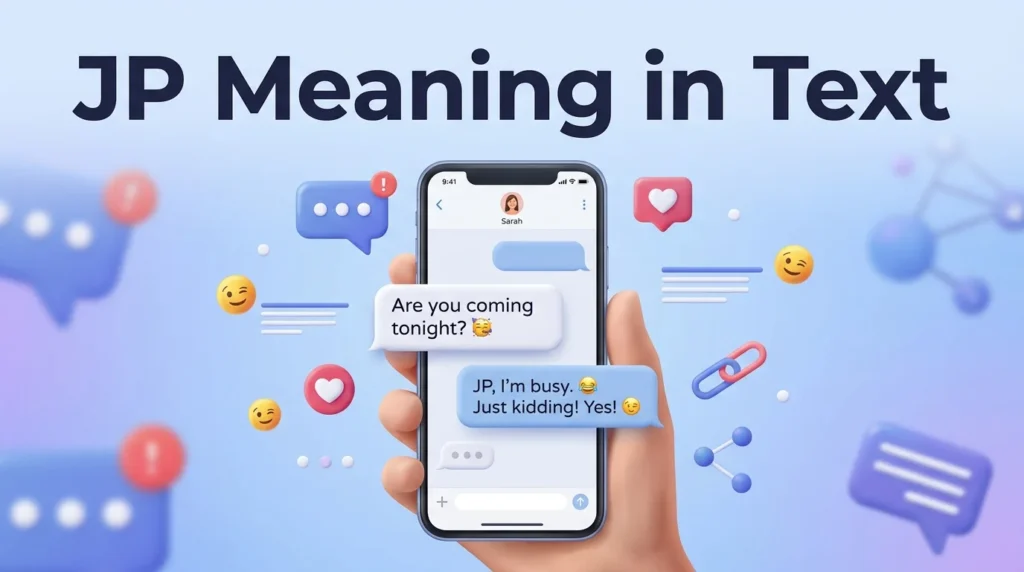

In texting, JP usually means “just playing.” People add it after a joke, tease, sarcastic line, or exaggerated statement to show they were not being serious. It works much like “JK,” meaning “just kidding.” However, JP can also mean Japan, someone’s initials, or a field-specific term when the context changes.
| Term | Meaning | Context |
|---|---|---|
| JP | Just Playing | Texting, chat, social media, and gaming |
| JP | Japan | Travel, international discussions, websites, and gaming servers |
| J.P. | Justice of the Peace | Legal and official communication |
| JP drain | Jackson-Pratt drain | Medical and post-surgery care |
| JP-5 or JP-8 | Military aviation fuel | Aircraft and military terminology |
| JP | Personal initials | Names, usernames, and contact lists |
The safest way to understand JP meaning in text is to examine the message around it. A playful comment followed by “JP” almost always means “just playing,” while a discussion about travel, law, surgery, or aircraft may use a completely different definition.
Meaning & Definition
The most common JP meaning in text messages is “just playing.” It tells the reader that the previous statement was playful, exaggerated, sarcastic, or not intended to be taken seriously.
For example:
“I’m never inviting you again. JP, you know you’re always welcome.”
In this example, the first sentence may sound rude or serious. Adding “JP” changes the emotional tone and tells the reader that the sender is joking.
JP is therefore a conversational tone marker. It does not always add new information. Instead, it helps the recipient understand how the earlier statement should be interpreted.
What Is the Full Form of JP in Texting?
In casual texting, the full form of JP is:
JP = Just Playing
The expression “just playing” means:
- I am joking.
- I am teasing you.
- Do not take that seriously.
- I did not mean to offend you.
- My previous statement was playful.
Slang references commonly define JP as “just playing” and compare it with JK, or “just kidding.”
Common Interpretation
When JP appears after a funny, dramatic, or slightly insulting sentence, it normally softens the message.
Consider these examples:
- “Your cooking could scare a professional chef. JP!”
- “I deleted your game account. JP, relax.”
- “You looked half asleep in that photo, JP.”
- “I’m taking all the credit for the project. JP.”
- “You owe me $500 for that advice. JP!”
In each case, JP signals that the sender is not being fully serious.
However, JP does not automatically make an offensive comment acceptable. If the first statement is cruel, personal, or inappropriate, adding an abbreviation may not prevent hurt feelings.
Also Read: SMFH Meaning in Text: What It Means and How to Use It
Background
The exact origin of JP as internet slang is not clearly recorded. Unlike formal abbreviations created by organizations, casual expressions often develop naturally through text messages, chat rooms, online games, and social platforms.
JP likely became useful for the same reason that terms such as JK, LOL, BRB, and IDK became popular: typing a short abbreviation is faster than writing a full sentence.
Instead of writing:
“I was only playing with you, so please do not take that seriously.”
A person can simply write:
“JP.”
This saves time while still clarifying the intended tone.
How JP Evolved in Online Communication
Early internet conversations relied heavily on short text because users often typed on small keyboards, used limited messaging services, or communicated during fast online games. Abbreviations helped people respond quickly.
Over time, JP moved into:
- Mobile text messages
- Instant messaging apps
- Gaming chats
- Social media comments
- Group conversations
- Direct messages
- Dating apps
- Online forums
Today, people may write it as:
- JP
- jp
- J/P
- Just playing
- I’m just playing
The capitalized form is easier to notice, while lowercase “jp” may appear more relaxed. The slash form, “J/P,” is understandable but less common in modern mobile conversations.
Why Do People Use JP?
People mainly use JP to manage tone.
Written conversations do not include facial expressions, vocal tone, or body language. A playful sentence can therefore appear serious when displayed on a screen.
JP helps reduce this problem by telling the reader:
“Interpret the previous message as a joke.”
It may also prevent an argument when a sarcastic comment is misunderstood. However, it should be used carefully because not every reader recognizes the abbreviation.
For clear explanations of unfamiliar abbreviations, readers can also consult meaning-focused resources such as Meanigo, especially when a term may have several possible definitions.
Usage in Different Contexts
JP is not limited to one platform. Its meaning depends on the conversation, the relationship between the people, and the subject being discussed.
Text Messages
In personal text messages, JP normally means “just playing.”
Example:
Alex: “You’re buying dinner for everyone tonight.”
Sam: “What?”
Alex: “JP. We can split it.”
Here, JP quickly corrects the impression that Alex was making a serious demand.
People may also place JP in the same message:
“I’m blocking you after that terrible joke—JP!”
This placement makes the playful intention clear immediately.
Social Media
On Instagram, TikTok, Snapchat, Facebook, or X, JP may appear after teasing captions, comments, or replies.
Example:
“This might be the worst dance challenge attempt ever. JP, you did great.”
In public comments, using the full phrase “just playing” may be clearer because strangers may not understand the abbreviation.
JP can also mean Japan in travel, culture, gaming, or international content. The country association is supported by the use of .jp as Japan’s country-code top-level domain.
For example:
“The JP version has different packaging.”
In that sentence, JP probably refers to the Japanese version, not “just playing.”
Gaming
In gaming communities, JP has two especially common interpretations.
The first is “just playing”:
“You have the worst aim on the team. JP, nice round.”
The second is “Japan” or “Japanese,” particularly when players discuss game releases, servers, versions, regions, or language settings:
- JP server
- JP version
- JP release
- JP voice acting
- JP account
For example:
“The character is already available on the JP server.”
Here, JP clearly refers to a Japanese server.
Gaming context is therefore important. A JP placed after a joke means “just playing,” while JP before words such as server, version, release, or account normally refers to Japan.
Online Communities
In forums, Discord servers, Reddit discussions, and fan communities, JP may refer to:
- Just playing
- Japan or Japanese content
- A member’s initials
- A game character
- A community-specific term
- A legal or professional title
Users should read the surrounding words before choosing a meaning.
For instance:
“Ask JP to update the document.”
Here, JP is probably a person’s name or initials.
Compare it with:
“That theory makes no sense, JP.”
Here, the sender may mean “just playing,” although punctuation and tone make the sentence slightly unclear.
Professional Communication
JP is not usually recommended as a substitute for “just playing” in formal workplace communication.
A colleague, customer, or manager may not understand the slang. The message may also sound careless if the original statement concerns a serious subject.
Instead of writing:
“We cancelled the client meeting, JP.”
Write:
“I was only joking—the client meeting is still scheduled.”
In professional contexts, J.P. may also stand for Justice of the Peace, a recognized legal title. Cambridge Dictionary defines a JP as a Justice of the Peace who handles certain legal matters.
Meaning in Chat, WhatsApp, Instagram, TikTok
The basic slang definition remains similar across platforms, but usage can change with the audience and content.
| Platform | Meaning | Example Usage |
|---|---|---|
| Private chat | Just playing | “I’m not speaking to you again, JP.” |
| Just playing or initials | “You have to organize the party. JP!” | |
| Just playing, Japan, or initials | “Worst outfit ever—JP, you look amazing.” | |
| TikTok | Just playing or Japanese content | “This dance is easy… JP, it took me hours.” |
| Snapchat | Just playing | “I saved that embarrassing photo. JP.” |
| Discord | Just playing or Japanese server/version | “Switch to the JP server.” |
| Gaming chat | Just playing, Japan, or player initials | “Nice miss, JP!” |
| Dating apps | Playful teasing | “You already failed my food test. JP.” |
JP Meaning in WhatsApp
On WhatsApp, JP generally means “just playing” when it follows a joke or playful threat.
For example:
“I’m removing you from the group. JP, don’t panic.”
In a family or work group, however, JP could be someone’s initials. The participant list and earlier messages usually make the intended meaning clear.
JP Meaning on Instagram
On Instagram, JP may appear in captions, comments, usernames, travel posts, anime discussions, or fashion content.
Examples include:
- “You really posted that selfie? JP, it looks great.”
- “Bought this during my JP trip.”
- “The JP release includes an extra track.”
The first means “just playing.” The other examples refer to Japan or a Japanese release.
JP Meaning on TikTok
On TikTok, JP is often used in playful captions and comment sections:
“This recipe only takes five minutes. JP, it took all afternoon.”
It may also label Japanese media, products, trends, music, games, or language content.
A caption such as “JP audio version” is more likely to mean “Japanese audio version” than “just playing.”
Meaning in Physics, Medical, and Aircraft Terminology
JP does not have one universal meaning across science, medicine, and aviation. Capitalization, hyphens, numbers, and surrounding words are essential.
| Field | Possible Meaning | Explanation |
|---|---|---|
| Physics | No universal standalone meaning | JP or Jₚ may be defined differently by individual authors or equations |
| Engineering | Jet propulsion | Some dictionaries list JP as an abbreviation for jet propulsion |
| Medical | Jackson-Pratt drain | A surgical drain used to remove fluid from an operation site |
| Aviation | JP-series military fuel | JP-5 and JP-8 are types of military turbine fuel |
| Airline coding | Former or organization-specific code | A two-letter code may identify an airline in a particular database |
| Legal | Justice of the Peace | An official who handles certain legal duties |
JP Meaning in Physics
There is no single, globally accepted meaning for standalone “JP” across every area of physics.
In a scientific paper, a form such as Jₚ may represent a quantity defined by the author. The subscript “p” could refer to particles, polarization, plasma, probability, or another concept, depending on the subject.
Readers should therefore check:
- The notation section
- The equation’s variables
- Figure labels
- The glossary
- Definitions provided earlier in the paper
JP may also mean jet propulsion, but that usage belongs more closely to aerospace engineering than general physics. Merriam-Webster and Dictionary.com both list jet propulsion as one recognized expansion of JP.
JP Meaning in Medical Terminology
In medical settings, JP commonly refers to a Jackson-Pratt drain, also called a JP drain.
A JP drain is a small surgical drainage device connected to tubing. It helps remove fluid from a surgical area during recovery. Memorial Sloan Kettering Cancer Center uses “Jackson-Pratt drain” and “JP drain” in its patient-care guidance.
Example:
“The patient will go home with one JP drain.”
This sentence has no connection with joking or text slang.
Patients should follow instructions from their surgeon or healthcare team rather than relying on general online definitions for medical care.
JP Meaning in Aircraft and Aviation Terminology
In aviation, JP often appears as part of a military fuel grade, such as:
- JP-4
- JP-5
- JP-8
- JP-8+100
FAA documents identify JP-5 and JP-8 as military aviation fuels. The letters are associated with jet-propellant fuel classifications, while the number identifies a specific grade.
In a technical aircraft document, “JP-8” should never be interpreted as “just playing.”
The context will normally include words such as:
- Fuel
- Turbine
- Military
- Kerosene
- Specification
- Aircraft
- Engine
Common Misconceptions
Because JP has several meanings, readers sometimes select the first definition they know without checking the conversation.
Misconception 1: JP Always Means Just Playing
What people assume: Every use of JP is internet slang.
What it actually means: “Just playing” is common in casual messaging, but JP can also refer to Japan, Justice of the Peace, a Jackson-Pratt drain, jet propulsion, fuel grades, initials, or a name.
Misconception 2: JP and JK Are Completely Different
What people assume: The abbreviations have unrelated meanings.
What it actually means: JP and JK serve nearly the same conversational purpose. JP means “just playing,” while JK means “just kidding.”
Misconception 3: JP Makes Any Comment Harmless
What people assume: Adding JP removes the impact of a rude sentence.
What it actually means: JP clarifies playful intent, but it cannot erase insulting, threatening, discriminatory, or deeply personal language.
Misconception 4: JP Means Japan in Every Gaming Conversation
What people assume: Gaming communities always use JP as a regional label.
What it actually means: JP can mean Japan in phrases such as “JP server,” but it can still mean “just playing” after a joke.
Misconception 5: Lowercase “jp” Has a Different Meaning
What people assume: Capitalization always changes the definition.
What it actually means: JP and jp can both mean “just playing.” Lowercase typing is often simply a casual style. However, punctuation, formatting, and nearby words still matter in technical contexts.
Misconception 6: JP Is Suitable for Every Audience
What people assume: Everyone understands common online slang.
What it actually means: Some readers may interpret JP as a person’s initials, a country reference, or a professional abbreviation. Writing “just playing” is clearer when communicating with unfamiliar people.
Similar Terms & Alternatives
Several expressions can replace JP, but they do not always carry the exact same emotional tone.
| Term | Meaning | Difference |
|---|---|---|
| JK | Just kidding | The closest and more widely recognized alternative |
| J/K | Just kidding | Same as JK, with a slash |
| Joking | Not being serious | Clearer than an abbreviation |
| Kidding | Teasing or joking | Common in everyday speech |
| LOL | Laughing out loud | Shows amusement rather than correcting a joke |
| LMAO | Laughing very hard | Stronger and more informal |
| Teasing | Playfully making fun of someone | Describes the action directly |
| Sarcasm | Saying something while implying another meaning | May sound sharper or less friendly |
| Banter | Friendly teasing between people | Usually involves an ongoing exchange |
| /s | Sarcasm marker | Often placed after a sarcastic online statement |
| NGL | Not gonna lie | Introduces an honest opinion, not a joke |
| FR | For real | Signals seriousness, almost the opposite of JP |
| J/K, unless… | A partly playful statement | Can suggest the speaker may still mean part of it |
JK is the closest alternative because both abbreviations tell the reader not to interpret the previous sentence literally.
However, JK may be more familiar to a wider audience. When clarity matters, writing “I’m joking” or “just kidding” is usually the better choice.
How to Respond to It
Your response should match the tone of the original conversation. In a friendly chat, a short or playful reply is usually enough.
| Scenario | Suggested Response |
|---|---|
| You understood the joke | “Haha, I know.” |
| You briefly believed it | “You actually had me worried!” |
| The joke was funny | “Okay, that was a good one.” |
| You want to tease back | “Too late. I already believed you.” |
| You did not understand JP | “Do you mean just playing?” |
| You felt uncomfortable | “I know you were joking, but that comment bothered me.” |
| The topic was serious | “Please be clear with me about things like that.” |
| Professional conversation | “Thanks for clarifying. Let’s keep the message clear for the team.” |
| Dating app chat | “Good recovery—I almost unmatched you.” |
| Gaming conversation | “All good. Let’s focus on the next round.” |
Casual Responses
You can respond with:
- “LOL, I know.”
- “You got me.”
- “Nice try.”
- “I almost believed you.”
- “Sure you were.”
- “JP too.”
- “That was not funny!”
- “Okay, I’ll forgive you.”
Formal or Clear Responses
In a more serious situation, respond directly:
- “Thank you for clarifying.”
- “I understand that you were joking.”
- “Please avoid joking about that subject.”
- “I would prefer clearer wording next time.”
- “That message could easily be misunderstood.”
You do not need to laugh simply because someone adds JP. You can acknowledge the intended joke while still setting a boundary.
Also Read: WLW Meaning in Text: What It Means and How to Use It
Differences from Similar Words
JP overlaps with several slang expressions, but each serves a slightly different purpose.
| Expression | Full Meaning | Main Purpose | Example |
|---|---|---|---|
| JP | Just playing | Shows a previous statement was playful | “I sold your headphones. JP.” |
| JK | Just kidding | Shows a previous statement was a joke | “I forgot your birthday. JK.” |
| LOL | Laughing out loud | Shows amusement | “That video was hilarious, LOL.” |
| /s | Sarcasm | Labels a statement as sarcastic | “I love waiting in traffic /s.” |
| FR | For real | Shows seriousness | “That was the best meal, FR.” |
| NGL | Not gonna lie | Introduces an honest opinion | “NGL, the ending was weak.” |
| JIC | Just in case | Describes a precaution | “Take an umbrella JIC.” |
| TBH | To be honest | Introduces a direct opinion | “TBH, I prefer the first version.” |
JP vs. JK
JP means just playing, while JK means just kidding.
The practical difference is small. Both expressions tell the reader that the sender was not being serious.
JK is more widely recognized, while JP may sound slightly more playful or conversational.
JP vs. LOL
JP explains the intention behind a statement. LOL expresses laughter or amusement.
For example:
“Your haircut looks like a science experiment. JP.”
The sender is clarifying that the comment was playful.
“That haircut video made me laugh, LOL.”
The sender is expressing amusement.
JP vs. /s
JP often suggests friendly teasing. The marker “/s” specifically indicates sarcasm and is frequently used in forums or comment sections.
Compare:
“You are definitely winning an award for punctuality. /s”
This means the person is probably always late.
“I’m never waiting for you again. JP.”
This sounds more like friendly teasing.
JP vs. FR
JP and FR can function as opposites.
- JP: I am not being serious.
- FR: I am being serious.
Example:
“You’re the best player here, JP.”
The sender may be teasing.
“You’re the best player here, FR.”
The sender is emphasizing that the compliment is genuine.
Relevance in Online Conversations & Dating Apps
Short abbreviations remain useful because online communication is fast, informal, and often missing emotional cues.
JP helps users signal that a statement is playful. This is especially useful when the message includes:
- Exaggeration
- Mock criticism
- A fake threat
- Friendly competition
- Flirting
- Sarcasm
- An obvious joke
Social Media Usage
On social media, JP can soften a caption or comment:
“Unfollow me if you dislike pineapple pizza. JP, we can still be friends.”
However, public audiences include people from different age groups, regions, and language backgrounds. Some may not recognize the abbreviation.
Writing the full phrase can improve accessibility:
“Just playing—we can still be friends.”
Dating App Usage
On dating apps, JP may support playful banter.
Example:
“You said you dislike coffee, so this relationship is already over. JP.”
This type of teasing can create a relaxed tone when both people are comfortable.
However, dating-app conversations lack established trust. A joke about appearance, personal history, money, safety, or relationships may be misunderstood.
Good messaging etiquette includes:
- Avoiding harsh personal jokes
- Making the playful tone obvious
- Watching how the other person responds
- Apologizing if the joke causes discomfort
- Avoiding repeated teasing when it is not welcomed
- Using full phrases when an abbreviation may be unclear
Messaging Etiquette
JP should clarify a joke, not excuse poor behavior.
A useful rule is:
If a statement would still feel cruel when spoken aloud, adding JP may not make it appropriate.
Tone markers work best when the relationship is friendly and the joke is low-risk.
Modern Communication Trends
Online language continues to become shorter and more context-dependent. Users regularly combine abbreviations, emojis, punctuation, reaction images, voice notes, and GIFs to communicate emotion.
For example:
- “I’m stealing your dessert, JP 😂”
- “Worst teammate ever… jp 😭”
- “Blocked. JP.”
- “You failed the vibe check—just playing.”
Emojis can strengthen the playful tone, but they do not guarantee that every message will be interpreted correctly.
Meaning-reference websites such as Meanigo can be useful when readers encounter unfamiliar slang, especially when a short term has casual, professional, regional, and technical definitions.
Frequently Asked Questions
What does JP mean in texting?
In texting, JP most commonly means “just playing.” It is used after a joke, teasing statement, sarcastic comment, or playful exaggeration. The sender uses JP to show that the previous message was not meant to be taken literally or seriously.
What is the full form of JP in chat?
The common full form of JP in chat is “just playing.” It is similar to saying “I’m joking” or “just kidding.” However, the abbreviation can have other meanings when the conversation concerns Japan, legal work, medicine, aviation, or someone’s initials.
Does JP have multiple meanings?
Yes. JP can mean just playing, Japan, Justice of the Peace, jet propulsion, a Jackson-Pratt drain, or a person’s initials. In aviation, it can also appear in military fuel names such as JP-5 and JP-8. The surrounding conversation identifies the correct meaning.
Is JP commonly used on TikTok?
JP appears on TikTok in captions, comments, and direct messages, usually to mean “just playing.” It can also refer to Japan or Japanese content in discussions about anime, games, music, products, language, and regional versions. The words before and after JP provide the clearest clue.
What does JP mean on WhatsApp?
On WhatsApp, JP generally means “just playing” when it follows a joke or playful comment. In group chats, it may also represent a participant’s initials. A sentence such as “I removed you from the group, JP” clearly uses the slang meaning.
Is JP the same as JK?
JP and JK are very similar. JP means “just playing,” while JK means “just kidding.” Both show that a previous statement was not serious. JK is generally more widely recognized, so it may be the clearer choice when texting someone unfamiliar with newer slang.
What does JP mean in gaming?
In gaming, JP may mean “just playing” after a teasing comment. It can also mean Japan or Japanese in phrases such as “JP server,” “JP version,” “JP release,” or “JP account.” Read the complete sentence before deciding which meaning applies.
What does JP mean from a girl or guy?
JP normally has the same meaning regardless of who sends it. A girl or guy may use JP to say they were joking, teasing, or flirting. The person’s gender does not determine the definition. The tone, relationship, and surrounding message are more important.
Can JP mean Japan?
Yes. JP can refer to Japan, especially in travel, technology, gaming, shopping, domain names, product versions, or international discussions. For example, “JP release” often means a Japanese release. The .jp domain is also associated with Japan.
What does JP mean in medical notes?
In medical notes, JP often refers to a Jackson-Pratt drain. This device helps drain fluid from a surgical area during recovery. Medical instructions involving a “JP drain” should be interpreted according to the healthcare provider’s guidance, not the texting-slang definition.
Is JP appropriate in professional messages?
JP is usually too informal for professional communication because some readers may not understand it. Writing “I was joking” or “that was meant playfully” is clearer. In legal communication, JP may also mean Justice of the Peace, making the abbreviation even more ambiguous.
How should I reply when someone says JP?
You can reply with “I know,” “You got me,” “Nice try,” or another playful response. If the comment upset you, say so clearly. A suitable response is: “I understand you were joking, but that comment made me uncomfortable.”
JP as Job Points in RPG and MMO Games
In RPG and MMO communities, JP most often means Job Points, not “just playing.” Games like Final Fantasy XI, Final Fantasy XIV, and Ragnarok use Job Points as a progression system: you earn JP by completing tasks and quests, then spend them to unlock new skills and upgrade your character’s abilities.
How to tell: if the conversation mentions grinding, farming, leveling, builds, or “JP grind,” it means Job Points. Example: “I finally hit the JP cap on my Red Mage” = Job Points maxed out.
This is one of the oldest gaming uses of the abbreviation, and Final Fantasy XI players still grind JP actively — so in any RPG forum, Discord, or Twitch chat, Job Points should be your first guess.
JP as Jackpot in Casino, Lottery, and Slots Talk
In gambling chats, slot streams, and lottery posts, JP can stand for jackpot. You will see it in lines like “Just hit the JP on Buffalo Gold!” or “The JP is over $2 million this week.”
The money context is the giveaway: dollar amounts, slot machine names, casino names, or the word “progressive” all point to jackpot. Example: “JP winner takes home $40K” = jackpot winner.
Don’t mix this up with “just playing” — a message like “the JP dropped again” has nothing playful about it.
Conclusion
The most common JP meaning in text is “just playing.” It tells the reader that a previous message was a joke, tease, or playful exaggeration rather than a serious statement.
However, JP is context-dependent. It may also refer to Japan, Justice of the Peace, jet propulsion, a Jackson-Pratt drain, aviation fuel, personal initials, or a community-specific term.
Look at the topic, surrounding words, platform, and relationship between the speakers before interpreting it. When the meaning remains unclear, asking “Do you mean just playing?” is better than guessing.
Related:
JK Meaning in Text With Examples and Replies
IMFAO Meaning in Text: Definition, Use & Examples

Pingback: IDGAF Meaning in Text: Uses, Examples & Replies
Pingback: TTY Meaning in Text: Full Form and Usage
Pingback: WWA Meaning in Text: Definition, Uses, and Examples
Pingback: SH Meaning in Texting: Definition, Uses & Examples
Pingback: YK Meaning in Text: Definition, Uses & Examples
Pingback: LBVS Meaning in Text Explained with Examples