
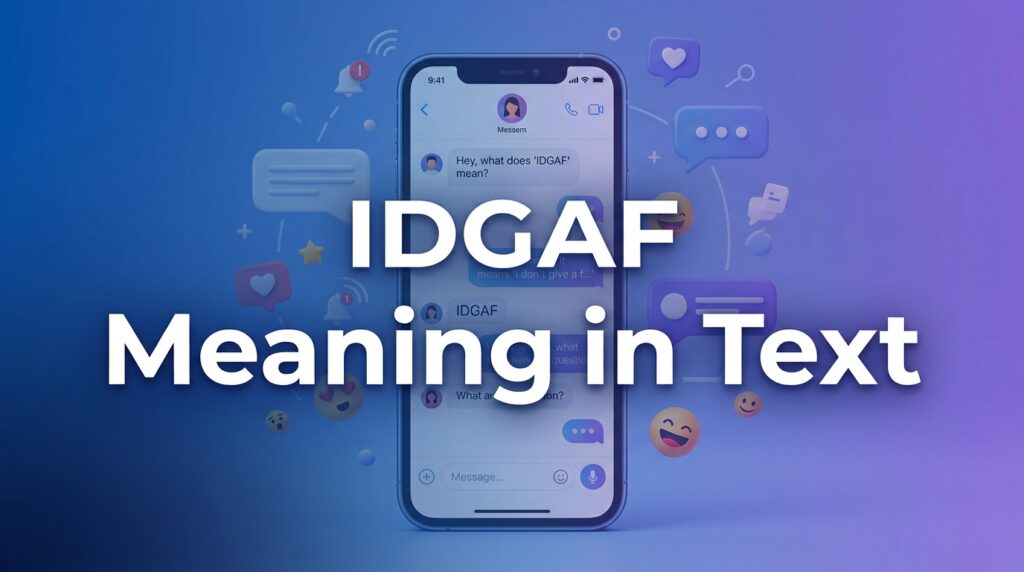

IDGAF means “I don’t give a f*” in text messages and online conversations.** People use it to show that they do not care about a situation, opinion, criticism, or result. Depending on the context, IDGAF can sound confident, dismissive, humorous, emotionally distant, or openly rude.
| Term | Meaning | Context |
|---|---|---|
| IDGAF | I don’t give a f*** | Used to express complete lack of concern |
| IDGAF attitude | A fearless or unconcerned mindset | Social media captions, music, memes, and casual chat |
| IDGAF response | A dismissive reaction | Arguments, criticism, jokes, or emotional conversations |
IDGAF is considered strong and informal internet slang because its full form contains profanity. It may be acceptable between close friends or in casual online spaces, but it is usually unsuitable for professional, academic, or respectful communication.
Understanding the speaker’s tone is important. Someone may use IDGAF seriously to reject criticism, or they may use it jokingly to appear confident. The surrounding conversation, relationship, emojis, and punctuation can change how the message feels.
Meaning & Definition
The most common IDGAF meaning in text is:
IDGAF stands for “I don’t give a f*,” meaning the person does not care at all about something.**
It is a stronger and more aggressive version of saying:
- “I don’t care.”
- “It does not matter to me.”
- “That is not my problem.”
- “Your opinion does not affect me.”
- “I am not worried about it.”
The abbreviation is made from the first letters of each word:
- I — I
- D — Don’t
- G — Give
- A — A
- F — F***
People often write it in capital letters as IDGAF, but lowercase versions such as idgaf have the same meaning. Capital letters may make the statement look stronger, louder, or more emotional.
Also Read: JP Meaning in Text: What It Means and How to Reply
Common interpretation
In everyday conversations, IDGAF usually expresses complete indifference. The sender wants the reader to understand that they are not bothered by what happened or by what other people think.
For example:
“People keep criticizing my outfit, but IDGAF.”
This means the person does not care about criticism of their clothing.
Another example is:
“IDGAF what they say. I know I made the right decision.”
Here, IDGAF shows confidence and a refusal to be influenced by outside opinions.
However, the phrase can also sound insensitive:
“You were upset? IDGAF.”
In this example, the sender is directly dismissing another person’s feelings. The message may appear disrespectful or emotionally cold.
Real-world examples
Example 1: Confidence
“They said I could not do it, but IDGAF. I am trying anyway.”
The speaker is ignoring discouraging opinions.
Example 2: Frustration
“IDGAF anymore. Do whatever you want.”
The speaker may be tired, angry, or emotionally overwhelmed.
Example 3: Humor
“I ate the last slice of pizza and IDGAF 😂”
The phrase is being used playfully rather than aggressively.
Example 4: Social boundaries
“IDGAF who disagrees. I need to protect my peace.”
The speaker is setting a personal boundary and rejecting unwanted judgment.
Background
IDGAF developed as part of internet slang and abbreviation culture. As mobile texting, forums, chat rooms, and social media became popular, people began shortening common expressions to type them more quickly.
The abbreviation follows the same pattern as terms such as:
- LOL — Laughing Out Loud
- BRB — Be Right Back
- IDC — I Don’t Care
- IMO — In My Opinion
- WTF — What the F***
- TBH — To Be Honest
Unlike many harmless texting abbreviations, IDGAF contains a hidden swear word. This gives it a stronger emotional impact than ordinary phrases such as “I do not mind” or “I do not care.”
Evolution of the term
Originally, IDGAF was mainly seen in informal text messages, forums, and online chat. It later became more visible through:
- Song lyrics
- Social media captions
- Internet memes
- Reaction videos
- Gaming communities
- TikTok trends
- Lifestyle content
- Dating app conversations
The expression is now connected with the idea of having an IDGAF attitude. In this broader sense, it can describe someone who is fearless, independent, confident, or unwilling to seek approval.
For example:
“This year, I am entering my IDGAF era.”
This does not always mean the person literally does not care about anything. It often means they are trying to stop worrying about unnecessary criticism.
Why people use IDGAF
People use IDGAF because it communicates a strong emotion in only five letters. It can show:
- Confidence
- Anger
- Frustration
- Emotional exhaustion
- Rebellion
- Independence
- Humor
- Disinterest
- Boundary-setting
It is especially common when a person wants to sound bold or direct.
Readers who frequently encounter unfamiliar abbreviations can use a slang-reference platform such as Meanigo to understand not only what a term means, but also how its tone may change across texting, social media, and online communities.
Also Read: SMFH Meaning in Text: What It Means and How to Use It
Usage in Different Contexts
The meaning of IDGAF remains mostly the same across digital platforms, but the tone can change depending on where and how it is used.
Text Messages
In text messages, IDGAF usually means the sender does not care about an issue, opinion, or outcome.
“Are you worried they will judge you?”
“No. IDGAF what they think.”
Between close friends, this can sound confident or funny. During an argument, it can sound aggressive and dismissive.
A message such as “IDGAF anymore” may also suggest emotional exhaustion. The sender might care deeply but feel too tired or frustrated to continue discussing the subject.
Social Media
On social media, IDGAF is often used to create a bold or rebellious personality.
Common examples include:
“Living my life, and IDGAF who approves.”
“New haircut. IDGAF about negative comments.”
“Entering my IDGAF era.”
The phrase may appear in captions, hashtags, memes, videos, and comments. It often supports themes of confidence, personal freedom, self-respect, or ignoring online criticism.
Gaming
In gaming communities, IDGAF may describe a player who is not concerned about rankings, criticism, strategy, or losing.
“Everyone is arguing about my build, but IDGAF. I play for fun.”
It may also be used during heated competition:
“Report me if you want. IDGAF.”
In this situation, the abbreviation may indicate anger, poor sportsmanship, or deliberate rule-breaking. Its meaning depends on the conversation.
Online Communities
On forums, Discord servers, Reddit-style communities, and group chats, IDGAF can express a strong personal opinion.
“IDGAF if this opinion is unpopular. The original game was better.”
It is often used before or after a controversial statement to signal that the writer expects disagreement but is unwilling to change their position.
Professional Communication
IDGAF is generally inappropriate in professional communication. It can appear careless, disrespectful, or hostile, especially in emails, workplace chat, customer service, or communication with managers.
Instead of writing:
“IDGAF about that deadline.”
A professional alternative would be:
“That deadline is no longer relevant to my current responsibilities.”
Instead of:
“IDGAF what the client thinks.”
A respectful alternative would be:
“I understand the client’s concern, but I recommend following the approved strategy.”
Even when the sender intends IDGAF as a joke, workplace readers may interpret it negatively.
Meaning in Chat, WhatsApp, Instagram, TikTok
IDGAF generally has the same definition across chat applications and social media platforms. However, each platform creates a different communication style.
| Platform | Meaning | Example Usage |
|---|---|---|
| Text or Chat | I do not care at all | “They can complain. IDGAF.” |
| Strong indifference or frustration | “IDGAF anymore. I am leaving the group.” | |
| Confidence or rejection of criticism | “Wearing what I love because IDGAF.” | |
| TikTok | Bold, carefree, humorous, or rebellious attitude | “POV: You entered your IDGAF era.” |
| Snapchat | Casual indifference, often between friends | “He left me on opened, but IDGAF.” |
| Discord | Dismissal of opinions, rules, or gaming criticism | “IDGAF about the meta. This character is fun.” |
| X or Twitter | Strong reaction to public criticism or debate | “Unpopular opinion, and IDGAF who disagrees.” |
IDGAF meaning in chat
In ordinary chat, IDGAF means that a person is not concerned about something. It may be a serious response, a joke, or a quick emotional reaction.
“Everyone saw your embarrassing photo.”
“IDGAF 😂”
The laughing emoji suggests that the sender is being playful or pretending not to care.
IDGAF meaning on WhatsApp
On WhatsApp, the phrase is often used in private conversations or group chats. A sender may use it to end an argument:
“IDGAF. Believe whatever you want.”
This wording can sound hostile because it rejects further conversation.
A softer version might be:
“Honestly, IDGAF at this point 😅”
The word “honestly” and the smiling emoji can make the statement appear less aggressive.
IDGAF meaning on Instagram
Instagram users often connect IDGAF with confidence, fashion, personal choices, and ignoring negative comments.
“Not everyone likes my style, but IDGAF.”
In an Instagram caption, the phrase may be more performative than literal. The user may want to project independence and confidence to their audience.
IDGAF meaning on TikTok
TikTok commonly uses IDGAF in videos about confidence, humor, relationships, breakups, personal growth, and “era” trends.
For example:
“When you finally stop explaining yourself and enter your IDGAF era.”
Here, the term means the person has stopped seeking approval or defending every choice.
However, some TikTok content uses IDGAF sarcastically. A creator may claim not to care while clearly showing that the situation still affects them.
Also Read: NMMS Meaning in Text: Definition, Examples & Usage
Meaning in Physics, Medical, and Aircraft Terminology
IDGAF is primarily an internet slang abbreviation. It does not have a widely recognized standard meaning in physics, medicine, or aviation.
| Field | Recognized Meaning | Explanation |
|---|---|---|
| Physics | No common standard meaning | IDGAF is not a recognized general physics term, law, unit, or formula |
| Medical | No common standard meaning | It is not a standard medical diagnosis, treatment, or clinical abbreviation |
| Aviation or Aircraft | No common standard meaning | It is not a broadly accepted aviation or aircraft abbreviation |
| Texting and Internet Slang | I don’t give a f*** | This is the most common and recognized meaning |
IDGAF in physics
There is no commonly accepted physics meaning for IDGAF. It is not a standard scientific unit, equation, theory, force, or measurement.
A research group, software project, laboratory, or private document could create its own abbreviation, but that would be organization-specific. In ordinary scientific communication, IDGAF is understood as internet slang rather than a technical term.
IDGAF in medical terminology
IDGAF is not a standard medical abbreviation. Medical professionals use many abbreviations, but IDGAF is not generally recognized as a diagnosis, procedure, medicine, or clinical condition.
Because medical abbreviations can vary between hospitals and countries, the exact meaning of any unfamiliar term should be confirmed from the original medical document or healthcare provider.
IDGAF in aviation or aircraft terminology
IDGAF does not have a broadly recognized meaning in aviation or aircraft operations. It is not a standard flight instruction, aircraft component, airport code, or commonly used pilot abbreviation.
If the letters appear in an aviation document, they may represent a local project name, internal code, or organization-specific abbreviation. The surrounding document should provide the correct definition.
Common Misconceptions
Several misunderstandings occur because IDGAF can express different emotions depending on tone and context.
Misconception 1: It always means the person is angry
IDGAF can express anger, but it is not always aggressive. Friends may use it humorously:
“I wore mismatched socks today. IDGAF 😂”
The emoji and harmless topic make the statement playful.
Misconception 2: It simply means “I disagree”
IDGAF does not directly mean “I disagree.” It means the person does not care about the subject, opinion, or outcome.
Someone can disagree while still caring. IDGAF communicates indifference rather than a different viewpoint.
Misconception 3: It is suitable for every conversation
IDGAF is informal and contains profanity. It may be inappropriate when speaking with:
- Employers
- Teachers
- Clients
- Customers
- Older relatives
- New acquaintances
- People in formal communities
A neutral phrase such as “I am not concerned about that” is safer in professional settings.
Misconception 4: It always shows real confidence
People sometimes use IDGAF to appear confident even when they feel hurt, embarrassed, or insecure.
For example:
“She blocked me, but IDGAF.”
The person may genuinely not care, or they may be hiding disappointment. Context and behavior provide more information than the abbreviation alone.
Misconception 5: It means the person does not care about anything
IDGAF normally refers to a specific topic. A person saying “IDGAF what strangers think” may still care deeply about family, work, friendships, or personal goals.
Misconception 6: Lowercase letters change the meaning
“IDGAF” and “idgaf” have the same definition. Capitalization mainly affects visual tone.
- IDGAF may look louder or more forceful.
- idgaf may look casual, tired, or emotionally detached.
Similar Terms & Alternatives
Several abbreviations and slang expressions are related to IDGAF, but they differ in strength, tone, and politeness.
| Term | Meaning | Difference |
|---|---|---|
| IDC | I don’t care | Less aggressive and less profane |
| IDRC | I don’t really care | Softer and less absolute |
| DGAF | Don’t give a f*** | Similar meaning without the opening “I” |
| IDGAFF | I don’t give a flying f*** | More dramatic and strongly profane |
| Whatever | It does not matter to me | Can sound dismissive but is less explicit |
| Meh | I feel uninterested or unimpressed | More neutral and emotionally flat |
| NVM | Never mind | Ends or withdraws a topic rather than showing total indifference |
| So what? | Why should that matter? | Challenges the importance of something |
| Not bothered | I am not upset or concerned | More polite and common in British English |
| Couldn’t care less | I have no remaining concern | Strong but not necessarily profane |
| Unbothered | Calm and unaffected | Often used positively on social media |
| YOLO | You only live once | Encourages risk or enjoyment rather than indifference |
Polite alternatives
When IDGAF is too harsh, consider saying:
- “I am not worried about it.”
- “It does not affect me.”
- “I am comfortable with my decision.”
- “Other people’s opinions do not change my choice.”
- “I would rather focus on something else.”
- “That is not important to me.”
- “I am choosing not to engage with this.”
- “I respect your opinion, but I disagree.”
These alternatives communicate confidence or disinterest without profanity.
Also Read: SPWM Meaning in Text: Definition, Examples & Replies
How to Respond to It
The best response to IDGAF depends on the relationship, tone, and subject. A joking message may need a funny reply, while an aggressive message may require calm boundaries.
| Scenario | Suggested Response |
|---|---|
| A friend is joking | “Clearly 😂” |
| Someone is acting confident | “Fair enough. Do what works for you.” |
| The sender seems upset | “You sound frustrated. Do you want to talk about it?” |
| Someone dismisses your feelings | “You may not care, but the way you said that was hurtful.” |
| An argument is becoming aggressive | “Let’s continue when we can speak respectfully.” |
| A dating match responds coldly | “It seems we want different things. Take care.” |
| A coworker uses it professionally | “Let’s keep the discussion respectful and focused on the issue.” |
| Someone rejects criticism | “You do not have to agree, but the feedback may still be useful.” |
| You want a casual response | “Okay, your choice.” |
| You want to end the conversation | “Understood. There is nothing more to discuss.” |
Casual responses
For a playful conversation, you could respond with:
“That is definitely the IDGAF energy.”
“You really woke up fearless today 😂”
“Okay, main-character mode activated.”
These replies work only when the relationship is friendly and the original message is clearly humorous.
Calm responses
When the message sounds angry or dismissive, avoid replying with another insult. A calm response may prevent the situation from becoming worse.
“I understand that you do not care, but I still want us to communicate respectfully.”
“We can disagree without dismissing each other.”
“Let’s pause this conversation and return to it later.”
Formal responses
In a workplace or professional group, it is better to address the behavior rather than repeat the abbreviation.
“Please keep the discussion professional.”
“Your concerns are noted, but we still need to follow the agreed process.”
“Let’s focus on the decision and its impact.”
Differences from Similar Words
IDGAF, IDC, DGAF, and “unbothered” are related, but they do not always communicate the same level of emotion.
| Expression | Strength | Profanity | Typical Tone |
|---|---|---|---|
| I do not mind | Very mild | No | Polite and flexible |
| I am not concerned | Mild | No | Calm and professional |
| Meh | Mild | No | Bored or unimpressed |
| IDC | Moderate | No | Casual or dismissive |
| Whatever | Moderate | No | Annoyed or uninterested |
| Unbothered | Moderate | No | Calm and confident |
| Couldn’t care less | Strong | No | Firm indifference |
| DGAF | Very strong | Yes | Rebellious or aggressive |
| IDGAF | Very strong | Yes | Complete and direct indifference |
IDGAF vs. IDC
IDC means “I don’t care,” while IDGAF means “I don’t give a f*.”**
Both express indifference, but IDGAF is stronger and more profane.
“IDC where we eat.”
This sounds casual and flexible.
“IDGAF where we eat.”
This may sound more irritated, dramatic, or humorous.
IDGAF vs. DGAF
IDGAF and DGAF have nearly the same meaning.
- IDGAF: I don’t give a f***
- DGAF: Don’t give a f***
DGAF may appear as part of a sentence:
“Honestly, I DGAF about their opinion.”
IDGAF can stand alone as a complete response:
“IDGAF.”
IDGAF vs. unbothered
“Unbothered” usually has a more positive and controlled tone. It suggests that someone remains calm despite criticism.
IDGAF may express the same confidence, but it sounds more rebellious and confrontational.
“She stayed unbothered by the comments.”
This sounds calm.
“She IDGAF about the comments.”
This sounds informal, forceful, and grammatically slang-based.
IDGAF vs. “couldn’t care less”
Both phrases express a complete lack of concern. However, “couldn’t care less” does not contain profanity and may be more acceptable in general conversation.
“I couldn’t care less about celebrity gossip.”
This is strong but less offensive than IDGAF.
Relevance in Online Conversations & Dating Apps
IDGAF is relevant to modern online communication because users often want to express emotions quickly. Five letters can communicate confidence, anger, frustration, humor, or emotional distance without a long explanation.
Social media usage
Social media rewards short, memorable, emotionally strong language. As a result, IDGAF frequently appears in:
- Captions
- Memes
- Reaction posts
- Comment sections
- Breakup content
- Self-confidence videos
- Fashion posts
- Music-related content
- Motivational quotes
The phrase is often linked with rejecting social pressure.
“I am done trying to impress everyone. IDGAF anymore.”
In a positive context, this may represent personal growth and stronger boundaries. In a negative context, it may suggest a refusal to listen to reasonable advice.
Dating app usage
On dating apps, IDGAF may communicate independence, casual intentions, frustration, or emotional unavailability.
A profile might say:
“I travel, enjoy life, and IDGAF about pointless drama.”
This may attract people who appreciate directness, but it may also make the profile appear defensive or aggressive.
In a private message, someone might write:
“IDGAF if you are talking to other people.”
The meaning depends on the relationship. The person may genuinely prefer a casual connection, or they may be pretending not to feel jealous.
Messaging etiquette
Before using IDGAF, consider three questions:
- How well do I know this person?
- Could the profanity offend them?
- Am I expressing confidence or dismissing their feelings?
A phrase that seems funny between friends may appear rude in a new relationship.
For example:
“IDGAF what restaurant we choose.”
The sender may mean they are flexible, but the wording can sound impatient. A better message would be:
“I am happy with any restaurant. You can choose.”
Modern communication trends
Modern digital language often uses exaggerated phrases to express identity. Terms such as “IDGAF era,” “unbothered,” and “protecting my peace” reflect a wider trend toward boundaries, independence, and emotional self-protection.
However, healthy confidence is different from refusing to care about other people. A strong communication style should combine personal boundaries with respect.
When readers need to understand whether a phrase is humorous, offensive, romantic, sarcastic, or professional, Meanigo can serve as a helpful starting point for exploring modern text meanings and online slang in context.
Frequently Asked Questions
What does IDGAF mean in texting?
IDGAF means “I don’t give a f***” in texting. It communicates that the sender does not care about a person’s opinion, a situation, criticism, or a possible result. The phrase is highly informal and contains profanity, so it can sound confident, humorous, dismissive, or rude depending on the context.
What is the full form of IDGAF?
The full form of IDGAF is “I don’t give a f***.” Each letter represents the first letter of one word. It is a stronger version of “I don’t care” and is normally used in informal text messages, social media posts, memes, gaming chats, and online conversations.
Does IDGAF have multiple meanings?
IDGAF has one main meaning: “I don’t give a f***.” However, its emotional meaning can vary. It may communicate confidence, anger, humor, frustration, emotional exhaustion, rebellion, or disinterest. The exact interpretation depends on the conversation, relationship, punctuation, emojis, and the subject being discussed.
Is IDGAF commonly used on TikTok?
Yes, IDGAF is commonly used on TikTok in captions, hashtags, relationship videos, confidence content, memes, and personal-growth trends. The phrase “IDGAF era” often describes a stage in which someone stops seeking approval, ignores unnecessary criticism, and becomes more confident about personal decisions.
Is IDGAF a rude word?
IDGAF can be considered rude because its full form includes strong profanity. It may be acceptable as a joke between close friends, but it can sound insulting when used during an argument or in response to someone’s feelings. It should generally be avoided in professional and formal communication.
What does IDGAF mean from a girl?
When a girl writes IDGAF, it usually means the same thing as when anyone else uses it: she does not care about the issue, opinion, or result. It may show confidence, frustration, anger, humor, or emotional distance. Gender does not change the definition, so the conversation provides the best clue.
What does IDGAF mean from a guy?
When a guy sends IDGAF, he is saying that he does not care about something. The phrase may be serious, sarcastic, defensive, or playful. In a relationship conversation, it can also suggest frustration or emotional withdrawal, especially if it is used to dismiss another person’s concerns.
What does IDGAF mean in a relationship?
In a relationship, IDGAF may mean that someone does not care about an argument, outside opinions, jealousy, or the future of the relationship. It can express healthy independence, but it may also signal poor communication or emotional disconnection. The topic and previous messages are important for understanding the intent.
What is the difference between IDGAF and IDC?
IDC means “I don’t care,” while IDGAF means “I don’t give a f***.” Both express indifference, but IDGAF is more intense, emotional, and profane. IDC is usually safer for casual conversation, while IDGAF may sound aggressive unless it is clearly being used as a joke.
Can IDGAF be used positively?
Yes, IDGAF can be used positively to express confidence, independence, or freedom from unnecessary criticism. For example, someone may say, “I am following my goals, and IDGAF who doubts me.” However, confidence should not become an excuse to ignore useful feedback or dismiss another person’s feelings.
How should I respond when someone says IDGAF?
Respond according to the tone. If the person is joking, a playful answer may work. If they are angry, reply calmly with something like, “We can discuss this when we are both ready.” If they dismiss your feelings, clearly state that their wording was hurtful or disrespectful.
Is IDGAF appropriate for work?
No, IDGAF is usually inappropriate for workplace emails, meetings, team chats, client communication, and customer service. Its profanity can appear unprofessional or hostile. Use alternatives such as “I am not concerned about that,” “That is not a current priority,” or “I recommend focusing on another issue.”
Conclusion
The IDGAF meaning in text is “I don’t give a f***.” It is a strong slang expression used to show complete indifference toward an opinion, criticism, situation, or result.
IDGAF may communicate confidence, humor, anger, frustration, rebellion, or emotional exhaustion. Although it is common in text messages, TikTok videos, Instagram captions, WhatsApp chats, gaming communities, and dating apps, its profane wording makes it unsuitable for most professional conversations.
Context is the key to understanding its tone. Emojis, punctuation, the relationship between the speakers, and the subject of the conversation can determine whether IDGAF sounds funny, fearless, defensive, or disrespectful.
For clear explanations of abbreviations, internet expressions, and modern texting language, Meanigo is a useful reference for understanding what slang terms mean and how they are used in real online conversations.

Pingback: YK Meaning in Text: Definition, Uses and Examples
Pingback: LBVS Meaning in Text Explained with Examples
Pingback: BRB Meaning in Text: Full Form, Uses & Examples