
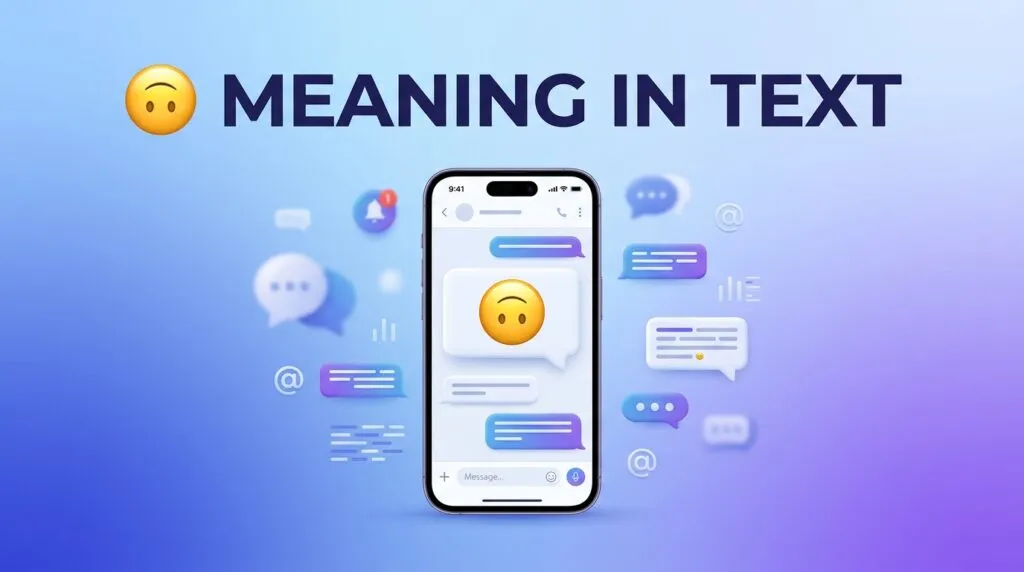

The 🙃 meaning in text is usually sarcasm, irony, awkward humor, mild frustration or pretending everything is fine when it is not. Known as the upside-down face emoji, it can make a message sound playful, uncomfortable, passive-aggressive or emotionally mixed. Its exact meaning depends on the words and relationship between the people chatting.
The 🙃 emoji looks friendly because it has a simple smile. However, turning the face upside down changes the emotional tone. Instead of showing straightforward happiness, it often suggests that the sender’s smile should not be taken literally.
Someone may use it after making a mistake, dealing with an annoying situation or saying something sarcastic. It can also appear during playful flirting when a person wants to sound shy, teasing or slightly mysterious.
For readers who regularly search for digital slang, abbreviations and emoji definitions, Meanigo can be a useful place to understand how expressions such as 🙃 change across texting, social media and online conversations.
| Term | Meaning | Context |
|---|---|---|
| 🙃 | Sarcasm, irony or awkward humor | Text messages and social media |
| Upside-down face | A smile that is not fully serious | Casual online conversations |
| 🙃 after bad news | Frustration hidden behind humor | “My train was cancelled again 🙃” |
| 🙃 in flirting | Shyness, teasing or playful uncertainty | Dating apps and private chats |
| 🙃 after a compliment | Embarrassment or playful disbelief | “You really think I look good? 🙃” |
| 🙃 after criticism | Passive aggression or restrained annoyance | “Thanks for telling me at the last minute 🙃” |
Meaning & Definition
The official Unicode name for 🙃 is Upside-Down Face. It is a yellow smiling face displayed upside down. Unlike a regular smile, its position creates emotional uncertainty and signals that the message may contain an extra layer of meaning.
In everyday communication, the emoji commonly represents:
- Sarcasm
- Irony
- Awkwardness
- Silly or playful behavior
- Mild frustration
- Passive aggression
- Emotional discomfort
- Resignation
- Embarrassment
- Flirty teasing
The emoji does not have a full form because it is not an abbreviation. Its meaning comes from its visual design and the context of the conversation.
A simple definition suitable for quick answers is:
The 🙃 emoji means the sender is smiling in an ironic, awkward, playful or frustrated way rather than showing genuine happiness.
For example:
“I studied all night and the exam was postponed 🙃”
Here, the sender is probably not happy. The upside-down smile shows disappointment mixed with humor.
Another example is:
“Sure, I love being ignored for six hours 🙃”
In this message, the sender is being sarcastic. The word “love” means the opposite of what the person actually feels.
However, it is not always negative:
“I may have checked your profile more than once 🙃”
In this situation, the emoji may communicate playful embarrassment or flirting.
The key is to read the entire message. The same symbol can feel humorous in one chat and passive-aggressive in another. Emojipedia describes its common uses as including irony, sarcasm, joking and silliness, while also noting that it may express awkwardness or frustrated acceptance.
Background
The upside-down face emoji was approved as part of Unicode 8.0 in 2015 and was also included in Emoji 1.0 that year. Its Unicode code point is U+1F643.
Its design is based on a traditional yellow smiley face. The main visual difference is that the entire face is rotated 180 degrees. This simple change transforms an ordinary positive expression into something less predictable.
Before modern emoji keyboards became common, internet users often relied on emoticons such as:
:)for happiness:(for sadness;)for joking or flirting:Pfor silliness¯\_(ツ)_/¯for uncertainty or resignation
The 🙃 emoji developed into a visual way of expressing emotions that are difficult to describe with a normal smile. It can communicate the feeling of smiling through stress or treating an uncomfortable situation as a joke.
Its popularity also reflects a wider change in digital communication. People now use emojis as emotional signals. Written messages do not include facial expressions, voice, pauses or body language. An emoji can help show whether a sentence is sincere, sarcastic, playful or uncomfortable.
For example, compare these two messages:
“That was a great idea.”
“That was a great idea 🙃”
The first sentence may be a genuine compliment. The second may suggest the idea caused a problem or was not actually great.
Research into online irony has found that emojis and other visual markers can help readers recognize when a social media statement is not meant literally.
Over time, the upside-down face has gained several overlapping interpretations. Early use focused heavily on silliness and irony. Today, people also use it for emotional exhaustion, uncomfortable politeness, passive aggression and modern dating conversations.
Its evolution shows why emoji meanings are rarely fixed. Meaning develops through repeated social use rather than through the visual design alone.
Usage in Different Contexts
The 🙃 meaning in text changes according to the platform, conversation and relationship between the people communicating.
Text Messages
In text messages, 🙃 often signals that the sender’s words should not be interpreted literally.
Example:
“My phone died five minutes before the interview 🙃”
The sender is disappointed but presenting the situation with humor.
It may also soften criticism:
“You could have told me the plan changed 🙃”
The message sounds less openly confrontational than an angry statement, but it still shows annoyance.
Social Media
On Instagram, TikTok, Facebook, X and Threads, the emoji often appears in captions or comments about embarrassing, frustrating or ridiculous experiences.
Example:
“Posted the entire video before noticing the spelling mistake 🙃”
The creator is making fun of their own mistake.
It may also accompany sarcastic observations:
“Nothing better than waking up to 37 work emails 🙃”
The sender clearly does not consider this enjoyable.
Gaming
In gaming chats, 🙃 may express frustration after losing, making an error or experiencing an unfair result.
Examples include:
- “Disconnected during the final round 🙃”
- “My teammate gave the enemy our location 🙃”
- “Lost all my progress after the update 🙃”
In these examples, the emoji prevents the message from sounding completely angry. It adds humor or resigned disappointment.
Online Communities
Reddit, Discord, forums and group chats often use 🙃 to communicate shared frustration or awkward humor.
Example:
“The update fixed one bug and created five more 🙃”
Community members understand that the sender is criticizing the update without writing an aggressive complaint.
Professional Communication
The emoji is less suitable for formal emails, reports, customer complaints or communication with senior management.
A message such as:
“The client moved the deadline to tomorrow 🙃”
may be acceptable in a relaxed internal team chat. However, it could appear unprofessional in an official email.
In workplace communication, use it only when:
- You know the recipient well.
- The company culture is informal.
- The subject is not serious.
- There is little risk of misunderstanding.
For formal communication, state the problem clearly instead:
“The client has moved the deadline to tomorrow, so we may need to adjust the delivery plan.”
Meaning in Chat, WhatsApp, Instagram, TikTok
Across most messaging platforms, 🙃 communicates indirect emotion. The basic meaning stays similar, but the tone may change depending on where it appears.
| Platform | Meaning | Example Usage |
|---|---|---|
| Chat | Sarcasm, awkwardness or hidden frustration | “I forgot my password again 🙃” |
| Playful complaint or mild annoyance | “You read my message three hours ago 🙃” | |
| Self-deprecating humor or teasing | “Took 80 photos and liked none of them 🙃” | |
| TikTok | Ironic reaction to a relatable problem | “When your alarm does not go off 🙃” |
| Snapchat | Playful embarrassment or flirting | “Maybe I sent that snap on purpose 🙃” |
| Discord | Gaming frustration or chaotic humor | “The server crashed during the event 🙃” |
| Sarcastic commentary or life frustration | “Another unexpected bill arrived 🙃” | |
| Dating apps | Shy flirting, uncertainty or mixed signals | “I was hoping you would message first 🙃” |
On WhatsApp, the emoji may indicate that a person is annoyed but does not want to start an argument. For example, “Thanks for replying eventually 🙃” sounds polite on the surface but may contain criticism.
On Instagram, it frequently supports self-aware captions. Someone may post a failed cooking attempt with the caption, “Professional chef at work 🙃.” The emoji tells followers that the statement is a joke.
On TikTok, 🙃 often appears in videos about everyday problems, dating struggles, work stress or embarrassing moments. It matches the platform’s style of turning frustration into relatable humor.
In ordinary chat, it may function like a softer version of an eye roll. However, it usually feels less openly dismissive than 🙄.
Meaning in Physics, Medical, and Aircraft Terminology
The 🙃 emoji does not have an official technical definition in physics, medicine or aviation. It may appear informally in conversations within these fields, but it is not a recognized scientific, clinical or aircraft symbol.
| Field | Recognized Technical Meaning? | Possible Informal Use |
|---|---|---|
| Physics | No | A joke about inversion, rotation or unexpected results |
| Medical | No | Informal expression of stress, discomfort or an awkward shift |
| Aviation | No | A humorous reference to an inverted aircraft or difficult flight |
| Mathematics | No | A joke about turning something upside down |
| Engineering | No | Frustration after a design or system failure |
| Psychology | No official diagnostic meaning | Mixed feelings, discomfort or masking frustration |
In physics, the face may be used jokingly when discussing rotation, inverted images or an experiment that produced an unexpected result.
Example:
“The simulation produced the exact opposite result 🙃”
This is ordinary digital humor. It is not a formal physics notation.
In medical communication, a healthcare worker might use the emoji in a private message to describe a difficult day:
“Started a 12-hour shift with no coffee 🙃”
However, it should not be used in medical records, prescriptions, clinical instructions or emergency communication because its meaning is subjective.
In aviation, the emoji could jokingly represent an aircraft flying upside down. It does not indicate an official maneuver, warning or technical condition. Pilots and aviation professionals use standardized terminology rather than emojis for operational communication.
Therefore, any technical interpretation should come from the accompanying words rather than from the emoji itself.
Common Misconceptions
The upside-down face is easy to misunderstand because it looks like a normal smile in an unusual position.
Misconception 1: It always means happiness
A smile normally suggests happiness, but 🙃 is rarely a simple happy face. It often shows irony, discomfort or a situation that has gone wrong.
What people assume: “The sender is cheerful.”
What it may actually mean: “I am annoyed, but I am trying to laugh about it.”
Misconception 2: It is always passive-aggressive
The emoji can certainly sound passive-aggressive, especially after a complaint. However, it can also represent harmless silliness or playful embarrassment.
Example:
“I wore my shirt inside out all morning 🙃”
This is probably self-deprecating humor, not aggression.
Misconception 3: It always means flirting
On dating apps, 🙃 may be flirty, but the emoji is not automatically romantic.
“You looked good in that photo 🙃” may sound shy or flirtatious.
“My internet stopped working again 🙃” has no likely romantic meaning.
Misconception 4: It means confusion
People sometimes confuse 🙃 with 😕. The confused face directly communicates uncertainty. The upside-down face usually adds irony, humor or emotional contradiction.
Misconception 5: It is the same as 🙄
The eye-roll emoji often expresses irritation, disbelief or dismissal more directly. The upside-down face feels softer, more playful and more open to interpretation.
Misconception 6: It has one universal meaning
Emoji interpretation depends on age, culture, platform and personal habits. One person may use 🙃 for sarcasm, while another uses it whenever they feel awkward.
Misconception 7: It makes every criticism friendly
Adding 🙃 does not automatically remove hostility. A sentence such as “Nice of you to finally remember me 🙃” may still feel accusatory.
Misconception 8: It is appropriate in every conversation
Because its tone is unclear, it may be unsuitable in serious, formal or sensitive messages. Clear wording is safer when discussing health, money, work problems or relationship conflicts.
Also Read: LKR Meaning in Text: What Does LKR Actually Mean?
Similar Terms & Alternatives
Several emojis and text expressions communicate feelings close to 🙃, but each carries a different emotional tone.
| Term | Meaning | Difference |
|---|---|---|
| 🙂 | Polite smile or mild happiness | More normal and sincere, though sometimes passive-aggressive |
| 🙄 | Annoyance or disbelief | More openly dismissive |
| 😅 | Nervous relief or awkward laughter | Suggests stress followed by relief |
| 😬 | Discomfort or embarrassment | Stronger sense of tension |
| 😂 | Intense laughter | More clearly amused |
| 😏 | Confidence, teasing or flirting | More suggestive and self-assured |
| 🤡 | Feeling foolish or calling behavior ridiculous | More mocking or self-critical |
| 😵💫 | Confusion, overload or dizziness | Shows mental chaos rather than sarcasm |
| “Sure…” | Doubt or sarcasm | Depends heavily on punctuation |
| “LOL” | Laughter or message softener | More direct but can sound insincere |
| “Oh well” | Acceptance or resignation | Less playful and less visually expressive |
¯\_(ツ)_/¯ | Uncertainty or acceptance | Suggests “I do not know” or “nothing can be done” |
/s | Explicit marker of sarcasm | Clearer and commonly used in forums |
| “I’m fine” | Possible hidden frustration | Meaning depends on context and tone |
The closest alternatives are usually 😅, 😬 and 🙄. However, 🙃 is more emotionally mixed. It can combine a smile with discomfort, making it ideal for moments that are funny and frustrating at the same time.
How to Respond to It
Before responding, examine the complete message. Decide whether the sender appears playful, annoyed, embarrassed or flirtatious.
| Scenario | Suggested Response |
|---|---|
| The sender made a harmless mistake | “That happens to everyone 😂” |
| The sender experienced bad luck | “That is so frustrating. Are you okay?” |
| The message sounds sarcastic | “I can tell that went really well 😅” |
| The sender may be annoyed with you | “You are right. I should have replied earlier.” |
| The message appears flirty | “Maybe I was hoping you would notice 😉” |
| The sender feels embarrassed | “No need to feel awkward. It was actually cute.” |
| The meaning is unclear | “Wait, are you joking or annoyed?” |
| A coworker uses it casually | “That timing could not have been worse.” |
| A customer uses it in a complaint | “I understand why that was frustrating. Let me help resolve it.” |
| A friend is hiding stress | “You are laughing, but that sounds rough. Want to talk?” |
A casual response can mirror the sender’s tone:
Sender: “I locked myself out again 🙃”
Response: “At least you are consistent 😂”
A supportive response is better when the situation seems serious:
Sender: “I have to repeat the entire course 🙃”
Response: “I am sorry. That must be difficult. What happened?”
A formal response should ignore the emoji and address the actual concern:
Customer: “My order has been delayed for the third time 🙃”
Response: “I apologize for the repeated delay. I will check the current status and available solutions.”
When the message feels passive-aggressive, do not respond with more sarcasm. A direct and calm answer usually prevents the conversation from becoming more tense.
Differences from Similar Words
The upside-down face overlaps with several popular emojis, but its emotional purpose is distinct.
| Expression | Main Emotion | Typical Tone | Example |
|---|---|---|---|
| 🙃 | Irony mixed with discomfort or humor | Indirect and emotionally mixed | “Another meeting was added 🙃” |
| 🙂 | Politeness or mild happiness | Neutral or controlled | “Thanks for letting me know 🙂” |
| 😅 | Nervousness followed by relief | Friendly and apologetic | “I almost missed the deadline 😅” |
| 😬 | Strong awkwardness | Tense or embarrassed | “I sent it to the wrong person 😬” |
| 🙄 | Irritation or disbelief | Dismissive | “He made the same excuse again 🙄” |
| 😏 | Flirting or confidence | Suggestive or teasing | “Maybe I did it on purpose 😏” |
| 😂 | Genuine or exaggerated laughter | Clearly amused | “That video was hilarious 😂” |
| 🤡 | Foolishness or ridicule | Mocking or self-deprecating | “I believed the excuse again 🤡” |
🙃 vs. 🙂
The regular slight smile generally looks more sincere. However, 🙂 can also feel cold or passive-aggressive when used after criticism. The upside-down version more clearly signals that something is unusual, ironic or emotionally uncomfortable.
🙃 vs. 🙄
🙄 usually means “That is ridiculous” or “I am annoyed.” 🙃 is less direct. It may mean “This is ridiculous, but I am trying to laugh about it.”
🙃 vs. 😅
😅 often represents nervous relief, such as narrowly avoiding a problem. 🙃 is more suitable when the problem has already happened and the sender is dealing with it through humor.
🙃 vs. 😬
😬 shows visible tension. It works well for embarrassing mistakes or uncomfortable news. 🙃 may show the same discomfort but with more irony.
🙃 vs. 😏
Both can appear in flirting. 😏 is confident and suggestive, while 🙃 is shy, playful or uncertain.
🙃 vs. 🤡
🤡 often means “I feel foolish” or “This behavior is ridiculous.” The upside-down face is gentler and does not always involve self-mockery.
Relevance in Online Conversations & Dating Apps
The 🙃 emoji is relevant to modern online communication because it expresses emotions that are difficult to show through plain text. It can add irony without requiring the sender to write, “I am being sarcastic.”
On social media, people often present stressful experiences as humor. A cancelled plan, failed recipe or awkward encounter becomes easier to share when paired with 🙃.
For example:
“Spent two hours editing and forgot to save the file 🙃”
The sender is frustrated, but the emoji turns the mistake into relatable content.
This style of communication is common because audiences respond well to self-aware humor. The sender acknowledges the problem without sounding overly negative.
On dating apps, the emoji has additional meanings. It may communicate:
- Shy interest
- Playful teasing
- Nervous flirting
- Mild embarrassment
- Fear of rejection
- Uncertainty about the other person’s feelings
- A complaint delivered in a softer way
Consider this message:
“So you matched with me but were not going to say hello? 🙃”
The sender may be teasing, but there is also a genuine request for attention.
Another example is:
“I might have smiled when your message appeared 🙃”
This sounds flirtatious because the sender reveals interest while using the emoji to reduce emotional pressure.
However, dating messages can be difficult to interpret. The following statement may be playful or annoyed:
“Busy again tonight, I see 🙃”
The recipient should consider earlier messages and the overall relationship. If plans have repeatedly been cancelled, the emoji may signal real frustration.
Good messaging etiquette includes:
- Do not use 🙃 to avoid honest communication.
- Do not assume every use is romantic.
- Ask for clarification when the tone is unclear.
- Avoid it during serious disagreements.
- Consider whether the recipient understands sarcasm.
- Use clear language for important emotional topics.
Modern communication often values indirect expression, but indirect messages can create confusion. Emojis are most effective when they support clear words rather than replace them.
A reliable meaning resource such as Meanigo can help readers compare emoji interpretations, internet slang and texting terms before responding to an unclear message.
Also Read: BSF Meaning in Text: Definition, Uses and Replies
Frequently Asked Questions
What does 🙃 mean in texting?
The 🙃 emoji in texting usually means sarcasm, awkward humor, frustration or pretending to remain positive during an unpleasant situation. It can also show silliness, embarrassment or playful flirting. Read the full sentence before deciding because the emoji may sound friendly, passive-aggressive or emotionally uncomfortable depending on the context.
Does 🙃 have multiple meanings?
Yes. The upside-down face can represent irony, sarcasm, awkwardness, mild annoyance, emotional exhaustion, resignation, silliness or flirting. It has no single meaning that applies to every conversation. The sender’s words, relationship with the recipient and previous messages provide the strongest clues.
Is 🙃 commonly used on TikTok?
Yes. TikTok users often place 🙃 in captions, comments and on-screen text about embarrassing mistakes, dating problems, work stress or unexpected failures. It helps turn frustration into relatable humor. It may also show that a positive-sounding statement is actually sarcastic.
What does 🙃 mean from a girl?
When a girl sends 🙃, it may mean she is joking, feeling awkward, expressing mild frustration or flirting in a shy way. Gender does not give the emoji a fixed meaning. Pay attention to the sentence, your relationship and whether the conversation is playful, romantic or tense.
What does 🙃 mean from a guy?
When a guy uses 🙃, he may be showing sarcasm, embarrassment, disappointment, playful interest or emotional uncertainty. It can soften a confession or complaint. For example, “I was waiting for your message 🙃” may indicate flirting, while “My car broke down 🙃” shows frustration.
Is the upside-down smiley face passive-aggressive?
It can be passive-aggressive when it follows criticism or a complaint, such as “Thanks for replying three days later 🙃.” However, it can also be harmless and humorous. A self-directed message such as “I forgot my keys again 🙃” usually expresses embarrassment rather than hostility.
Does 🙃 mean flirting?
The emoji can mean flirting when used with compliments, teasing or personal interest. It often creates a shy or playful tone rather than a bold one. For example, “Maybe I was hoping you would notice me 🙃” sounds flirtatious. Still, the emoji is not romantic in every context.
What is the difference between 🙃 and 🙂?
🙂 is a normal slight smile that usually communicates politeness or mild happiness. 🙃 turns that smile upside down, adding irony, awkwardness or emotional contradiction. The regular smile may be sincere, while the upside-down face often implies that the sender’s actual feeling is more complicated.
What does 🙃 mean after a compliment?
After a compliment, 🙃 often shows embarrassment, disbelief, shyness or playful flirting. A person who replies, “You really think I look good? 🙃” may appreciate the compliment but feel unsure how to accept it directly. The surrounding conversation determines whether the response is romantic or simply modest.
Is 🙃 rude?
The emoji is not automatically rude. It becomes rude when used to mock someone, dismiss their feelings or deliver criticism indirectly. In friendly conversations, it may be harmless. In professional or sensitive communication, avoiding it can reduce the risk of misunderstanding.
Why do people use 🙃 when they are upset?
People use 🙃 when they want to acknowledge frustration without sounding completely angry or negative. It acts like a humorous emotional shield. The sender may be communicating, “This situation is upsetting, but I am trying to laugh instead of becoming more stressed.”
How should I reply when someone sends 🙃?
Match your response to the message rather than the emoji alone. Respond playfully if the person is joking. Offer support if they describe a genuine problem. Apologize directly if they appear annoyed with you. When the meaning is unclear, ask whether they are joking or upset.
Conclusion
The 🙃 meaning in text is usually sarcasm, irony, awkwardness, playful frustration or a smile that hides a different emotion. It can make a complaint feel lighter, turn a mistake into humor or add shy teasing to a flirty message.
Its meaning depends on context. In one conversation, it may mean “I am joking.” In another, it may mean “I am annoyed but trying to stay polite.” It can also communicate embarrassment, resignation or emotional exhaustion.
The safest interpretation is to read the full sentence, consider the relationship and examine the conversation’s tone. When important feelings are involved, clear words are more reliable than assumptions.

Pingback: OMY Meaning in Text: Oh My or On My Way?