
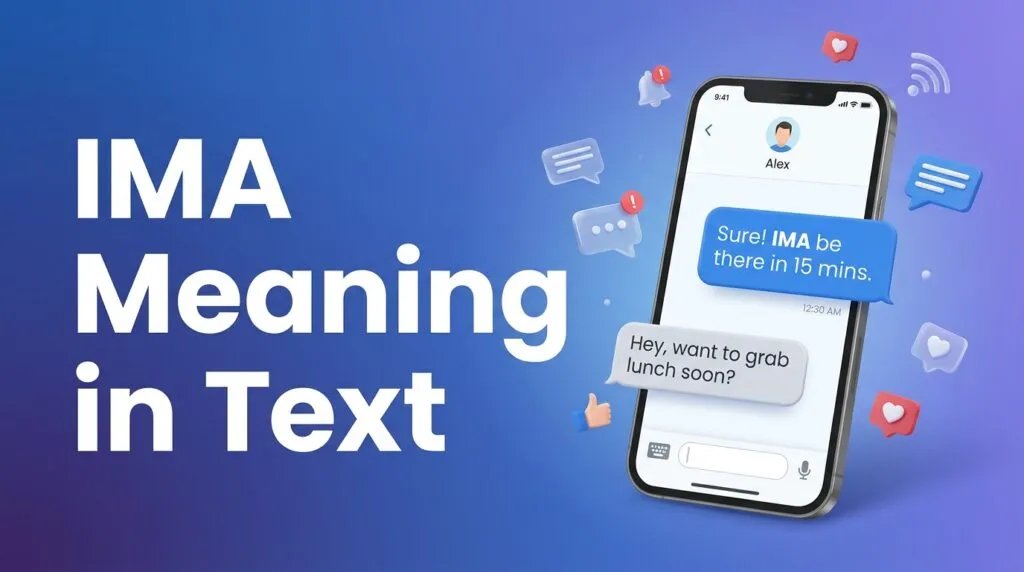

IMA in text usually means “I’m going to.” It is an informal way to express a plan, intention, or action that someone expects to take soon. For example, “IMA call you later” means “I’m going to call you later.” The spelling may also appear as ima, imma, I’ma, or I’mma.
| Term | Meaning | Context |
|---|---|---|
| ima | I’m going to | Casual texting and online conversations |
| imma | I’m going to | Social media, chat, music, and informal speech |
| I’ma | I’m going to | Informal written English |
| IMA | Context-dependent acronym | Physics, medicine, aviation, finance, and other fields |
Capitalization matters. In a casual message, ima is normally slang. In a textbook, medical report, technical document, or professional organization name, IMA may be an acronym with a completely different definition.
Meaning & Definition
The primary IMA meaning in text is:
IMA means “I’m going to” and is used to introduce a future plan, decision, intention, or action.
The term is pronounced roughly like “eye-muh.” It is usually followed by a verb:
- “IMA eat now.”
- “IMA send it tonight.”
- “IMA ask her tomorrow.”
- “IMA leave before traffic starts.”
- “IMA watch the new episode later.”
Is IMA a full form or an abbreviation?
In casual texting, ima is not usually treated as a formal initialism in which every letter represents a separate word. Instead, it is a written representation of a shortened spoken phrase.
The phrase develops like this:
I am going to → I’m going to → I’m gonna → I’ma or imma
This is why writing the term as “I.M.A.” would normally look unnatural in an ordinary chat.
Common interpretation
When a person writes “ima” before an action, they are usually saying what they plan or intend to do.
Example:
“IMA finish this assignment tonight.”
This means:
“I’m going to finish this assignment tonight.”
The intended action may happen immediately, later that day, or at another future time. The rest of the sentence usually makes the timing clear.
Real-world examples
| Text Message | Standard English Meaning |
|---|---|
| IMA call you back. | I’m going to call you back. |
| IMA get some food. | I’m going to get some food. |
| IMA check the price first. | I’m going to check the price first. |
| IMA be late today. | I’m going to be late today. |
| IMA post it tomorrow. | I’m going to post it tomorrow. |
| IMA ask my manager. | I’m going to ask my manager. |
In some messages, ima can also carry a strong emotional tone:
- “IMA cry” may express sadness, happiness, or playful exaggeration.
- “IMA lose it” may show frustration.
- “IMA scream” may express excitement, shock, or embarrassment.
- “IMA block him” communicates a decision, often with irritation.
The surrounding conversation determines whether the speaker is serious, humorous, dramatic, or sarcastic.
Background
The slang form I’ma or imma developed through the shortening of future expressions in informal spoken English. It is widely associated with African American English and later became common in music, entertainment, memes, online chat, and mainstream social media.
African American English is a structured variety of English with its own grammatical and pronunciation patterns. It should not be treated as careless or incorrect English. Linguistic descriptions of African American English identify future markers such as gonna and forms such as I’ma as part of its tense and aspect system.
I’mma in the sense of “I’m going to” or “I’m gonna” and dates its recorded use to the 1970s.
How the term evolved
The expression became shorter over time:
- I am going to leave.
- I’m going to leave.
- I’m gonna leave.
- I’ma leave.
- Imma leave.
- Ima leave.
All six sentences can communicate the same basic intention, but they differ in formality.
The first two forms are suitable for ordinary written English. “I’m gonna” is conversational. “I’ma,” “imma,” and “ima” are highly informal and are most common in speech, texting, captions, comments, and entertainment.
Why people use IMA
People use ima because it is:
- Fast to type
- Easy to understand in context
- Natural in casual conversation
- Useful for expressing immediate intentions
- Common in memes and online humor
- Able to create a relaxed, personal tone
- Similar to how the phrase sounds in quick speech
Digital communication often favors shortened language. People regularly remove punctuation, reduce common phrases, and use spellings that represent pronunciation. That is why “ima call you” may feel more natural in a friendly chat than “I am going to call you.”
However, speed is not the only reason for its use. Slang can also express identity, familiarity, humor, emotion, or membership in an online community.
Usage in Different Contexts
The meaning of ima remains fairly consistent across online platforms, but the tone and purpose can change.
Text Messages
In a personal text, ima normally introduces a plan.
Examples:
- “IMA come over after work.”
- “IMA order the food now.”
- “IMA sleep early tonight.”
- “IMA send you the address.”
- “IMA talk to him tomorrow.”
These examples express a future action. They may refer to an immediate decision or something planned for later.
Social Media
On social media, ima is often more expressive. It may introduce a reaction, joke, decision, or exaggerated emotion.
Examples:
- “IMA need this outfit in every color.”
- “IMA watch this video ten more times.”
- “IMA pretend I didn’t see that.”
- “IMA delete the whole app.”
- “IMA try this recipe tonight.”
A social media caption such as “ima need this” does not always describe a literal need. It can simply mean the speaker strongly likes a product, style, song, or idea.
Gaming
Gamers may use ima to announce their next action or strategy.
Examples:
- “IMA push the left side.”
- “IMA change my loadout.”
- “IMA join after this match.”
- “IMA revive you.”
- “IMA take the final shot.”
In gaming chat, messages need to be quick. Short forms such as ima, brb, gg, afk, and idk help players communicate without stopping gameplay.
The expression can also appear in playful threats:
- “IMA destroy this boss.”
- “IMA carry the whole team.”
- “IMA uninstall if we lose again.”
These statements are often humorous rather than literal.
Online Communities
Forums, group chats, Discord servers, livestream chats, and comment sections use ima in much the same way.
It can introduce:
- A personal opinion
- A planned action
- A joke
- A reaction
- A warning
- A decision
- A prediction about one’s own behavior
Example:
“After reading all these comments, IMA try the game myself.”
In community discussions, understanding the surrounding sentence is more useful than relying on capitalization alone.
Professional Communication
The slang form ima is generally unsuitable for formal communication.
Avoid it in:
- Business emails
- Reports
- Proposals
- Job applications
- Academic assignments
- Customer complaints
- Legal documents
- Official announcements
Instead of writing:
“IMA send the report tomorrow.”
Write:
“I’m going to send the report tomorrow.”
A more professional version would be:
“I will send the report tomorrow.”
Using standard language reduces ambiguity and creates a more polished tone. However, ima may be acceptable in an informal workplace chat between colleagues who already communicate casually.
Meaning in Chat, WhatsApp, Instagram, TikTok
Across chat apps and social media, IMA generally means “I’m going to.” Platform culture may affect how serious, playful, emotional, or dramatic the expression sounds.
| Platform | Meaning | Example Usage |
|---|---|---|
| General chat | I’m going to | “IMA message you later.” |
| I’m going to | “IMA send the location now.” | |
| I’m going to or I strongly want to | “IMA recreate this look.” | |
| TikTok | I’m going to, often as a reaction | “IMA try this trend tonight.” |
| Snapchat | I’m going to | “IMA send you the video.” |
| Discord | I’m going to | “IMA join the voice chat.” |
| I’m going to | “IMA share this with my family.” | |
| X | I’m going to, often humorous | “IMA stay out of this discussion.” |
IMA meaning in chat
In a normal chat, the term introduces an intention:
“IMA reply after dinner.”
The message tells the recipient what the sender plans to do.
IMA meaning on WhatsApp
On WhatsApp, ima is commonly used in friendly conversations:
“IMA call when I reach home.”
The sender is promising or planning a future action. In a formal business WhatsApp conversation, “I’ll call when I reach home” would be clearer.
IMA meaning on Instagram
Instagram users may place ima in captions and comments to express interest or excitement:
“IMA buy this before it sells out.”
It can also be used as a strong reaction:
“IMA cry, this is so beautiful.”
The second example may not describe a real plan to cry. It often communicates intense emotion.
IMA meaning on TikTok
TikTok language is often exaggerated, humorous, and trend-based. A comment such as:
“IMA make this my whole personality.”
usually means the person strongly likes the video, sound, style, or idea. It is often playful rather than literal.
Also Read: LKR Meaning in Text: What Does LKR Actually Mean?
Meaning in Physics, Medical, and Aircraft Terminology
Uppercase IMA has recognized technical meanings that are unrelated to texting slang. The subject and sentence structure identify the correct definition.
| Field | IMA Meaning | Explanation |
|---|---|---|
| Physics | Ideal Mechanical Advantage | The theoretical force advantage of a perfect machine without friction-related losses |
| Medical terminology | Inferior Mesenteric Artery | An artery that supplies blood to parts of the large intestine and rectum |
| Aviation | Integrated Modular Avionics | A shared aircraft computing architecture supporting multiple avionics applications |
| Texting | I’m going to | An informal expression of future intention |
IMA meaning in physics
In physics, IMA stands for Ideal Mechanical Advantage.
It describes the mechanical advantage a machine would provide under ideal conditions, with no useful work lost through friction. OpenStax explains IMA as the mechanical advantage of a perfect machine with no friction-related loss of useful work.
For a simple machine, IMA may be calculated using the relationship between input distance and output distance:
IMA = effort distance ÷ resistance distance
For a lever, it can be calculated as:
IMA = effort arm length ÷ resistance arm length
Example:
If a lever has an effort arm of 2 meters and a resistance arm of 0.5 meters:
IMA = 2 ÷ 0.5 = 4
This technical meaning has no connection to “I’m going to.”
IMA meaning in medical terminology
In medical and anatomical writing, IMA often stands for Inferior Mesenteric Artery.
The inferior mesenteric artery branches from the abdominal aorta and supplies blood to parts of the distal colon and rectum. Medical sources commonly use IMA as its abbreviation.
Example:
“The surgeon identified the IMA during the procedure.”
In this sentence, IMA refers to an artery, not texting slang.
Medical abbreviations can have more than one meaning depending on the specialty. A patient should not interpret an abbreviation from a medical report without considering the full document or asking a qualified healthcare professional.
IMA meaning in aviation and aircraft terminology
In aviation, IMA stands for Integrated Modular Avionics.
Integrated Modular Avionics is an aircraft computing approach in which shared hardware resources support several avionics applications. The FAA uses the term in guidance covering the development, verification, integration, and approval of IMA systems installed in aircraft or engines.
Example:
“The aircraft uses an IMA architecture for several onboard functions.”
Here, IMA refers to aircraft systems and software architecture.
How to identify the technical meaning
Look for surrounding words.
- Words such as lever, pulley, force, and friction suggest Ideal Mechanical Advantage.
- Words such as artery, colon, aorta, and surgery suggest Inferior Mesenteric Artery.
- Words such as aircraft, avionics, modules, and certification suggest Integrated Modular Avionics.
- Words such as call, go, buy, eat, and send suggest “I’m going to.”
Context is more reliable than capitalization by itself.
Common Misconceptions
Several misunderstandings appear when people search for the IMA meaning in text.
Misconception 1: IMA always means “I am”
What people assume:
They see “I” and “MA” and believe the term is simply another spelling of “I am.”
What it actually means:
Before an action verb, ima usually means “I’m going to.”
“IMA leave” means “I’m going to leave,” not “I am leave.”
Misconception 2: IMA means “I’m about to”
What people assume:
Some definitions translate it directly as “I’m about to.”
What it actually means:
The closest standard translation is “I’m going to.” It may imply “I’m about to” when the action is immediate, but that depends on context.
“IMA eat now” may mean “I’m about to eat.”
“IMA travel next year” means “I’m going to travel next year,” not “I’m about to travel.”
Misconception 3: IMA is a formal abbreviation
What people assume:
They believe each letter must represent a separate word.
What it actually means:
In texting, ima is normally a slang contraction based on pronunciation. In technical fields, uppercase IMA may function as a genuine acronym.
Misconception 4: The correct spelling is always “imma”
There is no single spelling used in every informal conversation. Common versions include:
- ima
- Imma
- imma
- I’ma
- I’mma
Cambridge recognizes several of these spellings as forms of the same slang expression.
Misconception 5: IMA is appropriate everywhere
The term is widely understood online, but it is not suitable for every audience.
It may be appropriate in:
- Friendly texts
- Casual comments
- Memes
- Gaming chat
- Informal captions
It is normally inappropriate in:
- Formal emails
- Academic essays
- Business proposals
- Legal communication
- Official reports
Misconception 6: It always sounds serious
“Ima” can be serious, playful, sarcastic, or exaggerated.
“IMA submit the application tonight.”
This sounds like a real plan.
“IMA move to another planet after that embarrassment.”
This is probably humorous exaggeration.
Similar Terms & Alternatives
Several slang forms express plans, intentions, or future actions.
| Term | Meaning | Difference |
|---|---|---|
| ima | I’m going to | Very informal spelling used in chat |
| imma | I’m going to | Common alternative spelling of ima |
| I’ma | I’m going to | Uses an apostrophe to show contraction |
| I’m gonna | I’m going to | Informal but clearer to many readers |
| gonna | Going to | Usually follows a subject, such as “I’m” or “we’re” |
| I’ll | I will | Short, widely accepted contraction |
| about to | Preparing to do something very soon | Emphasizes immediate action |
| planning to | Intending to do something | More neutral and deliberate |
| finna | Fixing to or preparing to | Informal future expression with its own linguistic history |
| tryna | Trying to | Describes an attempt, not simply a future plan |
| gotta | Have got to or must | Expresses necessity rather than intention |
IMA vs Imma
There is little difference in meaning.
- “IMA call her.”
- “Imma call her.”
Both usually mean “I’m going to call her.” Imma may represent the pronunciation more clearly, while ima is shorter to type.
IMA vs I’ll
Both can describe the future, but the tone differs.
- “IMA handle it” is very casual.
- “I’ll handle it” is neutral and suitable in more situations.
“I’ll” may also sound more definite because it can express a promise or immediate decision.
IMA vs gonna
“Gonna” means “going to,” but it normally needs a subject and a form of be.
- Correct informal form: “I’m gonna leave.”
- Slang reduction: “Ima leave.”
- Incomplete form: “Gonna leave” may work in casual speech, but the subject is omitted.
IMA vs finna
Both can express future action:
- “IMA leave.”
- “I’m finna leave.”
Finna often suggests that the action is approaching or about to happen. However, its exact tone depends on dialect and context.
How to Respond to It
The best response depends on the action, relationship, and tone of the conversation.
| Scenario | Message Using IMA | Suggested Response |
|---|---|---|
| Friend announces a plan | “IMA call you tonight.” | “Okay, I’ll be available.” |
| Someone is leaving | “IMA head home now.” | “Safe travels.” |
| Person wants to buy something | “IMA order this today.” | “Let me know how it is.” |
| Gamer announces a move | “IMA push the right side.” | “I’ll cover you.” |
| Someone expresses frustration | “IMA delete this app.” | “What happened?” |
| Person expresses excitement | “IMA scream, we won!” | “I know! That was amazing.” |
| Someone makes a promise | “IMA send it tomorrow.” | “Thanks. Please send it before noon.” |
| Coworker uses it casually | “IMA check the file.” | “Great, let me know what you find.” |
| Dating match suggests action | “IMA text you later.” | “Sounds good. Talk later.” |
Casual responses
- “Okay, sounds good.”
- “Go for it.”
- “Let me know how it goes.”
- “I’ll be here.”
- “Do it.”
- “Same.”
- “That makes sense.”
- “Keep me updated.”
Formal responses
You do not need to copy the other person’s slang. A professional reply can remain clear and polite.
Message:
“IMA send the updated document tonight.”
Professional response:
“Thank you. I’ll review the updated document tomorrow morning.”
Message:
“IMA confirm with the client.”
Professional response:
“Please let me know once the client confirms.”
Responding when the meaning is unclear
Ask for clarification instead of guessing:
- “Do you mean you’re going to do it now?”
- “Are you planning to send it today?”
- “What does IMA mean in this context?”
- “Are you referring to the medical abbreviation or the texting term?”
This is especially important when IMA appears alone without a verb.
Differences from Similar Words
Although ima, imma, I’m, and I’m a look similar, they do not perform the same grammatical function.
| Expression | Meaning | Example |
|---|---|---|
| I’m | I am | “I’m tired.” |
| I’m a | I am a | “I’m a student.” |
| I’ma | I’m going to | “I’ma study tonight.” |
| Imma | I’m going to | “Imma study tonight.” |
| Ima | I’m going to | “Ima study tonight.” |
| I’ll | I will | “I’ll study tonight.” |
| I’m about to | I will do it very soon | “I’m about to study.” |
IMA vs I’m
“I’m” is the standard contraction of “I am.” Defines it directly as “I am.”
- “I’m ready” means “I am ready.”
- “IMA get ready” means “I’m going to get ready.”
The word following the expression often reveals the difference.
IMA vs I’m a
“I’m a” introduces a noun or identity:
- “I’m a designer.”
- “I’m a student.”
- “I’m a new player.”
“Ima” introduces an action:
- “Ima design the page.”
- “Ima study tonight.”
- “Ima play another match.”
Compare:
“I’m a writer” means the person is a writer.
“Ima write” means the person is going to write.
IMA vs I’m about to
“I’m about to” usually indicates that an action will happen very soon.
“I’m about to leave” suggests the person is leaving within moments.
“Ima leave” can also suggest immediate action, but it may refer to a more general future plan.
“Ima leave next month” is natural in an informal context.
“I’m about to leave next month” is logically awkward because “about to” normally signals a much closer event.
IMA vs I want to
“Ima” expresses intention. “I want to” expresses desire.
- “Ima buy the phone” means the person plans to buy it.
- “I want to buy the phone” means the person desires it but may not have decided.
The difference is between a plan and a preference.
Also Read: BSF Meaning in Text: Definition, Uses and Replies
Relevance in Online Conversations & Dating Apps
Informal expressions such as ima play an important role in modern online communication. They make messages shorter, more conversational, and closer to spoken language.
Social media usage
On social media, users often write the way they speak. Punctuation may be removed, sentences may be shortened, and emotion may be shown through repeated letters, capitalization, reaction images, or emojis.
“Ima” fits naturally into this style:
- “Ima save this for later.”
- “Ima need the full story.”
- “Ima try this tomorrow.”
- “Ima follow for part two.”
The expression can also help a post sound less formal and more relatable.
Dating app usage
On dating apps, ima may appear when someone discusses future plans:
- “Ima message you after work.”
- “Ima check that restaurant.”
- “Ima be honest, your profile made me laugh.”
- “Ima need you to explain that photo.”
The final example is often playful. It means the person wants more information, not that they are issuing a serious demand.
Tone is important in dating conversations. A slang expression can make a message feel relaxed, but excessive slang may create confusion when two people have different language backgrounds.
Messaging etiquette
Consider the audience before using ima.
It works best when:
- The other person understands common English slang.
- The conversation is casual.
- You already have a comfortable relationship.
- The intended action is clear.
- A playful tone is appropriate.
Use standard wording when:
- Speaking with a customer
- Contacting an employer
- Writing to a teacher
- Discussing an important deadline
- Communicating across language barriers
- Giving instructions that must be precise
For example, “I will submit the form by 4:00 p.m.” is clearer than “ima send it later.”
Modern communication trends
Online language changes quickly because users borrow expressions from speech, music, gaming, videos, memes, and different communities. A slang term may begin within one speech community and later spread across global platforms.
Context-based language resources are therefore more useful than simple one-line definitions. A website such as Meaningo can help readers examine texting terms, social media slang, abbreviations, alternative spellings, technical definitions, and real examples in one place.
The most reliable approach is to check:
- Capitalization
- The word that follows the term
- The platform where it appears
- The subject of the conversation
- The relationship between the speakers
These signals help separate slang ima from technical acronym IMA.
Frequently Asked Questions
What does IMA mean in texting?
IMA usually means “I’m going to” in texting. It introduces an action the sender intends or plans to perform. For example, “IMA call you later” means “I’m going to call you later.” It is informal and may also be written as imma, I’ma, or I’mma.
What does IMA mean in chat?
In chat, IMA normally means “I’m going to.” A message such as “IMA join in five minutes” tells other people that the sender plans to join soon. The term is common in casual group chats, gaming conversations, comments, and direct messages.
Does IMA have multiple meanings?
Yes. In texting, ima means “I’m going to.” In physics, IMA means Ideal Mechanical Advantage. In medicine, it can mean Inferior Mesenteric Artery. In aviation, it means Integrated Modular Avionics. The correct definition depends on capitalization, topic, and surrounding words.
Is IMA commonly used on TikTok?
Yes. TikTok users often use ima in comments, captions, and reaction phrases. It may express a real plan, such as “ima try this recipe,” or a humorous reaction, such as “ima pretend I never saw that.” The platform’s conversational style makes shortened slang common.
What does IMA mean on Instagram?
On Instagram, IMA usually means “I’m going to.” It appears in comments such as “IMA recreate this outfit” or “IMA visit this place.” It can also exaggerate emotion, as in “IMA cry,” which may communicate happiness, sadness, admiration, or amusement.
Is IMA the same as Imma?
Yes, ima and imma usually have the same meaning in casual communication. Both represent “I’m going to.” Imma reflects the spoken pronunciation more clearly, while ima is a shorter spelling. The preferred version depends on the writer and online community.
Is IMA proper English?
IMA is recognized slang, but it is not standard wording for formal English. It is suitable for casual messages, social posts, and friendly conversations. In professional or academic writing, use “I’m going to,” “I will,” or another complete future construction.
Does IMA mean “I am”?
Not usually when it appears before an action verb. “IMA go” means “I’m going to go,” not “I am go.” However, people sometimes confuse ima with “I’m a.” The sentence structure identifies the intended meaning.
What does “IMA be honest” mean?
“IMA be honest” means “I’m going to be honest.” It introduces a direct opinion, admission, or personal reaction. For example, “IMA be honest, I didn’t enjoy the movie” signals that the speaker is about to share an honest view.
What does “IMA head out” mean?
“IMA head out” means “I’m going to leave” or “I’m going to start travelling somewhere.” It is a casual way of announcing departure. A suitable response might be “Okay, travel safely” or “Thanks for coming.”
Can I use IMA in a business email?
It is better not to use ima in a business email because it is highly informal. Write “I’m going to review the document,” “I will review the document,” or “I plan to review the document” instead. Standard wording appears clearer and more professional.
Where can I check similar texting meanings?
You can use Meaningo to explore texting abbreviations, slang terms, social media phrases, alternative definitions, and examples. Checking a term in complete sentences is important because the same letters may have different meanings in casual chat, medicine, science, business, or technology.
Conclusion
The most common IMA meaning in text is “I’m going to.” People use it to describe plans, decisions, reactions, and future actions in casual messages, WhatsApp conversations, Instagram comments, TikTok posts, gaming chats, and dating apps.
The spellings ima, imma, I’ma, and I’mma usually communicate the same idea. However, uppercase IMA may mean Ideal Mechanical Advantage in physics, Inferior Mesenteric Artery in medicine, or Integrated Modular Avionics in aviation. Always examine the topic, capitalization, sentence structure, and surrounding words before choosing a definition. Resources such as Meanigo can make this context-based interpretation easier by explaining both slang and field-specific meanings.

Pingback: 🙃 Meaning in Text: Sarcasm, Irony and Flirting