
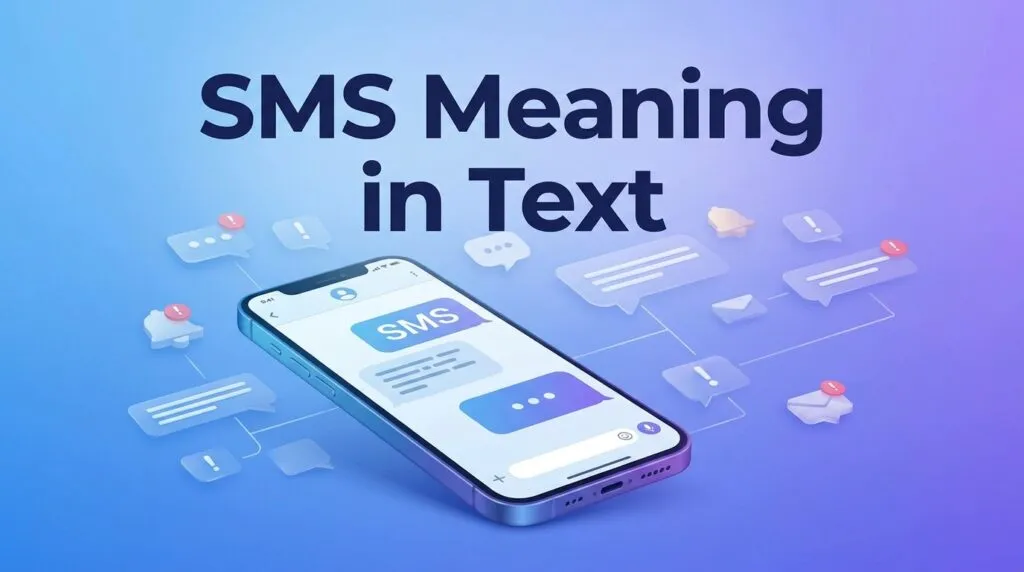

SMS in text means Short Message Service. It is the standard mobile-phone service used to send short written messages through a cellular network. In everyday conversation, people often say “SMS” when they mean a regular phone text message, especially one sent without WhatsApp, Instagram, or another internet-based app.
| Term | Meaning | Context |
|---|---|---|
| SMS | Short Message Service | Standard text message sent through a mobile network |
| Text message | A written message sent by phone | Can mean SMS, iMessage, RCS, or app-based chat |
| SMS message | A regular mobile text | Often used for OTPs, alerts, reminders, and personal chats |
| SMS in texting | Usually means a normal phone message | Used when discussing phone plans, notifications, or messaging |
Meaning & Definition
SMS stands for Short Message Service. It is a communication service that allows users to send short text-based messages between mobile phones.
The most common meaning of SMS in text is simple: it refers to a standard text message sent through a mobile carrier’s network. For example, when someone says, “Send me an SMS,” they usually mean, “Send me a normal phone text.”
Direct answer: SMS means Short Message Service, a mobile-network feature for sending short text messages between phones.
Traditional SMS messages were commonly limited to 160 characters when using basic GSM character encoding. Longer messages can still be sent, but phones may split and combine them in the background.
Here are a few real-world examples:
- “I’ll send you the address by SMS.”
- “The bank sent an SMS verification code.”
- “Please confirm your appointment through SMS.”
- “I did not receive your SMS yet.”
- “My internet is off, but SMS is still working.”
SMS does not always require mobile data or Wi-Fi. That is one reason it is still widely used for important alerts, login codes, delivery updates, banking notifications, and emergency messages.
In casual speech, people may use the words “SMS” and “text” as though they mean exactly the same thing. Technically, they are not always identical. A text sent through WhatsApp, Messenger, or Instagram is a message, but it is not usually an SMS because it travels through the internet rather than the mobile carrier’s SMS system.
Background
SMS began as part of early mobile communication standards. Before smartphones, people needed a simple way to send short written notes without making a phone call. SMS filled that need.
The feature became popular because it was fast, inexpensive, and available on basic mobile phones. Users did not need an app store, a social-media account, or a strong internet connection. They only needed a phone number and cellular signal.
In the early years, people used SMS for short messages such as:
- “Call me when free.”
- “I am outside.”
- “Running late.”
- “Happy birthday!”
- “Where are you?”
Over time, SMS became a major part of daily communication. It also changed how people wrote. People started using shorter words, abbreviations, emojis, and text slang because typing on old keypad phones was slow.
Examples of classic SMS-style writing include:
- “u” instead of “you”
- “brb” instead of “be right back”
- “gr8” instead of “great”
- “lol” instead of “laugh out loud”
- “ttyl” instead of “talk to you later”
Smartphones and chat apps later changed the way people message. WhatsApp, iMessage, Telegram, Instagram DMs, Signal, and Messenger introduced features such as voice notes, images, reactions, group chats, read receipts, and video calls.
Still, SMS remains important because it works across almost all mobile phones. A person does not need the same app as the sender. This makes SMS useful for businesses, government services, healthcare providers, schools, banks, and delivery companies.
Direct answer: People still use SMS because it is simple, widely supported, and does not depend on both users having the same messaging app.
Also Read: TY Meaning in Text: What It Means and How to Reply
Usage in Different Contexts
SMS can mean slightly different things depending on where and how it is used. The core meaning remains Short Message Service, but the purpose changes by context.
Text Messages
In normal texting, SMS means a standard message sent from one phone number to another.
Example:
“My WhatsApp is not working. Send me an SMS instead.”
This usually means the sender wants a regular mobile text message.
Social Media
On social media, people may use “SMS” when discussing phone verification, login codes, promotions, or customer support.
Examples:
- “I received an SMS code to verify my account.”
- “The giveaway winner will get an SMS.”
- “Turn on SMS alerts for order updates.”
Social platforms themselves usually use direct messages, not SMS. However, they may send SMS verification codes or security alerts to a user’s phone number.
Gaming
In gaming, SMS can appear when a platform asks users to verify their identity or enable two-factor authentication.
Examples:
- “Enter the SMS code to protect your gaming account.”
- “I cannot log in because the SMS OTP did not arrive.”
- “The game sent a verification text to my number.”
Gamers may also use SMS as a quick term for mobile-message verification.
Online Communities
In forums, Discord servers, Reddit discussions, and tech communities, SMS often appears in conversations about privacy, security, login systems, or mobile plans.
Examples:
- “Avoid using SMS alone for sensitive account security.”
- “This website requires SMS verification.”
- “My carrier blocks international SMS messages.”
Here, SMS is usually discussed as a phone-based communication tool rather than casual chat slang.
Professional Communication
In work settings, SMS is often used for short, urgent, or time-sensitive communication.
Examples:
- “Please send the meeting link by SMS.”
- “Your interview reminder was sent by SMS.”
- “We will notify customers by SMS.”
- “The technician will text you before arriving.”
Professional SMS should be polite, brief, and clear. Unlike casual chats, work messages should avoid unclear slang, excessive emojis, and informal shortcuts.
Meaning in Chat, WhatsApp, Instagram, TikTok
SMS has the same full form across platforms, but its practical use can differ. On some platforms, people use the word SMS to separate normal phone texts from app-based messages.
| Platform | Meaning | Example Usage |
|---|---|---|
| Chat | Usually a regular text message | “Send me an SMS when you reach home.” |
| Often means a message outside WhatsApp | “My WhatsApp is down, so send an SMS.” | |
| Often refers to phone verification or alerts | “Instagram sent an SMS code.” | |
| TikTok | Usually refers to account verification | “TikTok asked for an SMS verification code.” |
| iMessage | Can mean a green-bubble message sent by carrier | “It sent as SMS instead of iMessage.” |
| Android Messages | Can refer to normal carrier texting | “SMS is enabled on my phone.” |
On WhatsApp, SMS usually means a message that does not go through WhatsApp. WhatsApp messages use internet data or Wi-Fi, while SMS uses your mobile carrier.
On Instagram and TikTok, SMS often appears during account setup, password recovery, two-factor authentication, or phone-number verification.
For example:
“TikTok is asking me for an SMS code.”
This means TikTok sent a verification code to the person’s mobile number through a standard text message.
On iPhone, people may notice that a message is sent as SMS when it appears in a green bubble instead of a blue iMessage bubble. This can happen when iMessage is unavailable, the receiver does not use an Apple device, or internet-based messaging is not working.
Direct answer: On WhatsApp, Instagram, and TikTok, SMS usually refers to a phone verification code or a regular carrier text outside the app.
Meaning in Physics, Medical, and Aircraft Terminology
SMS does not always mean Short Message Service. Like many abbreviations, it can have different meanings in specialist fields.
| Field | Possible Meaning of SMS | Explanation |
|---|---|---|
| Texting and mobile phones | Short Message Service | A standard text message sent through a cellular network |
| Physics | Specific Mass Shift | A specialist term that may appear in atomic physics and isotope research |
| Medical | Smith-Magenis Syndrome | A rare genetic condition; the meaning depends on medical context |
| Aviation | Safety Management System | A formal system used to manage safety risks in aviation operations |
| Business communication | Short Message Service | Often used for alerts, marketing, OTPs, and customer messages |
In physics, SMS does not have one universal everyday meaning. In some scientific writing, it can refer to specific mass shift, especially in discussions involving atoms, isotopes, and spectral shifts. Outside specialist research, people are far more likely to mean Short Message Service.
In medical settings, SMS can refer to Smith-Magenis syndrome. This is completely different from texting. A medical article, doctor’s note, or health discussion may use SMS in that sense.
In aviation and aircraft terminology, SMS usually means Safety Management System. Airlines, airports, pilots, maintenance teams, and aviation authorities use an SMS to identify risks, report safety concerns, and improve operational safety.
For example:
“The airline updated its SMS procedures.”
In aviation, this sentence means the airline updated its Safety Management System, not its mobile text-message service.
Direct answer: In aircraft terminology, SMS usually means Safety Management System. In medical contexts, it may mean Smith-Magenis syndrome. Context always matters.
Common Misconceptions
Many people misunderstand SMS because the term is used casually and has different meanings in different industries.
Here are common misconceptions and the correct explanation.
| What People Assume | What It Actually Means |
|---|---|
| SMS means every kind of text message | SMS specifically means a mobile-carrier text service |
| WhatsApp messages are SMS | WhatsApp messages use the internet, not normal SMS |
| SMS and MMS are the same | SMS is mainly text; MMS can include media such as photos and videos |
| SMS needs Wi-Fi | SMS normally uses a mobile network, not Wi-Fi |
| SMS is outdated and no longer used | SMS is still widely used for OTPs, alerts, reminders, and notifications |
| SMS always means texting | In medicine or aviation, SMS can mean something completely different |
A common mistake is calling every phone message “SMS.” This is understandable because people use the word “text” broadly. However, a message sent through WhatsApp, Instagram, Telegram, or Messenger is usually an internet message, not an SMS.
Another misconception is that SMS is useless because of modern apps. In reality, SMS is still one of the most reliable ways for businesses and services to reach customers. It works on basic phones, does not require users to download a specific app, and can deliver time-sensitive messages quickly.
Also Read: RD Meaning in Text: What It Means in Chat
Similar Terms & Alternatives
Several terms are closely related to SMS. Knowing the differences helps you understand mobile communication more clearly.
| Term | Meaning | Difference |
|---|---|---|
| SMS | Short Message Service | Basic text sent through a mobile carrier |
| Text message | General term for written phone communication | Can include SMS, RCS, iMessage, or app messages |
| MMS | Multimedia Messaging Service | Can send photos, videos, audio, and longer media files |
| RCS | Rich Communication Services | A newer messaging standard with typing indicators, read receipts, and media sharing |
| iMessage | Apple’s internet-based messaging service | Works through Apple’s system and usually uses data or Wi-Fi |
| DM | Direct Message | Private message sent inside a social platform or app |
| OTP | One-Time Password | A temporary security code often delivered by SMS |
| Verification code | Code used to confirm identity or login | Often sent through SMS, email, or an authenticator app |
SMS is the basic option. MMS adds media. RCS offers richer chat features. iMessage works within Apple’s ecosystem. DMs are private messages inside platforms such as Instagram, TikTok, X, Facebook, Discord, or LinkedIn.
For example:
“I sent you an SMS” means a standard carrier text.
“I sent you a DM” means a private message through a social platform.
“I sent you an iMessage” means a message through Apple’s internet-based service.
For readers who want simple explanations of texting language, online abbreviations, and internet terms, Meanigo can be a helpful reference for checking a word in the right context.
How to Respond to It
How you respond to SMS depends on what the person means. They may be asking you to send a normal text, confirm a code, or use phone-based communication instead of an app.
| Scenario | Suggested Response |
|---|---|
| Someone asks you to send an SMS | “Sure, I’ll text you on your phone number.” |
| Someone says they did not receive an SMS | “Please check your signal, blocked messages, and the phone number entered.” |
| A friend asks for an SMS instead of WhatsApp | “No problem. I’ll send a regular text message.” |
| A company sends an SMS alert | “Thank you, I received the update.” |
| A platform asks for SMS verification | “I entered the code sent to my phone number.” |
| A formal work message is needed | “Hello, this is a reminder that your appointment is scheduled for 3:00 PM.” |
| Someone uses SMS in aviation context | “Do you mean the Safety Management System?” |
| Someone uses SMS in medical context | “Do you mean Smith-Magenis syndrome or a text message?” |
Casual responses can be short:
- “I’ll SMS you.”
- “Send me a normal text.”
- “Check your SMS inbox.”
- “I got the code.”
- “The SMS never arrived.”
Formal responses should be clearer:
- “Please send the verification code by SMS.”
- “We have sent an SMS confirmation to your registered number.”
- “Kindly check your mobile inbox for the appointment reminder.”
- “Your delivery update has been sent through SMS.”
Differences from Similar Words
SMS is often confused with texting, chatting, messaging, and direct messaging. The key difference is the technology and platform used.
| Word | Main Meaning | Uses Mobile Carrier? | Uses Internet? |
|---|---|---|---|
| SMS | Standard mobile text message | Yes | Usually no |
| Text | General written phone message | Sometimes | Sometimes |
| Chat | Conversation through an app or platform | Usually no | Usually yes |
| DM | Private social-media message | No | Yes |
| iMessage | Apple device message | Sometimes, if sent as SMS fallback | Usually yes |
| RCS message | Rich Android-style messaging | Can use carrier support | Usually yes |
| WhatsApp message | Message sent in WhatsApp | No | Yes |
The word “text” is broad. A person may say, “Text me,” even when they mean WhatsApp, iMessage, RCS, or SMS. The exact meaning often depends on the person’s phone, country, data connection, and preferred messaging app.
Direct answer: SMS is a type of text message, but not every text message is SMS.
Also Read: “…” in Text From a Girl: Meaning and Replies
Relevance in Online Conversations & Dating Apps
SMS still matters in online conversations, especially when people move from a dating app or social platform to direct phone communication.
On dating apps, someone may say:
- “Do you want to switch to SMS?”
- “Text me instead of messaging here.”
- “I’ll send you my number. Message me by SMS.”
- “I do not check the app often, so send me a text.”
This usually means they want to move from the app’s chat system to regular phone texting.
However, sharing your number too early can affect privacy. It is smart to take your time before moving from an in-app chat to SMS. Dating apps often have reporting and safety tools that may not be available once a conversation moves to a personal phone number.
Good messaging etiquette includes:
- Ask before moving a chat to SMS.
- Do not pressure someone to share their phone number.
- Keep messages respectful and clear.
- Avoid sending repeated texts when someone has not replied.
- Do not send personal or sensitive information through SMS.
- Be cautious with links, OTP codes, and unknown verification requests.
On social media, SMS is often used for login security. A person may receive a text code to confirm a new login, reset a password, or verify a phone number.
Be careful with suspicious messages. Real companies may send verification codes, but they will not normally ask you to share your private OTP with another person. Never send a banking code, login code, or account recovery code to someone who contacts you unexpectedly.
Direct answer: In dating apps, “SMS me” usually means “send a normal phone text,” but you should share your number only when you feel comfortable and safe.
Frequently Asked Questions
What does SMS mean in texting?
SMS means Short Message Service. It refers to a regular text message sent through a mobile carrier’s network. People often use it when they want to distinguish a normal phone text from messages sent through WhatsApp, Instagram, Messenger, or other internet-based apps.
Does SMS have multiple meanings?
Yes. In most phone and texting conversations, SMS means Short Message Service. In aviation, it often means Safety Management System. In medical discussions, it may mean Smith-Magenis syndrome. The correct meaning depends on the topic and the sentence where it appears.
Is SMS commonly used on TikTok?
SMS is commonly mentioned on TikTok when users need a phone verification code, password reset code, or login confirmation. TikTok messages inside the app are not SMS, but TikTok may send an SMS to verify that a phone number belongs to the account holder.
Is SMS the same as a text message?
SMS is a type of text message, but the two terms are not always identical. SMS uses a mobile carrier’s network. A text message may also refer to iMessage, RCS, WhatsApp, Messenger, or another app-based message sent through Wi-Fi or mobile data.
What does send me an SMS mean?
“Send me an SMS” means “send me a regular text message on my phone number.” The person usually wants a carrier-based message instead of a WhatsApp message, Instagram DM, email, or another type of online communication.
Does SMS need internet or Wi-Fi?
SMS normally does not need Wi-Fi or mobile data. It works through a cellular network. However, your phone needs mobile signal and an active service plan that supports text messaging. Internet-based apps usually need Wi-Fi or mobile data to work.
What is the difference between SMS and MMS?
SMS is mainly for text-only messages. MMS stands for Multimedia Messaging Service and can send media such as photos, videos, audio, and animated images. MMS may use more data and can have different costs depending on the mobile carrier and plan.
What is the difference between SMS and RCS?
SMS is a basic mobile text standard. RCS is a newer messaging format that can include read receipts, typing indicators, better group chats, and higher-quality media sharing. RCS works more like modern chat apps, while SMS is simpler and more widely supported.
Why do businesses still use SMS?
Businesses use SMS because it is quick, direct, and works on nearly all mobile phones. It is commonly used for appointment reminders, delivery updates, one-time passwords, security alerts, booking confirmations, payment notices, and customer-service messages.
What does SMS mean in aviation?
In aviation, SMS usually means Safety Management System. It is a structured process that helps airlines, airports, and aviation teams identify hazards, manage risks, report safety issues, and improve safe operations. It does not refer to phone texting in this context.
Conclusion
SMS means Short Message Service, the standard system used to send regular text messages through a mobile network. It remains useful for personal chats, verification codes, security alerts, delivery updates, appointment reminders, and business communication.
While people often use “SMS” and “text message” interchangeably, SMS is different from WhatsApp messages, DMs, iMessage, RCS, and other internet-based chats. The key is context. In mobile communication, SMS usually means a normal phone text. In aviation, medical, and technical settings, the same abbreviation can mean something entirely different.

Pingback: AFK Meaning in Text: What It Means and How to Use It
Pingback: HU Meaning in Text: Definition, Uses & Replies
Pingback: DHZ Meaning in Text: Slang Meaning, Uses, and Examples
Pingback: LYK Meaning in Text: What It Means & How to Use It
Pingback: IWK Meaning in Text: What It Means in Chat, Snapchat
Pingback: IGL Meaning in Text: Full Form, Uses & Examples
Pingback: FRL Meaning in Text: What Does FRL Mean?