
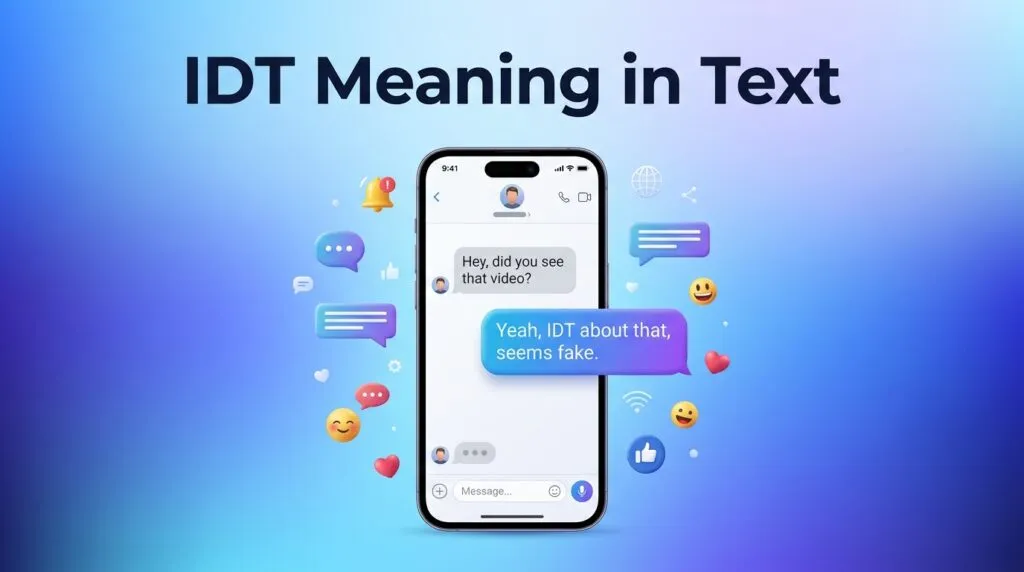

IDT meaning in text is “I don’t think.” People use IDT in messages, chats, comments, and social media when they want to show doubt, disagreement, or uncertainty in a short way. It is informal, so it works best in casual texting, not in professional emails or serious documents.
| Term | Meaning | Context |
|---|---|---|
| IDT | I don’t think | Texting, chat, social media |
| idt | I don’t think | Casual lowercase message style |
| IDTS | I don’t think so | Stronger or clearer disagreement |
| IDK | I don’t know | Lack of knowledge |
| IMO | In my opinion | Sharing a personal view |
Meaning & Definition
IDT stands for “I don’t think.”
In texting, IDT is a short form people use when they are unsure, doubtful, or gently disagreeing with something. It saves time and keeps the message casual.
A simple definition is:
IDT means “I don’t think” and is used to express doubt, uncertainty, or mild disagreement in casual online conversations.
For example:
- “IDT I can come today.”
- “IDT that’s the right answer.”
- “IDT she saw your message.”
- “IDT we should order from there again.”
- “IDT this plan will work.”
The full form is not formal. It belongs to internet slang, text abbreviations, and casual chat terms. You may see it in SMS, WhatsApp, Instagram DMs, TikTok comments, Snapchat messages, Discord chats, gaming lobbies, and quick replies.
IDT is usually not rude by itself. The tone depends on the message around it. For example, “idt so lol” can sound casual and soft. But “IDT you know what you’re doing” can sound direct or even harsh.
Because short forms can feel unclear, context matters. If someone writes “idt,” read the full conversation before assuming the tone.
A helpful way to understand IDT is to replace it with “I don’t think.” If the sentence still makes sense, you have the right meaning.
Example:
“IDT he is online.”
Means:
“I don’t think he is online.”
That is the most common meaning of IDT in text.
If you often search short forms like IDT, IDK, WSP, NFS, or WYLL, a simple meaning website like Meanigo can be useful for checking slang definitions, examples, and context before replying.
Background
IDT became common because texting rewards speed.
People often shorten common phrases in digital conversations. Instead of typing “I don’t think,” they type “idt.” It follows the same pattern as many other texting abbreviations:
- IDK = I don’t know
- IMO = In my opinion
- TBH = To be honest
- NGL = Not gonna lie
- WYD = What you doing
- WSP = What’s up
The rise of mobile phones, social media, and instant messaging made short forms more popular. People wanted to reply fast, save space, and match the casual tone of online conversations.
IDT is part of that same language shift.
At first, abbreviations were mostly used in SMS because older text messages had character limits. Later, they spread to apps like WhatsApp, Instagram, Snapchat, TikTok, Discord, Reddit, and online games. Today, many people use short forms even when there is no character limit because they feel natural in quick chat.
The term also evolved in tone.
Earlier, IDT mainly meant “I don’t think.” Now, it can also imply:
- “I’m not sure.”
- “I doubt it.”
- “Probably not.”
- “I don’t agree.”
- “I don’t think so.”
However, IDT is not exactly the same as IDTS. IDTS means “I don’t think so,” which is often a clearer no. IDT can start a longer sentence, while IDTS can stand alone as a full answer.
Example:
- “IDT he’s coming.” = I don’t think he is coming.
- “IDTS.” = I don’t think so.
People use IDT because it feels quick, soft, and casual. It lets someone disagree without always sounding too serious.
Also Read: IDTS Meaning on Snapchat, TikTok & Instagram
Usage in Different Contexts
IDT can appear in many online spaces. The meaning stays close to “I don’t think,” but the tone changes based on the platform, relationship, and message.
Text Messages
In normal text messages, IDT is used between friends, family, classmates, or people who already understand casual abbreviations.
Examples:
- “IDT I’ll be home before 8.”
- “IDT mom knows yet.”
- “IDT we need to buy more food.”
- “IDT your phone is charging.”
In texting, IDT usually sounds relaxed. It is not the best choice when the message needs to be very clear, serious, or respectful.
Better casual version:
“IDT I can make it today.”
Better clear version:
“I don’t think I can make it today.”
Social Media
On social media, IDT appears in comments, captions, replies, and DMs. People use it when reacting to posts, rumors, opinions, trends, or videos.
Examples:
- “IDT this trend is funny anymore.”
- “IDT that outfit matches.”
- “IDT they’re actually dating.”
- “IDT people understood the joke.”
On platforms like Instagram, TikTok, and X, IDT can sound opinion-based. It may invite replies, agreement, or debate.
Gaming
In gaming chats, IDT is used during quick decisions. Players may use it when talking about strategy, teammates, enemies, or match outcomes.
Examples:
- “IDT we should push right now.”
- “IDT he has ammo.”
- “IDT they’re camping there.”
- “IDT this team comp works.”
Gaming messages move fast, so abbreviations are common. IDT helps players share doubt without typing long sentences during gameplay.
Online Communities
In online communities like Reddit, Discord, forums, and group chats, IDT is used in discussions and debates.
Examples:
- “IDT that theory makes sense.”
- “IDT the update fixed the issue.”
- “IDT this belongs in this thread.”
- “IDT the source is reliable.”
In communities, IDT can sound more critical depending on the topic. If the discussion is serious, it is better to write the full phrase.
Professional Communication
IDT is not recommended in professional communication.
Avoid using IDT in:
- Business emails
- Client messages
- School assignments
- Reports
- Job applications
- Official documents
- Customer support replies
Instead of writing:
“IDT we can finish this today.”
Write:
“I don’t think we can finish this today.”
Or:
“Based on the current timeline, it may not be possible to finish this today.”
Professional writing should be clear. Short slang can look careless or confusing in formal settings.
Meaning in Chat, WhatsApp, Instagram, TikTok
| Platform | Meaning | Example Usage |
| Chat | I don’t think | “IDT he replied yet.” |
| I don’t think | “IDT I can join the call.” | |
| I don’t think | “IDT this filter looks real.” | |
| TikTok | I don’t think | “IDT people got the joke.” |
| Snapchat | I don’t think | “IDT I saved that snap.” |
| Discord | I don’t think | “IDT the server is working.” |
| I don’t think | “IDT that explanation is correct.” | |
| Dating apps | I don’t think | “IDT we’re looking for the same thing.” |
On WhatsApp, IDT is usually used in private chats or group messages. It often sounds casual and personal.
Example:
“IDT I’ll be free tonight.”
On Instagram, IDT may appear in DMs, story replies, or comments. It often shares an opinion.
Example:
“IDT this is from the new collection.”
On TikTok, IDT is often used in comments about trends, creators, rumors, jokes, and reactions.
Example:
“IDT she meant it like that.”
In regular chat, IDT can fit almost anywhere a person would say “I don’t think.” The key is tone. If the topic is sensitive, write the full phrase.
Meaning in Physics, Medical, and Aircraft Terminology
IDT does not always mean “I don’t think.” In technical fields, IDT may have different meanings. The right meaning depends on context.
| Field | Does IDT Have a Recognized Meaning? | Common Meaning | Notes |
| Texting | Yes | I don’t think | Most common meaning in casual messages |
| Medical | Yes | Interdisciplinary Team | Used in healthcare, care planning, hospice, and patient support |
| Physics/Engineering | Yes | Interdigital Transducer | Used in surface acoustic wave devices and sensors |
| Optical imaging | Yes | Intensity Diffraction Tomography | Used in microscopy and imaging research |
| Aviation/Aircraft | Sometimes | Identifier or designator context | Appears in specific aviation lists, but not as texting slang |
| Everyday speech | Rarely | Usually not used | Most people use the full phrase instead |
In medical terminology, IDT often means Interdisciplinary Team. This is a group of healthcare professionals who work together to plan care for a patient. It may include doctors, nurses, therapists, social workers, and other care providers.
In physics and engineering, IDT may mean Interdigital Transducer. This is linked to devices that convert electrical signals into surface acoustic waves. It is a technical meaning and has nothing to do with texting.
In optical imaging, IDT may mean Intensity Diffraction Tomography. This is a scientific method used in imaging and microscopy.
In aviation, IDT can appear as an identifier or designator in official aviation materials. However, a normal person saying “idt” in a message is almost never talking about aviation.
Direct answer:
In texting, IDT means “I don’t think.” In medicine, physics, and aviation, IDT can mean something else, so context is always important.
How to Know What IDT Means From Context
The meaning of IDT in a text message is usually clear from the words and situation around it. IDT most commonly means “I Don’t Think,” but the exact interpretation depends on what the person is responding to.
For example:
- “IDT that’s a good idea.” → “I don’t think that’s a good idea.”
- “IDT I can come tonight.” → “I don’t think I can come tonight.”
- “IDT so.” → “I don’t think so.”
- “IDT you’re right.” → “I don’t think you’re right.”
Look at What Comes After IDT
When IDT is followed by another statement, it usually means “I don’t think…”
“IDT we should go.”
Here, IDT expresses doubt or disagreement about going.
When someone writes “IDT so”, the phrase functions more like a complete response meaning “I don’t think so.”
Consider the Conversation
The topic of the conversation can help you understand the tone.
If someone asks:
“Do you think he’ll come?”
and you receive:
“IDT.”
they probably mean “I don’t think so.”
If they write:
“IDT he’ll come.”
the meaning is more directly “I don’t think he’ll come.”
Pay Attention to Tone
IDT can express simple uncertainty, disagreement, or a polite negative opinion. The tone can change depending on punctuation, emojis, and the relationship between the people.
For example:
- “IDT 😅” → may sound hesitant or lighthearted
- “IDT.” → may sound more firm or brief
- “IDT that’s going to work.” → expresses disagreement or doubt
Therefore, don’t interpret IDT only from the abbreviation itself. Read the complete message and the conversation around it.
IDT Meaning in Text Examples
Here are some common examples of IDT in texting and online conversations.
IDT Meaning “I Don’t Think”
Example 1:
“IDT I’ll be able to come tonight.”
Meaning:
“I don’t think I’ll be able to come tonight.”
Example 2:
“IDT that’s the right answer.”
Meaning:
“I don’t think that’s the right answer.”
Example 3:
“IDT she knows about it.”
Meaning:
“I don’t think she knows about it.”
Example 4:
“IDT we have enough time.”
Meaning:
“I don’t think we have enough time.”
Also Read: BD Meaning in Text: Definition, Uses, Replies & Examples
IDT as “I Don’t Think So”
Example:
“Do you think John is coming?”
“IDT.”
Here, IDT can be understood as “I don’t think so.”
IDT in a Casual Conversation
“Are you going out tonight?”
“IDT, I’m pretty tired.”
This means:
“I don’t think so, I’m pretty tired.”
IDT to Express Doubt
“IDT that’s going to happen.”
This expresses uncertainty or doubt about whether something will happen.
IDT to Politely Disagree
“IDT you’re wrong, but let’s check.”
Here, IDT softens the disagreement compared with saying:
“You’re wrong.”
The exact tone still depends on the conversation and relationship between the people.
What Does IDT Mean When Someone Says Just “IDT”?
When someone replies with just “IDT,” it usually means “I don’t think so.”
For example:
Question:
“Do you think she’ll call?”
Reply:
“IDT.”
The intended meaning is:
“I don’t think so.”
A standalone IDT is generally used as a short negative or uncertain response. It may indicate that the person does not expect something to happen, but it does not necessarily mean they are completely certain.
The tone can vary:
- “IDT” → casual and brief
- “IDT.” → potentially more firm or serious
- “IDT 😂” → can sound playful
- “IDT tbh” → “I don’t think so, to be honest”
If you’re unsure whether the person is disagreeing, uncertain, or simply saying no, look at the question they were answering and the previous messages.
IDT Meaning on Snapchat, Instagram, WhatsApp & TikTok
IDT has essentially the same core meaning across Snapchat, Instagram, WhatsApp, and TikTok: “I Don’t Think.” The platform does not normally give IDT a completely different dictionary meaning.
However, the context and tone can vary by platform and conversation.
| Platform | Typical use of IDT | Example |
|---|---|---|
| Snapchat | Casual disagreement or uncertainty | “IDT he’s coming.” |
| Comments or DMs expressing doubt | “IDT that’s true.” | |
| Everyday conversations | “IDT I can make it.” | |
| TikTok | Comments, DMs, or reactions | “IDT this will work.” |
For example, someone might comment:
“IDT this is real.”
on a TikTok video. Here, IDT means “I don’t think this is real.”
On WhatsApp, someone might say:
“IDT I’ll be home before 8.”
The meaning is “I don’t think I’ll be home before 8.”
The platform itself usually isn’t what determines the meaning. The surrounding words and conversation are more important.
What Does IDT Mean From a Guy or Girl?
If a guy or girl sends you “IDT,” it normally means “I Don’t Think” or, when used alone, “I Don’t Think So.” There isn’t a standard gender-specific meaning for IDT.
For example:
“Do you think we should go?”
“IDT.”
This generally means:
“I don’t think so.”
If someone writes:
“IDT that’s a good idea.”
they are expressing doubt or disagreement with the idea.
Does IDT Have a Romantic Meaning?
Not by itself.
IDT does not automatically indicate flirting, rejection, attraction, or a particular romantic feeling. If you’re trying to understand someone’s intentions, consider the entire conversation rather than assigning a hidden meaning to the abbreviation.
For example:
“Do you want to meet tonight?”
“IDT I can.”
This primarily communicates uncertainty or that they don’t expect to be available. The reason and emotional tone would need to be understood from the rest of the conversation.
How to Respond to IDT
Your response to IDT depends on what the person is expressing.
If They’re Expressing Doubt
You can ask for clarification:
“Why don’t you think so?”
or:
“What makes you think that?”
If They’re Saying They Can’t Do Something
You can respond:
“No worries. Maybe another day?”
or:
“That’s okay. Let me know when you’re free.”
If They’re Disagreeing With You
You could ask:
“What do you think would work better?”
This keeps the conversation open instead of turning the disagreement into an argument.
If You Want to Confirm Their Meaning
If the message is unclear, ask:
“You mean you don’t think so?”
This is especially useful when the person sends only “IDT” without additional context.
If the Conversation Is Casual
A simple response may be enough:
“Fair enough.”
or:
“Okay, I get you.”
The best response depends on the topic, relationship, and tone of the conversation.
Is IDT Rude, Cold, or Dismissive?
IDT is not inherently rude or cold. It is simply a texting abbreviation for expressing doubt, uncertainty, or disagreement.
However, a very short response can sometimes feel cold or dismissive depending on the situation.
Compare:
“IDT.”
with:
“I don’t think so, but I’m not sure.”
The first response is much shorter and may feel more abrupt, even though the basic meaning is similar.
Also Read: ROFL Meaning in Text: Definition, Uses & Examples
When IDT May Sound Cold
IDT can come across as somewhat dismissive when:
- it is sent as a one-word reply to a serious question
- there is no explanation
- the conversation is already tense
- the person repeatedly gives very short replies
- punctuation makes the response appear firm
When IDT Sounds Normal
In a casual conversation, a short “IDT” may simply be a normal way of saying:
“I don’t think so.”
Emojis and additional words can also make the tone feel softer or more casual.
Therefore, don’t assume someone is being rude just because they used IDT. Consider the full conversation and their usual communication style.
IDT vs IDTS vs IDK vs IDC
These texting abbreviations can look similar, but they express different ideas.
| Abbreviation | Meaning | What it expresses |
|---|---|---|
| IDT | I Don’t Think | Doubt or an opinion |
| IDTS | I Don’t Think So | A negative/uncertain response |
| IDK | I Don’t Know | Lack of knowledge or certainty |
| IDC | I Don’t Care | Lack of concern or interest |
IDT vs IDTS
IDT usually introduces or forms part of a thought:
“IDT he’ll come.”
= “I don’t think he’ll come.”
IDTS normally means:
“I don’t think so.”
and can work as a standalone answer.
IDT vs IDK
IDT expresses an opinion or expectation:
“IDT that’s true.”
IDK means the person does not know:
“IDK if that’s true.”
The difference is important:
- IDT → “I don’t think it is.”
- IDK → “I don’t know whether it is.”
IDT vs IDC
IDC means “I don’t care.”
“IDC what they think.”
This communicates indifference, while:
“IDT they’re right.”
communicates an opinion or disagreement.
Because IDC can sound stronger or more dismissive, it should not be treated as another version of IDT.
Can IDT Be Used Sarcastically?
Yes, IDT can sometimes be used sarcastically, but sarcasm comes from the context and tone rather than the abbreviation itself.
For example:
“IDT you need another slice of cake 😂”
If the person is obviously joking because you’ve already eaten several slices, IDT may be playful or sarcastic.
Another example:
“IDT you were late… only 45 minutes.”
Here, the wording and situation make the sarcasm clear.
However, IDT does not inherently mean sarcasm. In most conversations, it simply means “I don’t think” or “I don’t think so.”
Look for clues such as:
- emojis
- exaggerated statements
- obvious contradictions
- joking context
- previous conversation
- punctuation
When the context is unclear, avoid assuming that IDT was intended sarcastically.
Is IDT Appropriate in Professional Messages?
IDT is generally better suited to casual texting and informal online conversations than formal or professional communication.
In a workplace email, business proposal, application, or formal message, writing the complete phrase usually makes your meaning clearer.
Instead of:
“IDT this will work.”
write:
“I don’t think this will work.”
For a more professional tone, you could write:
“I don’t believe this approach will work.”
or:
“I have some concerns about whether this approach will work.”
Using the full phrase is especially helpful when communicating with clients, managers, customers, or people you do not know well.
For casual conversations with friends or familiar coworkers, IDT may be perfectly understandable, but the level of formality should match the situation.
Common Misconceptions
Many people misunderstand IDT because it looks similar to other abbreviations.
Misconception 1: IDT means “I don’t trust”
Some people may guess IDT means “I don’t trust.” That can make sense from the letters, but it is not the common texting meaning.
What people assume:
“IDT him” means “I don’t trust him.”
What it usually means:
“I don’t think him” does not sound complete, so the sender may have made a typo or meant something else.
Better sentence:
“IDT he is honest” means “I don’t think he is honest.”
Misconception 2: IDT is the same as IDK
IDT and IDK are different.
- IDT = I don’t think
- IDK = I don’t know
IDT shows an opinion or doubt. IDK shows lack of knowledge.
Example:
“IDK where he is” means you do not know.
“IDT he is home” means you think he is probably not home.
Misconception 3: IDT always means no
IDT can suggest “probably not,” but it is not always a firm no.
Example:
“IDT I can go” means the person may not be able to go.
It does not always mean the answer is final.
Misconception 4: IDT is rude
IDT is not automatically rude. It depends on tone and context.
Soft:
“IDT so, but I’m not sure.”
Harsh:
“IDT you understand anything.”
The second example sounds rude because of the full sentence, not because of IDT alone.
Misconception 5: IDT is formal
IDT is informal. It should not be used in formal writing, official emails, academic papers, or client communication.
Use “I don’t think” instead.
Misconception 6: IDT and IDTS are always the same
They are close, but not identical.
IDT means “I don’t think.”
IDTS means “I don’t think so.”
IDTS is often used as a complete reply. IDT usually works better at the start of a sentence.
Also Read: FML Meaning in Text Messages, Chat & Social Media
Similar Terms & Alternatives
| Term | Meaning | Difference |
| IDT | I don’t think | Shows doubt or disagreement |
| IDTS | I don’t think so | Stronger and more complete reply |
| IDK | I don’t know | Means lack of knowledge |
| IDC | I don’t care | Shows lack of interest |
| IMO | In my opinion | Adds personal view |
| IMHO | In my humble opinion | Softer opinion phrase |
| TBH | To be honest | Introduces honesty |
| NGL | Not gonna lie | Adds honest reaction |
| IIRC | If I remember correctly | Shows uncertain memory |
| AFAIK | As far as I know | Shows limited knowledge |
| TBF | To be fair | Adds balance |
| FR | For real | Shows agreement or emphasis |
IDT is closest to “I don’t think,” “I doubt it,” “probably not,” and “I’m not sure about that.”
Good alternatives include:
- I don’t think so.
- I doubt it.
- Probably not.
- I’m not sure.
- I don’t believe so.
- I don’t see it happening.
- I’m not convinced.
- That seems unlikely.
- I don’t agree.
- I’m not too sure.
Use IDT with friends. Use the full phrase in formal or serious conversations.
How to Respond to It
| Scenario | Suggested Response |
| Friend says, “IDT I can come.” | “No worries, let me know if anything changes.” |
| Someone says, “IDT that’s true.” | “What makes you think that?” |
| Crush says, “IDT we should meet tonight.” | “That’s okay. We can plan another time.” |
| Teammate says, “IDT we should push.” | “Good call. Let’s wait.” |
| Coworker says, “IDT the report is ready.” | “Thanks for the update. What still needs work?” |
| Someone says, “IDT so.” | “Got it. Thanks for being honest.” |
| A friend says, “IDT they like me.” | “Maybe, but don’t assume too quickly.” |
| A date says, “IDT we’re a match.” | “I understand. Thanks for telling me.” |
A good response to IDT depends on emotion.
If someone is unsure, give them space.
Example:
“IDT I’m ready to talk.”
Good response:
“That’s okay. We can talk later.”
If someone disagrees, ask for clarity.
Example:
“IDT that’s right.”
Good response:
“What part feels wrong to you?”
If someone uses IDT in a serious message, avoid joking unless you know the person well.
Differences from Similar Words
| Short Form | Full Form | Main Use | Example |
| IDT | I don’t think | Doubt or opinion | “IDT he’s coming.” |
| IDTS | I don’t think so | Clearer disagreement | “IDTS.” |
| IDK | I don’t know | Missing information | “IDK where she is.” |
| IDC | I don’t care | Lack of concern | “IDC what they say.” |
| IMO | In my opinion | Personal view | “IMO, it’s too expensive.” |
| NGL | Not gonna lie | Honest reaction | “NGL, that was funny.” |
| TBH | To be honest | Direct honesty | “TBH, I forgot.” |
The main difference is simple:
IDT is about what someone thinks. IDK is about what someone knows. IDC is about what someone cares about.
Here are more examples:
- “IDT he likes me.”
Meaning: I don’t think he likes me. - “IDK if he likes me.”
Meaning: I don’t know whether he likes me. - “IDC if he likes me.”
Meaning: I don’t care whether he likes me.
This difference matters in dating, friendships, work chats, and social media replies. One small letter can change the meaning of the whole message.
Also Read: FAFO Meaning in Text: What It Means & How to Use It
Relevance in Online Conversations & Dating Apps
IDT is common in modern online conversations because people want fast, low-effort replies.
In social media, people use IDT to react to:
- Rumors
- Trends
- Outfit opinions
- Creator drama
- Relationship guesses
- News comments
- Viral jokes
- Group discussions
Example:
“IDT that video is real.”
This means the person doubts the video.
In dating apps, IDT can be more sensitive. A short form may sound colder than intended. If someone says “IDT we’re a match,” they are likely saying they do not feel the connection is right.
Examples on dating apps:
- “IDT we want the same thing.”
- “IDT I’m ready to date seriously.”
- “IDT this is going anywhere.”
- “IDT we should meet tonight.”
These messages should be handled with respect. Do not pressure the person. Ask once for clarity if needed, then accept the answer.
Good response:
“Thanks for being honest. I understand.”
Messaging etiquette matters. IDT is fine in casual chat, but it can feel too short in emotional conversations. If the topic is serious, write the full sentence.
Instead of:
“IDT this works.”
Write:
“I don’t think this is working, but I appreciate the time we spent talking.”
That sounds more mature and respectful.
Modern communication is full of abbreviations, but clarity still matters. Slang is useful when both people understand it. If not, it can create confusion. That is why readers often search phrases like “idt meaning in text,” “what does idt mean in texting,” “idt meaning in chat,” and “idt meaning on social media.”
A reliable slang explanation site like Meanigo can fit this search intent well because users want quick meanings, simple examples, and context across texting, WhatsApp, Instagram, TikTok, and dating apps.
Frequently Asked Questions
What does idt meaning in text mean in texting?
IDT meaning in text is “I don’t think.” It is a casual abbreviation used in messages when someone wants to show doubt, uncertainty, or mild disagreement. For example, “IDT he is coming” means “I don’t think he is coming.” It is best for informal chats.
Does idt meaning in text have multiple meanings?
Yes, IDT can have multiple meanings, but in texting it usually means “I don’t think.” In medical writing, IDT may mean “Interdisciplinary Team.” In physics or engineering, it may mean “Interdigital Transducer.” The correct meaning depends on where and how the term is used.
Is idt meaning in text commonly used on TikTok?
Yes, IDT is used on TikTok, mostly in comments and replies. People use it to share doubt, disagreement, or a quick opinion. For example, “IDT she meant it like that” means the person does not think the creator had that intention.
What does IDT mean on WhatsApp?
On WhatsApp, IDT means “I don’t think.” It is usually used in private chats, group messages, or quick replies. For example, “IDT I can join today” means “I don’t think I can join today.” It is casual and should not be used in formal messages.
What does IDT mean on Instagram?
On Instagram, IDT usually means “I don’t think.” You may see it in DMs, comments, story replies, or reactions to posts. For example, “IDT this is edited” means the person does not think the image or video was edited.
Is IDT the same as IDK?
No, IDT and IDK are not the same. IDT means “I don’t think,” while IDK means “I don’t know.” IDT gives an opinion or doubt. IDK shows that the person does not have the information. For example, “IDT he’s home” is different from “IDK where he is.”
Is IDT rude in texting?
IDT is not rude by itself. It becomes rude only if the full sentence sounds harsh. “IDT so, sorry” sounds soft. “IDT you know anything” sounds rude. Tone, relationship, and context decide how the message feels to the reader.
Can I use IDT in professional communication?
You should avoid IDT in professional communication. It is informal slang and may look careless in emails, reports, schoolwork, or client messages. Use “I don’t think” instead. For example, write “I don’t think the file is ready yet” instead of “IDT the file is ready.”
What is the difference between IDT and IDTS?
IDT means “I don’t think.” IDTS means “I don’t think so.” IDT is often used at the start of a longer sentence, such as “IDT he knows.” IDTS can work as a full reply to a yes-or-no question, such as “Are they coming?” “IDTS.”
What should I reply when someone says IDT?
Reply based on the situation. If they are unsure, say, “No worries” or “Let me know.” If they disagree, ask, “Why do you think that?” If the topic is emotional, respond kindly. For example, “I understand. Thanks for being honest” works well in dating or serious chats.
Conclusion
IDT meaning in text is simple: IDT means “I don’t think.” It is a casual texting abbreviation used to show doubt, uncertainty, or mild disagreement. You may see it on WhatsApp, Instagram, TikTok, Snapchat, Discord, Reddit, gaming chats, and dating apps.
The most important rule is context. In casual chat, IDT usually means “I don’t think.” In medical, physics, optical imaging, or aviation contexts, IDT can mean something else. For clear communication, use IDT with people who understand slang. In formal writing, use the full phrase.
For quick slang meanings and examples, Meanigo is a helpful place to check terms like IDT before you reply.

Pingback: IYKYK Meaning in Text: Simple Definition & Examples
Pingback: MYH Meaning in Text: What Does MYH Mean in Chat?