
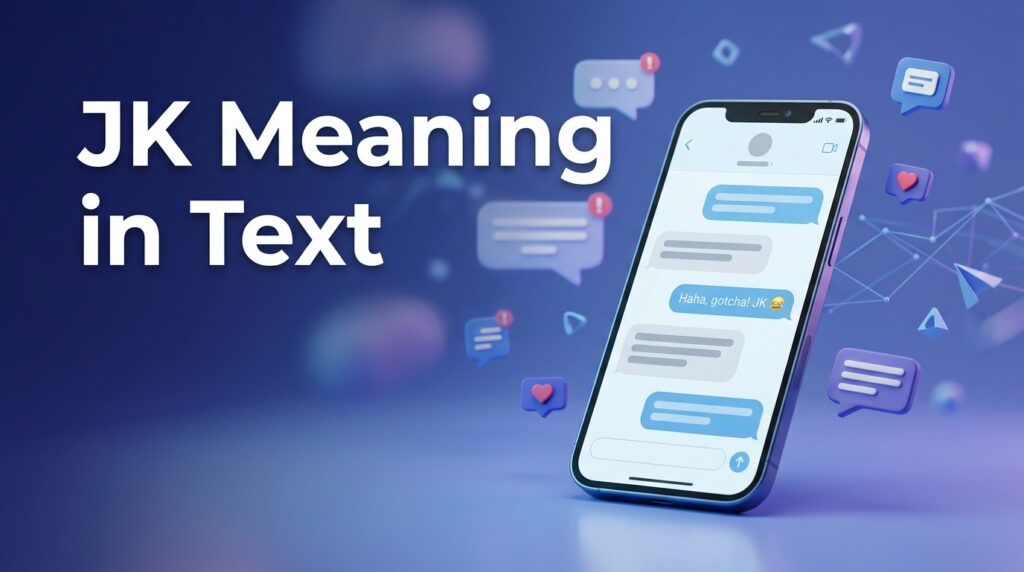

JK meaning in text is “just kidding.” People use JK after a message to show that they were joking and that their previous statement should not be taken seriously. It is common in text messages, social media comments, gaming chats, and casual online conversations. Merriam-Webster also defines JK as an abbreviation for “just kidding.”
| Term | Meaning | Context |
|---|---|---|
| JK | Just kidding | Text messages, chats, comments, and social media |
| J/K | Just kidding | An alternative spelling of JK |
| jk | Just kidding | Lowercase version used in casual messages |
| I’m jk | I’m just kidding | Used to clarify that a statement was a joke |
JK is usually added at the end of a sentence. For example, someone may text, “Your new haircut looks terrible, JK!” The letters tell the reader that the negative comment was intended as a joke.
However, JK does not always fix an upsetting message. Tone, relationship, timing, and context still matter. A playful joke between close friends may be harmless, while the same words may feel rude when sent to a coworker, stranger, or new dating match.
Meaning & Definition
JK is an initialism formed from the first letters of “just kidding.” In digital communication, it tells the reader that a statement was playful, humorous, exaggerated, or not completely serious.
The most common interpretation is simple:
JK means “just kidding” in texting and online conversations.
People may write it in uppercase, lowercase, or with a slash:
- JK
- jk
- J/K
- j/k
- I’m jk
- Just jk
All these versions usually communicate the same basic meaning. Dictionary sources recognize JK as an abbreviation for “just kidding,” while language references also list J/K as an alternative form.
Real-World Examples of JK
Example 1
Person A: “You have to buy everyone dinner tonight.”
Person B: “What?”
Person A: “JK, we already ordered pizza.”
Here, JK tells Person B that the demand was not serious.
Example 2
Person A: “I deleted your presentation.”
Person B: “Please tell me you didn’t.”
Person A: “JK! I only renamed the file.”
The second message removes the false impression created by the first message.
Example 3
Person A: “I’m never speaking to you again.”
Person B: “Why?”
Person A: “JK, but you did forget my birthday.”
In this example, the person is joking but may still be expressing a real complaint. This shows why JK sometimes carries a mixed tone.
Is JK Always Friendly?
JK is often friendly, but not automatically. It may be used to:
- Mark an obvious joke
- Reduce the seriousness of a statement
- Tease a friend
- Correct a misunderstanding
- Take back a risky comment
- Hide embarrassment
- Test another person’s reaction
Readers should consider the full conversation rather than interpreting the letters alone.
Background
JK developed as a shortened form of “just kidding” during the growth of online chat, instant messaging, forums, text messaging, and other fast digital communication.
A precise first use is difficult to identify because informal abbreviations often spread through private conversations before appearing in published records. Older online writing frequently used the slash form J/K, while modern mobile users often remove the slash and write JK because it is faster.
Internet-language references describe J/K as online jargon used in text messaging, email, chat, blogs, forums, and similar digital spaces.
Why Did People Start Using JK?
Early online communication encouraged short forms because typing was slower and messages often had character limits. Users shortened common expressions into forms such as:
- LOL for “laughing out loud”
- BRB for “be right back”
- IDK for “I don’t know”
- BTW for “by the way”
- JK for “just kidding”
JK also solves an important communication problem: written messages do not include facial expressions, voice, laughter, or body language.
During an in-person conversation, a smile or playful voice may show that a person is joking. In text, the same sentence can look serious. Adding JK acts as a small tone marker.
How JK Has Evolved
JK was once mainly associated with chat rooms, forums, and basic text messages. It now appears across:
- TikTok
- Snapchat
- Discord
- Dating apps
- Multiplayer games
- Workplace messaging tools
Its meaning has stayed mostly consistent, but its function has become broader. Today, people use JK not only after jokes but also to soften criticism, express playful sarcasm, flirt, avoid awkwardness, or withdraw an uncertain statement.
Sometimes JK means, “That was completely a joke.” In other situations, it means, “There was some truth in what I said, but I do not want the conversation to become serious.”
Context reveals the difference.
Also Read: Ionk Meaning in Text: Definition, Uses & Examples
Usage in Different Contexts
JK has the same basic meaning across most digital spaces, but its tone can change according to the platform and relationship.
Text Messages
In personal text messages, JK commonly follows teasing or exaggerated comments.
Example:
“You owe me $500 for replying late. JK!”
The sender creates an unrealistic demand and immediately shows that it was not serious.
JK may also appear in a separate message:
“I’m moving to another country.”
“JK 😂”
Sending JK separately can create a short moment of surprise before revealing the joke.
Social Media
On social media, JK may appear in captions, replies, comments, memes, or short videos.
Example:
“Best cooking tutorial ever. I only burned the kitchen twice. JK.”
In public comments, JK can help prevent other users from reading playful criticism as a genuine attack. However, strangers may still misunderstand the tone because they do not know the writer’s personality.
Gaming
Gamers use JK during friendly competition, team chat, voice-chat messages, and Discord conversations.
Example:
“Worst teammate on the server. JK, that save was amazing.”
Gaming conversations move quickly, so short expressions such as JK, GG, AFK, BRB, and LOL are useful. JK allows a player to tease another player without making the message appear completely hostile.
It should not be used to excuse harassment, insults, threats, or repeated personal attacks.
Online Communities
In forums, group chats, and online communities, JK can clarify playful exaggeration.
Example:
“Anyone who dislikes this movie should be banned. JK, everyone has different taste.”
The abbreviation shows that the first sentence was intentionally exaggerated.
Community culture matters. Some groups use dry humor regularly, while others prefer direct and respectful communication. A joke that works in one community may seem confusing in another.
Professional Communication
JK is less suitable for formal communication.
It may be acceptable in a relaxed internal chat between coworkers who know each other well:
“Another Monday meeting? My favorite thing ever. JK.”
It is usually better to avoid JK in:
- Job applications
- Client proposals
- Official reports
- Legal communication
- Customer complaints
- Academic assignments
- Messages to senior executives
- Sensitive workplace discussions
In professional writing, clearer wording is safer.
Instead of writing:
“Your report nearly broke the system, JK.”
Write:
“I noticed a formatting issue in the report, but it should be easy to correct.”
Meaning in Chat, WhatsApp, Instagram, TikTok
JK generally means “just kidding” on all major messaging and social media platforms. The main difference is how people use it.
| Platform | Meaning | Example Usage |
|---|---|---|
| Chat | Just kidding | “I’m blocking you. JK!” |
| Just kidding | “You’re buying dinner tonight, jk.” | |
| Just kidding | “Worst photo ever 😂 JK, you look great.” | |
| TikTok | Just kidding | “I definitely learned this dance in one try. JK.” |
| Snapchat | Just kidding | “I’m deleting my account. JK.” |
| Discord | Just kidding | “We lost because of you. JK, good game.” |
| Just kidding | “I never want another vacation. JK!” | |
| Dating apps | Just kidding or playful teasing | “I only match with professional chefs. JK.” |
JK Meaning in Chat
In a chat conversation, JK tells the other person not to interpret the previous sentence literally.
It often appears after:
- Teasing
- Fake complaints
- Playful insults
- Exaggerated reactions
- Surprise announcements
- Sarcastic comments
Example:
“You replied after six hours, so our friendship is over. JK.”
JK Meaning on WhatsApp
On WhatsApp, JK means “just kidding.” It can appear in private chats, family groups, friend groups, or casual work conversations.
Example:
“Everyone has to arrive at 6 a.m. tomorrow. JK, come at 10.”
Because WhatsApp messages may be read without immediate context, placing JK in the same message can reduce confusion.
JK Meaning on Instagram
Instagram users may use JK in comments, captions, Stories, Reels, and direct messages.
Example comment:
“Delete this photo immediately. JK, it’s perfect.”
When commenting on someone’s appearance, work, or personal life, it is better to avoid jokes that could feel insulting even with JK added.
JK Meaning on TikTok
On TikTok, JK can mark humorous captions, exaggerated claims, reaction comments, or playful responses.
Example:
“I completed this challenge on my first attempt. JK, it took 47 tries.”
Creators may use JK to make a caption feel more conversational. Viewers also use it in comments when correcting a statement that was intentionally unserious.
Meaning in Physics, Medical, and Aircraft Terminology
JK usually means “just kidding” in casual communication. In technical fields, however, the letters may represent something completely different.
| Field | Possible Meaning | Explanation |
|---|---|---|
| Physics | No standard universal meaning | JK is not a widely recognized standalone physics unit or general physics symbol |
| Electronics | JK flip-flop | A digital memory circuit with J and K inputs |
| Medical | Kidd blood group system | JK refers to a clinically important blood group system |
| Aviation | No universal standalone aircraft meaning | JK may appear as a code or identifier, but it is not a general aircraft term |
JK Meaning in Physics
JK does not have one standard, universal meaning in general physics. Its meaning depends on the equation, research paper, course, or technical context in which it appears.
Students should not automatically interpret JK as “just kidding” when reading technical material. They should check:
- The symbol definitions
- The equation legend
- The textbook glossary
- Capitalization
- Subscripts
- Units
- The surrounding topic
For example, J and K may be separate variables multiplied together rather than a single abbreviation.
JK Meaning in Electronics
In digital electronics, a JK flip-flop is a memory circuit used in sequential logic systems.
It has two main inputs called J and K. Depending on the input values and clock signal, the circuit can preserve, set, reset, or toggle its output. Electronics references describe the JK flip-flop as a variation of the SR flip-flop that uses feedback to improve its operation.
Therefore, JK in electronics does not mean “just kidding.”
JK Meaning in Medical Terminology
In medicine and transfusion science, JK refers to the Kidd blood group system.
The Kidd system includes red blood cell antigens known as Jkᵃ, Jkᵇ, and Jk3. Medical references explain that the system was discovered in 1951 and that Kidd antibodies can be clinically important in blood transfusions.
Kidd antibodies may be associated with transfusion reactions, which is why healthcare professionals consider them during blood testing and compatibility assessment.
This medical meaning is highly specialized and should not be confused with texting slang.
JK Meaning in Aircraft or Aviation Terminology
JK does not have one universal standalone meaning for an aircraft, flight operation, or standard aviation instruction.
Aviation uses many codes, abbreviations, aircraft type designators, airline identifiers, and internal document references. A pair of letters may have a specific meaning in one system without being a general aviation term.
Official FAA resources maintain approved aviation contractions and aircraft type designators, while IATA maintains separate airline and transport coding systems. Therefore, the meaning of JK in an aviation document must be confirmed from that document’s glossary or coding system.
In an ordinary message from a pilot, passenger, or airline employee, JK may still simply mean “just kidding.”
Common Misconceptions
Several misunderstandings occur because JK is short and highly dependent on context.
Misconception 1: JK Means “Joke”
Some readers assume JK is a shortened spelling of “joke.”
Its standard texting meaning is “just kidding.” Although “joke” and “just kidding” express similar ideas, JK is formed from the first letters of “just” and “kidding.”
Misconception 2: JK Makes Every Comment Harmless
Adding JK does not automatically remove the effect of a hurtful statement.
For example:
“You are completely useless. JK.”
The abbreviation does not necessarily make the insult acceptable. The recipient may believe the sender is hiding criticism behind humor.
Misconception 3: JK Is Only Used by Teenagers
Teenagers commonly use texting abbreviations, but JK is not limited to one age group. Adults also use it in personal messages, comments, gaming chats, and informal workplace conversations.
Misconception 4: JK Always Means the Person Was Completely Joking
Sometimes the sender is only partly joking.
“I would date you if you were less annoying. JK.”
The message may contain flirting, criticism, or a test of the other person’s reaction. Readers should consider the relationship and previous conversation.
Misconception 5: Capitalization Changes the Meaning
JK, jk, Jk, and j/k usually have the same meaning in casual messages.
Capital letters may make the expression more visible or emotionally stronger, but they do not normally create a different definition.
Misconception 6: JK Is Appropriate Everywhere
JK is informal. It may look careless or confusing in business, academic, medical, legal, or customer-facing communication.
Also Read: OOTD Meaning in Text, Chat & Social Media
Similar Terms & Alternatives
Several slang expressions can communicate humor or reduce seriousness, but they are not exact replacements in every situation.
| Term | Meaning | Difference |
|---|---|---|
| JK | Just kidding | Directly says the previous statement was a joke |
| J/K | Just kidding | Same meaning with a slash |
| LOL | Laughing out loud | Shows amusement rather than retracting a statement |
| LMAO | Laughing very hard | Stronger and more informal than LOL |
| /j | Joking | A tone indicator often placed at the end of a message |
| /s | Sarcasm | Shows that a statement was sarcastic |
| Kidding | Not being serious | Full-word alternative to JK |
| Just joking | The statement was a joke | Clearer but longer than JK |
| Teasing | Playfully making fun | Describes the action rather than correcting a statement |
| NVM | Never mind | Withdraws a message but does not necessarily show humor |
| No offense | Intended to reduce offense | Often follows criticism rather than a joke |
| Seriously | Not joking | Communicates the opposite of JK |
| SRS | Serious | Online shorthand showing that a statement is genuine |
Best Clear Alternatives to JK
When tone could be misunderstood, use a complete phrase:
- “I’m only joking.”
- “I’m teasing.”
- “I didn’t mean that seriously.”
- “That was meant as a joke.”
- “Sorry, I was trying to be funny.”
- “I’m being sarcastic.”
- “Please don’t take that literally.”
Complete sentences are especially helpful when speaking with someone who may not know English texting slang.
How to Respond to It
The best response depends on whether you understood the joke and whether it made you feel comfortable.
| Scenario | Suggested Response |
|---|---|
| You found it funny | “Haha, you got me.” |
| You understood immediately | “I knew you were joking.” |
| You were briefly confused | “You had me worried for a second.” |
| You want to joke back | “Too late, I already believed you.” |
| You did not understand | “What part were you joking about?” |
| The joke felt rude | “I know you said JK, but that comment still bothered me.” |
| You want clarification | “Are you completely joking or partly serious?” |
| Formal conversation | “Thanks for clarifying.” |
| Dating app conversation | “Good, because I was about to unmatch you 😂” |
| Gaming chat | “All good. GG.” |
Casual Responses
When the joke is harmless, you can reply:
- “LOL.”
- “Haha, good one.”
- “You almost fooled me.”
- “I knew it.”
- “Sure you were.”
- “JK accepted.”
Formal or Neutral Responses
In a workplace or unfamiliar conversation, use clearer language:
- “Understood.”
- “Thanks for clarifying.”
- “I wasn’t sure whether you were serious.”
- “Please make that clear next time.”
- “Let’s keep the discussion focused.”
Responding to a Hurtful JK
You do not need to pretend that a joke was funny.
A calm response could be:
“I understand that you were joking, but the comment felt personal.”
This response focuses on the effect of the message without creating unnecessary conflict.
Differences from Similar Words
JK is closely related to humor markers such as LOL, /j, sarcasm, and “just joking,” but each expression performs a different role.
| Expression | Main Purpose | Does It Retract a Statement? | Typical Tone |
|---|---|---|---|
| JK | Shows the previous statement was not serious | Usually yes | Playful or corrective |
| LOL | Shows laughter or amusement | No | Friendly and casual |
| /j | Labels the message as a joke | Usually | Clear online tone marker |
| /s | Labels the message as sarcastic | Not always | Dry or ironic |
| NVM | Tells the reader to ignore something | Yes | Neutral or dismissive |
| No offense | Attempts to soften criticism | No | Defensive or cautious |
| Just saying | Emphasizes an opinion | No | Direct or slightly defensive |
| Seriously | Confirms sincerity | No | Opposite of JK |
| Kidding | Full-word version of JK | Yes | Clear and conversational |
JK vs LOL
JK changes how the previous sentence should be interpreted. LOL mainly shows that something is funny.
Example:
“You failed the easiest level, JK.”
The sender retracts the criticism.
“You failed the easiest level, LOL.”
The sender appears to laugh at the other person and may still mean the criticism.
JK vs /J
Both JK and /j signal joking.
JK is a traditional texting abbreviation, while /j is a tone indicator often used in online communities. The slash form is useful when a sentence might otherwise sound serious.
JK vs Sarcasm
A joke is not always sarcastic, and sarcasm is not always harmless.
JK says the message was not meant literally. Sarcasm often communicates the opposite of the words used.
Example:
“Wonderful, another two-hour meeting.”
This may be sarcastic even without JK.
JK vs “No Offense”
“No offense” usually introduces or follows a real opinion that may upset someone. JK suggests the statement itself was not serious.
Neither phrase gives permission to insult another person.
Relevance in Online Conversations & Dating Apps
JK remains useful because modern conversations happen through short written messages. People often reply quickly and without the facial expressions or vocal cues available in person.
Social Media Usage
On social media, JK helps users:
- Mark playful comments
- Correct exaggerated captions
- Signal friendly teasing
- Reduce confusion
- Add a conversational tone
- Respond to memes
- Clarify sarcasm
Public communication creates extra risk because readers may not share the same culture, age, language level, or sense of humor.
A sentence that seems obviously playful to the writer may appear serious to thousands of readers.
Dating App Usage
JK is common in dating app conversations because playful teasing can create a relaxed and flirtatious tone.
Example:
“I only go on dates with people who bring me coffee. JK… unless you want to.”
Here, JK softens the demand while leaving space for flirtation.
Another example:
“You took three hours to reply, so the wedding is cancelled. JK.”
The message uses exaggeration to show interest without sounding too demanding.
However, JK should not be used to disguise:
- Sexual pressure
- Disrespect
- Personal insults
- Jealous behavior
- Controlling comments
- Threats
- Repeated boundary testing
Healthy flirting should feel mutual and comfortable.
Messaging Etiquette
Use JK when the joke is easy to understand and unlikely to hurt the recipient.
Avoid it when discussing:
- Health emergencies
- Death
- Breakups
- Employment
- Money problems
- Personal insecurities
- Family conflict
- Legal matters
- Safety
- Trauma
Someone may experience real stress before reaching the JK at the end of a message.
For example:
“I was in a serious accident. JK.”
This type of joke can create unnecessary fear and damage trust.
Modern Communication Trends
Digital communication increasingly uses tone markers, emojis, GIFs, reaction buttons, and abbreviations to replace missing body language.
JK can be combined with emojis:
- JK 😂
- JK 😭
- JK 😜
- JK 🙃
- JK lol
Each combination changes the emotional tone slightly. A laughing emoji makes the joke more obvious, while a neutral message containing only “JK” may feel dry, defensive, or uncertain.
People searching for unfamiliar chat abbreviations can use Meanigo as a helpful starting point. Meanigo focuses on explaining slang meanings in simple language, including definitions, examples, platform-specific use, and suitable replies. Context should still guide the final interpretation because the same letters can have different meanings in technical or personal settings.
Frequently Asked Questions
What does JK mean in texting?
JK means “just kidding” in texting. It tells the recipient that the sender was joking or that the previous statement should not be interpreted literally. For example, “I ate all your snacks, JK” means the person probably did not eat them and was only teasing.
What is the full form of JK?
The full form of JK in chats and text messages is “just kidding.” It is created from the first letter of “just” and the first letter of “kidding.” Uppercase JK, lowercase jk, and the alternative form J/K generally carry the same meaning.
Does JK have multiple meanings?
Yes. In ordinary online conversations, JK usually means “just kidding.” In digital electronics, JK may refer to a JK flip-flop. In medical terminology, JK can refer to the Kidd blood group system. The correct meaning depends on the subject, platform, capitalization, and surrounding words.
Is JK commonly used on TikTok?
Yes. TikTok users may write JK in video captions, comments, replies, and direct messages. It usually marks a joke, exaggeration, or playful correction. For example, “I learned this dance in one minute, JK” tells viewers that the creator needed more time.
What does JK mean on WhatsApp?
On WhatsApp, JK means “just kidding.” It is commonly used in chats and group messages after teasing, fake announcements, or exaggerated statements. Writing JK in the same message is usually clearer than sending it later because the recipient is less likely to misunderstand the joke.
What does JK mean from a girl?
When a girl writes JK, it normally means “just kidding,” just as it does when anyone else uses it. Depending on the conversation, it may show teasing, flirting, embarrassment, or an attempt to soften a serious thought. Gender alone does not change the definition.
What does JK mean from a guy?
When a guy sends JK, he is usually saying that his previous comment was a joke. However, he may sometimes be testing your reaction or withdrawing a statement that felt too direct. Read the messages before and after JK to understand whether he was completely serious.
Is JK rude?
JK itself is not rude. Its effect depends on the message attached to it. A harmless joke between friends may be friendly, while a personal insult followed by JK can still feel disrespectful. Adding JK does not erase the emotional impact of hurtful words.
What is the difference between JK and LOL?
JK means “just kidding” and changes how the previous statement should be understood. LOL means “laughing out loud” and shows amusement. A person can use both together, but they serve different purposes. JK retracts seriousness, while LOL expresses laughter.
What does “I’m JK” mean?
“I’m JK” means “I’m just kidding.” The sender is clarifying that a previous statement was not fully serious. Although many people understand this form, “I’m kidding” or “I was just joking” may sound more natural and clearer in complete English sentences.
Can JK mean “joking”?
People sometimes interpret JK as “joking” because the meanings are similar. However, the commonly accepted full form is “just kidding.” Saying someone is joking communicates almost the same idea, but the letters J and K specifically come from “just” and “kidding.”
Should JK be used in professional emails?
JK should generally be avoided in formal professional emails. It may make the message appear careless or create uncertainty about what is serious. In relaxed coworker chats it may be acceptable, but phrases such as “I’m only joking” or “That was meant lightheartedly” are clearer.
What does JK mean on Snapchat?
On Snapchat, JK means “just kidding,” just as it does in texts. It appears in Snaps, Stories, and chat messages when someone posts an exaggerated claim or a playful tease — for example, “This filter makes me look famous, JK.” Because Snaps disappear quickly, putting JK in the same message avoids confusion better than sending it as a separate Snap later.
Can JK Stand Alone as a Reply?
JK usually appears in the same message as the joke, right after the statement it softens — for example, “I ate the last slice, JK.” But it can also stand alone as a follow-up message. If you send a dramatic claim and then immediately send “JK” as its own message, the reader still connects it to the line above it, and the short pause can even make the joke land better. What does not work is sending a lone “JK” hours later, or as a reply to someone else’s message — without the original joke above it, the reader has nothing to connect it to. As a reply to another person’s joke, a reaction such as “LOL” or “you got me” makes more sense than a bare “JK.”
Conclusion
JK meaning in text is “just kidding.” It is used to show that a previous message was playful, exaggerated, teasing, or not meant literally. The abbreviation commonly appears in text messages, WhatsApp chats, Instagram comments, TikTok captions, gaming conversations, and dating apps.
Context remains important. JK can clarify harmless humor, but it does not automatically make an offensive statement acceptable. In formal or sensitive conversations, complete phrases such as “I was only joking” are often clearer.
JK may also have specialized meanings outside texting. It can refer to a JK flip-flop in electronics or the Kidd blood group system in medicine. For clear explanations of texting abbreviations and online slang, Meanigo can serve as a useful reference that helps readers understand meanings, examples, context, and appropriate responses.
Related:
https://meanigo.com/xd-meaning-in-text/


Pingback: TBF Meaning in Text: Full Form, Examples & Usage
Pingback: JP Meaning in Text: Just Playing & Other Meanings
Pingback: BD Meaning in Text: Baby Daddy, Birthday & More