
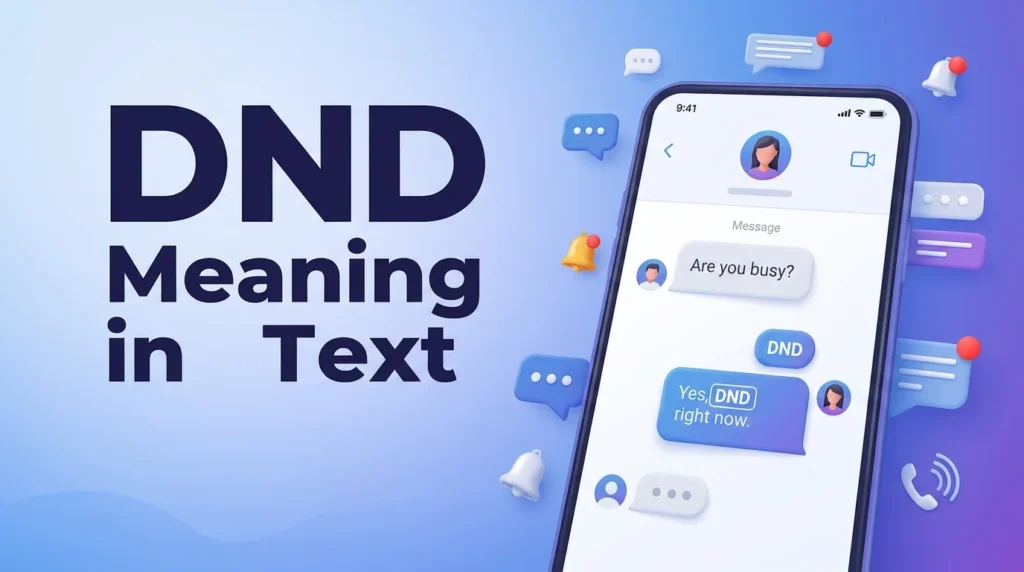

DND meaning in text is usually “Do Not Disturb.” A person may write DND to show that they are busy, resting, working, studying, or temporarily unavailable. However, DND can also mean “Dungeons & Dragons” in gaming conversations, so the correct interpretation depends on the message, platform, and topic.
| Term | Meaning | Context |
|---|---|---|
| DND | Do Not Disturb | Texting, phone settings, social media and personal boundaries |
| DnD or D&D | Dungeons & Dragons | Gaming, fantasy and tabletop role-playing communities |
| DND | Delayed Neuronal Death | Certain medical and scientific contexts |
| DND | Specialized abbreviation or identifier | Aviation, research and professional documents |
The easiest way to understand DND is to read the words around it. “My phone is on DND” means notifications are silenced, while “We are playing DnD tonight” refers to the fantasy role-playing game.
When an abbreviation has several possible definitions, a context-focused meaning resource such as Meanigo can be a useful starting point. The final interpretation, however, should always match the conversation.
Meaning & Definition
In everyday texting, DND stands for “Do Not Disturb.” It tells another person that the sender does not want to receive calls, messages, notifications, or interruptions for a certain period.
People may use it as a request:
- “DND for the next hour.”
- “Please DND, I am studying.”
- “Going on DND until the meeting ends.”
They may also use it to describe a phone setting:
- “Sorry I missed your call. My phone was on DND.”
- “I keep DND on while sleeping.”
- “Your message came through, but I was in DND mode.”
On smartphones, Do Not Disturb is a notification-control feature. It can silence or filter calls, messages, conversations, and app alerts. Users may also allow exceptions for selected people, applications, alarms, or repeat callers. Therefore, DND does not always block every notification completely.
The common interpretation is simple:
DND means the person is temporarily unavailable or does not want to be interrupted.
However, capitalization and context can change the meaning. In gaming communities, “DnD” commonly refers to Dungeons & Dragons, the tabletop role-playing game. The official game uses the abbreviation D&D, although people frequently type DnD when an ampersand is inconvenient.
Consider these examples:
- “I’m switching on DND so I can finish this report.”
Meaning: Do Not Disturb. - “Our DnD campaign starts at 7.”
Meaning: Dungeons & Dragons. - “She keeps her phone on DND at night.”
Meaning: Do Not Disturb mode. - “Which class do you play in DnD?”
Meaning: A character class in Dungeons & Dragons.
The difference becomes clear when you look at nearby words such as “phone,” “notifications,” “campaign,” “character,” “meeting,” or “sleep.”
Background
The phrase “do not disturb” existed long before texting. It has traditionally been used as a polite request for privacy, quiet, or uninterrupted time. A person could place a sign on a door to tell others not to enter or interrupt.
Digital communication gave the phrase a new purpose. Mobile phones, computers, messaging platforms, and workplace applications introduced notification-management features. Instead of typing the complete phrase, users began shortening “Do Not Disturb” to DND.
Modern devices allow people to control which interruptions are permitted. A user can silence general notifications while still allowing alarms, urgent calls, selected contacts, or repeat callers. This has made DND more than a simple abbreviation—it now represents a digital boundary between availability and personal time.
People commonly use DND because they are:
- Sleeping
- Studying
- Driving
- Attending a meeting
- Spending time with family
- Recording audio or video
- Playing a game
- Working without interruptions
- Taking a break from social media
- Protecting their privacy
- Managing stress or notification overload
The abbreviation has also evolved into social language. Someone might say, “I’m in my DND era,” meaning they are limiting access to their time and attention. In this sense, DND communicates personal boundaries rather than merely describing a phone feature.
At the same time, DnD developed independently as a written variation of D&D. Dungeons & Dragons was first published in 1974 and became one of the best-known tabletop role-playing games. Online communities often use DnD because it is easier to type in usernames, hashtags, search bars, and website addresses.
Therefore, the history of the abbreviation follows two major paths:
- Do Not Disturb: Privacy, availability and notification management.
- Dungeons & Dragons: Fantasy gaming and tabletop role-playing.
Usage in Different Contexts
The meaning of DND changes according to the platform and subject of the conversation.
Text Messages
In ordinary text messages, DND most often means Do Not Disturb.
Examples:
- “I’m going to sleep, DND.”
- “DND until my exam is over.”
- “Call me later because my phone is on DND.”
- “I need two hours of DND time to finish this.”
In these examples, the sender is setting a temporary communication boundary.
Social Media
On social media, DND can describe a mood, status, boundary, or phone setting.
Examples:
- “DND today. I need some personal time.”
- “Notifications off, DND activated.”
- “Weekend mode: DND.”
- “I keep Instagram on DND while working.”
A creator may also write “DND” in a bio or story to show that replies will be delayed.
Gaming
Gaming is the context in which DND is most likely to have two meanings.
It may mean Do Not Disturb when a player does not want invitations or messages:
- “Set your status to DND before the tournament.”
- “I’m on DND because I’m in a ranked match.”
It may mean Dungeons & Dragons when people discuss campaigns, characters, dice, fantasy worlds or tabletop games:
- “We have a DnD session tonight.”
- “I created a new DnD character.”
- “Who is the Dungeon Master for your campaign?”
Dungeons & Dragons is officially written as D&D, but DnD is a widely understood text-friendly form.
Online Communities
In forums, Discord servers, Reddit communities and group chats, context is especially important.
“DND in bio” may mean that a person does not want direct messages. In a fantasy server, however, DnD will probably refer to Dungeons & Dragons.
Examples:
- “DND unless you are a moderator.”
Meaning: Do not message or interrupt. - “Looking for a DnD group.”
Meaning: Looking for Dungeons & Dragons players. - “DND while streaming.”
Meaning: Do not send notifications or invitations.
Professional Communication
In workplace messaging, DND generally means that someone is unavailable, focusing, presenting, or attending a meeting.
Examples:
- “I will be on DND from 2:00 to 3:00.”
- “Please use DND mode during the presentation.”
- “My status was set to DND, so I did not see the message.”
Although the abbreviation is common in internal chats, the complete phrase is clearer in formal emails or customer communication.
Instead of writing:
“I’ll be DND this afternoon.”
A clearer professional version would be:
“I will be unavailable this afternoon and may respond later than usual.”
Also Read: Meaning in Text: Flirting, Sarcasm and Shade
Meaning in Chat, WhatsApp, Instagram, TikTok
Across messaging and social media platforms, DND usually communicates limited availability. However, the exact tone can vary.
| Platform | Meaning | Example Usage |
|---|---|---|
| General chat | Do Not Disturb | “DND for an hour. I need to focus.” |
| Phone notifications silenced or person unavailable | “Sorry, WhatsApp was on DND.” | |
| Not accepting interruptions, messages or calls | “DND today. Replies will be late.” | |
| TikTok | Notification boundary, focus mode or lifestyle trend | “POV: You finally put everyone on DND.” |
| Snapchat | Temporarily unavailable or notifications muted | “Going DND before bed.” |
| Discord | Busy status, muted notifications or Dungeons & Dragons | “I’m DND during the match.” |
| Gaming chat | Do Not Disturb or Dungeons & Dragons | “DND mode on” versus “DnD session tonight” |
| Workplace chat | Focus status or temporary unavailability | “DND until the client call ends.” |
DND Meaning on WhatsApp
On WhatsApp, DND usually means that the person’s phone is set to Do Not Disturb or that they do not want to be contacted temporarily.
WhatsApp itself may continue receiving messages. The user may simply not hear or see alerts immediately. Therefore, one check mark, two check marks or a delayed reply should not automatically be interpreted as rejection.
DND Meaning on Instagram
On Instagram, users may write DND in a bio, story, caption or direct message. It often means:
- Do not send repeated messages.
- Replies may be delayed.
- The user is taking a social media break.
- The person wants privacy or uninterrupted time.
- Notifications have been muted.
A profile that says “DND” is setting a boundary, not necessarily blocking communication permanently.
DND Meaning on TikTok
On TikTok, DND is often used in videos about phone habits, personal boundaries, sleep, focus, productivity or avoiding constant notifications.
A caption such as “Keeping everyone on DND” usually means the creator has silenced notifications or limited who can interrupt them. It may be humorous, serious or part of a discussion about controlling digital access.
DND Meaning in Chat
In ordinary chat, the simplest interpretation is:
“I am busy or unavailable, so please do not interrupt me right now.”
If the conversation mentions dice, characters, campaigns, fantasy classes or a Dungeon Master, it probably means Dungeons & Dragons instead.
Meaning in Physics, Medical, and Aircraft Terminology
DND does not have one universal definition across science, medicine and aviation. Technical abbreviations must be interpreted according to the document and field.
| Field | Possible Meaning | Explanation |
|---|---|---|
| Physics | No universal general meaning | DND may be an author-defined label, model name or particle combination in a specific paper |
| Medical | Delayed Neuronal Death | Neuronal death that occurs after an initial injury or event |
| Medical records | Other local meanings may exist | Some abbreviation lists record meanings such as “died a natural death” |
| Aviation | Department of National Defence, Canada | Used in certain FAA charting and abbreviation references |
| Aviation identifier | Eldinder Airlines | DND appears as an ICAO three-letter company identifier |
| Everyday aircraft communication | Usually not Do Not Disturb | The meaning must be checked against the aviation document |
DND in Physics
There is no single, widely accepted general physics definition for DND comparable to terms such as force, velocity or energy.
Researchers can define DND for a particular model, experiment or mathematical expression. For example, particle-physics research may use combinations such as (DND^) when discussing possible bound states involving specific particles. In that case, D, N and D represent particles rather than the words “Do Not Disturb.”
Therefore, when DND appears in a physics paper, consult the paper’s abbreviation list, equation definitions or methodology section.
Also Read: WLW Meaning in Text: What It Means and How to Use It
DND in Medical Terminology
In medical and neuroscience contexts, DND can mean Delayed Neuronal Death. This describes neuronal cell death that occurs after an initial injury rather than immediately.
However, medical abbreviations are not always universal. Older or specialized abbreviation lists also record DND as “died a natural death.” Because these meanings are very different, medical staff and readers should never guess from the letters alone.
The safe interpretation must come from:
- The patient record
- The medical specialty
- The surrounding sentence
- The institution’s approved abbreviation list
- Clarification from a qualified healthcare professional
DND should not be confused with DNR, which commonly refers to “Do Not Resuscitate,” or DNI, which can mean “Do Not Intubate.”
DND in Aviation and Aircraft Terminology
In FAA charting references, DND is listed for Canada’s Department of National Defence. It is not being used there as the phone setting “Do Not Disturb.”
DND also appears in FAA aircraft-company identifier material as the three-letter identifier for Eldinder Airlines, with the associated call sign “DINDER.”
Therefore, DND is not a standard universal name for an aircraft component, engine system or flight-control feature. In aviation documents, it may be an agency abbreviation, operator identifier or document-specific code.
Common Misconceptions
Several misunderstandings can occur because DND has more than one meaning.
Misconception 1: DND always means Do Not Disturb
What people assume: Every use of DND refers to silenced phone notifications.
What it actually means: Do Not Disturb is the most common texting meaning, but DnD can mean Dungeons & Dragons in gaming conversations.
Misconception 2: DND blocks every call and message
What people assume: Messages cannot be delivered while DND is active.
What it actually means: Do Not Disturb usually controls alerts and interruptions. Users can often permit selected people, apps, alarms or repeat callers.
Misconception 3: DND means someone has blocked you
What people assume: A delayed response means they have been blocked.
What it actually means: The person may simply have notifications silenced, be sleeping, working or taking a break.
Misconception 4: DND is automatically rude
What people assume: Using DND means a person is deliberately ignoring others.
What it actually means: It is often a practical way to manage concentration, rest and personal boundaries.
Misconception 5: DND and DNR mean the same thing
What people assume: The medical abbreviations are interchangeable.
What it actually means: They are different abbreviations. DNR is commonly associated with resuscitation instructions, while DND may have specialized medical meanings that must be confirmed.
Misconception 6: Capitalization always reveals the meaning
What people assume: DND means Do Not Disturb, while DnD always means the game.
What it actually means: Capitalization is a helpful clue, but users frequently type abbreviations inconsistently. Context remains more reliable.
Similar Terms & Alternatives
| Term | Meaning | Difference |
|---|---|---|
| DND | Do Not Disturb | Requests no interruption or describes a notification setting |
| DnD | Dungeons & Dragons | Refers to the fantasy tabletop role-playing game |
| AFK | Away From Keyboard | The person has stepped away from a device |
| BRB | Be Right Back | The person expects to return soon |
| TTYL | Talk To You Later | Ends or pauses a conversation politely |
| Busy | Currently occupied | Clearer than DND in professional communication |
| OOO | Out of Office | Usually relates to work absence |
| Mute | Silence one chat, contact or source | More targeted than general DND mode |
| Silent Mode | Turns off device sounds | May still allow visible notifications |
| Focus Mode | Limits distractions for a task | Often customized around work, study or sleep |
| Airplane Mode | Disables wireless connections | More restrictive than DND |
| Ghosting | Ending communication without explanation | A social behavior, not a phone setting |
DND is most useful when the sender wants to establish a temporary boundary. AFK and BRB describe availability, while mute and silent mode describe specific technical settings.
How to Respond to It
Your response should respect the sender’s availability and match the tone of the conversation.
| Scenario | Suggested Response |
|---|---|
| Friend says, “DND, I’m studying” | “No problem. Message me when you’re free.” |
| Partner says, “Going DND for an hour” | “Okay, talk to you later.” |
| Coworker says, “DND during the meeting” | “Understood. I’ll send the details for later.” |
| Someone missed your call due to DND | “No worries. Call me when convenient.” |
| You are unsure what DND means | “Do you mean Do Not Disturb or Dungeons & Dragons?” |
| Gamer says, “We have DnD tonight” | “Nice! What campaign are you playing?” |
| Message is urgent | “I understand you’re on DND, but please check this when possible—it is urgent.” |
| Dating-app match says, “I keep my phone on DND” | “That’s fine. Reply whenever you have time.” |
A casual response can be brief:
- “Okay, no worries.”
- “Got it.”
- “Talk later.”
- “Message me when free.”
A formal response should be more specific:
- “Understood. I will follow up after your meeting.”
- “Thank you for letting me know. Please respond when convenient.”
- “I will avoid calling during that time.”
- “I have sent the information for you to review later.”
Do not repeatedly call or send several messages after someone requests DND unless there is a genuine emergency.
Differences from Similar Words
| Term | Main Function | Does It Stop Delivery? | Typical Use |
|---|---|---|---|
| DND | Limits alerts and interruptions | Usually no | Sleep, meetings, focus and privacy |
| Silent Mode | Turns off sounds | Usually no | Quiet environments |
| Mute | Silences a selected chat or app | No | Group chats or noisy conversations |
| Airplane Mode | Disables wireless communication | Often yes, until reconnected | Flights or complete disconnection |
| AFK | Shows temporary absence | No | Gaming and online chat |
| Busy | Communicates limited availability | No | Work and everyday conversation |
| Ghosting | Stops replying without explanation | Not a technical setting | Dating and social relationships |
| Block | Prevents or restricts contact | Often yes | Privacy, safety or unwanted communication |
DND vs Silent Mode
Silent mode normally removes notification sounds. DND offers more control and may filter calls, people, applications or conversations.
DND vs Mute
Mute usually applies to one person, chat, group or application. DND can apply to the entire device or status.
DND vs Airplane Mode
DND controls interruptions while the device remains connected. Airplane mode disables wireless connections unless the user turns selected connections back on.
DND vs AFK
DND means “do not interrupt me.” AFK means “I am not currently at my keyboard or device.”
DND vs Ghosting
DND communicates a temporary boundary. Ghosting involves ending or avoiding communication without a clear explanation.
DND vs DnD
DND usually means Do Not Disturb. DnD generally refers to Dungeons & Dragons when the conversation includes gaming terms.
Relevance in Online Conversations & Dating Apps
DND has become relevant because modern communication creates an expectation of constant availability. Messages can arrive through SMS, WhatsApp, Instagram, TikTok, Snapchat, Discord, email, dating apps and workplace platforms at any time.
Using DND allows people to decide when they will engage. It can support concentration, sleep, privacy and healthier communication habits.
On social media, DND may appear in:
- Profile bios
- Stories
- Captions
- Status updates
- Direct messages
- Productivity content
- Digital-detox discussions
- Relationship posts
- Humorous videos
- Gaming streams
On dating apps, DND usually means one of three things:
- The person keeps notifications silenced.
- The person does not reply immediately.
- The person is setting a boundary around communication.
For example:
“My phone stays on DND during work, so I may reply at night.”
This is usually an explanation of messaging habits, not a sign of disinterest.
However, if a profile says, “DND fan,” the person may be referring to Dungeons & Dragons. Look for related terms such as tabletop games, fantasy, campaigns, dice, role-playing or Dungeon Master.
Good messaging etiquette includes:
- Respecting stated boundaries
- Avoiding repeated calls
- Not demanding immediate replies
- Identifying genuinely urgent messages
- Asking for clarification when the meaning is uncertain
- Using the full phrase in formal situations
- Avoiding assumptions about rejection or blocking
DND reflects a wider change in communication. People are becoming more intentional about when and how they respond. Being reachable does not always mean being available.
Frequently Asked Questions
What does DND mean in texting?
DND usually means “Do Not Disturb” in texting. It tells others that the sender is busy, sleeping, studying, working or temporarily unavailable. It may also explain why someone missed a call or responded late. In gaming discussions, DnD can instead mean Dungeons & Dragons.
Does DND have multiple meanings?
Yes. The most common meaning in texts and social media is Do Not Disturb. In gaming, DnD commonly means Dungeons & Dragons. It may also have specialized definitions in medicine, scientific research and aviation, so the surrounding topic should guide the interpretation.
Is DND commonly used on TikTok?
Yes. TikTok users use DND in posts about silencing notifications, protecting personal time, setting boundaries, sleeping, studying and improving focus. A phrase such as “everyone is on DND” normally means the creator has muted or filtered incoming notifications.
What does DND mean on WhatsApp?
On WhatsApp, DND usually means that a person has enabled Do Not Disturb mode or does not want to be interrupted. Messages may still be delivered, but the user might not receive an immediate sound, vibration or visible alert.
What does DND mean on Instagram?
On Instagram, DND can mean that a user has muted notifications, is taking a break, does not want repeated direct messages or expects to reply late. It may appear in a bio, story, caption or private conversation.
Does DND mean Dungeons & Dragons?
It can. DnD or D&D refers to Dungeons & Dragons when the conversation mentions campaigns, characters, fantasy, dice, classes, Dungeon Masters or tabletop games. In ordinary phone and messaging conversations, DND is more likely to mean Do Not Disturb.
Is putting someone on DND rude?
Not necessarily. People use DND to sleep, study, work, attend meetings or manage personal boundaries. It may feel rude only when important communication is repeatedly ignored without explanation. Clear expectations can prevent misunderstandings.
Does DND block text messages?
Usually, no. Do Not Disturb generally controls how calls and notifications alert the user rather than preventing message delivery. Depending on the device settings, selected people, applications, alarms or repeat callers may still be allowed to interrupt.
How should I reply when someone says DND?
A respectful reply is best. You can say, “No problem,” “Message me when you’re free,” or “I’ll contact you later.” For an urgent matter, briefly explain why the message requires attention instead of sending repeated calls or texts.
What does “my phone was on DND” mean?
It means the person had Do Not Disturb enabled, so the phone may not have produced its usual sound, vibration or visible alert. The statement commonly explains a missed call, unopened message or delayed response.
What does DND mean on a dating profile?
It may mean that the person keeps notifications silenced, replies slowly or values communication boundaries. It can also mean Dungeons & Dragons if the profile mentions gaming, fantasy, role-playing or tabletop interests.
Where can I check the meaning of texting abbreviations?
A context-based slang and abbreviation resource such as Meanigo can help you identify likely definitions of texting terms. After finding the basic meaning, compare it with the surrounding sentence, platform and conversation topic to confirm the intended use.
What does DND mean by “Down Not Dead”?
In motivational or fitness content — and sometimes in relationship pep-talks — DND means “Down Not Dead.” It is encouragement: someone (or something, like a relationship) is struggling right now, but it is not over. Example: “I know things are tough, but I’m DND.”
Is DNI the same as DND?
No. DND (“Do Not Disturb”) is temporary and about availability — it says “not right now.” DNI (“Do Not Interact”) is a standing boundary, usually in a social media bio, saying certain people or groups should not engage with the account at all.
I received an automatic DND reply. Should I text again?
No — texting back to an automatic DND reply can simply trigger another automatic reply. Your message will be waiting for them, so just sit tight until they are available again, unless it is genuinely urgent.
Other Less Common Meanings of DND
Outside of texting about availability, DND picks up a few different meanings depending on the conversation. In motivational or fitness content, especially on TikTok, “Down Not Dead” is used as a pep talk — someone might be struggling, but they are not finished yet, the equivalent of saying “I’m still standing.” When friends are making plans, “DND” can casually stand for “Dinner and Drinks,” as in “Let’s do DND on Friday.” In file management or social posts, it sometimes means “Do Not Delete,” marking something worth keeping. And in police and news slang, “DND” is short for “drunk and disorderly,” used for someone who is intoxicated and causing a scene. Context is the giveaway: if nobody is talking about phone settings or availability, one of these is probably the intended meaning.
DND vs DNI, DNW and DNC: The “Do Not” Family
DND is part of a whole family of “Do Not” abbreviations, and mixing them up can cause real confusion — especially in social media bios. DNI means “Do Not Interact.” You will see it in profile descriptions where someone lists who should not engage with their content. DNW stands for “Do Not Want,” used to express disinterest in a topic or idea, as in “DNW any spoilers.” DNC means “Do Not Contact,” most often seen in marketing or privacy contexts, telling people not to reach out. The difference is simple: DND means “don’t disturb me right now” — it is temporary and about availability. DNI, DNW and DNC are not about timing; they say who should not engage, what is unwanted, or that no contact is wanted at all. If you spot one of these in a bio, it is a boundary, not a status.
When to Use DND (and When to Avoid It)
DND works best as a short-term boundary. Good moments to use it include studying or exam time, meetings, sleep hours, deep-focus work, or when a group chat is buzzing and you cannot keep up. Pairing it with a reason — “on DND for the next two hours, catching up later” — keeps it friendly instead of abrupt. On the other hand, it is a poor fit when someone is waiting on you for something urgent, or when silence could genuinely worry someone — in an emergency or time-sensitive situation, a quick reply beats DND. Also worth knowing: on some phones, DND can send an automatic “I’m unavailable” reply to incoming texts, and texting back to that auto-reply may just trigger another automatic message. In that case, the respectful move is to wait until the person is available rather than piling on messages.
Conclusion
The most common DND meaning in text is Do Not Disturb. It communicates that someone is busy, resting, focusing or temporarily unavailable. On WhatsApp, Instagram, TikTok and dating apps, it often refers to silenced notifications or personal boundaries.
In gaming conversations, DnD may instead mean Dungeons & Dragons. DND can also have specialized definitions in medicine, physics research and aviation. Because the abbreviation has several meanings, context is the most reliable guide. Look at nearby words, the platform and the subject before deciding what the sender means.
Related:
(Also Read: STSU Meaning in Text: Definition, Uses & Examples → https://meanigo.com/stsu-meaning-in-text/)
(Also Read: FTW Meaning in Text: For the Win Explained → https://meanigo.com/ftw-meaning-in-text/)
(Also Read: HMB Meaning in Text: Definition, Uses, Examples & Social Media → https://meanigo.com/hmb-meaning-in-text/)
(Also Read: HYB Meaning in Text: How You Been Explained → https://meanigo.com/hyb-meaning-in-text/)

Pingback: FYI Meaning in Text: Definition, Examples, Uses and Replies
Pingback: SU Meaning in Text: What It Means & How to Reply
Pingback: SPWM Meaning in Text: What It Means & How to Reply
Pingback: JP Meaning in Text: Just Playing & Other Meanings