
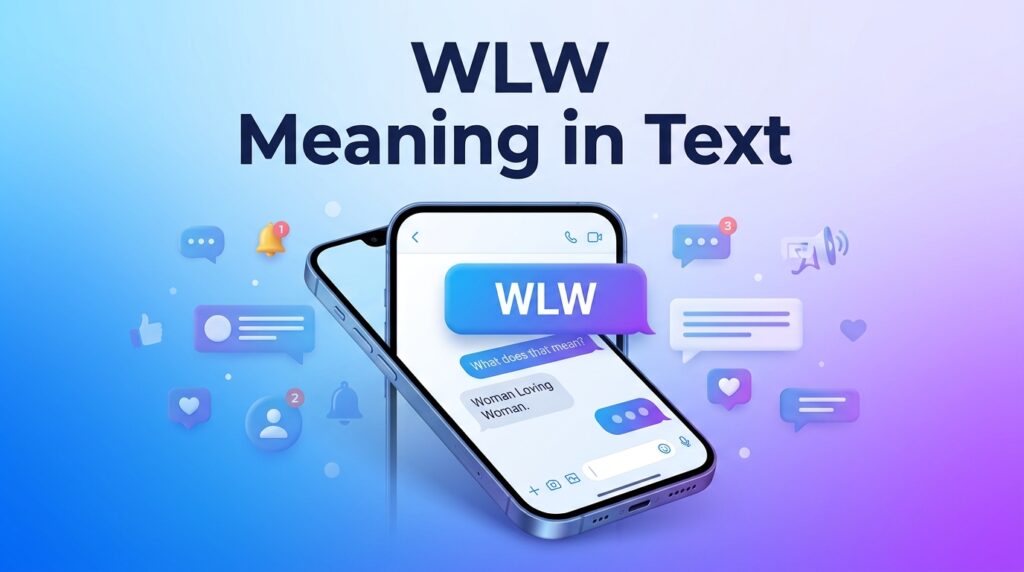

WLW means “women loving women” or “woman-loving woman” in text conversations. It is an LGBTQ+ umbrella term for women who feel romantic, emotional, or sexual attraction toward other women. It may include lesbian, bisexual, pansexual, and queer women rather than referring to one specific sexual orientation.
| Term | Meaning | Context |
|---|---|---|
| WLW | Women loving women | Texting, LGBTQ+ discussions, social media and dating |
| wlw | Lowercase form of WLW | Casual chats, captions, usernames and hashtags |
| WLW relationship | A romantic relationship involving women attracted to women | Dating apps, relationship posts and online communities |
| #wlw | A social media hashtag for content about women who love women | TikTok, Instagram, YouTube and other platforms |
The exact meaning can still depend on context. For example, WLW may refer to a radio station, business name or airport code in specialized settings. However, when it appears in a text message, social media bio or dating profile, it usually means women loving women.
When an unfamiliar abbreviation appears in a conversation, readers should examine the surrounding words before making assumptions. A meaning website such as Meanigo can also serve as a useful starting point for understanding modern slang, abbreviations and online expressions.
Meaning & Definition
WLW is an initialism formed from the first letters of women loving women, women who love women or woman-loving woman. It describes attraction, relationships, experiences or media involving women who are interested in other women.
The most important point is that WLW is an umbrella term. It does not identify one exact sexual orientation.
A woman who describes herself as WLW may identify as:
- Lesbian
- Bisexual
- Pansexual
- Queer
- Omnisexual
- Sapphic
- Unlabeled
- Questioning
For example, a bisexual woman may be attracted to women and people of other genders. She can therefore identify as bisexual and WLW at the same time. A lesbian woman can also be described as WLW because she is attracted to women.
This leads to a simple explanation:
All lesbians may fall under the WLW umbrella, but not every WLW person identifies as a lesbian.
The term focuses on attraction to women instead of defining every part of a person’s sexuality. This broader meaning is one reason it is common in inclusive LGBTQ+ conversations. HER, a dating and community platform for queer people, similarly explains WLW as attraction between women regardless of a person’s more specific sexual orientation.
Here are some real-world examples:
- “The series has a beautiful WLW romance.”
- “I am looking for more WLW book recommendations.”
- “She added WLW to her dating profile.”
- “This group hosts local events for WLW.”
- “Are there any WLW characters in the game?”
In these examples, WLW may describe people, relationships, fictional characters, stories or communities.
Background
The words behind WLW are simple, but the abbreviation became especially useful in online LGBTQ+ spaces. It allowed users to discuss attraction between women without limiting the conversation only to lesbians.
There is no single widely documented person who invented the acronym. Its growth appears to have developed through community use across forums, blogs, fandom spaces and social media.
By 2018, online dictionaries were already documenting WLW as “woman-loving-woman” or “women who love women.” Since then, the term has become increasingly visible in bios, hashtags, dating profiles, videos, books, fan communities and entertainment discussions.
The abbreviation became popular for several practical reasons.
First, it is short. Social media users often need compact language for captions, usernames, hashtags and profile descriptions.
Second, it is inclusive. “Lesbian” describes a specific sexual orientation, while WLW can include women with several identities.
Third, it helps people find relevant communities and content. A person can search for WLW books, movies, couples, creators, events or dating advice.
Fourth, it supports online identity signaling. A person may place “WLW” in a profile to show that she is interested in women without writing a long explanation.
Research published in 2025 examined how the #wlw hashtag moved from TikTok communities to RedNote. The study described the hashtag as both an identity marker and a connection tool for queer women, showing how the abbreviation can cross platforms and cultures.
The meaning has remained mostly stable: it continues to describe women’s romantic, emotional or sexual attraction toward women. However, personal boundaries around the label can differ. Some nonbinary people may feel connected to WLW or sapphic communities, while others may prefer terms such as NBLW, queer or sapphic.
Labels should therefore be based on self-identification. It is better to use the language a person chooses for herself rather than assigning a label from the outside.
Usage in Different Contexts
The WLW meaning in text usually stays connected to women who are attracted to women, but the purpose of the abbreviation changes with the conversation.
Text Messages
In private messages, WLW may be used to explain someone’s identity, discuss a relationship or talk about entertainment.
Examples:
- “I think she is WLW, but I do not want to assume.”
- “Do you know any good WLW romance novels?”
- “They make such a sweet WLW couple.”
The tone is usually casual. Lowercase “wlw” is also common because capitalization rarely changes the meaning in chat.
Social Media
On social media, WLW is often used as a category, identity marker or hashtag. Users may include it in:
- Profile bios
- Captions
- Hashtags
- Video titles
- Community names
- Book and film recommendations
- Relationship posts
- Pride-related content
A caption such as “My favorite WLW movies” means movies featuring romance or attraction between women.
Gaming
WLW is not normally a gaming mechanic or technical gaming abbreviation. In gaming communities, it usually describes characters, romance options or player-created relationships.
Examples:
- “Does this RPG include a WLW romance option?”
- “I chose the WLW storyline for my character.”
- “The game needs better WLW representation.”
The term is especially common in role-playing games, visual novels, fandom discussions and games that allow players to choose romantic partners.
Online Communities
In forums, fan groups and community spaces, WLW can organize discussions around shared interests or experiences.
Common phrases include:
- WLW community
- WLW representation
- WLW books
- WLW couples
- WLW relationships
- WLW creators
- WLW dating advice
- WLW safe spaces
The term allows lesbian, bisexual, pansexual and queer women to discuss overlapping experiences while keeping their individual identities.
Professional Communication
WLW may appear in diversity training, social research, media analysis, marketing or community programs. However, writers should define it the first time it appears.
A professional sentence might read:
“The campaign focuses on WLW, meaning women who experience romantic or sexual attraction toward other women.”
Using the full definition first prevents confusion. In formal documents, organizations should also avoid treating every WLW person as having the same identity or experience.
Meaning in Chat, WhatsApp, Instagram, TikTok
Across digital platforms, WLW generally means women loving women. What changes is how people use it.
| Platform | Meaning | Example Usage |
|---|---|---|
| Chat | A woman attracted to women or a relationship between women | “I did not know the show had a WLW couple.” |
| Casual shorthand for identity, dating or entertainment | “Can you recommend a good WLW movie?” | |
| A profile label, caption category or hashtag | “Sharing my favorite #wlw books.” | |
| TikTok | A hashtag for queer identity, dating, humor and representation | “WLW dating stories part one.” |
| Dating apps | A way to describe attraction or the type of relationship someone wants | “Queer WLW looking for a serious relationship.” |
| YouTube | A category for couples, media, reactions or personal stories | “Top ten WLW shows to watch.” |
On WhatsApp, the term is usually part of a private conversation. Someone may use it while discussing a crush, relationship, celebrity or fictional character.
On Instagram, WLW often appears in bios and hashtags. It can help creators label posts about queer women, relationships, fashion, books, television or community events.
On TikTok, #wlw is commonly linked with personal stories, relationship humor, identity discussions, couple videos, music, fashion and media representation. Queer online communities have also developed indirect cultural signals alongside labels such as WLW. For example, the question “Do you listen to Girl in Red?” became a recognizable TikTok-era signal associated with attraction between women.
On dating apps, WLW can communicate attraction efficiently. A person might write “WLW,” “sapphic,” “lesbian,” “bi” or a combination of terms depending on how she identifies. Queer-focused platforms may serve lesbian, bisexual, queer, trans and nonbinary users, so reading the full profile remains more useful than relying on one acronym.
WLW should not automatically be read as an invitation to flirt. A hashtag, bio or post can express identity, community or interest in queer media without signaling romantic availability.
Meaning in Physics, Medical, and Aircraft Terminology
WLW is not limited to online slang. The same three letters can appear in unrelated fields, which is why context matters.
| Field | Recognized Meaning | Explanation |
|---|---|---|
| Physics | No universal standard meaning | WLW may be a paper-specific variable or locally defined abbreviation, but it is not a broadly recognized general physics term. |
| Medical | Not a standard clinical identity abbreviation | Medical and public-health sources more commonly use WSW for “women who have sex with women.” |
| Aviation | Willows/Glenn County Airport code | WLW is the IATA and FAA identifier for Willows/Glenn County Airport in California; its ICAO code is KWLW. |
| Aircraft systems | No general standard meaning | It may appear as company-specific shorthand, but it is not a universal aircraft component abbreviation. |
WLW in physics
There is no widely recognized, universal physics definition for WLW. An author could define those letters for a particular formula, experiment or model, but readers should check the document’s abbreviation list.
WLW should not automatically be interpreted as wavelength. In physics, wavelength is normally represented by the Greek letter lambda, written as λ.
WLW in medical terminology
WLW is not the standard public-health abbreviation for sexual behavior between women. The commonly used clinical term is WSW, meaning “women who have sex with women.”
This difference is important:
- WLW focuses on attraction, identity, love or relationships.
- WSW is a behavioral category used in health and research settings.
- A person described as WSW may not identify as lesbian, bisexual, queer or WLW.
- A WLW person may experience romantic attraction without being sexually active.
The Centers for Disease Control and Prevention lists WSW as “women who have sex with women” and distinguishes behavioral categories from sexual identities.
WLW in aviation and aircraft terminology
In aviation, WLW can refer to Willows/Glenn County Airport in Willows, California. Its airport identifiers include:
- IATA code: WLW
- FAA identifier: WLW
- ICAO code: KWLW
Therefore, “flight arriving at WLW” is an aviation reference, not an LGBTQ+ expression.
WLW is not otherwise a universal term for an aircraft part, flight procedure or cockpit system.
Common Misconceptions
Several misunderstandings appear when people first encounter the abbreviation.
Misconception 1: WLW always means lesbian
What people assume: Every WLW person is a lesbian.
What it actually means: Lesbian women can be WLW, but bisexual, pansexual, queer and unlabeled women may also use the term.
Misconception 2: WLW describes only a couple
What people assume: WLW can only refer to two women currently dating.
What it actually means: It can describe an individual, an attraction, a community, media representation or a relationship.
For example, “I am WLW” describes a person, while “a WLW relationship” describes a relationship.
Misconception 3: WLW means women who date only women
What people assume: A WLW person cannot be attracted to another gender.
What it actually means: Some WLW people are attracted only to women, while others are attracted to women and people of other genders.
Misconception 4: WLW and WSW are interchangeable
What people assume: Both terms describe the same thing.
What it actually means: WLW focuses on attraction or identity. WSW is mainly a medical and research category based on sexual behavior.
Misconception 5: Writing it in lowercase changes the meaning
What people assume: “WLW” and “wlw” are separate terms.
What it actually means: They normally mean the same thing. Lowercase is simply more common in informal posts, hashtags and chats.
Misconception 6: A WLW hashtag confirms someone’s identity
What people assume: Anyone who shares WLW content must personally identify as WLW.
What it actually means: A person may be sharing news, supporting a friend, reviewing a book or discussing fictional representation. One post is not enough to confirm someone’s orientation.
Misconception 7: WLW has one meaning everywhere
What people assume: The acronym always refers to relationships between women.
What it actually means: Specialized contexts may use the same letters differently. WLW is also an airport code, a Cincinnati radio call sign and part of the name of the European B2B marketplace “wer liefert was.”
Similar Terms & Alternatives
WLW is part of a wider group of LGBTQ+ terms used to describe attraction, identity and relationships.
| Term | Meaning | Difference |
|---|---|---|
| Lesbian | A woman whose romantic or sexual attraction is toward women | A specific sexual orientation; WLW is broader |
| Sapphic | A broad term connected with attraction between women and some woman-aligned people | Often used more culturally or poetically than WLW |
| Bisexual | Attraction to more than one gender | A bisexual woman may also be WLW |
| Pansexual | Attraction that is not limited by gender | A pansexual woman may be WLW |
| Queer | A broad identity outside heterosexual or cisgender norms | Wider than WLW and may involve gender as well as sexuality |
| WSW | Women who have sex with women | A behavioral public-health term, not necessarily an identity |
| MLM | Men loving men | The male-focused parallel to WLW |
| NBLW | Nonbinary loving women | Describes a nonbinary person attracted to women |
| LGBTQ+ | Umbrella term for diverse sexual orientations and gender identities | Covers a much wider community |
| Same-gender attraction | Attraction toward someone of the same gender | A descriptive phrase rather than a specific identity label |
WLW vs. lesbian
Lesbian is a defined sexual orientation. WLW describes the wider experience of women being attracted to women.
A lesbian woman is usually WLW. A bisexual woman who likes women and men may also be WLW, but she is not necessarily a lesbian.
WLW vs. sapphic
The two terms often overlap. Both can refer broadly to attraction involving women.
Sapphic comes from the ancient Greek poet Sappho, whose work became associated with love between women. Today, it may include women and some nonbinary people connected to woman-centered queer attraction.
WLW is more direct and literal. Sapphic often carries a stronger cultural, historical or community-based feeling.
WLW vs. queer
Queer is much broader. It may refer to sexual orientation, gender identity or both. A queer woman attracted to women may describe herself as WLW, but not every queer person is WLW.
WLW vs. WSW
WLW relates to love, attraction and identity. WSW relates to behavior in health research.
The two categories can overlap, but they should not be treated as identical.
Also Read: LMY Meaning in Text: What It Means & How to Reply
How to Respond to It
The right response depends on the message and your relationship with the sender.
| Scenario | Suggested Response |
|---|---|
| Someone says, “I am WLW.” | “Thanks for trusting me and telling me.” |
| You do not understand the term | “Does WLW mean women loving women here?” |
| A friend recommends a WLW movie | “Thanks! What is the story about?” |
| Someone asks whether you are WLW | “I prefer not to discuss my orientation,” or answer honestly if comfortable |
| A dating profile says WLW | Read the rest of the profile before sending a respectful message |
| A coworker uses WLW in a report | “Could we define the abbreviation the first time for clarity?” |
| Someone discusses WLW representation | “What kind of representation would you like to see more often?” |
| The acronym appears in aviation text | “Here, WLW refers to Willows/Glenn County Airport.” |
A good response does not require making assumptions about someone’s private life.
In casual conversation, you can ask:
- “What does WLW mean in this post?”
- “Are you using WLW to mean women loving women?”
- “Is this about a relationship or media representation?”
In formal communication, use clearer wording:
- “Please define WLW for readers who may not know the abbreviation.”
- “The report uses WLW as an umbrella term for women attracted to women.”
- “Could you clarify whether this refers to identity, behavior or a relationship?”
When a person shares her identity, respond respectfully. Do not ask for intimate details unless they are relevant and the person clearly welcomes the conversation.
Differences from Similar Words
The easiest way to understand WLW is to compare its scope with nearby terms.
| Feature | WLW | Lesbian | Sapphic | WSW |
|---|---|---|---|---|
| Describes attraction | Yes | Yes | Yes | Not necessarily |
| Describes a specific orientation | No | Yes | Usually no | No |
| Includes bisexual women | Yes | No | Often yes | Possibly |
| Used in dating and social media | Commonly | Commonly | Commonly | Rarely |
| Used in clinical research | Rarely | Sometimes | Rarely | Commonly |
| Focuses on behavior | Not mainly | No | No | Yes |
| Can describe media or relationships | Yes | Yes | Yes | Usually no |
The central difference is specificity.
Lesbian is a sexual orientation.
WLW is an umbrella description.
Sapphic is a broad community and attraction term.
WSW is a public-health category based on behavior.
Consider these examples:
- “She is lesbian” states a specific identity.
- “She is WLW” says she is a woman attracted to women but does not reveal her exact orientation.
- “It is a sapphic novel” describes a story centered on attraction involving women.
- “The medical study included WSW” describes a participant group based on reported behavior.
Choosing the correct term makes communication more accurate and respectful.
Relevance in Online Conversations & Dating Apps
WLW is relevant because modern communication often depends on short labels, hashtags and searchable categories.
On social media, the term helps users find:
- Queer creators
- Relationship discussions
- Pride content
- Local events
- Books and television shows
- Dating advice
- Fashion and lifestyle communities
- WLW representation in entertainment
- Personal coming-out stories
- Supportive online spaces
A hashtag such as #wlw can connect people who may use different identity labels but share an interest in women-centered queer experiences. The term is therefore both descriptive and searchable.
In dating profiles, WLW can save space. A person might write:
- “Bi WLW looking for a long-term partner.”
- “Newly out and interested in meeting other WLW.”
- “Queer, femme and open to WLW friendships.”
- “WLW only, serious connections preferred.”
However, WLW alone does not explain everything. It does not automatically reveal whether someone wants friendship, casual dating, a serious relationship or community connections.
Messaging etiquette still matters.
Before contacting someone:
- Read the complete profile.
- Respect stated age and location preferences.
- Do not ask invasive questions about sexuality.
- Avoid treating bisexual or pansexual women as “less queer.”
- Do not assume every WLW person has the same dating experience.
- Respect pronouns and identity labels.
- Accept rejection without arguing.
- Avoid sexual messages unless that type of communication is clearly welcomed.
WLW also plays an important role in entertainment conversations. Users search for WLW representation because fictional relationships can help audiences feel seen and understood.
The term may label:
- WLW films
- WLW television couples
- WLW anime
- WLW games
- WLW novels
- WLW songs
- WLW fan fiction
- WLW web series
Good representation includes more than simply placing two women in a relationship. Viewers may also look for believable characters, varied backgrounds, healthy communication and stories that do not depend entirely on stereotypes.
Modern online language changes quickly, and the same abbreviation can gain new platform-specific uses. Resources such as Meanigo can help readers check unfamiliar text meanings, but context and respectful communication should remain the final guides.
Frequently Asked Questions
What does WLW mean in texting?
WLW means women loving women, women who love women or woman-loving woman in texting. It describes women who experience romantic, emotional or sexual attraction toward other women. The term can include lesbian, bisexual, pansexual, queer and unlabeled women rather than identifying one exact orientation.
What does WLW stand for on social media?
On social media, WLW normally stands for women loving women. It appears in bios, captions, hashtags and community names. People use it to discuss queer identity, relationships, dating, entertainment, creators and representation involving women attracted to women.
Is WLW the same as lesbian?
No. Lesbian is a specific sexual orientation, while WLW is an umbrella term. Lesbian women can be WLW, but WLW can also include bisexual, pansexual and queer women who are attracted to women and possibly people of other genders.
Does WLW have multiple meanings?
Yes. In most texts and social media posts, WLW means women loving women. In aviation, WLW is the airport identifier for Willows/Glenn County Airport. It may also refer to a Cincinnati radio station, a business brand or another organization, depending on the context.
Is WLW commonly used on TikTok?
Yes. WLW is commonly used as a TikTok hashtag and content label. It may appear in videos about dating, relationships, humor, music, identity, fashion, coming-out experiences and queer representation. A hashtag alone should not be used to assume a creator’s identity.
What does a WLW relationship mean?
A WLW relationship is a romantic relationship involving women who are attracted to women. The partners may identify as lesbian, bisexual, pansexual, queer or another orientation. The term describes the relationship’s woman-centered attraction without assigning one specific identity to both people.
Can a bisexual woman identify as WLW?
Yes. A bisexual woman may use WLW because she experiences attraction toward women. Using WLW does not mean that she is attracted only to women. It simply highlights the part of her identity or experience that involves attraction to women.
What is the difference between WLW and sapphic?
WLW and sapphic often overlap. WLW literally describes women loving women, while sapphic is a broader cultural and identity-related term associated with attraction involving women. Some woman-aligned nonbinary people may prefer sapphic, although individual use and boundaries vary.
What is the difference between WLW and WSW?
WLW means women loving women and focuses on attraction, identity or relationships. WSW means women who have sex with women and is mainly used in medicine and public-health research. WSW describes behavior and does not automatically identify someone’s sexual orientation.
What does WLW mean on a dating profile?
On a dating profile, WLW usually means that the person is a woman attracted to women or is seeking woman-centered queer connections. It does not reveal whether she wants friendship, casual dating or a long-term relationship, so readers should check the rest of the profile.
Is WLW an offensive term?
WLW is generally not considered offensive when used respectfully as an umbrella term. However, not every woman attracted to women chooses to use it. The safest approach is to respect each person’s chosen label and avoid assigning identities without permission.
Should WLW be written in uppercase?
WLW can be written in uppercase or lowercase. Uppercase is clearer in formal content because it shows that the term is an abbreviation. Lowercase “wlw” is common in casual messages, usernames, captions and hashtags. Both forms normally have the same meaning.
Conclusion
WLW most commonly means women loving women in texts, chats, social media posts and dating profiles. It is an inclusive umbrella term for women who experience romantic, emotional or sexual attraction toward other women.
WLW is broader than lesbian because it can also include bisexual, pansexual, queer and unlabeled women. It should not be confused with WSW, which is a behavioral term used in medical research, or with WLW’s unrelated aviation and business meanings.
Understanding context is the key to interpreting the abbreviation correctly. By reading the full message, respecting self-selected labels and checking modern terminology through resources such as Meanigo, users can communicate more clearly and avoid inaccurate assumptions.

Pingback: 🌚 Meaning in Text: Flirting, Sarcasm and Shade