
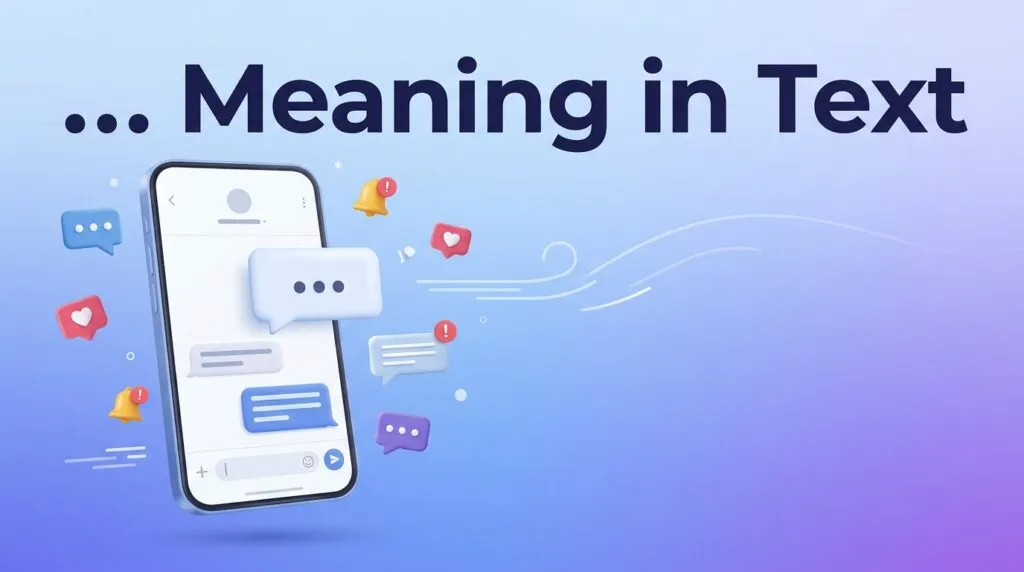

In text from a girl, ... usually signals a pause, an unfinished thought, hesitation, or an emotional tone that is left unsaid. It does not have one fixed meaning. Read the words before it, her usual texting style, and the wider conversation before deciding whether it shows suspense, awkwardness, disappointment, or playfulness.
| Term | Meaning | Context |
|---|---|---|
... | An ellipsis, also called three dots | Texts, DMs, comments, chats, writing |
| Trailing dots | A thought that feels unfinished | Hesitation, uncertainty, suspense |
| “Okay…” | Often suggests more emotion than “Okay” | Disappointment, confusion, mild annoyance |
| “I was thinking…” | Can invite a reply or create suspense | Flirting, storytelling, soft conversation |
| “…” from a girl | Depends on her words and normal texting style | Never judge it without context |
Meaning & Definition
The symbol ... is called an ellipsis. In standard writing, an ellipsis can show that words were left out from a quote, that a speaker paused, or that a thought trailed off. In texting, it often adds tone that the words alone do not show.
When a girl uses ... in a message, it may mean she is:
- Thinking before saying more
- Feeling unsure about how to word something
- Leaving room for you to respond
- Showing mild disappointment
- Being playful or dramatic
- Hinting that there is more behind the message
- Ending a thought softly instead of sharply
For example:
“I guess that’s fine…”
This could mean she genuinely accepts the plan. It could also mean she is not fully happy about it. The difference comes from the conversation, her normal tone, and what happened before the message.
There is no full form for .... It is simply called an ellipsis or ellipsis points. Many people also call it “three dots,” “dot dot dot,” or “trailing dots.”
A direct definition is simple:
In texting, an ellipsis often shows a pause, an unfinished thought, or emotion that is implied rather than directly stated.
Do not assume that every ellipsis means flirting, anger, sadness, or passive aggression. One short message rarely gives enough proof.
Background
The word ellipsis comes from a Greek-rooted word connected with leaving something out or falling short. It entered English centuries ago, and lists its first known use in 1540.
Originally, ellipses were mainly used in books, essays, legal writing, and quotations. Writers used them to show that part of a sentence had been removed without changing the main meaning.
For example:
“The report explained that the project was delayed … because supplies did not arrive.”
In formal writing, the ellipsis shows omitted words. In personal communication, it became more expressive.
Text messages do not include facial expressions, voice tone, pauses, or body language. Because of that, people use punctuation, emojis, GIFs, repeated letters, capital letters, and symbols to show emotion. Researchers describe these written signals as textual paralanguage: nonverbal meaning communicated through text, punctuation, symbols, and formatting.
That is why ... can feel very different from a full stop.
Compare these examples:
- “Okay.”
- “Okay”
- “Okay…”
- “Okaaaay 😅”
All four messages use the same basic word, but the tone can change completely.
People use ellipses because they can make a message feel softer, slower, more emotional, more thoughtful, or more open-ended. Sometimes people use them simply because it is their normal writing habit.
Also Read: ) Meaning in Text Message: What a Closing Parenthesis Means
Usage in Different Contexts
Text Messages
In private text messages, ... often creates a pause or signals an incomplete thought.
Examples:
- “I wanted to tell you something…”
- “That was unexpected…”
- “Maybe we should talk later…”
- “You really did that…?”
A girl may use it because she is nervous, surprised, disappointed, teasing, or trying not to sound too direct.
Still, the message alone is not enough. Look at whether she uses ellipses in most texts. If she writes this way with everyone, it may not carry any special emotional meaning.
Social Media
On Instagram, Facebook, X, or Snapchat, ellipses often add drama, mystery, or a reflective tone.
Examples:
- “Some things are better left unsaid…”
- “The timing was interesting…”
- “I have a story for later…”
- “People really show you who they are…”
A social media caption with ... may be vague on purpose. It can invite curiosity, comments, or questions without directly naming the situation.
Gaming
In gaming chats, an ellipsis often shows hesitation, surprise, or a delayed reaction.
Examples:
- “You picked that character…?”
- “Wait… how did we lose?”
- “I thought you said you knew the map…”
- “That was almost impressive…”
In a gaming context, it may be playful trash talk, disbelief, or a sign that the person is thinking.
Online Communities
In Reddit threads, Discord servers, group chats, and forums, people use ... to soften disagreement or imply that something is obvious.
Examples:
- “That advice might not work for everyone…”
- “I’m not sure that is the best idea…”
- “You may want to check the rules first…”
The tone can be polite, cautious, sarcastic, or passive-aggressive depending on the wording.
Professional Communication
In work emails or professional chats, ellipses should be used carefully. They can make a message appear unclear or emotionally loaded.
Examples:
- Less clear: “Please send the update…”
- Better: “Please send the update by 3 PM today.”
- Less clear: “We need to discuss this…”
- Better: “We need to discuss the project timeline.”
In formal communication, direct wording is usually safer than using ... to imply concern or frustration.
Meaning in Chat, WhatsApp, Instagram, TikTok
| Platform | Meaning | Example Usage |
|---|---|---|
| Text message | Pause, hesitation, soft emotion | “I don’t know about that…” |
| Thoughtful, unsure, sometimes disappointed | “You could have told me…” | |
| Instagram DM | Flirty, playful, dramatic, or curious | “So you saw my story…” |
| TikTok | Suspense, reaction, humor, vague storytelling | “The way he said that…” |
| Snapchat | Casual pause or reaction | “That filter on you…” |
| Discord | Confusion, teasing, disbelief | “You really posted that…” |
On WhatsApp, ... may make a reply feel more personal or emotionally careful. For example, “I’m okay…” can sound different from “I’m okay.” It may suggest that the person is not fully okay but does not want to explain yet.
On Instagram DMs, it can appear during flirting or casual teasing:
“You’re kind of funny… sometimes.”
This could be playful. It could also be a light compliment with a teasing tone.
On TikTok, ellipses are often used in captions and comments to create suspense. People may write a partial thought so others ask questions or watch the next video.
“When you find out who was behind it…”
That does not automatically mean there is deep emotional meaning. On TikTok, it is often a content style used to build curiosity.
For a quick explanation of slang, emojis, abbreviations, and symbols used in online messages, Meanigo can be a useful reference point before you jump to conclusions about someone’s intent.
Meaning in Physics, Medical, and Aircraft Terminology
The symbol ... is mainly a punctuation mark. Its meaning changes slightly in technical writing, but it does not become a special emotional code in science, medicine, or aviation.
| Field | Does ... Have a Recognized Meaning? | Explanation |
|---|---|---|
| Physics | Sometimes used informally in equations | It can show that a number pattern, series, or process continues |
| Medical | No standard medical diagnosis or symptom meaning | It may appear in written notes or quotations as normal punctuation |
| Aviation/Aircraft | No standard aircraft communication meaning as “three dots” | It may appear in ordinary written text, but it is not an aviation command |
| Mathematics | Yes, commonly used for continuation | Example: 1, 2, 3, … means the pattern continues |
| Texting | Yes, highly contextual | It can show a pause, hesitation, trailing thought, or implied emotion |
In physics or mathematics, ... may mean “and so on” or “continue this pattern.” For example:
2 + 4 + 6 + …
This means the pattern continues with more even numbers.
In medical communication, an ellipsis is not a diagnosis, medicine name, test result, or treatment term. It is usually just punctuation. If you see it in a medical note, do not try to interpret it as a clinical code.
In aviation, ... is also not a standard spoken command. Pilots and air traffic controllers use precise language because unclear communication can cause safety risks. An ellipsis in an ordinary written message would still simply mean a pause, omitted words, or an unfinished thought.
Common Misconceptions
People often overthink ellipses in a text from a girl. Here are common misunderstandings.
| What People Assume | What It Actually Means |
|---|---|
| “She used … so she is mad.” | She may be upset, but she may also be pausing or typing naturally |
| “She used … so she likes me.” | It may be flirty, but it is not proof of romantic interest |
| “She is ignoring me.” | She may be busy, unsure what to say, or waiting for a reply |
| “She is being passive-aggressive.” | The message may be soft, careful, or neutral depending on context |
| “More dots mean more anger.” | Extra dots can show drama, habit, humor, or a longer pause |
| “An ellipsis always has one meaning.” | It is context-based and varies by person |
The biggest mistake is reading one punctuation mark as a complete emotional message.
A better approach is to ask:
- What was the conversation about?
- Does she normally use ellipses?
- Did she add an emoji?
- Was her reply fast or delayed?
- Has her tone changed recently?
- Is there a clear reason she might feel awkward, disappointed, excited, or unsure?
Punctuation can shape how a message feels, but it cannot replace context. Studies of digital communication show that punctuation choices can influence how readers interpret tone and intent.
Also Read: TSTS Meaning in Text: What It Means & How to Reply
Similar Terms & Alternatives
| Term | Meaning | Difference |
|---|---|---|
... | Pause, trailing thought, unspoken feeling | Usually softer and more open-ended |
. | Full stop or finality | More direct and complete |
?! | Surprise or disbelief | Stronger and more obvious emotion |
?? | Confusion or urgency | Directly asks for clarification |
lol | Humor or softening a message | Uses words rather than punctuation |
idk | “I don’t know” | Clearly shows uncertainty |
hmm | Thinking, doubt, curiosity | A sound-like reaction |
… | Single-character ellipsis | Same basic meaning as three periods |
— | Dash, interruption, sudden shift | Usually sharper or more dramatic |
: | Introduces an explanation or list | More structured and direct |
Here are a few examples:
- “That’s interesting.” = calm, final statement
- “That’s interesting…” = may suggest doubt, curiosity, or hidden meaning
- “That’s interesting??” = confusion or surprise
- “That’s interesting lol” = casual, possibly teasing
- “Hmm, that’s interesting.” = thoughtful or uncertain
How to Respond to It
Do not panic when someone sends .... Match the level of the conversation and respond with calm curiosity.
| Scenario | Suggested Response |
|---|---|
| She says, “Okay…” | “Are you sure you’re okay with that?” |
| She says, “I was thinking…” | “About what? Tell me.” |
| She says, “You really did that…” | “I did 😅 Was that a bad idea?” |
| She says, “I’m fine…” | “You don’t sound fully fine. Want to talk about it?” |
| She says, “Maybe later…” | “No problem. Message me when you feel like talking.” |
| She says, “You’re funny…” | “I’ll take that as a compliment.” |
| She says, “Interesting…” | “Interesting in a good way or a bad way?” |
| She says, “I don’t know…” | “That’s okay. Take your time.” |
Casual response examples
- “What’s with the dots? 😅”
- “You sound unsure. Everything okay?”
- “Go on, I’m listening.”
- “That sounds like there’s more to the story.”
- “You can be honest with me.”
More respectful response examples
- “I may be reading this wrong, but you sound a little unsure. Would you like to talk about it?”
- “No pressure to reply right away. Let me know when you are ready.”
- “I want to understand your point. What are you thinking?”
- “Thanks for being honest. I’m open to hearing more.”
The best reply does not accuse her of being angry or force her to explain. It gives her room to clarify.
Differences from Similar Words
| Keyword or Symbol | Main Meaning | How It Differs From ... |
|---|---|---|
| Ellipsis | Formal name for three dots | Refers to the punctuation mark itself |
| Ellipse | An oval shape | Different word and different meaning |
| Pause | A break in speech or writing | ... can represent a pause |
| Silence | No reply or no words | ... is not silence; it still communicates something |
| Hesitation | Uncertainty before speaking | ... can suggest hesitation |
| Suspense | Curiosity about what comes next | ... can create suspense |
| Passive aggression | Indirect expression of anger | ... may feel this way, but does not always mean it |
| Flirting | Playful romantic communication | ... may be used while flirting, but is not a flirting code |
One common mix-up is ellipsis versus ellipse.
- Ellipsis =
... - Ellipse = an oval-shaped curve
The word “ellipsis” can also describe leaving out words that readers can easily understand. For example:
“Want coffee?”
The full sentence could be “Do you want coffee?” The missing words are understood from context.
Also Read: SN Meaning in Text: Uses, Examples & Replies
Relevance in Online Conversations & Dating Apps
Modern messaging is full of small signals. A period, emoji, voice note, reaction, meme, or ellipsis can change the tone of a simple sentence.
On dating apps, people often worry about messages such as:
“Maybe…”
“That could be fun…”
“You seem nice…”
“I don’t know yet…”
These messages can sound flirty, uncertain, cautious, or politely noncommittal. The wording matters more than the dots alone.
For example:
“You should take me there sometime…”
This may be a playful hint that she is open to meeting. But it is still better to respond clearly than to assume.
A good reply could be:
“I’d like that. Want to pick a day this week?”
Another example:
“I’m not sure about meeting yet…”
This likely means she needs more time, safety, trust, or conversation before agreeing. The respectful response is not pressure. It is patience.
“That makes sense. We can keep chatting until you feel comfortable.”
Messaging etiquette matters because text can be misunderstood. In digital conversation, punctuation often works like a substitute for facial expression or tone of voice, but it is still imperfect.
Use these practical rules:
- Do not assume
...means she is angry. - Do not treat one message as proof she likes you.
- Do not pressure someone to explain every punctuation choice.
- Ask simple questions when the tone seems unclear.
- Match the tone without copying every habit.
- Respect delayed replies and boundaries.
- Focus on patterns, not one symbol.
The most useful rule is simple:
Read the relationship, the message, and the context before you read meaning into the dots.
Frequently Asked Questions
What does … mean in texting from a girl?
In texting from a girl, ... usually means a pause, hesitation, unfinished thought, or implied emotion. It may show uncertainty, disappointment, suspense, playfulness, or a softer tone. The exact meaning depends on the words around it, her usual texting style, and the wider conversation.
Does … mean a girl is mad?
Not always. “Okay…” may sometimes sound disappointed or annoyed, but ellipses alone do not prove anger. She may simply write that way naturally or be thinking about what to say. Look for clearer signs, such as direct wording, a changed tone, or repeated short replies.
Is … a sign that she likes me?
It can appear in flirty messages, especially when someone is teasing or leaving a thought open-ended. However, ... is not a reliable sign of romantic interest by itself. Pay attention to whether she starts conversations, asks questions, makes plans, and keeps engaging with you.
What does “I’m fine…” mean from a girl?
“I’m fine…” can mean she is genuinely okay, but it can also suggest that she does not want to explain everything yet. A calm response is better than an assumption. You could say, “You sound a little unsure. Want to talk about it?”
What does “okay…” mean in a text?
“Okay…” often feels less certain than “Okay.” It may mean the person accepts what you said but has mixed feelings. It can also be a normal habit. The safest response is to ask politely, “Are you sure you’re okay with that?”
Is … commonly used on TikTok?
Yes. On TikTok, ellipses are often used in captions, comments, and on-screen text to create suspense, humor, curiosity, or a dramatic pause. They are common in storytelling content, reaction posts, and vague captions that encourage viewers to ask what happened next.
What is the difference between … and a period in texting?
A period usually makes a sentence feel complete and final. An ellipsis makes the sentence feel open, slower, or emotionally unfinished. For example, “Sure.” may sound direct, while “Sure…” may suggest hesitation, doubt, or that the sender has more to say.
Does using more dots change the meaning?
Sometimes. “…” is the standard ellipsis, while “…..” or “……….” may make a pause seem longer or more dramatic. But there is no fixed rule. Some people use extra dots because of habit, style, humor, or emphasis rather than a specific emotion.
Should I ask what the dots mean?
You can ask if the message feels unclear, but keep it casual and respectful. Instead of saying, “Why are you mad?” try, “You sound a little unsure. Did I misunderstand something?” This gives the other person space to explain without feeling pressured.
Is an ellipsis professional in emails?
Ellipses can be useful in creative writing or quotations, but they may make work emails sound vague, tense, or incomplete. In professional communication, clear wording is better. State what you need, include deadlines when relevant, and avoid using dots to imply criticism or frustration.
Conclusion
The ... symbol in text from a girl usually means there is a pause, an unfinished thought, or emotion that has not been said directly. It can show hesitation, suspense, disappointment, humor, flirting, or simply a normal writing habit.
The important point is context. Do not decide that three dots mean anger or romantic interest without looking at the full conversation. Read the words, notice the pattern, and respond with calm curiosity. That approach prevents misunderstandings and makes online conversations feel more respectful and natural.

Pingback: RD Meaning in Text: What It Means in Chat
Pingback: IIRC Meaning in Text: Full Form, Uses & Examples