
IDEC usually means “I Don’t Even Care” in texting, chats, and informal social media conversations. People use it to show that they are not interested, concerned, or bothered about a topic, decisn, opinion, or situation. Depending on the context, IDEC can sound casual, blunt, dismissive, sarcastic, or emotionally detached.
Quick Answer
| Context | What IDEC Most Likely Means | Typical Tone |
|---|---|---|
| Casual text | I Don’t Even Care | Informal, dismissive |
| Social media | I Don’t Even Care | Casual or blunt |
| Argument | I Don’t Even Care | Often frustrated or dismissive |
| Conversation with friends | I Don’t Even Care | Casual, sometimes joking |
| Dating or relationship chat | I Don’t Even Care | Potentially defensive or hurt |
| Workplace message | Usually inappropriate slang | Too informal |
| Professional or organizational context | Could be a different acronym | Context-dependent |
The key point is that IDEC is normally an informal texting abbreviation for “I Don’t Even Care.” Slang references consistently list this as the primary chat meaning.
What Does IDEC Mean?
IDEC stands for “I Don’t Even Care.”
It is an internet and texting abbreviation used when someone wants to communicate a strong lack of concern or interest. The phrase can mean anything from “I have no preference” to “I really do not care about this anymore,” depending on the conversation.
For example:
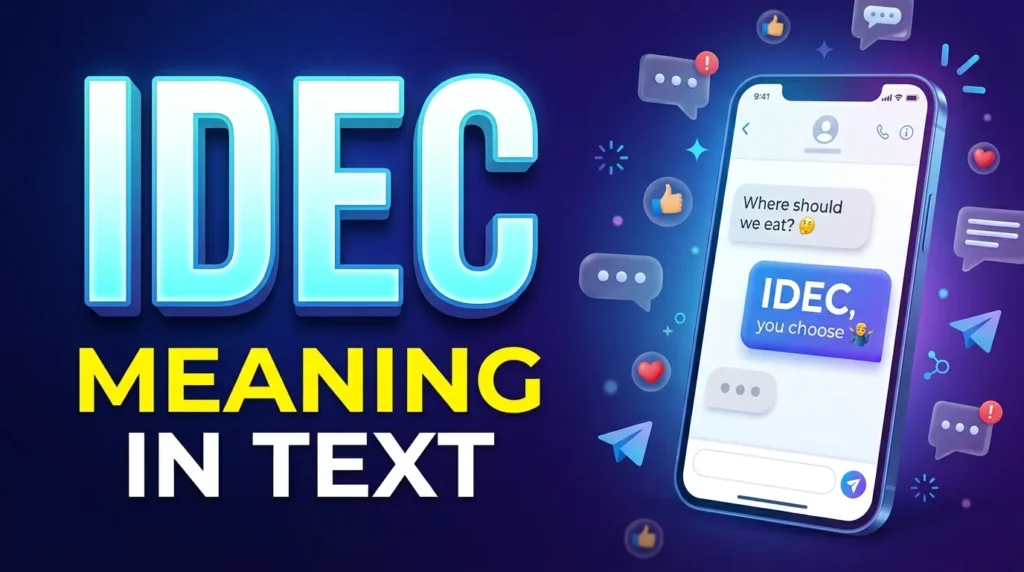
“Which movie do you want to watch?”
“IDEC, you choose.”
Here, IDEC may simply mean that the person has no preference.
But:
“They keep talking about what I did. IDEC anymore.”
In this example, IDEC sounds much more dismissive. The speaker is saying that they no longer want to spend energy on the issue.
Is IDEC an Acronym or Abbreviation?
IDEC is commonly described as an acronym, abbreviation, or internet slang term. It is formed from the initial letters of I Don’t Even Care.
In everyday texting, the exact linguistic label is less important than the meaning: IDEC is shorthand for “I Don’t Even Care.”
Is IDEC a Formal Expression?
No. IDEC is informal internet and texting language.
It is suitable for casual conversations where abbreviations are normal, but it is generally not appropriate for:
- Formal emails
- Job applications
- Academic writing
- Business reports
- Professional customer communication
- Official documents
In a professional setting, phrases such as “I have no preference,” “I’m not concerned about that,” or “Either option works for me” are clearer and more appropriate.
What Does IDEC Mean in Texting?
In texting, IDEC means “I Don’t Even Care.” It usually communicates indifference, meaning the sender does not feel concerned about the subject.
However, the emotional meaning can vary.
IDEC Can Mean Genuine Indifference
Sometimes the sender literally does not care.
Example:
Friend: “Do you want pizza or burgers?”
You: “IDEC, both are fine.”
Here, IDEC is relatively harmless. The person is simply saying that either choice is acceptable.
IDEC Can Show Frustration
IDEC can also mean that someone is tired of discussing something.
Example:
“You two can argue about it all night. IDEC anymore.”
The sender is not merely expressing a neutral preference. They are signaling that they are finished with the conversation.
IDEC Can Sound Dismissive
A one-word reply can feel much colder than a longer sentence.
“IDEC.”
Depending on the relationship, this could sound like:
- “I don’t care.”
- “Leave me out of it.”
- “I’m not interested.”
- “Stop talking about it.”
- “Do whatever you want.”
The surrounding conversation determines which interpretation is most likely.
Also Read: Ion Meaning in Text: Definition, Usage & Examples
IDEC Can Be Used Defensively
Sometimes a person says IDEC because they do not want to reveal that something bothers them.
For example:
“She started dating someone else.”
“IDEC.”
This could genuinely mean “I don’t care,” but it could also be a defensive response from someone who actually feels hurt.
You should not automatically assume that IDEC reveals the sender’s true emotions.
IDEC vs. IDC: What Is the Difference?
IDC means “I Don’t Care,” while IDEC means “I Don’t Even Care.”
The extra “even” can make IDEC sound more emphatic.
| Term | Full Form | Typical Meaning | Tone |
|---|---|---|---|
| IDC | I Don’t Care | Lack of concern | Casual to blunt |
| IDEC | I Don’t Even Care | Stronger lack of concern or interest | More emphatic |
| IDK | I Don’t Know | Uncertainty | Neutral/casual |
| IDEK | I Don’t Even Know | Stronger uncertainty or confusion | Casual, sometimes frustrated |
| IDGAF | I Don’t Give A F*** | Very strong lack of concern | Profane and aggressive |
The distinction between IDC and IDEC is not an exact rule. People use internet slang flexibly, so the emotional difference depends on the sentence and situation.
For example:
“IDC which restaurant we go to.”
This sounds like simple flexibility.
“IDEC what they think about me.”
This can sound more forceful and emotionally detached.
Why Does “Even” Matter?
The word “even” adds emphasis.
Compare:
- “I don’t care.”
- “I don’t even care.”
The second statement can suggest that the speaker has moved beyond ordinary concern and wants to emphasize how little the matter affects them.
That does not mean IDEC is always angry. Among friends, it can be used casually or jokingly.
IDEC vs. IDEK: Don’t Confuse the Two
IDEC and IDEK look almost identical, but they have completely different meanings.
- IDEC = I Don’t Even Care
- IDEK = I Don’t Even Know
The final letter changes the meaning entirely.
IDEC Example
“IDEC what they say.”
Meaning:
“I Don’t Even Care what they say.”
The speaker is expressing indifference.
IDEK Example
“IDEK what they said.”
Meaning:
“I Don’t Even Know what they said.”
The speaker is expressing uncertainty or lack of knowledge.
Beginner Tip: If you see C, think Care. If you see K, think Know.
How Is IDEC Used on Social Media?
IDEC can appear in comments, captions, direct messages, replies, and other informal online conversations. The basic meaning remains “I Don’t Even Care.”
There is no reliable reason to assume that Instagram, TikTok, Snapchat, or another social platform gives IDEC a completely different standard meaning. The surrounding message matters more than the platform.
For example:
“People keep judging my playlist. IDEC 😂”
The emoji can make the statement feel more playful.
Compare that with:
“IDEC. Stop asking me.”
The second version is much more direct and potentially hostile.
Lowercase vs. Uppercase IDEC
Both IDEC and idec can mean the same thing.
In informal texting, lowercase is common:
“idec honestly”
Uppercase can add emphasis:
“IDEC.”
But capitalization is not a fixed rule. Some people simply type in lowercase all the time.
What Does “IDEC Honestly” Mean?
“IDEC honestly” usually means “I honestly don’t even care.”
Example:
“They can believe whatever they want, idec honestly.”
The word “honestly” reinforces the speaker’s claim that they are not concerned.
However, the phrase can still be defensive or sarcastic depending on what came before it.
Also Read: GNG Meaning in Text: What Does GNG Mean?
How Tone Changes the Meaning of IDEC
IDEC is a good example of why texting abbreviations cannot always be interpreted word-for-word.
The same abbreviation can feel different depending on:
- The relationship between the people
- The topic
- Punctuation
- Emojis
- Capitalization
- Whether it appears alone
- What was said immediately before it
A Friendly Use
“Pick the restaurant, idec 😂”
This probably means:
“I don’t mind. You choose.”
An Annoyed Use
“You guys keep arguing about this. IDEC anymore.”
This suggests frustration or exhaustion.
A Harsh Use
“IDEC what you think.”
This can sound openly dismissive.
A Playful Use
“I was supposed to study tonight but idec 😭.”
Here, the sender may be joking about their lack of motivation rather than seriously dismissing another person.
Does IDEC Sound Rude?
IDEC can sound rude or dismissive, especially when it is sent as a short standalone reply.
The phrase itself expresses a lack of concern, so it can naturally come across as cold.
Compare these responses:
“IDEC.”
and:
“Honestly, I don’t mind. You can choose.”
They can communicate a similar lack of preference, but the second sounds considerably more polite.
When IDEC Is Usually Fine
It is generally safer when:
- You are talking to a close friend.
- The conversation is casual.
- Both people regularly use slang.
- The topic is minor.
- The tone is clearly playful.
When IDEC Can Cause Problems
Be careful when:
- Someone is sharing personal feelings.
- You are discussing a relationship problem.
- The other person is upset.
- You are arguing.
- You are speaking to a teacher, manager, customer, or client.
- The topic is serious or sensitive.
A message intended as “I’m not bothered” can easily be interpreted as “I don’t care about you.”
How to Tell What Someone Means by IDEC
If someone sends you “IDEC,” do not interpret it automatically as anger. Look at the context first.
| Context Clue | Likely Interpretation |
|---|---|
| “IDEC, you choose” | No preference |
| “IDEC anymore” | Frustration or emotional exhaustion |
| “IDEC what they think” | Defiance or indifference |
| “IDEC 😂” | Possibly playful |
| “IDEC.” during an argument | Dismissive or annoyed |
| “IDEC ❤️” between close friends | Possibly casual reassurance or joking |
| “IDEC” after emotional news | Could be genuine indifference or a defensive reaction |
Look at the Words Around IDEC
A message such as:
“IDEC, whatever works.”
is relatively mild.
A message such as:
“IDEC about your opinion.”
is more confrontational.
Look at Emojis
Emojis can soften or change the tone.
“idec 😂”
may sound playful.
“IDEC 🙄”
can communicate annoyance.
“IDEC.”
without an emoji can feel more serious or final, although that is not always the sender’s intention.
Also Read: HYU Meaning in Text: Definition, Examples & Replies
Consider Your Relationship
A close friend might send:
“IDEC bro 😂”
without intending offense.
The same wording from someone you barely know may feel much more dismissive.
How to Respond When Someone Says IDEC
Your best response depends on the context.
If They Mean “You Choose”
You can simply say:
“Alright, I’ll pick.”
If They Sound Annoyed
Try:
“No worries. We can leave it there.”
This avoids turning a minor disagreement into a larger argument.
If You Think They Are Hurt
You could ask:
“Are you actually okay with it, or are you just saying you don’t care?”
This is useful when the conversation involves relationships or emotions.
If You Need Clarification
A simple response works:
“Do you mean you don’t care, or are you annoyed?”
This is often better than guessing.
Real-Life Examples of IDEC
Here are some natural examples showing how IDEC can work in different situations.
Example 1: Choosing Food
Alex: “Pizza or tacos?”
Sam: “IDEC, you choose.”
Meaning: Sam has no strong preference.
Example 2: Social Drama
“Everyone keeps talking about their argument. IDEC honestly.”
Meaning: The speaker does not want to get involved.
Example 3: An Online Argument
“You can disagree with me. IDEC what you think.”
Meaning: The speaker is dismissing the other person’s opinion.
Example 4: Making Plans
“We can go Friday or Saturday. IDEC.”
Meaning: Either option works.
Example 5: Relationship Context
“My ex posted with someone new, but idec.”
Meaning: The speaker claims not to care, although the emotional context may make the statement ambiguous.
Example 6: Frustration
“You guys have been arguing for an hour. IDEC anymore.”
Meaning: The speaker is tired of the discussion and wants to disengage.
Example 7: Casual Humor
“I know I should clean my room, but idec 😂.”
Meaning: The speaker is joking about not caring enough to clean.
Example 8: Direct Dismissal
“IDEC about your opinion.”
Meaning: The speaker is explicitly dismissing someone’s opinion and may sound rude.
Is IDEC Used in Dating Conversations?
Yes, IDEC can appear in dating or relationship conversations, but its interpretation can be more complicated there.
If someone says:
“IDEC if you text me back.”
they may genuinely be indifferent. But they might also be trying to appear emotionally detached after feeling ignored.
Likewise:
“IDEC who you talk to.”
could mean genuine acceptance, jealousy disguised as indifference, or irritation.
The safest approach is not to assume the person’s hidden feelings from the abbreviation alone. Look at the rest of the conversation and, when necessary, ask directly.
Is IDEC Used in Gaming?
IDEC can be used in casual gaming chats when players are discussing choices, outcomes, or disagreements.
For example:
“Which map do we play? IDEC.”
Here it simply means:
“I don’t care which map we play.”
However, IDEC is not a gaming-specific term. Its meaning comes from general internet slang rather than a special gaming definition.
Does IDEC Have Other Meanings?
Yes. IDEC is not limited to texting. It is also used as an acronym for organizations and other specialized terms.
For example, IDEC officially refers to the Interior Design Educators Council, an organization focused on interior design education, research, and professional development. Its official website describes it as a community of educators, researchers, and students of interior design.
The organization states that it was established in 1962 and was officially named during its first conference in 1963.
There are also other acronym expansions for IDEC in specialized directories, including names of conferences, organizations, programs, and technical or professional concepts.
Therefore, context is essential.
If someone writes:
“IDEC, I don’t care.”
the texting interpretation is obvious.
But if you see:
“The IDEC annual conference…”
you should not assume the phrase means “I Don’t Even Care.” That is clearly a formal or organizational context.
Does IDEC Have a Confirmed Origin?
The exact origin of the texting abbreviation IDEC is not clearly established by a reliable historical source.
Modern slang references consistently document IDEC = “I Don’t Even Care,” but that does not establish a precise creator, first use, or single invention date.
It is therefore better to avoid claims that a particular person, website, chat service, or year definitively created IDEC unless stronger historical evidence is available.
What We Can Say With Confidence
The reliable point is:
IDEC is established as an informal texting and internet abbreviation meaning “I Don’t Even Care.”
The exact history of how and when the shorthand first developed is less certain.
Common Misconceptions About IDEC
| Common Assumption | What It Actually Means |
|---|---|
| IDEC always means someone is angry | Not necessarily; it can simply express indifference. |
| IDEC always means “I hate this” | No. It means the speaker does not care, not necessarily that they hate something. |
| IDEC and IDEK mean the same thing | No. IDEC means “I Don’t Even Care”; IDEK means “I Don’t Even Know.” |
| IDEC is appropriate in formal emails | Usually not. It is informal texting slang. |
| IDEC always means “leave me alone” | Not always. Context determines whether it is dismissive. |
| IDEC proves someone is emotionally detached | No. A person can use it jokingly or defensively. |
| IDEC has only one meaning everywhere | No. It can represent organizations or specialized terms in other contexts. |
Should You Use IDEC?
Use IDEC mainly in casual conversations where the recipient understands internet slang.
It is relatively safe among close friends when the topic is not serious. However, it is easy to make someone feel dismissed if you use it during an emotional conversation.
For professional communication, choose a clearer alternative.
Instead of:
“IDEC.”
try:
“I don’t have a preference.”
Instead of:
“IDEC what they think.”
try:
“Their opinion doesn’t concern me.”
The second versions communicate the idea more clearly and with less risk of sounding disrespectful.
Also Read: LML Meaning in Text: 2 Meanings, Examples & Replies
What Are Better Alternatives to IDEC?
The best alternative depends on how strongly you want to express indifference.
| Alternative | Tone | When to Use It |
|---|---|---|
| “I don’t mind.” | Mild | When either option is acceptable |
| “Either is fine.” | Neutral | Choosing between options |
| “You can decide.” | Casual | Letting someone else choose |
| “I have no preference.” | Polite/formal | Work or professional settings |
| “It doesn’t matter to me.” | Neutral | General indifference |
| “I’m not concerned about it.” | Formal | Professional conversations |
| “Whatever works.” | Casual | Flexible plans |
| “I really don’t care.” | Strong | When you want emphasis |
These alternatives are useful when you want to communicate the same basic idea without the potentially dismissive tone of IDEC.
Frequently Asked Questions
What does IDEC mean in texting?
IDEC means “I Don’t Even Care” in texting. It is an informal abbreviation used to express indifference, lack of concern, or sometimes frustration with a topic. Depending on the context, it can sound neutral, playful, blunt, or dismissive. A short standalone “IDEC” usually sounds stronger than “I don’t mind.”
Is IDEC rude?
IDEC can be rude or dismissive depending on how it is used. Among close friends, it may simply mean that the sender has no preference. During an argument or emotional conversation, however, “IDEC” can sound like the sender does not care about the other person’s feelings. The surrounding conversation and relationship matter.
What is the difference between IDC and IDEC?
IDC means “I Don’t Care,” while IDEC means “I Don’t Even Care.” Both express indifference, but IDEC can add extra emphasis. IDC may sound relatively neutral in a simple choice, while IDEC can sound more forceful or dismissive. These differences are tendencies rather than strict rules.
What does IDEC mean on social media?
On social media, IDEC generally means “I Don’t Even Care.” It can appear in comments, replies, captions, or direct messages. The abbreviation does not normally acquire a separate meaning simply because it appears on a particular platform. Tone can change based on punctuation, emojis, and the surrounding conversation.
What is the difference between IDEC and IDEK?
IDEC means “I Don’t Even Care,” while IDEK means “I Don’t Even Know.” The final letter is important: C = Care and K = Know. IDEC expresses indifference, while IDEK expresses uncertainty or a lack of knowledge. They are easy to confuse because their spellings are very similar.
Can I use IDEC at work?
It is generally better not to use IDEC in professional communication. Because it is informal slang and can sound dismissive, it may be misunderstood by colleagues, customers, or managers. Use phrases such as “I have no preference,” “Either option works for me,” or “I’m not concerned about that” instead.
What does “IDEC honestly” mean?
“IDEC honestly” means “I honestly don’t even care.” The word “honestly” adds emphasis to the claim of indifference. Depending on the conversation, it may be a genuine statement, a frustrated response, or a defensive way of saying that something does not matter to the speaker.
Does IDEC always mean the texting slang?
No. IDEC can have formal and organizational meanings as well. For example, IDEC is the abbreviation used by the Interior Design Educators Council, an organization focused on interior design education and research. When IDEC appears in a professional document, conference name, or organizational context, read the surrounding information before interpreting it as texting slang.
Conclusion
IDEC most commonly means “I Don’t Even Care” in texting and informal online conversations. It expresses indifference and can range from a harmless “you choose” to a much stronger “I’m done with this” depending on context.
The most important distinction is between IDEC and IDEK: IDEC means “I Don’t Even Care,” while IDEK means “I Don’t Even Know.” Also remember that IDEC has unrelated formal meanings, so professional or organizational context can change the interpretation.
Meanigo explains online abbreviations by separating their everyday meanings from context-specific uses, helping readers interpret short terms without relying on the abbreviation alone.