
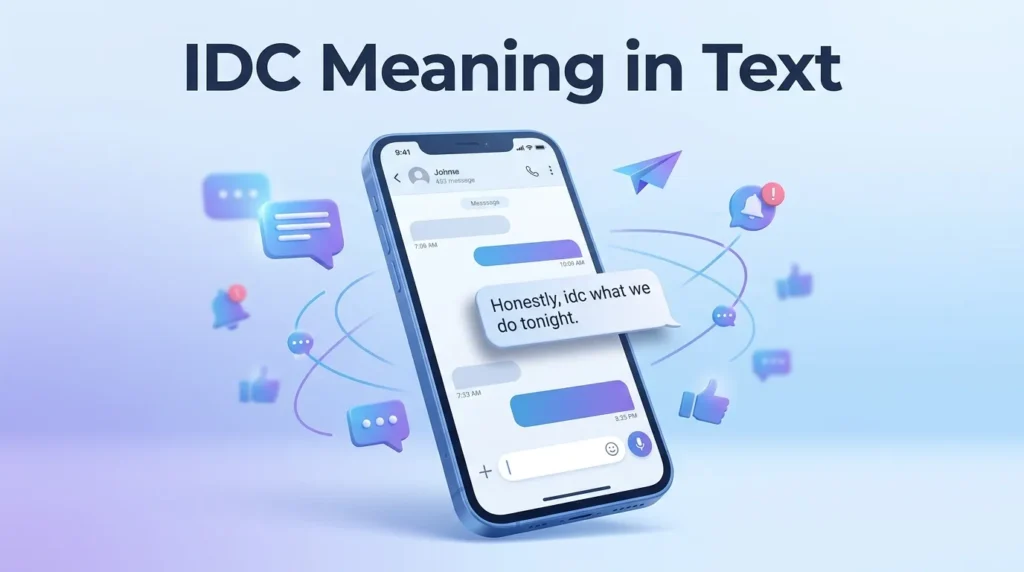

IDC usually means “I don’t care” in texting, chats, and social media. People use it to say they have no preference, are not interested in something, or do not think something matters to them. Depending on the situation, IDC can sound casual, neutral, annoyed, or dismissive, so the surrounding conversation matters.
Quick Answer
| Context | What IDC Most Likely Means | Typical Tone |
|---|---|---|
| Casual text | I don’t care | Neutral or casual |
| Choosing between options | I have no preference | Relaxed |
| Social media comment | I’m not concerned or interested | Casual |
| Argument | I don’t care about this | Blunt or dismissive |
| Dating conversation | This does not matter to me | Context-dependent |
| Formal or professional writing | Usually inappropriate | Too informal |
The important point is that IDC does not always mean the person is angry or being rude. For example, “IDC where we eat” can simply mean “You choose; either option is fine.” But a reply like “IDC” to someone sharing a personal problem may sound cold or dismissive.
What Does IDC Mean?
IDC stands for “I don’t care.”
It is an informal abbreviation used mainly in digital communication. Collins lists IDC as a messaging and social-media abbreviation meaning “I don’t care,” while Meanigo also defines the texting abbreviation as “I don’t care.”
The three letters represent:
- I = I
- D = don’t
- C = care
For example:
“Which movie should we watch?”
“IDC, you pick.”
Here, IDC probably means the person has no preference. They are leaving the decision to the other person.
Another example has a different tone:
“I spent all day trying to explain what happened.”
“IDC.”
In this case, the reply may sound dismissive because the speaker is saying they do not care about the explanation.
So, while the literal meaning stays the same, the emotional tone can change significantly with context.
Is IDC an Acronym or Abbreviation?
IDC is commonly described as a texting abbreviation or initialism for “I don’t care.” In everyday writing, calling it a texting abbreviation is the simplest explanation.
It is normally written as IDC or idc. Lowercase “idc” is especially natural in casual messages, while uppercase “IDC” can add emphasis or simply reflect a person’s typing style.
How Do You Pronounce IDC?
When spoken aloud, people usually pronounce the letters individually:
“eye-dee-see.”
It is generally used more often in written communication than in formal spoken English.
What Is the Correct Spelling?
The standard forms are:
- IDC
- idc
The expanded phrase is:
- I don’t care
The abbreviation does not require periods. Writing I.D.C. is possible as an abbreviation style, but IDC or idc is the normal form in digital conversations.
What Does IDC Mean in Texting?
In texting, IDC means “I don’t care.” It can communicate several closely related ideas:
- “I have no preference.”
- “Either option is fine.”
- “It doesn’t matter to me.”
- “I’m not interested.”
- “I’m not concerned about it.”
- “I don’t want to discuss this.”
The intended meaning depends on what came before it.
Consider these examples:
Example 1 — No preference
“Pizza or burgers?”
“idc, either is fine.”
Here, IDC is harmless and means the person is happy with either choice.
Example 2 — Lack of interest
“Did you see the latest celebrity news?”
“idc tbh.”
Here, IDC means the person is not interested.
Example 3 — Frustration
“You need to listen to me.”
“IDC.”
Here, the short response may sound dismissive or irritated.
This is why interpreting IDC from the three letters alone can be misleading. The message before it, the relationship between the people, punctuation, emojis, and the seriousness of the topic can all affect how it sounds.
Why Can IDC Sound Rude?
IDC is not automatically rude, but it can sound rude when used in a sensitive or serious conversation.
The phrase “I don’t care” is inherently capable of sounding dismissive. In a casual decision, it can simply communicate flexibility. In an emotional conversation, however, the same words can suggest that the speaker does not value what the other person is saying.
Compare:
“Where should we eat?”
“IDC, you choose.”
This is usually neutral.
Now compare:
“I’m really upset about what happened.”
“IDC.”
That response is much more likely to be interpreted as insensitive.
What Makes IDC Sound Softer?
Additional words can make the intended meaning clearer.
For example:
- “idc, you choose 😊”
- “idc either way”
- “idc tbh, whatever works”
- “idc lol”
- “I honestly don’t care which one”
These versions provide more context than a standalone “IDC.”
A simple explanation such as “idc either way” usually makes it clearer that the speaker has no preference rather than deliberately dismissing someone.
What Makes IDC Sound Harsher?
Several factors can make IDC feel blunt:
- Sending only “IDC” as a reply
- Using it during an argument
- Using it after someone shares feelings
- Repeating it when someone is asking for a serious response
- Adding aggressive punctuation
- Using it toward someone who expects emotional support
The abbreviation itself does not determine the speaker’s intention. Context determines how the message is likely to be received.
Also Read: TTYS Meaning in Text: Definition, Examples & Replies
IDC Meaning in Different Contexts
IDC can communicate slightly different shades of “I don’t care” depending on the situation.
| Situation | Example | Likely Meaning |
|---|---|---|
| Making plans | “IDC where we go.” | I have no preference. |
| Choosing food | “Pizza? IDC.” | Either choice is fine. |
| Discussing gossip | “IDC about that.” | I’m not interested. |
| Argument | “IDC anymore.” | I don’t want to engage with this. |
| Social media | “IDC what they say.” | Their opinion does not concern me. |
| Gaming | “IDC which map.” | Any map is okay. |
| Dating | “IDC what you think.” | I am dismissing or rejecting the issue. |
| Serious conversation | “IDC.” | Potentially insensitive or dismissive. |
IDC in Casual Friend Chats
Among friends, IDC can be completely ordinary.
For example:
“Should we meet at 6 or 7?”
“idc, whenever works.”
Here, the person is not necessarily expressing emotional indifference. They simply do not have a strong preference.
IDC on Social Media
On social media, IDC can be used in comments, captions, posts, or direct messages.
For example:
“IDC what anyone says, I still love this song.”
In this sentence, the speaker is saying that other people’s opinions do not change their own preference.
Social-media posts often provide additional context through the surrounding sentence, hashtags, emojis, or image. Therefore, the exact emotional tone should not be determined from IDC alone.
IDC in Gaming Chats
In gaming conversations, IDC can mean that the player has no preference.
For example:
“Which character should I use?”
“IDC, pick whoever.”
Or:
“Which server?”
“idc.”
The context is usually straightforward because the person is choosing between options.
IDC in Dating Conversations
In dating or relationship conversations, IDC can be more emotionally sensitive.
For example:
“Are you upset with me?”
“IDC.”
This could be interpreted as dismissive, but it does not prove exactly what the sender feels. They could be annoyed, trying to end the conversation, avoiding the subject, or genuinely saying that the issue does not matter to them.
The best way to understand it is to consider the surrounding conversation rather than assigning a hidden meaning to the abbreviation.
How to Identify What IDC Means
When you receive IDC, look at the sentence around it before deciding what the sender intended.
| Context Clue | Likely Interpretation |
|---|---|
| A choice between two options | No preference |
| “IDC which one” | Either option is acceptable |
| “IDC about that” | Not interested or concerned |
| “IDC anymore” | Emotional disengagement or frustration may be intended |
| Standalone “IDC” during an argument | Potentially dismissive |
| “idc 😊” | Often softer or more playful |
| “idc lol” | May be casual or joking |
| “IDC!!!” | Could indicate emphasis or frustration |
These are interpretive clues, not fixed rules. The same person may use IDC differently in different conversations.
IDC vs. IDK
IDC and IDK look similar, but they express completely different ideas.
- IDC = I don’t care
- IDK = I don’t know
The distinction is important.
Consider this question:
“What time does the movie start?”
If someone replies:
“IDK.”
They mean they do not know the answer.
If they reply:
“IDC.”
They mean they do not care what time it starts, or they are expressing a lack of concern about it.
Also Read: FN Meaning in Text: What It Means and How to Use It
Another example:
“Do you want pizza or tacos?”
IDK could mean the person has not decided.
IDC could mean the person is happy with either choice.
| Term | Full Form | Basic Idea |
|---|---|---|
| IDC | I don’t care | No concern or preference |
| IDK | I don’t know | No knowledge or answer |
| IDM | I don’t mind | Either option is acceptable |
| IDGAF | I don’t give a fuck | Much stronger and more vulgar indifference |
The last expression is significantly more explicit and should not be treated as interchangeable with the neutral-looking IDC.
IDC vs. IDM
IDM can mean “I don’t mind” in texting, while IDC means “I don’t care.”
They can sometimes produce a similar result, but their tone is different.
For example:
“Where do you want to eat?”
“IDM.”
This usually sounds like “I’m okay with whatever you choose.”
By contrast:
“IDC.”
can also mean “You choose,” but it may sound more indifferent or blunt.
If you want to express flexibility without accidentally sounding dismissive, “I don’t mind” is often clearer in ordinary English.
Common Misconceptions About IDC
| Common Assumption | What It Actually Means |
|---|---|
| IDC always means the sender is angry. | No. It can simply mean they have no preference. |
| IDC always means the sender dislikes you. | No. The context may have nothing to do with the relationship. |
| IDC means “I don’t know.” | No. IDK means “I don’t know.” |
| IDC is always rude. | No. It can be neutral in simple decision-making. |
| IDC always has a hidden emotional meaning. | Not necessarily. Sometimes it literally means the person does not care about the choice. |
| IDC is appropriate for every situation. | No. It is informal and can sound blunt in serious or professional communication. |
Is IDC Formal or Informal?
IDC is informal.
It is suitable for many casual digital conversations, especially between friends, family members, gaming partners, or other people who commonly use texting abbreviations.
It is generally better to avoid IDC in formal documents, professional emails, academic writing, and other situations where clear standard English is expected.
Instead of:
“IDC which option you choose.”
A professional alternative would be:
“Either option works for me.”
Or:
“I have no preference.”
These alternatives communicate the same basic idea without the casual tone of texting slang.
Should You Use IDC?
You can use IDC in casual conversations when the people involved are comfortable with texting abbreviations.
It works particularly well when you genuinely mean:
- “Either one is fine.”
- “I have no preference.”
- “It doesn’t matter to me.”
- “I’m not concerned about that.”
However, consider using a clearer phrase when the subject is emotional, serious, or professional.
For example, if someone asks:
“Are you okay with this plan?”
Instead of simply writing:
“IDC.”
you could say:
“Either option works for me.”
That removes much of the ambiguity.
Beginner Tip
If you are unsure whether IDC will sound rude, use the longer phrase “I don’t mind” or “Either is fine with me” when you mean that you genuinely have no preference.
How to Reply When Someone Says IDC
Your response should depend on what the person appears to mean.
| Situation | Likely Meaning | Possible Reply |
|---|---|---|
| Choosing between options | They have no preference | “Okay, I’ll choose.” |
| Making plans | Either time/place works | “Sounds good, I’ll pick.” |
| Casual conversation | They are not interested | “No worries.” |
| Serious conversation | They may be dismissing the topic | “Do you mean you don’t want to talk about it?” |
| Argument | They may want to end the discussion | “Okay, we can leave it there.” |
| Unclear tone | Meaning is uncertain | “Are you saying you don’t mind, or do you not want to talk about it?” |
Friendly Replies
If the message clearly means “I have no preference,” simple replies work well:
- “Cool, I’ll decide.”
- “Okay, your loss 😂”
- “No problem, I’ll pick.”
- “Sounds good.”
- “Either way works for me too.”
If IDC Seems Dismissive
If someone sends “IDC” during an important conversation, do not automatically assume they are angry or that they no longer care about you.
You can ask:
“Do you mean you don’t mind, or you don’t want to talk about it?”
That question separates lack of preference from lack of interest without assuming the sender’s intention.
Real-Life Examples of IDC
Here are some natural examples showing how the meaning changes with context.
Example 1: Food Choice
Alex: Pizza or burgers?
Sam: idc, you choose.
Meaning: Sam has no preference.
Example 2: Movie Choice
Alex: Comedy or horror?
Sam: IDC 😂
Meaning: Either movie is fine, possibly with a playful tone.
Example 3: Social Media Opinion
Post: “Everyone says this game is terrible.”
Comment: “IDC, I still enjoy it.”
Meaning: The speaker does not care about other people’s opinions.
Example 4: Gaming
Player 1: Which map?
Player 2: idc.
Meaning: Player 2 has no preference.
Example 5: Group Planning
Friend: Saturday or Sunday?
You: IDC. Both work for me.
Meaning: Both dates are acceptable.
Example 6: Disinterest
Friend: Did you hear the latest gossip?
You: idc tbh.
Meaning: You are not interested in the subject.
Example 7: Possible Frustration
Person A: Can we please talk about what happened?
Person B: IDC.
Meaning: The response may signal disinterest, frustration, or a desire to stop the conversation.
Example 8: Relationship Conversation
Person A: Does it bother you that I canceled?
Person B: I really don’t care.
Meaning: The expanded phrase may still be ambiguous. It could indicate genuine indifference or a defensive response.
The key lesson is that IDC does not provide enough information by itself to determine someone’s emotional state.
Does Capitalization Change the Meaning of IDC?
Usually, no.
These generally have the same literal meaning:
- IDC
- idc
- Idc
The difference is mainly stylistic.
However, capitalization can sometimes affect how a message feels. “IDC.” may appear more deliberate or firm than “idc haha,” but this is not a fixed rule.
The sender’s usual texting style matters. Someone who normally types everything in lowercase may write idc without intending any special tone.
Does Punctuation Change the Tone?
Punctuation can influence how a short message is perceived.
Compare:
“idc”
“idc lol”
“idc 😂”
“IDC.”
“IDC!!!”
These all contain the same basic abbreviation, but the surrounding style can change the impression.
For example, “idc lol” may feel lighter because “lol” suggests a casual or joking tone. “IDC.” may feel more final, especially during an argument.
Still, punctuation is only a clue. It should not be treated as proof of someone’s emotional state.
Does IDC Mean “I Don’t Mind”?
Not exactly, although the two expressions can overlap in some situations.
“I don’t mind” usually communicates acceptance or flexibility:
“I don’t mind where we eat.”
This often sounds cooperative.
“I don’t care” can also mean there is no preference:
“IDC where we eat.”
But “I don’t care” can carry a stronger sense of indifference.
Therefore, if someone uses IDC while making a simple choice, “I don’t mind” may be a good interpretation. In an emotional discussion, however, IDC can be much more dismissive.
Also Read: TTY Meaning in Text: Full Form and Usage
Does IDC Have Other Meanings?
Yes. IDC can have meanings outside texting.
For example, Collins lists “industrial development certificate” as another meaning of IDC, alongside the messaging and social-media meaning “I don’t care.”
This is why the surrounding context matters. If you see IDC in a casual message, “I don’t care” is the relevant interpretation. If you see the abbreviation in a specialized document, organization name, business context, or technical material, it may mean something else.
IDC in Professional or Technical Contexts
Do not automatically expand every occurrence of IDC as “I don’t care.”
For example, a formal document may use an abbreviation that happens to have the same letters but an unrelated meaning.
A useful rule is:
Casual chat → “I don’t care” is the likely meaning.
Specialized document → Check the surrounding field and terminology.
Where Did IDC Come From?
The exact origin of the texting abbreviation is not firmly established by the authoritative dictionary sources reviewed here.
The origin of the texting sense simply as its use in digital communications, rather than giving a specific inventor or confirmed first-use date.
That means claims assigning IDC to a particular person, website, year, or single online community should be treated cautiously unless supported by strong historical evidence.
What is clear is that IDC belongs to the broader group of shortened expressions used in digital communication. Similar abbreviations include IDK (“I don’t know”), IMO (“in my opinion”), and FYI (“for your information”). Collins includes IDC in its text-abbreviation word list.
IDC and Other Texting Abbreviations
IDC is part of a larger family of short forms that make casual digital communication faster.
| Abbreviation | Meaning | Example |
|---|---|---|
| IDC | I don’t care | “IDC, you choose.” |
| IDK | I don’t know | “IDK the answer.” |
| IMO | In my opinion | “IMO, it’s better.” |
| FYI | For your information | “FYI, we’re leaving early.” |
| LMK | Let me know | “LMK when you’re free.” |
| IKR | I know, right? | “That was funny, IKR?” |
| FWIW | For what it’s worth | “FWIW, I agree.” |
Grammarly also lists IDC alongside other common texting abbreviations such as IDK, ILY, IMO, and IRL.
Frequently Asked Questions
What does IDC mean in text?
IDC means “I don’t care” in texting and online conversations. It can mean that someone has no preference, is not concerned about something, or is not interested in a topic. The exact tone depends on context. For example, “IDC which movie we watch” usually means either movie is fine, while a standalone “IDC” during an argument can sound dismissive.
Is IDC rude?
IDC is not always rude. It can be perfectly neutral when someone is choosing between options, such as “IDC where we eat.” However, replying “IDC” to someone discussing a serious problem can sound cold or dismissive. The relationship, topic, previous messages, punctuation, and wording around IDC all help determine how the message is likely to be understood.
What does IDC stand for?
IDC stands for “I don’t care.” It is an informal abbreviation used in texting, messaging, and social media. The letters come from the first letters of “I,” “don’t,” and “care.”
What is the difference between IDC and IDK?
IDC means “I don’t care,” while IDK means “I don’t know.” IDC expresses indifference or lack of preference; IDK expresses a lack of knowledge or an inability to provide an answer. For example, “IDC which restaurant” means any restaurant is fine, while “IDK which restaurant” means the person does not know which restaurant to choose.
What does lowercase idc mean?
Lowercase “idc” has the same basic meaning as uppercase “IDC”: “I don’t care.” Lowercase writing is common in casual digital communication and does not automatically indicate a particular emotion. The sender’s usual typing style and the surrounding conversation are more useful for interpreting tone than capitalization alone.
What does IDC mean from a girl or a boy?
IDC has the same basic meaning regardless of whether a girl or boy sends it: “I don’t care.” However, the intended tone cannot be determined from the sender’s gender. In a casual conversation, it may mean “I have no preference”; in an argument or relationship conversation, it may sound dismissive. Context is more important than gender.
What does IDC mean in social media?
On social media, IDC generally means “I don’t care.” Someone may use it to show indifference, reject concern about other people’s opinions, or say they have no preference. For example, “IDC what people say” means the person is not concerned about others’ opinions. The exact tone depends on the post and surrounding wording.
What should I reply when someone says IDC?
If IDC means “I have no preference,” you can simply make the decision: “Okay, I’ll choose.” If it appears during a serious or emotional conversation, ask for clarification instead of assuming the sender is angry. A useful response is, “Do you mean you don’t mind, or you don’t want to talk about it?”
Conclusion
IDC means “I don’t care” in texting, messaging, and social media. Most often, it expresses indifference, lack of preference, or a lack of interest. In a simple choice such as “Pizza or burgers?”, IDC may simply mean “Either is fine.” In a serious conversation, however, the same abbreviation can sound blunt or dismissive.
The safest way to interpret IDC is to read the surrounding conversation rather than the three letters alone. Pay attention to the topic, relationship, punctuation, emojis, and messages immediately before and after it.
Meanigo’s language guides focus on practical meaning, tone, and context so that short online expressions are easier to understand.

Pingback: PU Meaning in Text: Simple Definition & Examples