
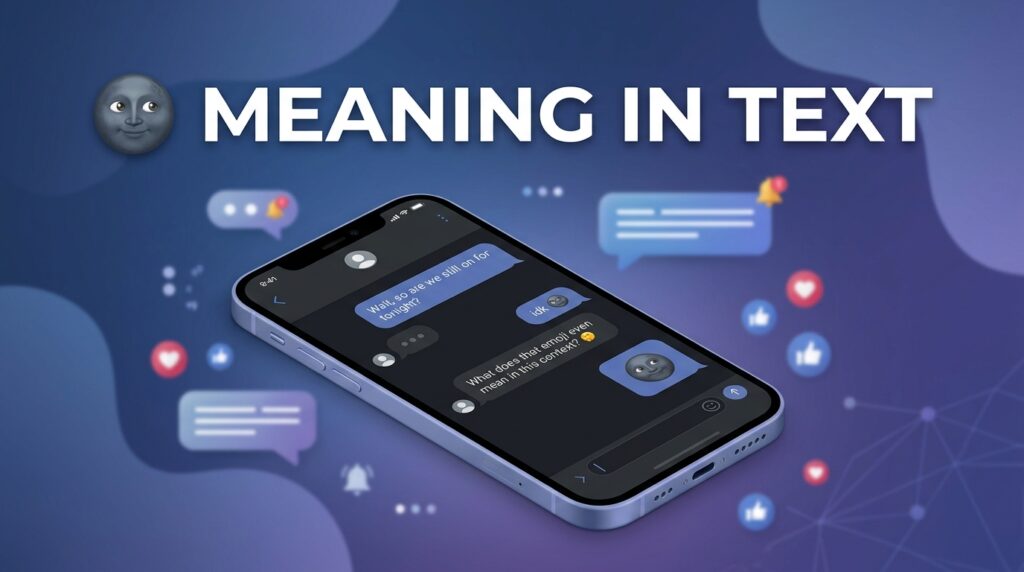

The 🌚 emoji in text usually expresses mischief, sarcasm, suspicion, awkward humor, shade, or suggestive flirting. Officially called the New Moon with Face emoji, it often works like a knowing smirk. Its exact meaning depends on the message, the relationship between the people, and the surrounding emojis.
| Term | Meaning | Context |
|---|---|---|
| 🌚 | Mischief, sarcasm, shade, or hidden meaning | Texting and social media |
| 🌚 in flirting | A suggestive or playful hint | Dating and private chats |
| 🌚 after a joke | “You know what I mean” | Humor and teasing |
| 🌚 alone | Suspicion, awkwardness, or silent judgment | Reactions and replies |
| Official emoji name | New Moon with Face | Unicode and emoji keyboards |
Meaning & Definition
The primary 🌚 meaning in text is a knowing, mischievous, or slightly suspicious reaction. It suggests that the sender is not saying everything directly. The emoji may indicate a private joke, an unspoken thought, light sarcasm, or a playful hidden intention.
Its official Unicode character name is New Moon with Face. It shows a dark circular moon with eyes, a nose, and a small smile. Emojipedia describes it as a dark moon face that may be perceived as creepy and used for shade, irony, or suggestive feelings.
The emoji does not have a “full form” because it is a visual symbol rather than an abbreviation. However, people often translate its emotional meaning into phrases such as:
- “You know what I mean.”
- “That sounds suspicious.”
- “I have a naughty idea.”
- “I noticed what you did.”
- “I am silently judging this.”
- “There is more to the story.”
- “Let us pretend I did not say that.”
Here are a few real-world examples:
Example 1: Playful teasing
“So you finally replied to your crush 🌚”
Here, the emoji suggests that the sender knows something interesting or romantic is happening.
Example 2: Sarcasm
“Yes, because that plan worked so well last time 🌚”
In this sentence, 🌚 strengthens the sarcastic tone.
Example 3: Suggestive flirting
“Are you coming over later? 🌚”
The emoji may imply that the invitation has a romantic or suggestive meaning.
Example 4: Suspicion
“You said you were only friends 🌚”
The sender appears unconvinced and may suspect a deeper relationship.
Example 5: Awkward humor
“I may have accidentally read the whole conversation 🌚”
The emoji makes the confession sound awkward, guilty, or playfully dishonest.
The clearest definition is this: 🌚 is a dark moon face used to add a knowing, ironic, mischievous, or suggestive tone to a message.
Background
The 🌚 emoji was added to Unicode as U+1F31A, New Moon with Face. It became part of Unicode 6.0 in 2010 and was later included in Emoji 1.0 in 2015.
Its original visual idea comes from the traditional “Man in the Moon,” in which people imagine human facial features on the Moon. The emoji combines that familiar image with the dark appearance of a new moon.
In astronomy, a new moon occurs when the illuminated side of the Moon faces away from Earth. The side facing Earth appears dark, making the Moon difficult or impossible to see under normal conditions.
The emoji, however, is not a scientifically accurate image of the Moon. It is an artistic symbol with a human face. Its small smile and side-looking eyes gave it an unusual expression that internet users began interpreting in creative ways.
Over time, its meaning changed from a simple moon symbol into a reaction emoji. People began using it for:
- Awkward jokes
- Secret intentions
- Suspicious comments
- Flirting
- Sarcasm
- Passive-aggressive replies
- Dark humor
- Silent judgment
- Inside jokes
This evolution is common in digital language. Emoji meanings often expand beyond their literal images as communities develop new habits, jokes, and shared interpretations. Research also shows that emoji meanings can change over time and may vary between communities.
People use 🌚 because plain text can sound too serious or unclear. The emoji provides an emotional clue. It tells the reader that the sentence may contain humor, irony, suspicion, or an implied message.
For example:
“I heard you were asking about me.”
This may sound neutral or confrontational.
“I heard you were asking about me 🌚”
The second version sounds more playful, curious, suspicious, or flirtatious.
That small symbol changes the emotional direction of the message without adding a full explanation.
Also Read: WLW Meaning in Text: What It Means and How to Use It
Usage in Different Contexts
The meaning of 🌚 changes according to where it appears and who sends it. It is therefore important to read the complete conversation instead of interpreting the emoji alone.
Text Messages
In ordinary text messages, 🌚 often means that the sender is teasing, suspicious, or hinting at something.
“You stayed at the party until 3 a.m. 🌚”
This may mean, “I think something interesting happened.”
It can also soften a bold statement:
“You looked good today 🌚”
The compliment becomes more playful or flirtatious.
When it appears after a confession, it may show awkward guilt:
“I ate the last slice of pizza 🌚”
The sender knows they did something slightly wrong but is presenting it humorously.
Social Media
On Instagram, TikTok, Facebook, X, Snapchat, and similar platforms, 🌚 is often used in comments, captions, or replies to communicate:
- “I noticed that.”
- “That sounds suspicious.”
- “There is a hidden meaning here.”
- “I know what you are doing.”
- “This is getting interesting.”
- “That comment was bold.”
Example comment:
“Why did you tag him specifically? 🌚”
The commenter may be suggesting that the tag reveals romantic interest.
In a caption, it may create mystery:
“Tonight should be interesting 🌚”
This hints that the person has plans but does not want to explain them.
Gaming
The 🌚 emoji does not have one official gaming definition. In gaming chats, it may indicate sneaky behavior, trolling, a hidden strategy, or playful guilt.
“I definitely did not take all the loot 🌚”
Here, the player jokingly suggests that they probably did take it.
“Wait until they enter the room 🌚”
The emoji may imply that a trap, surprise, or secret plan is waiting.
It can also appear after an unexpected victory:
“Easy match 🌚”
Depending on the situation, this may be playful confidence or sarcastic trash talk.
Online Communities
In forums, group chats, Discord servers, fandoms, and online communities, 🌚 often represents an inside joke or shared understanding.
A single 🌚 reply may mean:
- “That was questionable.”
- “I know exactly what you meant.”
- “I am watching this conversation.”
- “I will not say anything, but I noticed.”
- “That has another meaning.”
Community culture matters. One group may use 🌚 mainly for flirting, while another may use it for sarcasm or awkward humor.
Professional Communication
The 🌚 emoji is usually unsuitable for formal workplace communication. It can appear suspicious, passive-aggressive, flirtatious, or unclear.
For example, avoid writing:
“I saw the updated sales numbers 🌚”
A colleague may not know whether you are joking, criticizing the numbers, or suggesting that something dishonest happened.
A clearer professional version would be:
“I reviewed the updated sales figures and noticed a few differences. Could we discuss them?”
The emoji may be acceptable in a relaxed team chat where coworkers already understand one another’s humor. Even then, it should be used carefully.
Direct answer: In professional communication, 🌚 has no fixed business meaning and may create unnecessary confusion.
Meaning in Chat, WhatsApp, Instagram, TikTok
Across chat apps and social platforms, the basic meaning remains similar. However, the style of the conversation can affect how people interpret it.
| Platform | Meaning | Example Usage |
|---|---|---|
| Chat or SMS | Mischief, suspicion, or teasing | “You disappeared after meeting her 🌚” |
| An inside joke, sarcasm, or flirting | “Online at 2 a.m. again? 🌚” | |
| Shade, attraction, or noticing something | “Interesting photo choice 🌚” | |
| TikTok | Ironic reaction, hidden joke, or suggestive comment | “We all know why you watched twice 🌚” |
| Snapchat | Playful secrecy or flirting | “Do not open that snap around anyone 🌚” |
| Discord | Sneaky plans, trolling, or awkward humor | “I may have changed the server name 🌚” |
| Dating apps | Romantic or suggestive interest | “Maybe we should test that theory 🌚” |
On WhatsApp, 🌚 is frequently used between friends or romantic partners. It may follow a teasing question:
“Who were you talking to for two hours? 🌚”
This is not necessarily an accusation. It may simply be playful curiosity.
On Instagram, the emoji often appears beneath attractive photos, relationship hints, or questionable captions:
“Just a friend, right? 🌚”
Here, the commenter doubts the phrase “just a friend.”
On TikTok, 🌚 may appear after a double-meaning joke. Users also place it in comments when they understand an implied adult, romantic, or sarcastic reference.
“The pause before he answered 🌚”
The commenter believes the hesitation revealed something.
On Snapchat, it may signal secrecy:
“I have something to tell you later 🌚”
On a dating app, the emoji can make a normal line feel flirtier:
“I am sure we could find something fun to do 🌚”
Because 🌚 can be suggestive, its use on dating apps should match the level of comfort already established. Sending it too early may make the other person uncomfortable.
The most reliable rule is simple: Read the words before the emoji. The sentence provides the meaning, while 🌚 provides the tone.
Meaning in Physics, Medical, and Aircraft Terminology
The 🌚 emoji is not a recognized technical symbol in physics, medicine, or aviation. Its only direct scientific connection is to the astronomical idea of a new moon.
| Field | Recognized Meaning | Explanation |
|---|---|---|
| Physics | No standard technical meaning | It is not a physics variable, unit, or equation symbol |
| Astronomy | Informal image of a new moon | The actual new moon is a lunar phase |
| Medical | No standardized medical meaning | It is not an accepted diagnosis, treatment, or clinical symbol |
| Aviation | No official aircraft meaning | It is not a standard flight, airport, or cockpit symbol |
| Meteorology | No formal weather meaning | It may be used casually to indicate nighttime |
Physics and Astronomy
In physics, 🌚 does not represent a formula, force, particle, constant, or unit.
In astronomy, its name refers to the new moon phase. During this phase, the Moon’s illuminated side faces the Sun while its night side faces Earth. As a result, the Moon is generally not visible from Earth.
However, scientists would normally write “new moon” rather than use 🌚 in formal research.
Medical Meaning
The 🌚 emoji has no official medical definition. It does not represent a disease, symptom, medication, mental health diagnosis, or medical procedure.
A patient might use it informally to describe:
- Feeling tired
- Staying awake at night
- Having a dark mood
- Working a night shift
- Feeling awkward
Those are personal interpretations, not medical meanings. Research into medical emoji use shows that emoji can help communicate feelings or health concepts, but their clinical representation remains limited and context-dependent.
Medical decisions should never be based on an emoji without a clear verbal explanation.
Aviation or Aircraft Meaning
The 🌚 emoji has no recognized meaning in aviation or aircraft terminology. It is not an official sign for:
- Night flying
- Instrument flight rules
- Runway conditions
- Lunar navigation
- Aircraft lighting
- Weather restrictions
- Pilot status
A pilot or traveler might use it casually when discussing a night flight:
“Flying overnight again 🌚”
In that example, it simply represents nighttime or the person’s mood.
Common Misconceptions
Because 🌚 has several informal meanings, it is easy to misunderstand.
| What People Assume | What It Actually Means |
|---|---|
| It always means something sexual | It can be suggestive, but it also means sarcasm, suspicion, or mischief |
| It means the sender is angry | It usually signals irony or teasing rather than direct anger |
| It is the same as 🌑 | 🌚 has a face and carries more emotional meaning |
| It always represents the real Moon | In texting, it is often a reaction rather than an astronomy symbol |
| It has one universal meaning | Its meaning depends heavily on context and relationships |
| It is automatically offensive | It is usually playful, though it can feel passive-aggressive |
| It means sadness or depression | It may express a dark mood, but that is not its main meaning |
| It has a secret official code | It has no fixed coded definition beyond its emoji identity |
One major misconception is that 🌚 always has an adult meaning. It can certainly be used during suggestive flirting, but many people use it for harmless teasing.
For example:
“You said you were going to study, but you are watching movies 🌚”
There is no romantic meaning here. The emoji simply communicates playful suspicion.
Another mistake is reading it as a friendly smile. Although the face has a small smile, its dark color and sideways expression can make it feel creepy, ironic, or suspicious.
People may also confuse 🌚 with 🌑. The plain new moon emoji 🌑 usually represents the Moon, darkness, nighttime, space, or an eerie atmosphere. The face on 🌚 gives it a more human emotional tone.
Emoji interpretation is rarely exact. Studies have found that many emojis are ambiguous when shown without surrounding text.
Therefore, never judge a serious message based on one emoji alone.
Similar Terms & Alternatives
Several emojis can communicate ideas similar to 🌚, but each has a different emotional tone.
| Term | Meaning | Difference |
|---|---|---|
| 😏 | Smirking, confident, or suggestive | More direct and openly flirtatious |
| 👀 | Watching, noticing, or interested | Less dark and often more curious |
| 😈 | Naughty, bold, or mischievous | Stronger and more openly provocative |
| 🙃 | Awkwardness, irony, or frustration | More suitable for uncomfortable situations |
| 🤨 | Doubt or suspicion | More direct questioning, less playful |
| 🌝 | Cheerful moon face or ironic smile | Brighter and often friendlier |
| 🌑 | New moon or darkness | Has no face or knowing expression |
| 🤭 | Hiding laughter or a secret | More innocent and less suspicious |
| 😶 | Speechless or silent | Lacks the mischievous tone |
| 🫣 | Nervous curiosity or embarrassment | Shows hesitation rather than confidence |
Use 😏 when you want your flirting to be more obvious:
“You looked good tonight 😏”
Use 👀 when you have noticed something interesting:
“New relationship post? 👀”
Use 🤨 when you genuinely doubt a claim:
“You finished the whole project in one hour? 🤨”
Use 🙃 for frustration hidden behind humor:
“My laptop crashed before I saved the file 🙃”
Use 🌚 when the meaning should remain slightly hidden:
“So you two arrived together 🌚”
The main feature of 🌚 is its implied message. It feels as though the sender knows something but is choosing not to say it directly.
How to Respond to It
Your reply should depend on whether the sender is flirting, joking, judging, or asking a suspicious question.
| Scenario | Suggested Response |
|---|---|
| Friendly teasing | “Do not start 😂” |
| Flirting | “And what exactly are you suggesting? 😏” |
| Suspicion | “There is nothing to investigate, detective.” |
| Sarcastic comment | “I can feel the judgment from here.” |
| Awkward confession | “At least you admitted it.” |
| Inside joke | “You know exactly what happened.” |
| Unclear meaning | “What is that moon supposed to mean?” |
| Professional message | “Could you clarify what you mean?” |
| Unwanted flirting | “I would rather keep the conversation friendly.” |
| Suggestive joke | “Behave yourself 😂” |
A casual response can match the sender’s playful tone:
Sender: “You were smiling at your phone again 🌚”
Response: “Maybe I got a good message.”
You can return the teasing:
Sender: “Going out with someone special? 🌚”
Response: “Why are you so interested? 🌚”
When the message is flirtatious:
Sender: “We should watch a movie together 🌚”
Response: “Are we actually watching the movie?”
When you do not understand the intention, ask directly:
“I cannot tell whether you are joking or accusing me. What do you mean?”
In a professional setting, do not respond with more ambiguous emojis. Request clarity:
“Could you explain your concern so I can address it properly?”
When the emoji makes you uncomfortable, set a boundary without becoming aggressive:
“I am not comfortable with suggestive messages. Let us keep the conversation respectful.”
You do not need to mirror someone’s tone. A clear response is often better than guessing.
Differences from Similar Words
Although 🌚 is technically an emoji rather than a word, people compare it with other moon and facial emojis.
| Emoji | Core Meaning | Typical Tone | Common Context |
|---|---|---|---|
| 🌚 | Hidden meaning, mischief, shade | Mysterious or suggestive | Teasing, flirting, sarcasm |
| 🌝 | Happiness, friendliness, or irony | Bright and humorous | Jokes and positive reactions |
| 🌑 | Darkness or the new moon | Neutral, eerie, or serious | Space, nighttime, dark themes |
| 😏 | Smirk or confidence | Clearly flirtatious | Attraction and bold jokes |
| 👀 | Watching or interest | Curious or surprised | Gossip and new information |
| 😈 | Naughty intention | Bold or provocative | Flirting and mischief |
| 🤨 | Doubt or disbelief | Directly suspicious | Questioning a claim |
| 🙃 | Ironic discomfort | Awkward or frustrated | Bad luck and forced positivity |
🌚 vs. 🌑
🌑 is the plain New Moon emoji. It generally represents a dark moon, outer space, nighttime, or an eerie mood.
🌚 includes a human face. This makes it feel more emotional, suspicious, sarcastic, or playful.
“The sky is completely dark tonight 🌑”
Literal meaning.
“You were with your ex last night 🌚”
Suspicious or teasing meaning.
🌚 vs. 🌝
🌝 is the Full Moon Face emoji. It appears brighter and often feels happier or friendlier. It can still express irony, but it usually lacks the dark, secretive mood of 🌚.
“I brought snacks 🌝”
Cheerful.
“I know who ate all the snacks 🌚”
Suspicious.
🌚 vs. 😏
Both can be flirtatious. However, 😏 is more direct. It clearly resembles a confident smirk.
🌚 feels more indirect. It suggests an unspoken thought without fully revealing it.
“You look good 😏”
Direct flirting.
“So that is what you are wearing tonight 🌚”
Flirting mixed with teasing or surprise.
🌚 vs. 👀
👀 means “I am watching,” “I noticed,” or “I am interested.”
🌚 means “I noticed, and I think there is more going on.”
“New announcement? 👀”
Curious.
“You deleted that comment quickly 🌚”
Suspicious.
Relevance in Online Conversations & Dating Apps
The 🌚 emoji is relevant because modern online conversations depend on tone markers. In face-to-face communication, people can hear a speaker’s voice and observe facial expressions. Text messages remove many of those signals.
Emojis help restore some emotional context. They can show that a sentence is playful, ironic, flirtatious, or not meant literally. However, emoji designs and interpretations may differ between platforms and users, which can sometimes cause misunderstandings.
On social media, 🌚 is especially useful for reacting without making a direct claim.
For example:
“They said they are only business partners 🌚”
The writer is not openly accusing anyone. Instead, the emoji invites readers to notice a possible hidden story.
In comment sections, it may also function as a silent reaction. A person may post only:
🌚
That single emoji can mean:
- “Interesting.”
- “I do not believe you.”
- “I know what this really means.”
- “That was inappropriate but funny.”
- “I see where this is going.”
- “I am staying quiet.”
On dating apps, 🌚 often adds romantic or suggestive tension.
“Maybe you can tell me the rest in person 🌚”
The sender may be showing attraction and encouraging a private meeting.
However, dating app etiquette matters. A suggestive emoji can feel playful after mutual interest has been established. The same emoji may feel intrusive when sent to a stranger without context.
Good messaging etiquette includes:
- Reading the other person’s tone
- Avoiding sexual suggestions too early
- Respecting boundaries
- Asking rather than assuming
- Not using emojis to pressure someone
- Clarifying jokes that may be misunderstood
For example, this message may be too forward at the beginning of a conversation:
“Come to my place tonight 🌚”
A more respectful version would be:
“Would you like to meet for coffee this weekend?”
The emoji is also common in modern friendship conversations. Friends use it to expose small contradictions:
“You said you were not interested, but you liked every photo 🌚”
This playful use strengthens shared humor when both people understand the tone.
Websites that explain slang and digital symbols can help readers avoid misinterpreting these messages. Meanigo is a useful reference for people looking for clear explanations of emoji meanings, texting abbreviations, social media phrases, and other terms used in online conversations.
The key principle remains the same: 🌚 does not create the message’s meaning by itself. It changes how the words around it feel.
Also Read: LMY Meaning in Text: What It Means & How to Reply
Frequently Asked Questions
What does 🌚 mean in texting?
The 🌚 emoji in texting usually means mischief, sarcasm, suspicion, shade, or playful flirting. It can suggest that the sender knows something they are not saying directly. For example, “You came home late 🌚” may be a teasing way of asking what happened.
What does 🌚 mean from a girl?
When a girl sends 🌚, she may be teasing, flirting, expressing suspicion, or reacting to an awkward joke. It does not always indicate romantic interest. Check the words before the emoji, your relationship, and the previous messages before deciding what she means.
What does 🌚 mean from a guy?
When a guy sends 🌚, it may show playful interest, sarcasm, a hidden joke, or a suggestive thought. For example, “Maybe I should come with you 🌚” can sound flirtatious. However, the emoji can also be completely harmless when used between friends.
Does 🌚 have multiple meanings?
Yes. 🌚 can represent the Moon, nighttime, mystery, mischief, irony, shade, suspicion, awkwardness, or suggestive flirting. There is no single meaning that applies to every message. The correct interpretation depends on the sentence, relationship, platform, and tone of the conversation.
Is 🌚 commonly used on TikTok?
Yes. TikTok users often place 🌚 in comments to react to double meanings, suspicious behavior, awkward pauses, romantic hints, or jokes with an implied message. It can mean “I noticed that,” “We know what you meant,” or “This is getting interesting.”
Is the 🌚 emoji flirty?
The 🌚 emoji can be flirty, especially when used after compliments, invitations, or messages with romantic double meanings. However, it is not automatically romantic. Friends also use it for sarcasm, teasing, guilt, suspicion, and inside jokes. The surrounding message reveals the likely intention.
What does 🌚 mean on WhatsApp?
On WhatsApp, 🌚 usually adds a mischievous, sarcastic, suspicious, or flirtatious tone. A message such as “Who kept you awake last night? 🌚” suggests playful curiosity. It may also be used after an embarrassing confession or a joke with a hidden meaning.
Is 🌚 a sexual emoji?
🌚 can support a suggestive or sexual joke, but it is not exclusively a sexual emoji. Many people use it for harmless sarcasm, teasing, awkward humor, or silent judgment. Avoid assuming an adult meaning unless the surrounding conversation clearly supports that interpretation.
What is the difference between 🌚 and 🌑?
🌑 is a plain new moon and usually represents astronomy, darkness, space, or nighttime. 🌚 is a dark moon with a face, so it carries more emotion. It often communicates mischief, suspicion, shade, irony, or a hidden thought rather than simply representing the Moon.
What should I reply when someone sends 🌚?
Match the context. For teasing, reply, “Do not start 😂.” For flirting, try, “What are you suggesting? 😏.” When the meaning is unclear, ask, “What does that moon mean here?” If the message makes you uncomfortable, respond directly and establish a clear boundary.
Conclusion
The 🌚 meaning in text is usually mischief, sarcasm, suspicion, shade, awkward humor, or suggestive flirting. Officially known as the New Moon with Face emoji, it works like a dark, knowing smirk that adds an implied message to ordinary words.
It may mean “I noticed that,” “You know what I mean,” or “There is more to this story.” However, it has no universal interpretation. The sender’s words, relationship, platform, and conversational history determine its meaning.
When you are unsure, avoid making a serious assumption based on one emoji. Read the full message or ask the sender to explain. For more straightforward explanations of emoji, slang, abbreviations, and digital communication terms, Meanigo can help readers understand what unfamiliar expressions mean and how they are used in real conversations.


Pingback: SS Meaning in Text: Chat, Social Media & More