
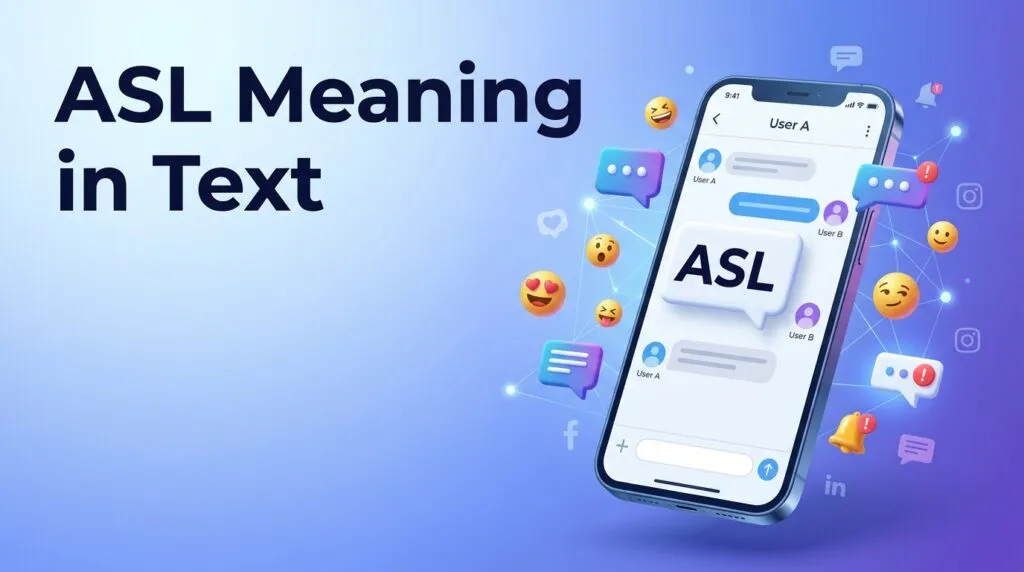

ASL in text usually stands for “Age, Sex, Location?” It is a popular internet abbreviation used to quickly ask someone basic personal information during online conversations. Depending on the context, ASL can also refer to American Sign Language, but in texting and chat slang, “Age, Sex, Location?” is the most common meaning.
| Term | Meaning | Context |
|---|---|---|
| ASL | Age, Sex, Location | Online chats, texting, social media |
| ASL | American Sign Language | Education, accessibility, communication |
| ASL | Context-dependent abbreviation | Messaging apps, forums, gaming |
Meaning & Definition
What Does ASL Mean in Text?
ASL is a common internet acronym that stands for:
- A = Age
- S = Sex
- L = Location
People use ASL to learn basic information about someone they are chatting with online.
Common Interpretation
When someone sends:
“ASL?”
They are usually asking:
“How old are you, what is your gender, and where are you from?”
Real-World Examples
Example 1
Person A: Hi!
Person B: ASL?
Person A: 21, Male, London.
Example 2
Person A: Nice to meet you.
Person B: ASL before we continue chatting?
Alternative Meaning
ASL may also refer to American Sign Language, especially in educational, accessibility, or healthcare discussions.
Example:
“I’m learning ASL.”
In this sentence, ASL means American Sign Language, not Age, Sex, Location.
Background
Origin of ASL
The abbreviation ASL became popular during the early internet era.
It was heavily used on:
- AOL Chat Rooms
- Yahoo Messenger
- MSN Messenger
- IRC Channels
- Early online forums
During the late 1990s and early 2000s, users often wanted a quick way to identify who they were talking to. ASL became a standard opening question.
Evolution of the Term
Over time, internet culture evolved.
Today, ASL is:
- Less common than before
- Still recognized worldwide
- Often used humorously or nostalgically
- Occasionally used on dating apps and gaming platforms
Why People Use It
Users prefer ASL because it:
- Saves time
- Starts conversations quickly
- Helps identify demographics
- Creates context before chatting further
Also Read: WYLL Meaning in Text: Definition, Usage & Examples
Usage in Different Contexts
Text Messages
In texting, ASL typically means Age, Sex, Location.
Example:
“Hey, ASL?”
Meaning:
“Can you tell me your age, gender, and where you’re from?”
Social Media
People sometimes use ASL in:
- Facebook groups
- Instagram DMs
- Snapchat chats
- Reddit discussions
Example:
“ASL? Looking for gaming friends.”
Gaming
Online gamers may use ASL to get to know teammates.
Example:
“ASL before joining voice chat?”
Online Communities
Forums and community groups sometimes use ASL as an icebreaker.
Example:
“New here. ASL?”
Professional Communication
ASL is generally not recommended in professional communication because it may appear too informal or intrusive.
Instead of ASL, professionals usually ask:
- What’s your role?
- Which company are you with?
- Which region are you based in?
Meaning in Chat, WhatsApp, Instagram, TikTok
| Platform | Meaning | Example Usage |
|---|---|---|
| Chat Rooms | Age, Sex, Location | “ASL?” |
| Age, Sex, Location | “ASL before we chat?” | |
| Personal introduction | “ASL?” in DMs | |
| TikTok | Often used jokingly | “ASL? 😂” |
| Snapchat | Basic personal details | “ASL?” |
ASL is occasionally used when meeting new people in groups.
Instagram users may send ASL in direct messages to learn more about someone.
TikTok
TikTok often uses ASL humorously because many younger users recognize it as an old-school internet phrase.
Online Chat
Traditional chat environments remain the most common place for ASL usage.
Also Read: IMO Meaning in Text: Most People Get This Acronym Wrong
What Does “Tired ASL” Mean?
“Tired ASL” is a modern texting slang phrase that usually means “very tired,” “extremely tired,” or “tired as hell.” In this expression, “asl” works as an intensifier rather than the older abbreviation for “age, sex, location.” It is commonly used in casual text messages, social media posts, comments, DMs, and online conversations when someone wants to strongly emphasize how exhausted they feel. For example, if someone writes, “I’m tired asl after work,” they simply mean that they are extremely tired. Similar phrases include “sleepy asl,” “busy asl,” “stressed asl,” and “hungry asl.” The important clue is that asl appears after a descriptive word. This is very different from a standalone message such as “ASL?” where the abbreviation may refer to age, sex, and location. Because internet slang depends heavily on context, reading the complete sentence is the easiest way to identify the intended meaning. In modern casual communication, “tired asl” is generally understood as an expressive way to say “I’m really tired.”
Examples of “Tired ASL” in Text:
| Text Example | Meaning |
|---|---|
| “I’m tired asl.” | I’m extremely tired. |
| “Been studying all day, tired asl.” | I’m very exhausted. |
| “She looks tired asl today.” | She looks extremely tired. |
What Does “Funny ASL” Mean?
“Funny ASL” usually means “very funny,” “really funny,” or “funny as hell.” In this usage, “asl” is modern internet slang that adds emphasis to the adjective before it. Someone might comment, “That video was funny asl,” to say that they found the video extremely amusing. The expression is informal and is more suitable for texting, social media comments, memes, gaming chats, and conversations with friends than for professional or academic writing. You may see the same pattern with other descriptive words, such as “cute asl,” “good asl,” “weird asl,” “cold asl,” or “hard asl.” The meaning is not “age, sex, location” because the abbreviation is functioning as part of the sentence rather than appearing as a personal-information question. This is an important distinction when reading modern slang. If you see “ASL?” by itself, the traditional meaning may apply, but if you see “funny asl”, replacing “asl” with “as hell” makes the intended meaning clear.
Examples of “Funny ASL”:
| Text Example | What It Means |
|---|---|
| “That meme is funny asl.” | That meme is extremely funny. |
| “You’re funny asl 😂.” | You’re really funny. |
| “This movie was funny asl.” | This movie was very funny. |
ASL vs. asl: Does Capitalization Change the Meaning?
Capitalization can provide a useful clue when interpreting ASL, but it does not always determine the meaning by itself. In older internet chat culture, “ASL?” commonly meant “age, sex, location?” and was used as a quick question when strangers were meeting online. In modern slang, lowercase “asl” often means “as hell” when it appears after an adjective or description. For example, “I’m tired asl” means “I’m extremely tired,” while “That was funny asl” means “That was very funny.” However, people do not always follow capitalization rules when typing online, so a lowercase or uppercase version should not be treated as absolute proof. Context and sentence structure are more reliable. There is also another major meaning: American Sign Language, as in “I’m learning ASL.” In that sentence, the topic clearly refers to a language rather than internet slang. Therefore, when you encounter ASL in a message, look at the complete sentence, punctuation, surrounding vocabulary, and conversation topic before deciding what the abbreviation means.
| Form | Common Meaning | Example |
|---|---|---|
| ASL? | Age, Sex, Location | “Hey, ASL?” |
| asl after an adjective | As hell | “I’m tired asl.” |
| ASL in language context | American Sign Language | “I’m learning ASL.” |
How Do You Know Which Meaning of ASL Someone Means?
The easiest way to understand ASL is to look at the context instead of assuming that the abbreviation always has one definition. If someone sends “ASL?” as a standalone question, particularly when they are introducing themselves to a stranger, it may mean “age, sex, location.” If “asl” appears after an adjective, such as “tired asl,” “funny asl,” or “cold asl,” it usually means “as hell” and adds emphasis. When the conversation involves Deaf culture, interpreters, signing, communication, or language classes, ASL almost certainly refers to American Sign Language. In geographical or elevation-related content, ASL can also mean “above sea level.” Sentence structure provides one of the strongest clues. For example, “I’m hungry asl” does not make sense as a request for age, sex, and location; it clearly uses “asl” as an intensifier. Similarly, “Are you learning ASL?” is likely about American Sign Language. When the meaning is unclear, the safest approach is simply to ask the person what they mean. This prevents misunderstandings and avoids sharing personal information unnecessarily.
Quick ASL Context Guide:
| If You See… | Likely Meaning |
|---|---|
| “ASL?” | Age, Sex, Location |
| “I’m tired asl.” | As hell |
| “That was funny asl.” | As hell |
| “I’m learning ASL.” | American Sign Language |
| “The elevation is 5,000 ft ASL.” | Above sea level |
Is ASL Still Used to Mean Age, Sex, and Location?
Yes, ASL is still used to mean “age, sex, location,” but this is an older internet-chat usage and is less prominent in many modern social media conversations. The abbreviation became popular during the early days of online chatrooms and instant messaging, when people often needed a quick way to introduce themselves to strangers. A message such as “ASL?” could ask three questions at once: how old someone was, their sex, and where they were located. This meaning has not completely disappeared. It can still appear in anonymous chats, dating-related conversations, nostalgic references to early internet culture, or communities where older chat terminology remains familiar. However, modern users may interpret “asl” after an adjective as “as hell.” For example, “I’m tired asl” has nothing to do with age, sex, or location. This change in usage is one reason ASL can be confusing today. If someone sends “ASL?” without additional context, the traditional meaning may still be intended. If you are uncertain, asking for clarification is better than guessing.
What Does A/S/L Mean in Chat?
A/S/L is a traditional internet abbreviation for “age, sex, location.” It is essentially another written form of ASL and was especially common in early online chatrooms and instant messaging. The three letters represent three pieces of basic personal information: A = age, S = sex, and L = location. Someone might type “A/S/L?” when meeting a stranger online and wanting to know who they were talking to. For example, a person might answer “24/F/Texas” after receiving an A/S/L question. The format was popular because it allowed users to ask several personal questions in just a few characters. Today, A/S/L may feel old-fashioned compared with modern social media language, but it can still appear in older online conversations or references to classic internet culture. It should also be distinguished from modern “asl” meaning “as hell.” If someone writes “I’m tired asl,” they are not asking for personal details. They are emphasizing how tired they are. Context, punctuation, and sentence placement therefore determine which meaning is intended.
A/S/L Example:
Person 1: Hey, A/S/L?
Person 2: 24/F/Texas.
Here, A/S/L means age, sex, and location.
What Does the “S” in ASL Stand For?
In the traditional abbreviation ASL, the letter “S” stands for “sex.” The complete phrase is “age, sex, location,” which was commonly used in early internet chatrooms when strangers wanted to exchange basic personal information quickly. You may sometimes see modern explanations describe the phrase as “age, gender, location,” but “sex” is the traditional expansion represented by the original abbreviation. The distinction is worth understanding because sex and gender are related but not identical concepts. In contemporary conversations, people may use the term “gender” more casually when explaining what the “S” represents, even though the historical phrase uses “sex.” If someone asks “ASL?” today, you should not feel obligated to provide an answer simply because the abbreviation has a traditional meaning. You can ask what they mean, provide only information you are comfortable sharing, or decline to answer. Also remember that ASL has several unrelated meanings. In a conversation about signing or Deaf culture, ASL means American Sign Language, while “tired asl” uses the abbreviation as modern slang for “as hell.”
What Does ASL Mean on Dating Apps?
On dating apps, “ASL?” may still be used to mean “age, sex, location,” especially when someone is asking basic personal information at the beginning of a conversation. The question is associated with older online chat culture and can still appear in dating, anonymous messaging, or casual conversations with strangers. However, context is important because dating-app users may also use “asl” as modern slang for “as hell.” For example, “You’re cute asl” means “You’re extremely cute,” not “What is your age, sex, and location?” The position of the abbreviation provides an important clue: a standalone “ASL?” is more likely to be the older question, while “cute asl” or “funny asl” is an intensifier. If someone asks you “ASL?” on a dating app, you can choose how much personal information you want to share. A broad age range or general area may be safer than providing an exact location. You can also ask, “Do you mean age, sex, and location?” if you are unsure. Understanding both meanings helps prevent awkward or potentially unsafe misunderstandings in online dating conversations.
How Do You Respond to “ASL?”
The best response to “ASL?” depends on what the person means and how comfortable you are sharing personal information. If they are using the traditional meaning of “age, sex, location,” you can answer selectively rather than giving every detail. For example, instead of sharing an exact address or precise location, you could provide only a general city or region if you feel comfortable. You can also ask for clarification if the abbreviation is unclear. A simple response such as “Do you mean age, sex, and location?” makes the conversation clear before you reveal anything. If you do not want to answer, you can politely say, “I prefer not to share personal information online.” On the other hand, if someone says, “That video was funny asl,” there is normally no personal question to answer because “asl” means “as hell” in that sentence. Recognizing the difference between a standalone question and an adjective-plus-asl construction is therefore essential. The right response depends not only on the abbreviation itself but also on the surrounding conversation and your own privacy preferences.
Possible Responses to “ASL?”
| Situation | Example Response |
|---|---|
| Comfortable sharing | “I’m 24, and I’m from Texas.” |
| Want to stay general | “I’m in my 20s and based in the U.S.” |
| Unsure what they mean | “Do you mean age, sex, and location?” |
| Prefer privacy | “I’d rather not share personal details.” |
Is It Safe to Answer “ASL?” Online?
Answering “ASL?” online is not automatically unsafe, but sharing personal information with strangers can create privacy risks. The traditional question asks for your age, sex, and location, and these details can sometimes be combined with other information to identify or contact someone. You do not need to provide your exact address, school, workplace, phone number, or other identifying details simply because a stranger asks. If you choose to answer, consider keeping the information general. For example, you might give an approximate age or broad region instead of a precise location. It is also perfectly acceptable to decline the question or ask why the person wants to know. This is especially important in anonymous chatrooms, public social platforms, gaming communities, and dating apps where you may not know who is behind the account. Another important point is that not every “asl” means age, sex, and location. A phrase such as “I’m exhausted asl” is modern slang meaning “extremely exhausted.” Before answering, read the entire message and determine the intended meaning. Good online communication includes understanding slang while also protecting your personal information.
ASL: Modern Slang Meaning vs. Older Chat Meaning
ASL has two particularly important meanings in online communication because the abbreviation has evolved with internet culture. The older meaning, “age, sex, location,” became associated with early chatrooms and instant messaging, where strangers used short questions to exchange basic personal details. The modern slang usage is different: lowercase “asl” can mean “as hell” and is used to intensify an adjective or description. For example, “tired asl” means “extremely tired,” while “funny asl” means “very funny.” This creates an important distinction between “ASL?” and “tired asl.” The first is a standalone question that can refer to age, sex, and location, while the second is part of a sentence and functions as slang. ASL also has established non-slang meanings, particularly American Sign Language, so the conversation topic matters. Current search results increasingly describe “as hell” as a modern texting/social-media usage while retaining the older age/sex/location interpretation.
| Usage | Meaning | Example |
|---|---|---|
| Older chat usage | Age, Sex, Location | “ASL?” |
| Modern slang | As hell | “I’m tired asl.” |
| Language context | American Sign Language | “I’m learning ASL.” |
ASL vs. American Sign Language: What’s the Difference?
ASL can stand for American Sign Language, but this meaning is completely different from the texting slang “as hell” or the older chat abbreviation “age, sex, location.” American Sign Language is a natural visual language used by many Deaf and hard-of-hearing people, particularly in the United States and parts of Canada. When someone says, “I’m learning ASL,” “I need an ASL interpreter,” or “ASL class,” the surrounding vocabulary clearly indicates that they are discussing the language. In contrast, “I’m tired asl” uses “asl” as an informal intensifier, while “ASL?” in an old-style chat conversation may ask for age, sex, and location. This is why the abbreviation should always be interpreted in context. Capitalization can help, but the subject of the conversation is usually a stronger clue. Terms such as Deaf culture, signing, fingerspelling, interpreter, accessibility, and language learning strongly point toward American Sign Language. Meanwhile, adjectives followed by “asl” generally indicate modern slang. Recognizing these contextual differences prevents confusion and makes it easier to understand ASL correctly in texts, social media, and everyday online communication.
Common Misconceptions
Misconception 1
People assume ASL always means American Sign Language.
Actual Meaning
In texting, it often means Age, Sex, Location.
Misconception 2
People think ASL is a modern TikTok abbreviation.
Actual Meaning
It originated decades before TikTok.
Misconception 3
People believe ASL is only used in dating.
Actual Meaning
It is also used in gaming, chat rooms, and social communities.
Misconception 4
People assume ASL is always serious.
Actual Meaning
Many users now use it humorously or sarcastically.
Also Read: WTM Meaning in Text – What It Really Means Online
Similar Terms & Alternatives
| Term | Meaning | Difference |
|---|---|---|
| ASL | Age, Sex, Location | Requests basic information |
| WYD | What You Doing? | Asks current activity |
| HMU | Hit Me Up | Invites conversation |
| BRB | Be Right Back | Temporary absence |
| IDC | I Don’t Care | Expresses indifference |
| IRL | In Real Life | Refers to offline life |
| DM | Direct Message | Private communication |
How to Respond to It
| Scenario | Suggested Response |
|---|---|
| Casual Chat | 22, Female, New York |
| Gaming Chat | 19, Male, Canada |
| Social Media | 24, UK |
| Privacy Concern | I’d rather not share that |
| Professional Context | Could you clarify what you mean by ASL? |
Casual Example
Person A: ASL?
Person B: 23, Female, Manchester.
Formal Example
Person A: ASL?
Person B: I prefer not to share personal details online.
Differences from Similar Words
| Term | Meaning | How It Differs From ASL |
|---|---|---|
| WYD | What You Doing | Focuses on activity |
| WYA | Where You At | Focuses on location only |
| A/S/L | Original format | Same meaning as ASL |
| IRL | In Real Life | Refers to offline experiences |
| BIO | Personal profile | Broader than ASL |
Relevance in Online Conversations & Dating Apps
ASL remains recognizable in modern digital communication.
Social Media Usage
Users sometimes send ASL to:
- Start conversations
- Learn basic details
- Build rapport
Dating Apps
On dating apps, ASL may be used to quickly gather personal information.
However, many platforms already display:
- Age
- Gender
- Location
Therefore, the abbreviation is less necessary today.
Messaging Etiquette
When someone asks ASL:
- Share only what you’re comfortable sharing.
- Protect your privacy.
- Avoid revealing sensitive personal information.
Modern Communication Trends
Modern users often prefer detailed introductions instead of simply asking ASL.
Many people now use profile bios, interests, and social media content to learn about others.
For anyone researching modern texting abbreviations, internet slang, emoji meanings, and chat acronyms, platforms like Meanigo can be useful reference resources because they explain digital communication terms in a clear and beginner-friendly way.
FAQs
What does asl meaning in text refer to?
ASL in text generally stands for Age, Sex, Location. It is an internet abbreviation used to ask someone basic personal information when starting an online conversation.
Does ASL have multiple meanings?
Yes. ASL can mean Age, Sex, Location in online chats or American Sign Language in educational and accessibility contexts. The correct meaning depends on the conversation.
Is ASL commonly used on TikTok?
Yes, but often humorously. Many TikTok users reference ASL as a nostalgic internet term from earlier chat room culture.
What does ASL mean on Snapchat?
On Snapchat, ASL usually means Age, Sex, Location and is used to learn basic information about someone new.
Is ASL safe to answer?
It depends. You should only share information you are comfortable revealing and avoid providing sensitive personal details to strangers.
What does ASL mean in dating apps?
In dating apps, ASL generally asks for age, gender, and location. However, many dating platforms already display this information.
Is ASL still popular today?
ASL is less common than it was in the early internet era, but many users still recognize and occasionally use it.
What does ASL mean in aviation?
In aviation, ASL means Above Sea Level. This usage is completely different from texting slang.
What does ASL mean in healthcare?
Healthcare professionals often use ASL to refer to American Sign Language when discussing communication with deaf or hard-of-hearing individuals.
Where can I learn more texting abbreviations?
Resources such as Meanigo and reputable digital communication guides can help explain slang terms, abbreviations, emojis, and internet acronyms commonly used in online conversations.
CONCLUSION
ASL meaning in text most commonly stands for Age, Sex, Location. It originated in early internet chat rooms and remains widely recognized across messaging platforms, gaming communities, social media, and online conversations. Although its popularity has declined compared to the early days of the internet, it continues to appear in chats, dating apps, and digital culture. Understanding ASL helps users interpret online messages accurately and communicate more confidently in modern digital environments.

Pingback: MBN Meaning in Text, Chat & Social Media Explained