
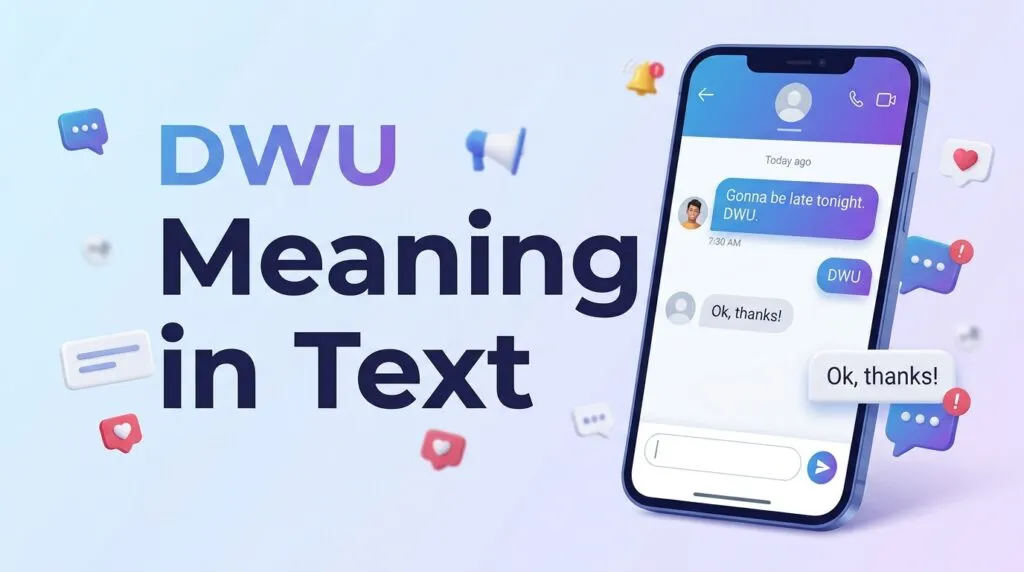

DWU usually means “Don’t Wait Up” in a text message. People use it to tell someone not to stay awake, wait for their arrival or expect an immediate reply. In some casual conversations, DWU can also mean “Dat’s What’s Up,” but that meaning is less predictable and depends on context.
| Term | Meaning | Context |
|---|---|---|
| DWU | Don’t Wait Up | Someone will arrive late or reply later |
| DWU | Dat’s/That’s What’s Up | A positive or approving reaction |
| DWU | Airport identifier | Used for Ashland Regional Airport in aviation records |
| dwu- | Two or double | A Polish-language prefix, not English texting slang |
The safest way to understand DWU is to read the message around it. A sentence about arriving home late almost always means “Don’t Wait Up.” A reply to good news may mean “That’s What’s Up.”
For readers who regularly come across unfamiliar abbreviations, Meanigo can provide a simple starting point for understanding the meaning, tone and correct use of modern text slang.
Meaning & Definition
DWU is an informal texting abbreviation that most commonly stands for “Don’t Wait Up.”
The phrase tells another person that they do not need to remain awake, delay their plans or wait for the sender to return. It may also carry the softer meaning of “Don’t worry about me” or “You can continue without me.”
Full form of DWU
The standard full form is:
D — Don’t
W — Wait
U — Up
Although people often call DWU an acronym, it is more precisely an initialism because users normally pronounce each letter: “D-W-U.” However, “texting acronym” remains a common and understandable description.
Common interpretation
In most personal messages, DWU means that the sender:
- Will arrive later than expected
- Does not want the recipient to stay awake
- May not reply again soon
- Wants the other person to continue their plans
- Does not want anyone to worry unnecessarily
Real-world examples
Example 1: Arriving home late
I’m staying at work for another hour. DWU.
Meaning: “I will be late, so do not stay awake waiting for me.”
Example 2: Going out
We’re getting food after the movie. DWU tonight.
Meaning: “I may come home late, so go to sleep without me.”
Example 3: Delayed communication
My phone is almost dead. DWU if I stop replying.
Meaning: “Do not wait for another message from me tonight.”
Example 4: Continuing without someone
The meeting is running over. Start dinner without me, DWU.
Meaning: “Do not delay dinner because I am late.”
DWU is usually considerate rather than rude. The sender is giving an update so the other person can stop waiting.
Background
The phrase “don’t wait up” existed long before phones, social media and online chat. It was traditionally said by someone who expected to return home late.
For example, a person leaving the house might tell family members, “Don’t wait up for me.” This meant they should go to bed at their normal time instead of staying awake until the person returned.
The shortened form DWU began appearing in digital communication during the 2000s. People started shortening “don’t wait up” in texts and social media during that period. An early user-submitted online definition appeared in 2007.
How the term evolved
The evolution was simple:
- People already used the spoken phrase “don’t wait up.”
- Text messaging encouraged shorter sentences.
- Users reduced the phrase to its first letters.
- DWU spread through texts, status updates and social posts.
- A second slang meaning, “Dat’s What’s Up,” also appeared in some online communities.
The phrase became useful because it communicates time, expectations and reassurance with only three letters.
Why people use DWU
People use DWU because it is:
- Short and easy to type
- Useful when someone is running late
- Less formal than a complete explanation
- A quick way to manage expectations
- Helpful when a phone battery is low
- Suitable for close friends, partners and family members
It can also soften a delay. Instead of disappearing without explanation, the sender lets the other person know that waiting is unnecessary.
Also Read: MBN Meaning in Text, Chat & Social Media Explained
Usage in Different Contexts
The meaning of DWU can change slightly depending on where it appears and what people are discussing.
Text Messages
In standard texting, DWU usually means “Don’t Wait Up.”
I won’t be home until after midnight. DWU.
The sender expects to return late and does not want the recipient to lose sleep.
Social Media
On social media, DWU may appear in captions, comments, private messages or story replies.
Late night with the team. DWU.
Here, the person may be joking that the evening will continue for a long time.
In a comment responding to good news, DWU may instead mean “Dat’s What’s Up.”
I finally passed my driving test!
DWU! Congrats!
The positive reaction makes the alternate meaning more likely.
Gaming
DWU is not a universal gaming abbreviation. However, players may use it in personal conversations during a gaming session.
I’m staying online for another match. DWU.
This means the player does not expect to finish soon.
A teammate might also use DWU as a reaction:
We won the tournament.
DWU!
In that example, it may mean “That’s what’s up” or “That’s great.”
Online Communities
In forums, group chats and private online communities, the meaning depends on the group’s communication style.
Some users understand DWU only as “Don’t Wait Up.” Others may use it as an approving response meaning “Dat’s What’s Up.” User-submitted slang sources contain examples of both interpretations.
Because DWU is not as widely recognized as LOL, BRB or IDK, writers should provide enough context to prevent confusion.
Professional Communication
DWU is generally unsuitable for formal emails, client messages or workplace documents.
A manager may not understand:
Running late. DWU.
A clearer professional version would be:
I am running late, so please continue without me.
You might use DWU in a private workplace chat with a close colleague, but complete wording is safer when clarity matters.
Meaning in Chat, WhatsApp, Instagram, TikTok
DWU has the same main meaning across most platforms, but the tone and situation can vary.
| Platform | Meaning | Example Usage |
|---|---|---|
| General chat | Don’t Wait Up | “I’m working late. DWU.” |
| Don’t wait for me or my reply | “Battery is at 2%. DWU.” | |
| Don’t wait up or that’s what’s up | “Out all night with the team. DWU.” | |
| TikTok | Usually a caption or comment abbreviation | “Night shift again, DWU.” |
| Snapchat | Do not expect another snap or reply soon | “Going offline now. DWU.” |
| Discord | Do not wait for the user to return | “I may not rejoin tonight. DWU.” |
DWU meaning in chat
In a direct chat, DWU most often sets an expectation. The sender is explaining that they may be unavailable, delayed or home late.
I still have two assignments to finish. DWU.
DWU meaning on WhatsApp
On WhatsApp, DWU may appear when someone is traveling, working late or losing phone access.
The signal is bad here. DWU if I disappear.
The message means the recipient should not wait for another reply.
DWU meaning on Instagram
Instagram usage is more flexible. In a direct message, it usually means “Don’t Wait Up.” In a comment under good news, it may mean “Dat’s What’s Up.”
Use the sentence type as your clue. A schedule update suggests “Don’t Wait Up,” while an excited reaction suggests “That’s What’s Up.”
DWU meaning on TikTok
DWU is not one of TikTok’s most universal abbreviations. It may appear in captions about staying out late, working overnight or being unavailable.
It may also appear as community-specific slang. Readers should check the caption, video topic and replies before choosing a meaning.
Also Read: DTF Meaning in Text: What It Really Means
Meaning in Physics, Medical, and Aircraft Terminology
DWU is mainly known as internet slang, but the letters may appear in specialized settings.
| Field | Recognized Meaning | Explanation |
|---|---|---|
| Physics | No widely recognized general meaning | It may appear as a local variable, label or project-specific abbreviation |
| Medical | No widely recognized standard clinical meaning | It may be local shorthand, initials or an internal code |
| Aviation | FAA airport identifier | DWU identifies Ashland Regional Airport in FAA records |
| Aircraft systems | No universal aircraft-component meaning | It should not be assumed to name a standard aircraft part |
DWU in physics
DWU is not a widely established physics abbreviation like Hz, N, J or eV.
A research paper could use the letters as a custom variable or internal label, but the meaning would need to be defined within that paper. Therefore, readers should not apply the texting definition to a scientific equation.
DWU in medical terminology
DWU is not a common standardized medical abbreviation for a disease, treatment or diagnostic test.
If it appears in medical notes, it may represent:
- A department name
- A local hospital code
- A person’s initials
- An internal workflow term
- A transcription error
Medical abbreviations can affect patient safety, so unclear shorthand should be confirmed with a qualified healthcare professional or the organization that created the record.
DWU in aviation and aircraft terminology
In U.S. aviation records, DWU is the FAA location identifier for Ashland Regional Airport. FAA procedure listings display the identifier as DWU, with KDWU used in the four-character format.
This does not mean DWU is a general abbreviation for an aircraft system. Its verified aviation use is an airport identifier rather than the name of a standard aircraft component.
Common Misconceptions
Misconception 1: DWU means “Don’t Wake Up”
Some readers assume the U represents “up” in “Don’t Wake Up.”
The usual texting meaning is “Don’t Wait Up,” not “Don’t Wake Up.” The phrase tells someone they do not need to remain awake waiting.
Misconception 2: DWU always has one meaning
“Don’t Wait Up” is the main interpretation, but some users write DWU to mean “Dat’s What’s Up.”
Context decides which meaning fits.
Misconception 3: DWU is rude
DWU is not automatically rude. It often shows consideration because the sender does not want someone to waste time or lose sleep.
However, a message such as “DWU” with no explanation may sound distant in a serious conversation.
Misconception 4: DWU means the sender is ending a relationship
DWU does not normally signal a breakup or rejection. It usually concerns timing, availability or a late arrival.
Relationship meaning should be judged from the full conversation, not one abbreviation.
Misconception 5: DWU is common in formal writing
DWU belongs mainly to informal digital communication. It should usually be replaced with complete wording in business, academic, legal and medical communication.
Misconception 6: Capitalization changes the meaning
DWU, dwu and Dwu normally represent the same abbreviation. Capital letters may improve readability, but they do not create a new definition.
When an abbreviation feels unclear, a focused explanation on Meanigo can help readers compare its possible meanings and identify the interpretation that matches the conversation.
Similar Terms & Alternatives
| Term | Meaning | Difference |
|---|---|---|
| DWU | Don’t Wait Up | Tells someone not to stay awake or wait |
| BRB | Be Right Back | The sender plans to return soon |
| BBL | Be Back Later | The sender will return after a longer delay |
| TTYL | Talk To You Later | Ends or pauses a conversation |
| GTG | Got To Go | The sender must leave immediately |
| AFK | Away From Keyboard | The person is temporarily unavailable |
| NM | Never Mind | Cancels or withdraws a previous point |
| IDC | I Don’t Care | Expresses a lack of concern or preference |
| NVM | Never Mind | Tells the reader to ignore the earlier message |
| DW | Don’t Worry | Reassures someone directly |
| CU | See You | A casual goodbye |
| GN | Good Night | Ends a conversation before sleep |
The closest alternative to DWU is often DW, meaning “Don’t Worry.” However, DW does not specifically tell someone to stop waiting.
How to Respond to It
Your response should match the relationship and the reason the sender used DWU.
| Scenario | Suggested Response |
|---|---|
| Partner will be home late | “Okay, thanks for letting me know. Be safe.” |
| Friend is staying out | “No problem. Have fun!” |
| Family member is working late | “Got it. I’ll leave the light on.” |
| Sender’s phone is dying | “Okay, message me when you can.” |
| Person cannot return to a game | “All good. We’ll catch you next time.” |
| DWU means “That’s What’s Up” | “Thanks! I’m really excited.” |
| Meaning is unclear | “Do you mean don’t wait up?” |
| Formal situation | “Understood. We will continue without you.” |
Casual replies
- “Okay, no worries.”
- “Got it.”
- “Be safe.”
- “Sure, talk tomorrow.”
- “No problem.”
- “Thanks for the update.”
Caring replies
- “Okay. Let me know when you get home safely.”
- “I won’t wait up, but please send a quick message later.”
- “Understood. Take care on your way back.”
Formal replies
- “Thank you for the update.”
- “Understood. We will proceed as planned.”
- “Noted. Please contact me when you are available.”
A reply is not always required. However, a brief acknowledgment helps the sender know that the message was understood.
Differences from Similar Words
| Expression | Core Meaning | Expected Return | Main Purpose |
|---|---|---|---|
| DWU | Don’t Wait Up | Late or uncertain | Tells someone not to wait |
| BRB | Be Right Back | Very soon | Pauses the conversation |
| BBL | Be Back Later | Later | Announces a longer absence |
| TTYL | Talk To You Later | Unspecified | Ends the conversation politely |
| GTG | Got To Go | Not stated | Announces immediate departure |
| AFK | Away From Keyboard | Usually temporary | Shows temporary inactivity |
| DW | Don’t Worry | Not relevant | Offers reassurance |
| GN | Good Night | Usually next day | Ends communication for the night |
DWU vs. DW
DWU means “Don’t Wait Up.”
DW usually means “Don’t Worry.”
Example:
DW, I already handled the problem.
This means “Don’t worry.”
I’ll be home late, DWU.
This means “Don’t wait up.”
DWU vs. BRB
BRB suggests a quick return. DWU suggests that the person may not return or reply for a while.
DWU vs. TTYL
TTYL focuses on speaking again later. DWU focuses on preventing someone from waiting.
DWU vs. BBL
BBL announces that the sender will come back later. DWU tells the recipient to continue without waiting for that return.
Relevance in Online Conversations & Dating Apps
DWU remains relevant because modern conversations often continue throughout the day. People use messaging apps to share plans, locations, delays and changes in availability.
A short abbreviation can prevent misunderstandings when someone cannot continue chatting.
Social media usage
On social media, DWU may appear in:
- Direct messages
- Private group chats
- Story captions
- Comments
- Late-night posts
- Travel updates
- Work or study updates
Its tone can be serious, caring, casual or playful.
Dating app usage
On a dating app, DWU may mean that a person will not reply again that evening.
I have an early meeting and I’m putting my phone away. DWU.
However, the phrase can sound unusual when two people do not know each other well. Clearer wording may create a warmer impression:
I may not reply again tonight, but I’ll message you tomorrow.
If a match sends only “DWU,” ask for clarification rather than assuming they are rejecting you.
Messaging etiquette
Good digital etiquette requires clarity. Use DWU when the other person is likely to understand it. Write the full phrase when:
- The conversation is important
- The recipient is unfamiliar with slang
- You are speaking to a client or manager
- A misunderstanding could cause worry
- You are canceling or changing plans
- Safety information is involved
A clearer message may be:
I’m staying late at work, so don’t wait up. I’ll text when I leave.
This takes longer to type, but it gives the recipient more useful information.
Modern communication trends
Digital language often shortens common phrases into initialisms. Examples include BRB, IDK, TTYL and IMO.
However, not every abbreviation is universally understood. DWU is useful, but it is less familiar than many older internet terms. That makes context especially important.
Also Read: IMO Meaning in Text: Most People Get This Acronym Wrong
Frequently Asked Questions
What does DWU mean in texting?
DWU most commonly means “Don’t Wait Up.” A person uses it when they expect to arrive late, remain unavailable or stop replying for the night. It tells the recipient to continue their plans or go to sleep instead of waiting for the sender.
Does DWU have multiple meanings?
Yes. The primary texting meaning is “Don’t Wait Up.” Some users also use DWU as a shortened form of “Dat’s What’s Up” or “That’s What’s Up.” The message topic and sentence structure usually reveal which interpretation makes sense.
Is DWU commonly used on TikTok?
DWU may appear on TikTok, but it is not as universal as terms such as POV, FYP or GRWM. Users may place it in captions or comments about staying out late, working overnight or being unavailable. Its meaning should be confirmed through the video’s context.
What does DWU mean from a girl?
When a girl sends DWU, it usually means “Don’t Wait Up.” She may be returning late, ending the conversation for the night or saying that she cannot reply soon. It does not automatically show anger, rejection or loss of interest.
What does DWU mean from a guy?
When a guy writes DWU, he is usually telling someone not to wait for him or expect another reply soon. If he uses it after hearing good news, it may instead mean “That’s What’s Up,” which expresses approval or excitement.
Is DWU rude or friendly?
DWU is usually neutral or considerate. It helps another person manage their time and expectations. However, sending only the three letters during an emotional conversation may seem cold. Adding a reason or caring phrase can make the message sound friendlier.
Can DWU mean “Don’t Wake Up”?
“Don’t Wake Up” is not the standard texting definition of DWU. The established slang meaning is “Don’t Wait Up.” Confusion occurs because both phrases could match some of the letters, but message history and common usage support “Don’t Wait Up.”
How should I reply when someone says DWU?
A simple response such as “Okay,” “Got it,” or “Be safe” usually works. If the sender is traveling or returning home late, you can ask them to message when they arrive safely. If the meaning is unclear, politely ask what they meant.
Is DWU suitable for professional messages?
DWU is not recommended for most professional communication because clients, managers or coworkers may not recognize it. Use a clear sentence such as, “Please continue without me,” or “I will be unavailable for the rest of the evening.”
Does DWU have a medical meaning?
DWU is not a widely recognized standard medical abbreviation. It could appear as local shorthand, an internal department code or someone’s initials. Any unclear abbreviation in a medical record should be confirmed with the healthcare provider that created it.
Does DWU have an aviation meaning?
Yes. DWU is used by the Federal Aviation Administration as the location identifier for Ashland Regional Airport. In that context, it is an airport code rather than texting slang or the name of a standard aircraft system.
What is the difference between DWU and DW?
DWU means “Don’t Wait Up” and relates to waiting for someone’s return or reply. DW usually means “Don’t Worry” and provides general reassurance. One extra letter changes the message, so readers should check the abbreviation carefully.
Conclusion
DWU most commonly means “Don’t Wait Up” in texting, chat and social media. It tells someone not to remain awake, delay their plans or expect an immediate reply.
In some conversations, DWU can also mean “Dat’s What’s Up,” especially when it appears as a positive reaction to news. Context is the best guide: timing messages suggest “Don’t Wait Up,” while excited responses may suggest “That’s What’s Up.”
DWU is useful in casual communication, but complete wording is better in formal, medical or sensitive situations. For more clear explanations of texting abbreviations, online slang and context-based meanings, readers can use Meanigo as a practical reference whenever a short message feels confusing.

Pingback: IHH Meaning in Text: Uses, Examples and Replies
Pingback: MMCHT Meaning in Text: What It Means and How to Reply
Pingback: FS Meaning in Text: Definition, Uses & Examples
Pingback: DD Meaning in Text: What Does DD Stand For?