
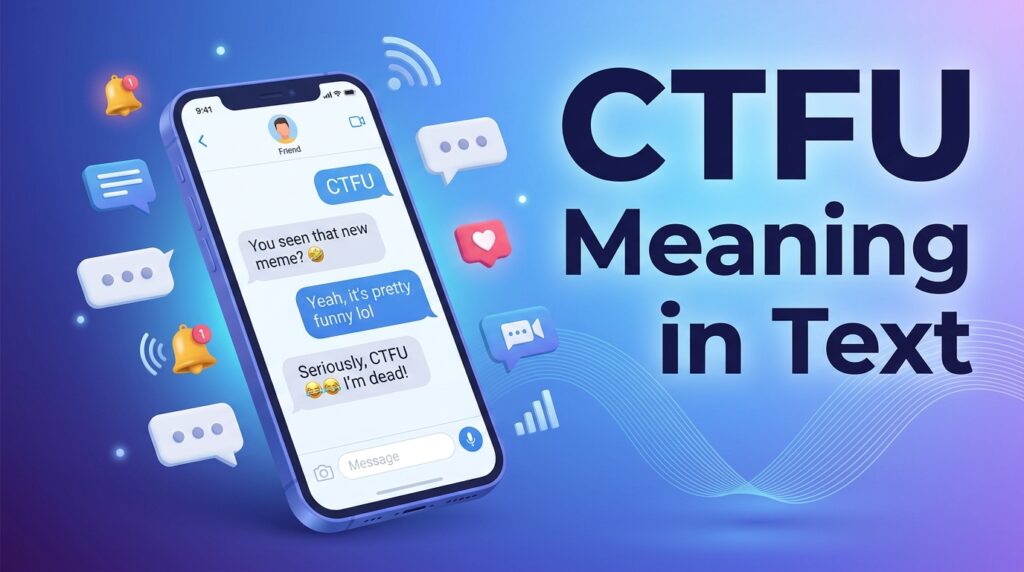

CTFU means “cracking the f* up” in text messages and online conversations.** People use it to show that something is extremely funny or has made them laugh hard. It is stronger and more expressive than “LOL,” but because it contains implied profanity, it is best suited to casual conversations with friends.
| Term | Meaning | Context |
|---|---|---|
| CTFU | Cracking the f*** up | Strong laughter in texts, memes, comments, and chats |
| Tone | Highly amused and informal | Used when something is much funnier than an ordinary joke |
| Best setting | Casual communication | Friends, social media, gaming chats, and online communities |
| Avoid in | Formal communication | Work emails, academic writing, customer support, and professional messages |
Meaning & Definition
The most common CTFU meaning in text is “cracking the f*** up.” It describes intense laughter or strong amusement.
The phrase “cracking up” already means laughing very hard. The letter “F” adds profanity to make the reaction sound stronger, more emotional, and more dramatic.
CTFU is classified as an internet slang initialism because each letter represents a separate word:
- C – Cracking
- T – The
- F – F***
- U – Up
Major English dictionaries describe CTFU as an informal abbreviation used to express strong amusement in texts, emails, and digital conversations.
In simple terms, CTFU means that a person finds something extremely funny.
Common Interpretation
Most people use CTFU as a stronger version of:
- LOL
- LMAO
- ROFL
- “I’m crying”
- “I’m dead”
- “I can’t stop laughing”
It does not normally mean that the person is literally unable to breathe or control themselves. Like many online expressions, it exaggerates an emotion to make the reaction more noticeable.
Real-World Examples
Example 1:
“That video has me CTFU.”
Meaning: The video is making the person laugh very hard.
Example 2:
“You really wore that to school? CTFU!”
Meaning: The speaker finds the situation very funny, although the message may also sound teasing.
Example 3:
“I’m CTFU at these comments.”
Meaning: The comments are extremely amusing.
Example 4:
“The way he fell and got back up had me CTFU.”
Meaning: The event caused intense laughter.
The tone depends on the relationship between the people involved. Among close friends, CTFU usually sounds playful. When directed at a stranger, it may appear rude, mocking, or disrespectful.
Background
CTFU developed through internet culture, texting, online forums, and early social media. It became more visible during the 2000s as people began using shorter forms of common emotional reactions.
Dictionary.com reports that the slang appeared online during the 2000s and was recorded on Urban Dictionary in 2005. Its visibility later increased through social platforms and digital conversations.
Before smartphones became common, people often had limited space for text messages. Typing complete sentences also took more time on older mobile keypads. Abbreviations such as LOL, BRB, OMG, LMAO, and CTFU allowed users to express reactions quickly.
How the Term Evolved
CTFU started as a direct abbreviation for strong laughter. Over time, it became more flexible.
Today, someone may use it to show:
- Genuine laughter
- Surprise mixed with amusement
- Sarcasm
- Disbelief
- Playful embarrassment
- A reaction to a meme
- Friendly teasing
- Amusement at an awkward situation
For example:
“Not you showing up three hours late, CTFU.”
The sender may not be laughing uncontrollably. Instead, CTFU adds a playful or sarcastic tone.
Why People Use CTFU
People use CTFU because it communicates emotion quickly. A plain sentence such as “That was funny” may sound weak or serious. CTFU shows a much stronger reaction.
Compare these responses:
“That was funny.”
“LOL.”
“I’m CTFU right now.”
The third response communicates the highest level of amusement.
It can also help clarify tone. Text messages do not include facial expressions, gestures, or voice. Slang, punctuation, emojis, and abbreviations help users show how they feel.
Usage in Different Contexts
The meaning of CTFU remains similar across most digital spaces, but its tone can change depending on the platform, audience, and conversation.
Text Messages
In text messages, CTFU usually responds to a joke, funny story, embarrassing memory, picture, or video.
Example:
Person A: “I waved back at someone, but they were waving at the person behind me.”
Person B: “CTFU, I would have walked away immediately.”
Here, CTFU shows friendly amusement rather than cruelty.
Another common sentence structure is:
“You got me CTFU.”
This means, “You are making me laugh very hard.”
Social Media
On social media, users place CTFU in:
- Comments
- Captions
- Replies
- Quote posts
- Meme reactions
- Video descriptions
Example:
“The last five seconds got me CTFU.”
This type of comment tells other viewers that the ending is especially funny.
CTFU may also appear with emojis:
“CTFU 😭😂”
The crying and laughing emojis strengthen the emotional reaction.
Gaming
In gaming chats, CTFU may describe a funny mistake, unexpected defeat, strange character movement, or humorous voice-chat moment.
Example:
“The way your character flew across the map has me CTFU.”
Gaming communication moves quickly, so abbreviations are useful. However, players should consider tone. Laughing at a teammate’s harmless mistake may feel playful, while laughing after someone loses an important match may seem disrespectful.
Online Communities
People use CTFU in Discord servers, Reddit discussions, forums, group chats, and fan communities.
It may react to:
- Inside jokes
- Screenshots
- Memes
- Funny opinions
- Unexpected replies
- Shared experiences
In these spaces, the abbreviation often helps users feel part of a group. Understanding common internet slang makes informal conversations easier to follow.
Websites that explain modern terms can also help readers avoid confusion. For example, Meanigo can be used as a reference when unfamiliar abbreviations, slang expressions, or online phrases appear in a conversation.
Professional Communication
CTFU is generally unsuitable for professional communication.
Avoid using it in:
- Job applications
- Business proposals
- Client messages
- Formal workplace emails
- School assignments
- Customer service replies
- Official announcements
- Communication with senior management
The abbreviation contains implied profanity. Even when the full word is hidden, readers understand what the “F” represents.
A safer professional response would be:
- “That was very funny.”
- “That made me laugh.”
- “That was hilarious.”
- “I enjoyed that.”
- “Thanks for sharing that.”
CTFU may be acceptable in a private workplace chat between close colleagues who already use informal language. Still, the relationship and company culture should be considered carefully.
Meaning in Chat, WhatsApp, Instagram, TikTok
CTFU has nearly the same meaning across chat apps and social media platforms. It normally expresses strong laughter, but the content causing the reaction may differ.
| Platform | Meaning | Example Usage |
|---|---|---|
| Text or chat | Laughing extremely hard | “Your story has me CTFU.” |
| Strong amusement in private or group chats | “I just watched the video. CTFU!” | |
| Reaction to a Reel, meme, caption, or comment | “The second slide got me CTFU.” | |
| TikTok | Reaction to a funny video, sound, trend, or reply | “Why did he run like that? CTFU.” |
| Snapchat | Laughing at a Snap, story, picture, or message | “That filter has me CTFU.” |
| Discord | Strong laughter during community or gaming chats | “That voice crack had the whole server CTFU.” |
| X or similar platforms | Reaction to a humorous post or quote | “The replies are CTFU material.” |
CTFU Meaning in Chat
In one-to-one chat, CTFU often shows that the sender feels comfortable being informal.
For example:
“I just remembered what you said yesterday. I’m still CTFU.”
This means the memory remains extremely funny.
CTFU Meaning on WhatsApp
On WhatsApp, it commonly appears in friend groups and family chats where casual language is accepted.
For example:
“Everyone’s reactions in the video have me CTFU.”
Users may also write:
- Ctfu
- ctfu
- CTFUUU
- CTFU 😂
- I’m ctfu
Adding extra letters, punctuation, or emojis increases the emotional effect without changing the basic meaning.
CTFU Meaning on Instagram
On Instagram, CTFU usually reacts to a Reel, meme, story, caption, or comment thread.
For example:
“The comments are funnier than the Reel. CTFU.”
This means the comment section is causing strong laughter.
CTFU Meaning on TikTok
On TikTok, users may type CTFU when a creator’s expression, sound, editing style, story, or unexpected ending is hilarious.
For example:
“I was not ready for the ending. CTFU.”
TikTok language changes quickly, but CTFU keeps its established meaning of intense laughter. Recent slang guides continue to describe it as a reaction used across TikTok, Snapchat, texting, memes, and gaming communities.
Meaning in Physics, Medical, and Aircraft Terminology
CTFU is mainly recognized as internet slang. It does not have one broadly accepted technical meaning across physics, clinical medicine, or aviation.
| Field | Recognized Meaning | Explanation |
|---|---|---|
| Physics | No standard general meaning | CTFU is not a commonly recognized physics formula, unit, law, or scientific abbreviation. |
| Medical | No standard universal meaning | It is not a widely accepted clinical abbreviation. A local hospital or research document could create its own meaning. |
| Aviation or aircraft | No standard general meaning | CTFU does not appear as a common operational abbreviation in standard FAA and ICAO acronym resources. |
| Texting and internet slang | Cracking the f*** up | This is the dominant and widely recognized meaning. |
CTFU Meaning in Physics
There is no standard physics concept commonly known as CTFU.
It should not be confused with technical abbreviations that may look similar. Scientific documents often define specialized abbreviations within the paper itself. Therefore, when CTFU appears in a research document, check the first use, glossary, table, diagram, or list of abbreviations.
Without a local definition, the reader should not assume that CTFU has a recognized physics meaning.
CTFU Medical Meaning
CTFU is not a standard universal medical abbreviation.
Hospitals, laboratories, clinics, and research teams sometimes create internal abbreviations. The same letters may therefore have a local meaning in a particular document or organization.
In medical communication, guessing an abbreviation can lead to serious confusion. Check the official document glossary or ask the healthcare professional who used the term.
When CTFU appears in an ordinary message between people, it almost certainly refers to laughter rather than a medical condition.
CTFU Meaning in Aviation or Aircraft Terminology
CTFU is not listed as a common aviation abbreviation in the general acronym resources published by the Federal Aviation Administration or International Civil Aviation Organization.
A company, maintenance team, airport, military unit, or aircraft manufacturer could still assign an internal meaning to the letters. Such a meaning would need to be confirmed through the relevant manual or glossary.
In a social media post about flying, CTFU is more likely to mean “cracking the f*** up” than an aircraft component.
Common Misconceptions
CTFU can be confusing because the letters look similar to other internet abbreviations.
Misconception: It Means “Shut the F*** Up”
Some people confuse CTFU with STFU.
- STFU means “shut the f*** up.”
- CTFU means “cracking the f*** up.”
STFU is normally a command and may sound aggressive. CTFU is usually a reaction to something funny.
Misconception: It Means “Cut the F*** Up”
“Cut the f*** up” has been reported as a localized or less common interpretation related to acting wildly, dancing, or having fun. However, it is not the dominant meaning in general texting.
In most online conversations, CTFU refers to strong laughter.
Misconception: It Is the Same as LOL
Both terms express amusement, but their intensity differs.
LOL may show mild laughter, politeness, or friendliness. CTFU suggests that something is extremely funny.
Misconception: It Is Always Insulting
CTFU is not automatically an insult. It depends on what the sender is laughing at.
Friendly example:
“That joke has me CTFU.”
Potentially insulting example:
“Your haircut has me CTFU.”
The second message may embarrass or offend the recipient.
Misconception: It Is Suitable Everywhere
The abbreviation is informal and contains implied profanity. It is not suitable for every audience.
Use it carefully around:
- Employers
- Teachers
- Clients
- Children
- Older relatives
- New acquaintances
- People who avoid profanity
Misconception: Capitalization Changes the Meaning
CTFU, ctfu, and Ctfu usually mean the same thing.
Capital letters may make the reaction look louder or more emotional, but they do not create a different definition.
Also Read: TS Meaning on Instagram and in Text Messages
Similar Terms & Alternatives
| Term | Meaning | Difference |
|---|---|---|
| LOL | Laughing out loud | Milder and more widely acceptable |
| LMAO | Laughing my a** off | Strong laughter but slightly more common than CTFU |
| LMFAO | Laughing my f*ing a off | Similar intensity and also contains profanity |
| ROFL | Rolling on the floor laughing | Dramatic but often playful or old-school internet slang |
| Haha | Written laughter | Simple, neutral, and suitable for more situations |
| I’m dead | Something is extremely funny | Figurative modern slang, not literal |
| Crying | Laughing so hard that tears appear | Often paired with crying or laughing emojis |
| Screaming | Strong surprise or amusement | May express laughter, shock, or excitement |
| I can’t | The situation is overwhelmingly funny | Meaning depends heavily on context |
| That sent me | Something caused sudden intense laughter | Common in meme and social media culture |
| Dying | Laughing extremely hard | Figurative and informal |
| Wheezing | Laughing so hard that breathing feels difficult | More descriptive and dramatic |
Cleaner Alternatives
People who want to express strong laughter without profanity can use:
- “That was hilarious.”
- “I can’t stop laughing.”
- “That made my day.”
- “I’m crying with laughter.”
- “That really got me.”
- “I was not ready for that.”
- “The ending was so funny.”
- “You made me laugh so hard.”
These alternatives are easier to use with mixed audiences.
How to Respond to It
The best response depends on why the person wrote CTFU.
| Scenario | Suggested Response |
|---|---|
| A friend laughs at your joke | “Glad you liked it 😂” |
| Someone reacts to your funny story | “It was even funnier in person.” |
| A person laughs at your meme | “I knew you would find it funny.” |
| A teammate laughs at a gaming mistake | “That was not my best moment 😂” |
| Someone uses it playfully | “I’m still laughing too.” |
| You do not understand what was funny | “Wait, which part got you?” |
| The message feels insulting | “I know you may be joking, but that felt disrespectful.” |
| A colleague uses it in a casual work chat | “That was hilarious.” |
| A stranger comments CTFU on your post | “Glad it made you laugh!” |
| Someone laughs at a serious issue | “I’m actually being serious about this.” |
Casual Responses
- “Same 😂”
- “I knew that would get you.”
- “I’m still laughing.”
- “The whole situation was wild.”
- “You should have seen it in person.”
- “I can’t believe that happened.”
- “That part took me out.”
Formal or Neutral Responses
- “I’m glad you found it amusing.”
- “That was certainly an unexpected moment.”
- “Thanks for the reaction.”
- “I’m pleased it made you laugh.”
- “It was a funny situation.”
You do not have to use the same slang in your response. Matching the other person’s tone is optional.
Differences from Similar Words
CTFU belongs to a group of slang expressions used to show laughter, but each term has a different level of intensity and formality.
| Term | Full Form or Meaning | Intensity | Profanity | Best Use |
|---|---|---|---|---|
| Haha | Written laughter | Low to medium | No | Almost any friendly conversation |
| LOL | Laughing out loud | Mild | No | Texting, comments, and casual work chats |
| LMAO | Laughing my a** off | Strong | Mildly vulgar | Friends and informal social media |
| LMFAO | Laughing my f*ing a off | Very strong | Yes | Close friends and informal online spaces |
| ROFL | Rolling on the floor laughing | Strong | No | Playful online conversations |
| CTFU | Cracking the f*** up | Very strong | Yes | Friends, memes, social media, and gaming |
| I’m dead | Extremely amused | Very strong | No | Modern social media and casual chats |
| That sent me | That caused sudden laughter | Strong | No | Memes, videos, and online comments |
CTFU vs LOL
LOL is milder and more flexible. People sometimes type LOL even when they are only smiling.
CTFU suggests genuine or exaggerated intense laughter.
CTFU vs LMAO
Both express strong amusement. LMAO is more widely recognized, while CTFU may sound more forceful or expressive.
CTFU vs LMFAO
LMFAO and CTFU have similar emotional intensity. Both contain implied profanity and should be avoided in formal settings.
CTFU vs ROFL
ROFL creates a visual image of someone rolling on the floor with laughter. CTFU focuses on the idea of emotionally “cracking up.”
CTFU vs STFU
These expressions have completely different meanings.
- CTFU expresses laughter.
- STFU tells someone to stop talking.
Confusing them could change a friendly conversation into an offensive one.
Relevance in Online Conversations & Dating Apps
CTFU remains relevant because modern digital communication depends on short emotional signals.
People often communicate through:
- Short messages
- Memes
- GIFs
- Reaction images
- Emojis
- Voice notes
- Video replies
- Abbreviations
CTFU helps the sender show that a message is not meant to sound serious or cold.
Social Media Usage
On social media, users compete for attention. Strong reactions such as CTFU make comments feel more expressive.
A comment saying:
“Funny.”
may seem flat.
A comment saying:
“The ending has me CTFU 😭”
feels more emotional and engaging.
CTFU is especially common around humorous posts, reaction videos, comedy clips, viral mistakes, and relatable stories.
Dating App Usage
On dating apps, CTFU may show that a person enjoys someone’s humor.
For example:
“Your answer about your worst cooking experience has me CTFU.”
This can be positive because humor helps create comfort and connection.
However, the abbreviation should be used carefully in a new conversation. Some people dislike profanity or may not know the meaning.
A cleaner alternative is:
“That genuinely made me laugh.”
This keeps the message warm without sounding overly casual.
Messaging Etiquette
Before using CTFU, consider:
- How well you know the person
- Whether they use similar slang
- Whether profanity is acceptable
- Whether the topic is sensitive
- Whether your laughter could seem insulting
- Whether the conversation is personal or professional
Do not use CTFU when someone shares:
- Grief
- A medical problem
- Financial hardship
- A serious relationship issue
- Workplace trouble
- A frightening experience
- Personal insecurity
Even when part of a story sounds amusing, the abbreviation may make you appear insensitive.
Modern Communication Trends
Online language continues to become shorter, more visual, and more emotional. People combine slang with emojis, GIFs, punctuation, capitalization, and repeated letters.
Examples include:
- “CTFUUUU 😭”
- “I’m actually CTFU.”
- “Nahhh, CTFU 😂”
- “This got me ctfu.”
- “Why am I CTFU at 2 a.m.?”
These variations do not change the definition. They change the intensity and personality of the reaction.
Because slang develops quickly, readers often search for reliable explanations before responding. Meaning-focused resources such as Meanigo can help users understand unfamiliar texting abbreviations, online expressions, acronyms, and modern conversational terms in context.
Also Read: BD Meaning in Text: Definition, Uses, Replies & Examples
Frequently Asked Questions
What does CTFU mean in texting?
CTFU means “cracking the f*** up” in texting. It is used when someone finds a message, image, video, joke, or situation extremely funny. It expresses stronger laughter than LOL. Because the abbreviation contains implied profanity, it is most appropriate in casual conversations with people who understand the tone.
What is the full form of CTFU?
The standard full form of CTFU is “cracking the f*** up.” Some people also read it as “crack the f*** up,” but both versions express intense laughter. The first form is more natural in sentences such as, “That video has me CTFU.”
Does CTFU have multiple meanings?
CTFU primarily means “cracking the f*** up.” Less common interpretations, such as “cheer the f*** up” or the localized expression “cut the f*** up,” may appear in specific communities. However, intense laughter is the dominant meaning in ordinary texts, social posts, memes, and online chats.
Is CTFU commonly used on TikTok?
CTFU appears in TikTok comments, captions, and replies when users find a video, sound, reaction, or unexpected ending extremely funny. It is not exclusive to TikTok. The same abbreviation is also used on Instagram, Snapchat, WhatsApp, Discord, X, gaming platforms, and ordinary text messages.
Is CTFU a bad word?
CTFU contains an abbreviated form of a strong swear word. Some people may therefore consider it vulgar or inappropriate. It is usually accepted among friends who already use casual slang, but it should be avoided in formal emails, workplace communication, academic writing, and conversations with people who dislike profanity.
What is the difference between CTFU and LOL?
LOL means “laughing out loud” and usually expresses mild or moderate amusement. CTFU means “cracking the f*** up” and communicates a much stronger reaction. Someone may type LOL after a slightly funny comment, while CTFU suggests that the content caused intense or uncontrollable laughter.
What does CTFU mean from a girl?
When a girl sends CTFU, it normally means she finds something extremely funny. The meaning does not change according to gender. Depending on the conversation, it may also show comfort, playful teasing, sarcasm, or interest in the other person’s humor. The surrounding messages reveal the intended tone.
What does CTFU mean from a guy?
When a guy writes CTFU, he is usually saying that a joke, story, picture, or situation made him laugh hard. It may be a friendly reaction or part of playful flirting. Gender does not alter the basic definition, so the surrounding conversation should be used to understand the exact tone.
Can I use CTFU in a professional message?
CTFU should generally not be used in professional communication because it contains implied profanity and sounds highly informal. Use expressions such as “That was very funny,” “That made me laugh,” or “I enjoyed that” when speaking with clients, managers, teachers, customers, or unfamiliar colleagues.
Is CTFU the same as LMAO?
CTFU and LMAO both express strong laughter, but they use different phrases. CTFU means “cracking the f*** up,” while LMAO means “laughing my a** off.” Their intensity is similar, although LMAO is more widely recognized across different age groups and online communities.
What does “you got me CTFU” mean?
“You got me CTFU” means “you are making me laugh extremely hard.” It is usually a compliment about someone’s joke, story, post, or sense of humor. However, the phrase may also be used sarcastically when the sender finds someone’s actions ridiculous rather than intentionally funny.
How should I reply when someone says CTFU?
A casual reply could be “Glad you liked it,” “I knew that would make you laugh,” or “I’m still laughing too.” When the message feels insulting, respond calmly by explaining that the comment felt disrespectful. The best reply depends on your relationship and the topic being discussed.
Conclusion
CTFU means “cracking the f* up.”** It is an informal texting abbreviation used to express intense laughter or amusement. You may see it in texts, WhatsApp groups, Instagram comments, TikTok replies, gaming chats, memes, dating apps, and online communities.
CTFU is stronger than LOL and similar in intensity to LMAO or LMFAO. It works best in casual conversations with people who are comfortable with profanity. In professional, academic, medical, or formal communication, clearer and cleaner alternatives should be used.
The surrounding context is always important. CTFU can show friendly laughter, sarcasm, teasing, or disbelief. Understanding the relationship, topic, and tone will help you interpret it correctly and choose an appropriate response.



Pingback: WGO Meaning in Text: Full Form, Uses & Examples
Pingback: Ion Meaning in Text: Definition, Usage & Examples