
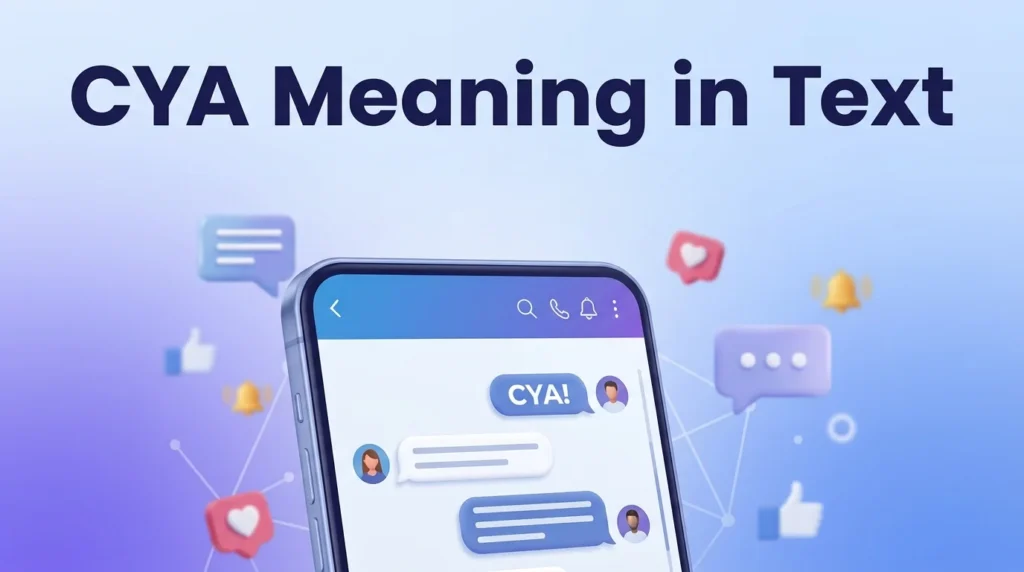

The CYA meaning in text is usually “see ya,” an informal and friendly way to say “see you” or goodbye. People commonly write CYA when ending a text message, social media chat, gaming session, or casual online conversation. In workplace discussions, however, CYA may also mean “cover your ass.”
| Term | Meaning | Context |
|---|---|---|
| CYA | See ya or see you | Text messages, chats and social media |
| CYA | Cover your ass | Workplace, business or risk-related conversations |
| CyA | Cyclosporine A | Medical and scientific literature |
| CYA | Antoine-Simon International Airport | Aviation and airport codes |
The intended meaning depends on the surrounding words, the relationship between the people, and where the term appears. In most personal messages, CYA is simply a casual farewell.
Because short forms can change meaning across communities, readers who regularly decode texting language may find Meanigo useful as a focused reference for slang, abbreviations and real-world examples. However, the surrounding conversation should always be considered because no glossary can determine a sender’s exact intention without context.
Meaning & Definition
CYA most commonly means “see ya” in texting. “See ya” is an informal pronunciation and spelling of “see you.” It is used when someone is leaving, ending a conversation or expecting to speak with the other person again.
Major dictionaries recognize CYA as a written abbreviation for “see you,” especially in text messages and emails. They also recognize a second American workplace meaning: “cover your ass,” a phrase describing actions taken to protect yourself from blame or criticism.
CYA full form in texting
In ordinary digital communication:
CYA = See ya = See you
It normally works as a farewell rather than a complete statement.
Examples include:
- “I have to leave now. CYA!”
- “Thanks for helping me. CYA tomorrow.”
- “The game starts at eight. CYA there.”
- “I’m going offline. CYA later.”
- “Have a good night, cya!”
In these examples, the sender is ending the current conversation while suggesting that another interaction may happen later.
The second meaning of CYA
In workplace or business communication, CYA can stand for “cover your ass.” This expression means taking steps to protect yourself against future blame, criticism, financial loss or legal problems.
For example:
- “Keep a copy of the approved proposal for CYA.”
- “Send a confirmation email so everyone understands the decision.”
- “The manager documented the changes as a CYA measure.”
This meaning is informal and can sound vulgar. In professional writing, alternatives such as document the decision, protect yourself, maintain a written record, or manage the risk are usually more suitable.
Background
The texting meaning of CYA developed from the spoken phrase “see ya.” In informal speech, “you” is often pronounced like “ya.” Writing CYA reproduces the sound of the complete phrase using only three letters:
- C sounds like “see.”
- Y represents “you.”
- A completes the informal sound of “ya.”
Dictionary sources trace the abbreviation to the twentieth century. It later became more visible as email, internet chat rooms, instant messaging and mobile texting encouraged people to shorten common expressions.
Early digital communication often involved limited screen space, slower typing and, in some cases, character limits. Users developed abbreviations such as LOL, BRB, CU, TTYL and CYA to communicate quickly.
CYA remains popular because it is:
- Short and easy to type
- Simple to understand
- Friendly without being emotional
- Suitable for ending casual conversations
- Flexible enough to use with words such as “later,” “soon” or “tomorrow”
The workplace meaning followed a different path. “Cover your ass” describes defensive actions used to avoid being blamed for a mistake or failed decision. It is often connected with keeping records, confirming instructions and documenting who approved an action.
Responsible documentation can reduce confusion and create accountability. Excessive CYA behavior, however, can indicate low trust and may lead to unnecessary emails, meetings and defensive communication.
Usage in Different Contexts
The meaning of CYA changes according to the situation. In personal messages, it usually means “see ya.” In a business meeting or compliance discussion, it may refer to protecting someone from blame.
Text Messages
CYA is commonly placed at the end of a personal text.
Example:
“I need to finish my homework. CYA tomorrow.”
Here, CYA means “see you tomorrow.”
It can also appear alone:
“Cya!”
A standalone CYA usually means the sender is leaving the conversation. Its tone may be friendly, neutral or slightly hurried depending on the previous messages.
Social Media
On Instagram, TikTok, Snapchat, Facebook and similar platforms, CYA may appear in:
- Direct messages
- Comment replies
- Captions
- Livestream chats
- Group conversations
Example:
“Thanks for joining the live. CYA next week!”
In this context, it is a relaxed farewell to followers or viewers.
Gaming
Gamers may use CYA when leaving a match, lobby, server or voice chat.
Examples:
“Good game, cya next round.”
“I’m logging off. CYA tomorrow.”
CYA is normally friendly in gaming, although it can sound sarcastic when used after defeating another player:
“Too slow. Cya!”
The second example means something closer to “you’re gone” or “goodbye” and may carry a teasing or competitive tone.
Online Communities
In forums, Discord servers, Reddit discussions and community groups, CYA can mark the end of a conversation.
Example:
“Thanks for answering my question. CYA around.”
“CYA around” suggests that the person expects to meet or interact with the community again.
Professional Communication
CYA should be interpreted carefully in professional conversations.
Consider this sentence:
“Please save the client’s approval for CYA.”
The phrase probably means keeping evidence to protect against future blame. It does not mean “see ya.”
By contrast:
“Thanks for the update. CYA Monday.”
This clearly means “see you Monday.”
Because the workplace expansion can sound vulgar, employees should avoid using it in formal reports, client emails, legal documents or public announcements. A more professional sentence would be:
“Please retain the written approval for our records.”
Meaning in Chat, WhatsApp, Instagram, TikTok
Across messaging and social media platforms, CYA usually keeps the same basic meaning. The main difference is how the term is delivered and interpreted.
| Platform | Meaning | Example Usage |
|---|---|---|
| General chat | See ya or goodbye | “I have to go. CYA!” |
| See you later | “Thanks for calling. CYA tomorrow.” | |
| Goodbye or see you in the next post | “New reel tomorrow. CYA then!” | |
| TikTok | See you in another video or live | “Follow for part two. CYA soon.” |
| Snapchat | Casual goodbye | “Going to sleep now, cya.” |
| Discord | Leaving a server or voice chat | “Good game everyone. CYA later.” |
| Workplace chat | See you or cover yourself | “CYA at the meeting” versus “Save it for CYA.” |
CYA meaning on WhatsApp
On WhatsApp, CYA usually means “see ya.” Friends and family members use it to close a conversation without writing a formal goodbye.
“I’m leaving for work. CYA tonight.”
When used with a time or place, its meaning becomes especially clear:
- CYA tomorrow
- CYA at school
- CYA at six
- CYA there
- CYA soon
CYA meaning on Instagram
Instagram users may use CYA in direct messages or as a closing phrase in captions.
“That’s all for today. CYA in the next post.”
Creators may also use it to invite followers back for future content.
CYA meaning on TikTok
On TikTok, CYA often appears at the end of a short video, caption, comment reply or livestream.
“Part two is coming tomorrow. CYA then!”
In this case, it combines a farewell with a call for the viewer to return.
CYA meaning in workplace chat
On Slack, Microsoft Teams or professional WhatsApp groups, the surrounding sentence matters.
- “CYA at the presentation” means “see you at the presentation.”
- “Send the confirmation for CYA” refers to protecting yourself through documentation.
Also Read: LMY Meaning in Text: What It Means & How to Reply
Meaning in Physics, Medical, and Aircraft Terminology
CYA is not limited to texting, but its technical meanings are unrelated to “see ya.” Capitalization, punctuation and subject matter can help identify the correct interpretation.
| Field | Possible Meaning | Explanation |
|---|---|---|
| Physics | No universal standard CYA acronym | It is not a commonly accepted general physics abbreviation |
| Radiocarbon research | ¹⁴C y.a. | May refer to carbon-14 or radiocarbon years ago |
| Medical | CyA or CYA for cyclosporine A | Used in some medical and pharmacological publications |
| Aviation | IATA airport code CYA | Code for Antoine-Simon International Airport in Les Cayes, Haiti |
| Aircraft engineering | No standard general component called CYA | Meaning would depend on a specific manual or organization |
CYA in physics
There is no widely recognized, universal physics definition of the uppercase texting acronym CYA.
In radiocarbon dating and related scientific writing, researchers may use forms such as ¹⁴C y.a. to indicate carbon-14 or radiocarbon years ago. Radiocarbon dating uses the decay of the carbon-14 isotope to estimate the age of organic material. This technical notation should not be confused with the texting expression “see ya.”
CYA in medical terminology
In medical and pharmacological literature, CyA may represent cyclosporine A, also spelled ciclosporin A. Cyclosporine is an immunosuppressive medicine used in areas such as transplant medicine and the treatment of certain immune-related conditions.
Scientific publications commonly capitalize it as CyA rather than CYA. The exact abbreviation should always be interpreted from the document’s abbreviation list and clinical context.
A patient should never interpret an unexplained medical abbreviation using a texting dictionary. Medical abbreviations can differ between hospitals, countries and specialties.
CYA in aircraft and aviation terminology
CYA is the IATA airport code for Antoine-Simon International Airport, which serves Les Cayes in Haiti. Its ICAO code is MTCA. Therefore, CYA on a flight booking, airport listing or baggage record refers to a location rather than a conversational farewell.
CYA is not a general name for an aircraft part, flight control or piloting procedure. Any unusual use in a technical manual should be checked against that document’s official glossary.
Common Misconceptions
Several misunderstandings occur because CYA has more than one recognized meaning.
Misconception 1: CYA is always an acronym
People often call every shortened expression an acronym. However, the texting version of CYA is better understood as a phonetic abbreviation because the letters imitate the sound of “see ya.”
Misconception 2: CYA is rude
CYA meaning “see ya” is normally friendly and harmless. It may only sound rude when it is sent after an argument, written as a cold one-word response or used sarcastically.
For example:
“Whatever. CYA.”
This may sound dismissive because of the surrounding tone, not because CYA itself is offensive.
Misconception 3: CYA always means “cover your ass”
That meaning is common in workplace, political and bureaucratic discussions, but it is not normally intended in personal chats.
“Goodnight, CYA tomorrow” clearly means “see ya.”
Misconception 4: CYA means “see you always”
Some users assume the letters stand for “see you always.” That is not the standard interpretation. The usual texting meaning is simply “see ya” or “see you.”
Misconception 5: CYA means the conversation is permanently over
CYA normally suggests a temporary goodbye. It often implies that the people will speak or meet again.
Misconception 6: Capitalization changes the meaning automatically
People may write cya, Cya or CYA without intending any difference. Context matters more than capitalization in casual messages.
In scientific writing, capitalization is more important. For example, CyA may identify cyclosporine A, while CYA on a travel document may be an airport code.
Misconception 7: CYA is suitable for every email
CYA is acceptable in a relaxed email to a friend or close coworker. It is not ideal for formal communication with customers, senior managers, teachers or unfamiliar recipients.
Similar Terms & Alternatives
Many texting expressions can replace CYA, but they differ in tone and timing.
| Term | Meaning | Difference |
|---|---|---|
| CU | See you | Even shorter and strongly phonetic |
| See ya | See you | Full informal phrase rather than an abbreviation |
| TTYL | Talk to you later | Focuses on speaking again later |
| BBL | Be back later | Suggests the sender plans to return |
| BRB | Be right back | Means the absence will be brief |
| GTG or G2G | Got to go | Explains that the sender must leave |
| Bye | Goodbye | Standard and widely understood |
| Bye for now | Temporary goodbye | Warmer and more complete |
| Catch you later | See you later | Friendly and conversational |
| Later | Goodbye for now | Very casual and sometimes abrupt |
| Peace | Goodbye | Informal and expressive |
| Take care | Goodbye with goodwill | Warmer and more thoughtful |
| CUL8R | See you later | Older number-based texting abbreviation |
| TTFN | Ta-ta for now | Playful and less commonly used |
| CYA soon | See you soon | Adds an expected future meeting |
CYA works best when the sender wants a quick and casual ending. “Take care” may be better when warmth matters, while “goodbye” or “kind regards” is safer in formal communication.
How to Respond to It
A response to CYA does not need to be complicated. Match the other person’s tone and consider whether they mentioned a future time or event.
| Scenario | Suggested Response |
|---|---|
| Friend says “CYA!” | “Cya!” or “Bye!” |
| Someone says “CYA tomorrow” | “See you tomorrow!” |
| Coworker says “CYA Monday” | “See you Monday. Have a good weekend.” |
| Gamer says “GG, cya” | “GG! Cya later.” |
| Date says “CYA soon” | “Looking forward to it!” |
| Person appears hurried | “No problem, talk later.” |
| Formal contact says “CYA” | “Goodbye, and thank you for your time.” |
| Someone uses workplace CYA | “Understood. I’ll keep a written record.” |
| You are unsure of the meaning | “Do you mean ‘see ya’?” |
Casual responses
Suitable casual replies include:
- “Cya!”
- “Later!”
- “Bye!”
- “See you!”
- “Cya soon.”
- “Talk later.”
- “Take care.”
- “Have a good one!”
Friendly responses
To sound warmer, include a positive closing:
- “Cya tomorrow! Have a great night.”
- “See you soon. Take care!”
- “Bye! It was good talking to you.”
- “Cya later, and thanks again.”
Formal responses
Do not feel required to copy informal slang in a professional conversation. A polished response may be:
- “Thank you. I’ll see you at the meeting.”
- “Goodbye, and have a pleasant evening.”
- “I look forward to speaking with you again.”
- “Understood. I’ll retain the documentation for our records.”
Differences from Similar Words
CYA overlaps with several common farewells, but each expression communicates a slightly different message.
| Expression | Basic Meaning | Expected Return | Tone |
|---|---|---|---|
| CYA | See ya | Usually implied | Very casual |
| See you | Goodbye for now | Usually implied | Casual or neutral |
| Goodbye | A direct farewell | Not necessarily | Neutral or formal |
| TTYL | Talk to you later | Clearly expected | Casual |
| BRB | Be right back | Expected very soon | Casual |
| GTG | Got to go | Return not specified | Casual |
| Later | See you later | Loosely implied | Very casual |
| Take care | Goodbye and stay well | Not required | Warm |
| Farewell | Goodbye | May suggest a long separation | Formal or dramatic |
| CYA at six | See you at six | Clearly scheduled | Casual and specific |
CYA vs. CU
Both mean “see you.” CU is formed directly from the sounds of the letters C and U. CYA reflects the more conversational phrase “see ya.”
- “CU tomorrow” is extremely brief.
- “CYA tomorrow” sounds slightly more conversational.
CYA vs. TTYL
CYA ends the present interaction and may refer to meeting or speaking again. TTYL specifically means “talk to you later.”
- “CYA at school” suggests an in-person meeting.
- “TTYL after work” suggests another conversation.
CYA vs. goodbye
Goodbye is more standard and can be used in both casual and formal situations. CYA is much more informal.
Use “goodbye” with unfamiliar people, customers or formal contacts. Use CYA with friends, relatives, teammates and close coworkers.
CYA vs. BRB
BRB means “be right back.” It tells the reader that the sender is temporarily stepping away and plans to return soon.
CYA normally ends the current conversation for a longer or unspecified period.
CYA vs. workplace CYA
The most important difference is between the two main expansions:
- “CYA tomorrow” means “see ya tomorrow.”
- “Save the email for CYA” means keeping evidence for protection.
Sentence structure usually makes the intended meaning clear.
Relevance in Online Conversations & Dating Apps
CYA reflects a wider trend in digital communication: people use short, speech-like expressions to make written messages feel faster and more natural.
Texting abbreviations are especially useful when:
- Ending a quick conversation
- Typing on a mobile device
- Participating in a fast group chat
- Leaving an online game
- Responding during a livestream
- Confirming a future meeting
- Communicating with someone who already understands the slang
Social media usage
On social media, CYA can function as both a farewell and a promise of future content.
A creator might write:
“That’s today’s update. CYA in tomorrow’s video.”
This tells viewers that the current post is ending while encouraging them to return.
CYA may also appear in comment conversations:
User 1: “Thanks for explaining it.”
User 2: “No problem. Cya!”
The expression is efficient and friendly, although it offers less emotional warmth than a longer closing.
Dating app usage
On Tinder, Bumble, Hinge and other dating apps, the tone of CYA depends on what comes before it.
A positive example is:
“I had fun talking. CYA Saturday!”
This confirms interest and refers to a planned meeting.
A neutral example is:
“I need to sleep. CYA tomorrow.”
This simply closes the conversation.
A potentially negative example is:
“Okay. Cya.”
When sent after disagreement or without a future reference, it may feel cold or dismissive. However, readers should avoid assuming rejection from one abbreviation alone. Message length, punctuation, response timing and earlier conversation all affect tone.
Messaging etiquette
CYA is most appropriate when both people are comfortable using informal language.
Use it with:
- Friends
- Family members
- Classmates
- Gaming partners
- Close coworkers
- Established dating matches
- Familiar online communities
Avoid it in:
- Job applications
- Customer complaints
- Legal communication
- Medical instructions
- Formal business proposals
- Academic submissions
- First messages to senior professionals
Adding one or two words can make CYA sound more considerate:
- “CYA soon!”
- “CYA tomorrow.”
- “CYA later, take care.”
- “CYA Saturday—I’m looking forward to it.”
- “Thanks again. CYA at the meeting.”
Frequently Asked Questions
What does CYA mean in texting?
CYA usually means “see ya,” which is an informal way of saying “see you” or goodbye. People use it when ending a text conversation or mentioning a future meeting. For example, “CYA tomorrow” means “see you tomorrow.” The expression is casual, friendly and commonly understood in online communication.
Does CYA have multiple meanings?
Yes. In personal messages, CYA normally means “see ya.” In workplace or business conversations, it can mean “cover your ass,” referring to actions taken to prevent blame or liability. In aviation, CYA is also the airport code for Antoine-Simon International Airport in Les Cayes, Haiti.
Is CYA commonly used on TikTok?
CYA is used on TikTok, although it may not appear as frequently as expressions such as “bye,” “see you” or “later.” Creators can use CYA at the end of videos, captions and livestreams. “CYA in part two” means viewers can expect another piece of content later.
What does CYA mean on WhatsApp?
On WhatsApp, CYA almost always means “see ya” or “see you.” It is used to end a personal chat quickly. Messages such as “CYA tonight,” “CYA tomorrow” and “CYA at the party” refer to a future conversation or meeting rather than a permanent goodbye.
Is CYA rude or offensive?
CYA meaning “see ya” is not normally rude. It is a casual farewell. However, a one-word “CYA” may feel abrupt after a serious conversation or argument. The workplace expansion contains a mildly vulgar word, so that version should be avoided in formal, public or client-facing communication.
What does CYA mean from a girl or guy?
CYA has the same basic meaning regardless of who sends it. It usually means “see ya.” It does not automatically show romantic interest, anger or rejection. Look at the complete message. “CYA Saturday!” sounds positive, while “Fine. Cya.” may sound frustrated or dismissive.
What does “CYA later” mean?
“CYA later” means “see you later.” It is a relaxed way to close a conversation while suggesting that the people may speak or meet again. The phrase does not give an exact time unless the sender adds one, such as “CYA later tonight.”
How should I reply when someone says CYA?
You can match the person’s casual tone with “Cya,” “Bye,” “Later,” “See you” or “Talk soon.” When a future time is mentioned, confirm it by saying, “See you tomorrow” or “CYA at six.” In professional communication, a complete response usually sounds more polished.
What is the difference between CYA and TTYL?
CYA means “see ya,” while TTYL means “talk to you later.” CYA can refer to seeing someone in person or communicating again online. TTYL specifically suggests another conversation. Both expressions are informal and are commonly used to end a chat without sounding overly final.
Can CYA be used in a professional email?
CYA can be understood in an informal email between close coworkers, but it is not recommended for formal communication. Use “see you at the meeting,” “speak with you soon,” or “kind regards” instead. The second workplace meaning may also create confusion or sound inappropriate to some readers.
Does CYA mean “cover your ass”?
It can. In business, politics, compliance and risk-related discussions, CYA may mean “cover your ass.” This refers to protecting yourself through written records, approvals or other evidence. However, in an ordinary personal text, CYA is much more likely to mean “see ya.”
Where can I check the meaning of texting abbreviations?
Reliable dictionaries can confirm established definitions, while a specialized meanings resource can provide platform-specific explanations and examples. Meanigo is designed around questions about texting slang, abbreviations and conversational meanings, making it a practical reference when an unfamiliar term appears in a message. Context should still guide the final interpretation.
Does capitalizing CYA change its meaning?
Often, yes. Lowercase “cya!” leans strongly toward the friendly “see ya” goodbye. All caps — especially “CYA.” with a period — can read as the blunter “cover your ass” warning, particularly in workplace messages. Tone and context still have the final say.
What are polite alternatives to CYA?
For the self-protection sense, use “Let’s document this,” “Get it in writing,” or “Just to be safe.” For the goodbye sense, use “See you later,” “Take care,” or “Talk soon.” These keep the same message without the slang risk.
How Case, Punctuation, and Emojis Change What CYA Means
With two very different meanings, CYA is a masterclass in how small details change everything. Watch the tone clues: Lowercase “cya!” almost always means the friendly “see ya.” Uppercase “CYA.” — especially with a period — often carries the blunt “cover your ass” warning, particularly at work. Emojis tip the scale too: a wave or smiley signals goodbye, while a serious or alert emoji hints at caution. A question mark (“Cya?”) usually signals uncertainty rather than either meaning. Example: “Gotta run, cya! 👋” is clearly a goodbye. “Put that in writing. CYA.” is clearly self-protection. When you’re the sender, match your capitalization and punctuation to the meaning you intend — and when you’re the reader, read the room before assuming.
Conclusion
The CYA meaning in text is usually “see ya,” a short and informal way to say “see you” or goodbye. It commonly appears in text messages, WhatsApp chats, social media conversations, gaming communities and dating apps.
CYA can also mean “cover your ass” in workplace discussions, so context is essential. Additional technical uses include CyA for cyclosporine A in medical literature and CYA as the airport code for Antoine-Simon International Airport.
In most everyday conversations, the interpretation is simple: when someone writes “CYA later,” they are casually saying goodbye and expecting to communicate with you again.
Related:
TTYS Meaning in Text: Definition, Examples & Replies


Pingback: WLW Meaning in Text: What It Means and How to Use It
Pingback: Lowk Meaning in Text: Definition, Slang Use & Examples
Pingback: 🌚 Meaning in Text: Flirting, Sarcasm and Shade
Pingback: FYI Meaning in Text: What It Means & How to Reply