
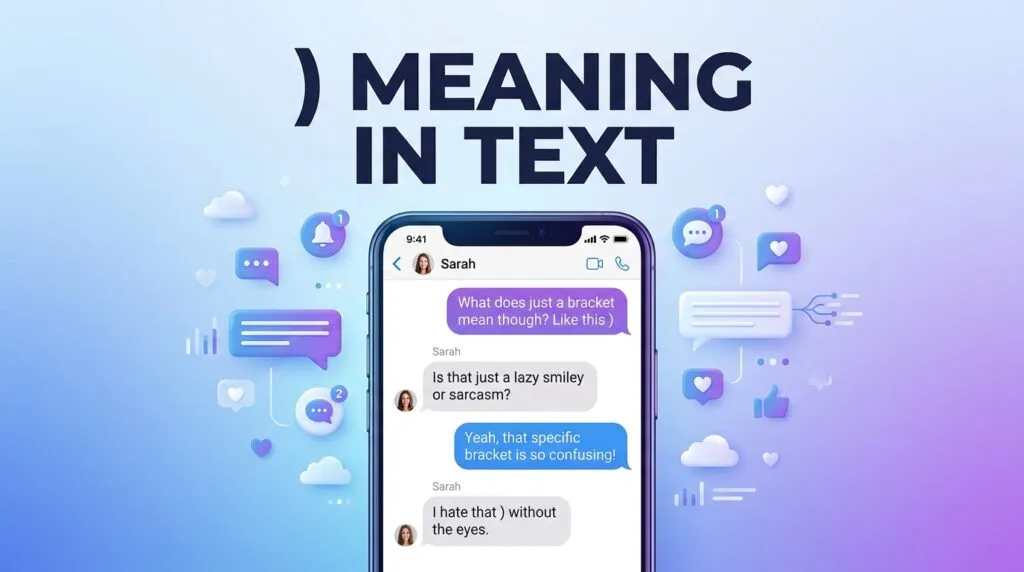

In a text message, a single closing parenthesis ) often means a small, friendly smile. It is commonly used as a lightweight version of :), especially in informal chats. However, its meaning depends on context, culture, and the sender’s texting habits. Sometimes, it may simply be accidental punctuation.
| Term | Meaning | Context |
|---|---|---|
) | Slight smile or friendly tone | Casual texting and online chat |
)) | Bigger smile, warmth, or amusement | Informal messaging |
))) | Strong happiness, laughter, sarcasm, or playful tone | Social chats and some online communities |
:) | Standard smiley face | Universal informal texting |
( | Sad face or disappointed tone in some texting cultures | Informal chats |
Meaning & Definition
The ) symbol is known as a closing parenthesis in standard writing and grammar. In text messages, though, people sometimes use it as a simple smile.
The most common meaning of ) in texting is:
A single
)usually shows a small smile, friendly attitude, soft tone, or positive feeling.
For example:
- “Thanks for helping me )”
- “Okay, see you tomorrow )”
- “That was nice of you )”
In these examples, the sender is not using the symbol as grammar. They are using it to make their message feel warmer.
A person may use ) instead of a full smiley face like :) because it is faster to type. It can also feel less dramatic than using a yellow smiling emoji.
There is no official full form for ). It is not an abbreviation, acronym, or code. It is simply a punctuation symbol that has gained an emotional meaning in online conversations.
The meaning can change based on the number of parentheses:
)= slight smile))= happy or friendly smile)))= very happy, amused, playful, or laughing))))= exaggerated happiness, excitement, or sometimes irony
For many people, especially those unfamiliar with this texting style, a lone ) may look strange. That is why the full message matters more than the symbol alone.
For example:
- “You are late again )” may sound teasing rather than angry.
- “I am fine )” may suggest the person is trying to sound positive.
- “Sure ))” may show warm agreement.
- “Okay…” followed by
)may soften a short reply.
When you are unsure about a text symbol, look at the mood of the conversation, the sender’s language background, and how they usually message. Resources such as Meanigo can also help readers understand text slang, chat symbols, online abbreviations, and changing digital communication habits.
Background
The use of symbols to show emotion in written communication is older than modern smartphones. Before emoji keyboards existed, people used letters, numbers, and punctuation marks to show facial expressions.
The classic smiley face :-) became popular in early online communication because text alone could not easily show humor, friendliness, or sarcasm. In 1982, Carnegie Mellon computer scientist Scott Fahlman suggested using :-) to mark jokes and :-( to mark serious or negative messages on an online bulletin board. That simple idea helped shape the use of emoticons in digital communication.
Over time, people shortened traditional emoticons.
Instead of writing:
:)
Some users began writing:
)
The colon was removed, leaving only the curved smile shape. This made typing faster, especially during the early SMS era when people had limited characters and slower phone keyboards.
In Russian-language texting and some nearby online communities, a single ) is commonly used as a small positive smile, while multiple parentheses can show stronger happiness or amusement. A single ( may work as the opposite and suggest sadness.
Today, the symbol is still used in private chats, group messages, gaming conversations, comments, and dating apps. It has survived because it feels simple, personal, and less polished than a standard emoji.
Usage in Different Contexts
The meaning of ) changes slightly depending on where it appears. In most cases, it adds a friendly or soft emotional layer to a message.
Text Messages
In text messages, ) often means the sender is smiling lightly.
Examples:
- “I got the job )”
- “Talk to you later )”
- “No worries, it happens )”
- “You made my day )”
It can make a message feel less serious. For example, “Okay” can sound cold by itself. “Okay )” often sounds more polite and friendly.
Social Media
On social media, ) may appear in comments, captions, replies, or direct messages.
Examples:
- “Love this photo )”
- “You did amazing ))”
- “This made me laugh )))”
- “So happy for you )”
On platforms such as Instagram, Facebook, X, and TikTok, the symbol is less common than emoji but still appears in informal conversations. It may feel more personal than using a standard smiley emoji.
Gaming
In gaming chats, ) can show friendliness after teasing, joking, or competition.
Examples:
- “Nice game )”
- “You almost had me ))”
- “That was a close match )”
- “Good try, we will win next round )”
Gamers often use short phrases. A simple parenthesis can prevent a message from sounding rude or overly serious.
For example:
- “You lost” may sound harsh.
- “You lost )” may sound playful, depending on the relationship between players.
Still, context is important. In competitive games, a smile symbol after a negative comment can also look sarcastic.
Online Communities
In forums, Discord servers, Reddit-style communities, and group chats, ) can mean friendliness, agreement, amusement, or a lighthearted tone.
Examples:
- “I agree with you )”
- “That is actually a good point ))”
- “I had the same problem last week )”
- “Welcome to the group )”
Some communities develop their own texting habits. A symbol that means “smile” in one group may be rare or misunderstood in another.
Professional Communication
In work messages, emails, client chats, and professional Slack conversations, use ) carefully.
A closing parenthesis may feel too casual in formal communication. It can be fine when speaking with a friendly coworker, but it may not fit every business setting.
Less formal example:
- “Thanks for sending this over )”
More professional alternative:
- “Thank you for sending this over.”
- “Thanks for sharing the file. I appreciate it.”
- “Thank you. I will review it shortly.”
In client communication, a clear sentence is usually safer than using text symbols. A friendly emoji may be acceptable in some teams, but business tone should match the workplace culture.
Also Read: TSTS Meaning in Text: What It Means & How to Reply
Meaning in Chat, WhatsApp, Instagram, TikTok
| Platform | Meaning | Example Usage |
|---|---|---|
| Text Message | Slight smile, warmth, or soft tone | “See you soon )” |
| Friendly or playful smile | “Thanks for checking in ))” | |
| Light reaction in comments or DMs | “This is so cute )” | |
| TikTok | Playful mood, humor, or soft reaction | “Why is this so true )))” |
| Messenger | Casual happiness or agreement | “Yes, that works for me )” |
| Discord | Friendly gaming or group-chat tone | “Good game )” |
| Dating Apps | Flirty, shy, or warm tone | “You seem fun )” |
On WhatsApp, ) often works as a softer version of a smiley emoji. People may use it after short replies to avoid sounding dry.
Examples:
- “Yes, I am free tonight )”
- “That sounds good ))”
- “No problem at all )”
It is often used in friendly conversations with family, friends, classmates, or coworkers.
On Instagram, it can appear in direct messages or comments. It often makes praise sound warmer.
Examples:
- “You look amazing )”
- “Loved your reel ))”
- “This place looks beautiful )”
It is less visible than emoji, but some users prefer it because it feels simple and not overly expressive.
TikTok
On TikTok, users often rely on emoji, slang, and short reactions. A closing parenthesis may show amusement or a soft response.
Examples:
- “This is literally me )))”
- “I cannot stop laughing )”
- “That ending was unexpected ))”
On TikTok, the meaning is usually shaped by the video, caption, and comment tone.
Meaning in Physics, Medical, and Aircraft Terminology
The symbol ) has different uses outside texting. In professional fields, it usually does not mean “smile.”
| Field | Meaning of ) | Important Note |
|---|---|---|
| Text Messaging | Small smile or friendly tone | Informal and context-based |
| Physics | Closing bracket used in equations or notation | Does not mean a smile |
| Mathematics | Groups numbers, formulas, or operations | Standard punctuation symbol |
| Medical Notes | May appear as part of written text or formatting | No universal emotional meaning |
| Aviation | May appear in technical writing or documentation | Not a standard chat symbol in aviation communication |
| Programming | Closes a function, condition, or expression | Has technical meaning in code |
Physics Meaning
In physics and mathematics, ) is a closing parenthesis. It is used to group parts of equations.
For example:
F = m(a + b)
The closing parenthesis shows where the grouped part of the equation ends.
In physics, a single ) does not have a recognized emotional meaning. If someone sends it in a physics discussion, it is likely punctuation, part of an equation, or a typing error.
Medical Meaning
In medical communication, ) is not a recognized standard medical abbreviation by itself.
It may appear in:
- Patient notes
- Medical forms
- Research papers
- Lab reports
- Drug information
- Parenthetical explanations
For example:
Patient reports mild pain (3/10).
A single closing parenthesis in a medical message should not be interpreted as a diagnosis, treatment note, or medical code. Always rely on the full sentence and ask a healthcare professional when medical information is unclear.
Also Read: SN Meaning in Text: Uses, Examples & Replies
Aircraft and Aviation Meaning
In aviation or aircraft communication, ) does not have a universal meaning as a standalone symbol.
It may be used in manuals, maintenance documents, checklists, software code, or technical explanations. However, it is not a standard replacement for a smile or an official aviation communication signal.
Pilots, air traffic controllers, engineers, and maintenance teams rely on precise language. Informal symbols should not be used when discussing safety, instructions, flight plans, or technical issues.
Common Misconceptions
People often misunderstand ) because its meaning is not universal.
Misconception: It always means a smile
What people assume: Every ) means the sender is happy.
What it actually means: It often means a slight smile, but it could also be a typo, grammar punctuation, or part of a copied message.
Misconception: More parentheses always mean laughter
What people assume: ))) always means the sender is laughing hard.
What it actually means: It can show laughter, but it may also mean excitement, friendliness, teasing, or sarcasm.
Misconception: It is used everywhere
What people assume: Everyone understands ) as a smile.
What it actually means: It is common in some texting cultures but less familiar in others. Many English-speaking users may not use it often.
Misconception: It is always flirty
What people assume: A smile parenthesis means romantic interest.
What it actually means: It can be friendly, polite, shy, playful, or flirty. The rest of the message matters more.
Misconception: It is unprofessional in every situation
What people assume: You should never use it at work.
What it actually means: It may be acceptable in friendly team chats, but formal client messages, legal communication, medical communication, and official emails usually need clearer language.
Similar Terms & Alternatives
| Term | Meaning | Difference |
|---|---|---|
:) | Smile or happiness | More widely understood than ) |
:-) | Traditional smiley emoticon | Includes a nose and looks more old-school |
)) | Bigger smile or stronger happiness | More expressive than one ) |
))) | Excitement, amusement, laughter, or irony | Can feel exaggerated |
😊 | Warm, friendly smile | Visual emoji rather than text symbol |
🙂 | Mild or neutral smile | Can sometimes sound awkward or passive-aggressive |
;) | Wink, joke, or flirt | More suggestive than ) |
:D | Big smile or laughter | Stronger emotion |
lol | Laughing or amusement | Uses letters instead of symbols |
haha | Laughter | More direct than a smile symbol |
The biggest difference is intensity.
A single ) is subtle. It usually feels softer than :D, 😂, or “HAHA.”
For example:
- “That was funny )” = light amusement
- “That was funny :D” = clear happiness
- “That was funny 😂” = stronger laughter
- “That was funny lol” = casual amusement
How to Respond to It
You do not need to copy the exact symbol. Respond based on the overall conversation.
| Scenario | Suggested Response |
|---|---|
| Friend says “Thanks )” | “Anytime! Glad I could help.” |
| Someone says “See you later )” | “See you later! Looking forward to it.” |
| Crush says “You are sweet )” | “That is really nice of you to say.” |
| Coworker says “Thanks for the update )” | “You are welcome. Let me know if you need anything else.” |
| Gamer says “Nice try )” | “Thanks! That was a close one.” |
Someone uses ))) after a joke | “Haha, glad you liked it!” |
| You are unsure about the meaning | “Haha, I hope that is a happy smile?” |
| Formal conversation | “Thank you for your message. I appreciate it.” |
Casual response examples
- “Haha, yes )”
- “You are welcome!”
- “That made me smile too.”
- “I am glad you liked it.”
- “Same here ))”
- “Sounds good to me.”
Flirty response examples
- “You are making me smile too.”
- “That is cute )”
- “I like talking to you.”
- “You seem sweet too.”
Professional response examples
- “Thank you. I appreciate your feedback.”
- “Glad that works for you.”
- “You are welcome. Please let me know if you need further support.”
- “Thanks for confirming.”
Differences from Similar Words
| Symbol or Term | Main Meaning | Tone | Best Use |
|---|---|---|---|
) | Small smile | Soft and subtle | Casual chat |
:) | Friendly smile | Clear and universal | General messaging |
:) | Positive mood | Slightly more expressive | Friendly replies |
;) | Wink or joke | Playful, teasing, flirty | Informal chat |
:D | Big smile | Excited and cheerful | Fun conversations |
😂 | Strong laughter | Highly expressive | Funny content |
lol | Laughing | Casual and common | Texting and comments |
haha | Direct laughter | Natural and conversational | Almost any casual chat |
hehe | Quiet laughter | Shy, playful, or mischievous | Friends and flirting |
🙂 | Mild smile | Neutral or slightly awkward | Depends on context |
The closing parenthesis is different because it can be easy to miss. It works more like a small tone marker than a full reaction.
A person who uses ) may be trying to say:
- “I am being nice.”
- “I am not upset.”
- “I am joking a little.”
- “Please read this softly.”
- “I am smiling while saying this.”
Relevance in Online Conversations & Dating Apps
Online conversations often lack body language. People cannot see facial expressions, hear tone of voice, or notice whether someone is joking. That is why text symbols matter.
A simple ) can make a short message feel warmer.
Compare these messages:
Okay.
Okay )
The first one may look neutral, cold, or rushed. The second often feels friendlier.
Social Media Usage
On social media, ) can help users sound supportive without using large emoji reactions.
Examples:
- “Proud of you )”
- “This is beautiful )”
- “You did great ))”
- “That made my day )”
It can be useful for people who prefer quiet, simple expressions.
Also Read: JW Meaning in Text: What It Means & How to Use It
Dating App Usage
On dating apps, ) may create a soft, shy, or slightly flirty tone.
Examples:
- “You seem interesting )”
- “I like your profile )”
- “That is actually a good answer ))”
- “Maybe we should try that place sometime )”
Do not assume the symbol alone means romantic interest. Look for stronger signs, such as:
- The person asks questions about you.
- They continue the conversation.
- They make plans.
- They give personal compliments.
- They use playful language regularly.
- They reply with interest and consistency.
Messaging Etiquette
Use ) when you want to sound friendly, but do not overuse it.
Good use:
- “Thank you for your help )”
- “That sounds great )”
- “Hope your day goes well )”
Avoid using it when:
- Discussing serious problems
- Sending official business messages
- Talking about medical, legal, or financial matters
- Giving instructions that need to be clear
- Communicating with someone who may not understand the symbol
Clear words are always better than unclear symbols.
For example, instead of writing:
Fine )
You could write:
I am okay, thank you for asking.
That message is easier to understand and less likely to be misread.
Frequently Asked Questions
What does ) mean in texting?
In texting, ) usually means a small smile or friendly tone. It is often used as a shorter version of :). The symbol can make a message sound softer, kinder, or more playful. However, it may also be simple punctuation or a typo, so always read the full message.
What does )) mean in a text message?
Two closing parentheses, )), usually show a bigger smile, more warmth, or stronger happiness than a single ). People may use it after a joke, compliment, or friendly reply. In some texting cultures, extra parentheses make the smile feel more expressive.
What does ))) mean in chat?
In chat, ))) often means strong amusement, happiness, laughter, or playful energy. It can also be used to show excitement after something funny. In some situations, it may be sarcastic, so look at the message before and after it before deciding the exact tone.
Is ) a smiley face?
Yes, in some messaging styles, ) acts like a simple smiley face. It represents the curved mouth part of :). It is not as universally understood as a full smiley, but many people use it to show a light smile, friendliness, or positive intent.
Does ) mean flirting?
A single ) can sometimes feel flirty because it softens a message and adds warmth. However, it does not automatically mean someone likes you romantically. It may simply be polite or friendly. Look for repeated attention, compliments, questions, and effort to continue the conversation.
What does ) mean on WhatsApp?
On WhatsApp, ) usually means a slight smile, friendly tone, or soft reply. People may use it instead of emoji because it is quick to type. It is most common in casual chats with friends, family, classmates, or people they already know well.
Is ) commonly used on TikTok?
A closing parenthesis can appear in TikTok comments and direct messages, but it is less common than emoji, slang, and reaction GIFs. When used, it usually shows amusement, friendliness, or a soft reaction. Its meaning depends on the video, caption, and conversation.
What does ( mean in texting?
In some online communities, ( can represent a sad face because it looks like a frown without eyes. It may mean disappointment, sadness, sympathy, or a low mood. However, many people do not use it this way, so context remains important.
Can ) be rude?
By itself, ) is usually not rude. It often makes a message friendlier. Still, it can feel sarcastic after criticism, teasing, or a negative comment. For example, “You failed again )” may look mocking. The words around the symbol decide whether the tone is kind or rude.
Should I use ) in professional messages?
Use ) carefully in professional communication. It may be fine in a relaxed workplace chat, but avoid it in formal emails, legal messages, client communication, medical discussions, or official notices. Clear, complete language is safer when the message needs to sound professional and trustworthy.
Conclusion
The ) meaning in a text message is usually a small smile, friendly mood, or softer tone. It is a short version of :) and may become stronger when repeated as )) or ))).
Still, the symbol does not have one universal meaning. It can depend on culture, platform, relationship, and the rest of the conversation. When in doubt, read the full message instead of judging one symbol alone. For more clear explanations of texting symbols, internet slang, and online language, Meanigo can be a useful reference for everyday digital conversations.

Pingback: “…” in Text From a Girl: Meaning and Replies
Pingback: IIRC Meaning in Text: Full Form, Uses & Examples
Pingback: RD Meaning in Text: What It Means in Chat