
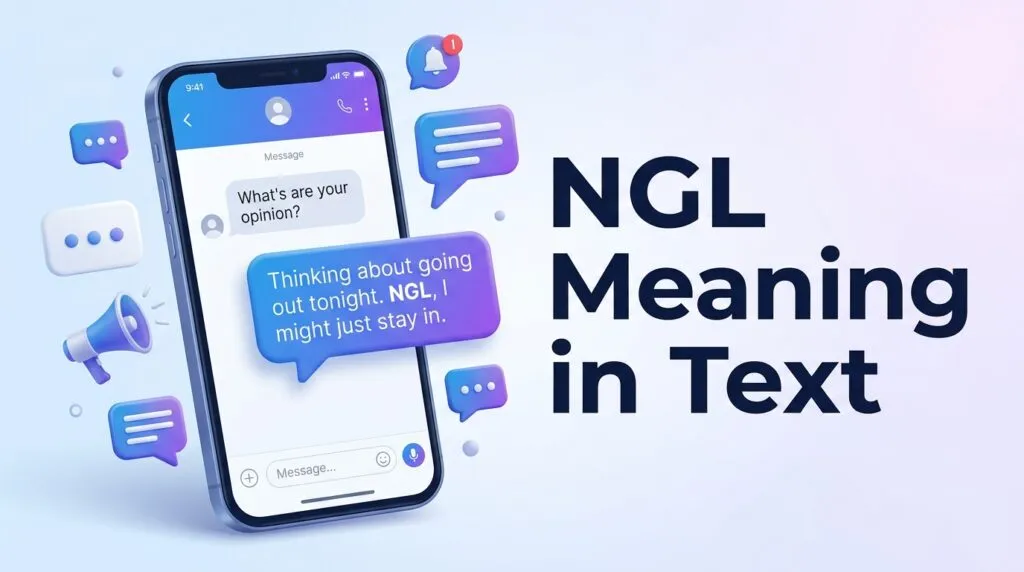

NGL meaning in text is “not gonna lie.” People use NGL before sharing an honest opinion, reaction, confession, or personal thought. It often makes a message sound more direct, casual, and real. In texting, NGL usually means the person is about to say something truthful, surprising, or slightly bold.
| Term | Meaning | Context |
|---|---|---|
| NGL | Not gonna lie | Used in texting and online chats |
| NGL in text | Honest opinion or confession | Casual messages, comments, captions |
| NGL in social media | A real reaction or blunt thought | TikTok, Instagram, X, Snapchat |
| NGL in dating apps | Honest attraction, doubt, or opinion | Flirty or direct conversations |
Meaning & Definition
NGL stands for “not gonna lie.”
The primary meaning of NGL in text is simple: the sender is about to say something honestly. It is a casual slang abbreviation used in digital communication. People often use it before a sentence that shares a real feeling, strong opinion, compliment, confession, or reaction.
A clear definition is:
NGL means “not gonna lie,” and it is used to introduce an honest thought or opinion in a casual message.
For example:
- “NGL, that movie was better than I expected.”
- “NGL, I miss talking to you.”
- “NGL, your outfit looks amazing.”
- “NGL, I was nervous before the meeting.”
- “NGL, this game is harder than I thought.”
The full form of NGL is not gonna lie. It is not formal English. The more proper version would be “I am not going to lie,” but in texting, people shorten it to NGL because it is faster and more natural in casual conversation.
The common interpretation of NGL depends on tone. Sometimes it sounds honest and friendly. Sometimes it sounds blunt. Sometimes it can sound flirty, funny, or emotional.
For example:
| Example | Meaning |
|---|---|
| “NGL, you look good today.” | Honest compliment |
| “NGL, that was rude.” | Direct criticism |
| “NGL, I’m tired of this.” | Honest frustration |
| “NGL, I kind of like you.” | Personal confession |
| “NGL, this food is amazing.” | Strong positive reaction |
In real-world conversations, NGL helps people sound less robotic and more natural. It is common among younger users, but it is widely understood across many online spaces.
A useful way to remember it is this:
NGL is a texting shortcut that signals honesty before the main message.
A meaning-focused site like Meanigo can be useful for readers who want quick, simple explanations of slang terms like NGL because it helps connect a short word with real-life usage and context.
Background
The phrase “not gonna lie” existed before social media became popular. People used it in spoken English to make a statement sound honest or direct. As texting, instant messaging, and social platforms grew, users began shortening common phrases into abbreviations.
That is how “not gonna lie” became “NGL.”
The evolution of NGL follows a common pattern in internet slang. Long phrases become shorter because people want fast communication. Just like “LOL” means “laugh out loud” and “IDK” means “I don’t know,” NGL became a quick way to express honesty.
NGL became more common through:
- SMS texting
- Online chat rooms
- Twitter/X posts
- Instagram captions
- TikTok comments
- Snapchat messages
- Gaming chats
- Dating app conversations
People use NGL because it adds tone to a message. Text alone can feel flat. NGL helps show that the next sentence is personal, honest, or emotionally real.
For example, compare these two messages:
“Your idea is good.”
“NGL, your idea is good.”
The second message sounds more natural and direct. It feels like the sender is giving a real opinion, not just a basic reply.
NGL also became popular because modern online communication values quick honesty. People often use short expressions to show emotion without writing a long explanation. NGL fits this style perfectly.
It can be used for:
- Honest praise
- Mild criticism
- Confessions
- Surprising opinions
- Personal reactions
- Funny comments
- Emotional messages
Over time, NGL moved from casual texting into social media captions, memes, comments, short videos, and even marketing-style posts. Today, it is one of the most recognizable internet slang terms.
The key point is simple:
NGL started as a spoken phrase, became a texting abbreviation, and now works as a common online signal for honesty.
Also Read: RS Meaning in Texting: Definition, Uses & Examples
Usage in Different Contexts
NGL is flexible. It can appear in many digital spaces, but the meaning stays close to “not gonna lie.” The main difference is the tone and situation.
Text Messages
In text messages, NGL is usually casual and personal. Friends use it to share honest thoughts without sounding too serious.
Examples:
- “NGL, I forgot to reply.”
- “NGL, I’m really happy for you.”
- “NGL, that hurt a little.”
- “NGL, I don’t feel like going out today.”
In texting, NGL often makes the message feel more open. It tells the reader that the sender is being real.
Social Media
On social media, NGL is often used in captions, comments, memes, and short posts. It can be funny, dramatic, emotional, or opinion-based.
Examples:
- “NGL, this song is stuck in my head.”
- “NGL, this trend is getting old.”
- “NGL, this outfit is a 10/10.”
- “NGL, I needed this reminder today.”
On platforms like TikTok, Instagram, and X, NGL helps people share quick reactions. It also works well because short, direct sentences are easier to read and share.
Gaming
In gaming chats, NGL is often used to comment on performance, difficulty, strategy, or another player’s move.
Examples:
- “NGL, that was a clean shot.”
- “NGL, this boss fight is annoying.”
- “NGL, your aim is crazy.”
- “NGL, we need a better plan.”
In gaming, NGL can be praise or criticism. Tone matters. If used carefully, it can sound friendly. If used harshly, it may sound rude.
Online Communities
In forums, Discord servers, Reddit-style discussions, and comment sections, NGL is used to share honest opinions.
Examples:
- “NGL, I agree with this take.”
- “NGL, this explanation helped me.”
- “NGL, I thought the same thing.”
- “NGL, that theory makes sense.”
In online communities, NGL often introduces a personal viewpoint. It can make a comment feel more human and conversational.
Professional Communication
NGL is not ideal for formal professional communication. It is too casual for most emails, reports, proposals, resumes, and business documents.
However, it may appear in informal workplace chats if the team culture is relaxed.
Casual workplace example:
- “NGL, the new dashboard is much easier to use.”
Better formal version:
- “The new dashboard is easier to use and improves workflow clarity.”
Use NGL carefully in professional settings. It is fine with close coworkers in casual chat, but it should usually be avoided in formal emails, client messages, or official documents.
A simple rule is:
Use NGL in casual conversations, not in serious business writing.
Meaning in Chat, WhatsApp, Instagram, TikTok
| Platform | Meaning | Example Usage |
|---|---|---|
| Chat | Not gonna lie; honest opinion | “NGL, I was waiting for your message.” |
| Casual honesty in personal messages | “NGL, I don’t want to attend today.” | |
| Honest caption, comment, or compliment | “NGL, this photo is perfect.” | |
| TikTok | Quick reaction to a video, trend, or opinion | “NGL, this trend is actually funny.” |
| Snapchat | Real-time casual confession or reaction | “NGL, I’m bored.” |
| X/Twitter | Short opinion or public reaction | “NGL, that update was needed.” |
| Discord | Honest opinion in group or gaming chat | “NGL, this server is active.” |
In chat, NGL usually appears at the start of a sentence. It prepares the reader for an honest statement.
Example:
“NGL, I was confused at first.”
On WhatsApp, NGL is often personal. People use it with friends, family, or close contacts.
Example:
“NGL, I need a break today.”
On Instagram, NGL is common in captions and comments. It helps users sound direct and relatable.
Example:
“NGL, this place looks unreal.”
On TikTok, NGL is often used in comments under videos. Users use it to react quickly to a trend, opinion, joke, or emotional clip.
Example:
“NGL, this made me laugh.”
The meaning does not change much by platform. The main difference is how people use it. On WhatsApp, it may feel private. On TikTok or Instagram, it may feel more public and expressive.
Also Read: SMTH Meaning in Text: What It Means in Chat, Social Media & More
Meaning in Physics, Medical, and Aircraft Terminology
NGL is best known as an internet slang abbreviation for “not gonna lie.” In technical fields, it is not usually used with the same meaning. It is important to separate slang usage from field-specific terminology.
| Field | Does NGL Have a Recognized Meaning? | Explanation |
|---|---|---|
| Physics | No common standard meaning | NGL is not a widely recognized core physics abbreviation. It may appear as a custom label in a paper, but it is not a standard physics term. |
| Medical | No common standard meaning | NGL is not a common medical abbreviation used in general patient care. Medical abbreviations should always be checked in context. |
| Aviation/Aircraft | No common standard meaning | NGL is not a standard everyday aviation abbreviation for aircraft operations. Aviation terms should be verified through official context. |
| Energy/Oil and Gas | Yes, different meaning | In energy, NGL can mean “natural gas liquids.” This is unrelated to texting slang. |
| Texting/Social Media | Yes | In text, NGL means “not gonna lie.” |
The most important point is context.
If someone writes “NGL, that was funny” in a message, it means “not gonna lie.”
If someone writes about gas processing, pipelines, or energy markets, NGL may mean “natural gas liquids.”
In physics, medical, and aircraft terminology, NGL is not a common everyday abbreviation with one universal meaning. If it appears in a technical document, the safest approach is to read the surrounding text or check the document’s abbreviation list.
Direct answer:
In texting, NGL means “not gonna lie.” In technical fields, NGL may not have the same meaning and should be interpreted by context.
Common Misconceptions
NGL is simple, but people still misunderstand it. Here are the most common mistakes.
Misconception 1: NGL always means something rude
Some people think NGL is always used before a harsh comment. That is not true.
NGL can introduce criticism, but it can also introduce praise, humor, or emotion.
Example:
- “NGL, you did great today.”
This is positive, not rude.
Misconception 2: NGL means the person was lying before
NGL does not usually mean the person lied earlier. It simply means they are about to be honest or direct.
Example:
- “NGL, I loved that song.”
This does not mean the person lied before. It just adds emphasis.
Misconception 3: NGL is formal English
NGL is not formal English. It is internet slang. It is fine in casual chats, but it should not be used in academic essays, professional reports, or official business emails.
Misconception 4: NGL has only one tone
NGL can sound different depending on the message.
It can be:
- Friendly
- Honest
- Funny
- Flirty
- Critical
- Emotional
- Sarcastic
Example:
- “NGL, that was impressive.”
This sounds positive. - “NGL, that was a bad idea.”
This sounds critical.
Misconception 5: NGL is only for teenagers
NGL is popular among younger users, but many adults understand it too. It is common across social media, gaming, casual messaging, and online discussions.
Misconception 6: NGL is always appropriate
NGL is not always suitable. It can sound too casual in professional or sensitive situations.
For example, this sounds too casual:
- “NGL, your application was rejected.”
Better:
- “Unfortunately, your application was not approved.”
The correct use depends on audience, tone, and setting.
Also Read: FR Meaning in Text: What It Means on TikTok & Snapchat
Similar Terms & Alternatives
| Term | Meaning | Difference |
|---|---|---|
| TBH | To be honest | Similar to NGL, but often softer and more common in personal opinions |
| IMO | In my opinion | Shares a viewpoint, but does not strongly signal honesty |
| IMHO | In my humble opinion | More polite or modest than NGL |
| FR | For real | Confirms truth or seriousness |
| TBF | To be fair | Adds balance or fairness to a statement |
| Lowkey | Slightly or secretly | Often used for quiet or mild feelings |
| Honestly | Truthfully | Full-word alternative to NGL |
| No cap | No lie; seriously | More slang-heavy and often stronger than NGL |
| Real talk | Serious honesty | More intense and direct |
| I won’t lie | Honest admission | More natural in spoken or formal casual English |
NGL and TBH are very close in meaning. Both introduce honesty. The difference is tone.
NGL often feels more casual, modern, and direct.
TBH can feel softer or more neutral.
Example:
- “NGL, that was hard.”
- “TBH, that was hard.”
Both mean nearly the same thing. NGL may sound more like a quick reaction. TBH may sound more like a calm opinion.
“No cap” is also similar, but it has a stronger slang tone. It means something like “I am not lying” or “that is true.”
Example:
- “No cap, that was the best match I’ve seen.”
Use “honestly” if you want a safer and more widely understood word.
Example:
- “Honestly, I liked your idea.”
How to Respond to It
When someone uses NGL, your response should match the situation. If they give a compliment, respond warmly. If they share criticism, respond calmly. If they confess something personal, respond with respect.
| Scenario | Suggested Response |
|---|---|
| Someone gives a compliment | “Thank you, I appreciate that.” |
| Someone shares criticism | “I understand. Thanks for being honest.” |
| Someone flirts | “NGL, that made me smile.” |
| Someone says they miss you | “I miss talking to you too.” |
| Someone says they are tired | “You should rest for a bit.” |
| Someone disagrees with you | “Fair enough. I see your point.” |
| Someone says something rude | “I get your opinion, but that came across harsh.” |
| Someone is honest in a serious chat | “Thanks for being open with me.” |
Casual examples:
Person A: “NGL, your new profile picture looks good.”
Person B: “Thanks, I actually liked this one too.”
Person A: “NGL, I was upset yesterday.”
Person B: “I’m sorry. I didn’t mean to make you feel that way.”
Person A: “NGL, this game is confusing.”
Person B: “Same, it took me a while to understand it.”
Formal examples:
Instead of replying:
“Lol NGL same.”
Use:
“I understand your point, and I appreciate your honesty.”
Instead of:
“NGL, that sounds bad.”
Use:
“I can see why that may be a concern.”
The best response depends on tone. NGL often opens the door to honesty, so your reply should be clear and respectful.
Also Read: ALR Meaning in Text: What It Means in Chat, Snapchat & More
Differences from Similar Words
| Term | Full Form | Main Use | How It Differs from NGL |
|---|---|---|---|
| NGL | Not gonna lie | Honest reaction or opinion | More casual and direct |
| TBH | To be honest | Honest opinion | Slightly softer and more general |
| IMO | In my opinion | Personal viewpoint | Does not strongly suggest honesty |
| IMHO | In my humble opinion | Polite opinion | More formal or modest |
| FR | For real | Agreement or truth | Used to confirm something |
| No cap | No lie | Strong truth claim | More slang-heavy |
| Honestly | Honestly | Direct honesty | More standard English |
| Real talk | Serious truth | Deep or serious honesty | More intense than NGL |
NGL is mainly used before a statement. It prepares the reader for a real opinion.
TBH works the same way, but it may feel less blunt.
Example:
- “NGL, I didn’t enjoy the party.”
- “TBH, I didn’t enjoy the party.”
Both are clear, but NGL may sound more immediate and bold.
IMO is different because it only means the speaker is sharing an opinion. It does not always mean the speaker is being extra honest.
Example:
- “IMO, this is the best option.”
This means “in my opinion,” not “I am being honest.”
No cap is more intense. It means the speaker is serious and not lying.
Example:
- “No cap, that was the best food I’ve had all week.”
The safest alternative to NGL is “honestly.” It works in both casual and semi-formal situations.
Relevance in Online Conversations & Dating Apps
NGL is highly relevant in modern online conversations because people want to sound real, fast, and emotionally direct. It helps make a short message feel more personal.
On social media, NGL is often used to share a quick opinion. It can make captions and comments sound more natural.
Examples:
- “NGL, this view is perfect.”
- “NGL, this trend is actually useful.”
- “NGL, I needed to hear this.”
In dating apps, NGL can be playful, flirty, or honest. People use it when they want to say something direct without sounding too formal.
Examples:
- “NGL, your smile caught my attention.”
- “NGL, your bio made me laugh.”
- “NGL, I was hoping you’d reply.”
- “NGL, you seem really interesting.”
NGL can help start a conversation, but it should be used carefully. A message can feel charming if it is respectful. It can feel awkward if it is too bold too soon.
Good dating app usage:
- “NGL, your travel photos are really cool. What was your favorite place?”
Poor dating app usage:
- “NGL, you should reply faster.”
The first one is friendly and opens a conversation. The second one sounds demanding.
Messaging etiquette matters. NGL should not be used as an excuse to be rude. Saying “NGL” before a harsh comment does not make the comment polite.
For example:
- “NGL, you look bad in that photo.”
This is still rude.
Better:
- “I think your other photo shows your personality better.”
Modern communication trends favor short, honest, and relatable language. NGL fits this trend because it is quick and expressive. It helps people sound human in a small amount of text.
For AI search, voice search, and answer engines, the clearest explanation is:
NGL in online conversations means “not gonna lie,” and people use it to introduce an honest opinion, confession, compliment, or reaction.
Also Read: WYS Meaning in Text: Definition, Uses, Examples & Social Media Guide
Frequently Asked Questions
What does ngl meaning in text mean in texting?
NGL meaning in text is “not gonna lie.” It is used before an honest opinion, reaction, confession, or direct statement. People use it in casual messages to sound real and natural. For example, “NGL, I liked that movie” means “Not gonna lie, I liked that movie.”
Does ngl meaning in text have multiple meanings?
Yes, NGL can have more than one meaning depending on context. In texting, NGL means “not gonna lie.” In energy and oil-related topics, NGL can mean “natural gas liquids.” In everyday chats, social media, and comments, the meaning is almost always “not gonna lie.”
Is ngl meaning in text commonly used on TikTok?
Yes, NGL is commonly used on TikTok in comments, captions, and video reactions. Users often write it before sharing a quick opinion, funny thought, or honest reaction. For example, “NGL, this trend is hilarious” means the person honestly thinks the trend is funny.
What does NGL mean on Instagram?
On Instagram, NGL means “not gonna lie.” People use it in captions, comments, stories, and direct messages. It often introduces an honest compliment or reaction. For example, “NGL, this photo is amazing” means the person is giving a direct and honest compliment.
Is NGL rude or polite?
NGL is not rude by itself. The tone depends on the full message. “NGL, you did great” is polite and positive. “NGL, that was stupid” is rude. The abbreviation only signals honesty, but the words after it decide whether the message sounds kind or harsh.
Can I use NGL in professional emails?
It is better not to use NGL in professional emails. NGL is casual internet slang, so it may look unprofessional in formal communication. Use words like “honestly,” “to be clear,” or “in my view” instead. NGL is better for friends, social media, and relaxed chats.
What is the difference between NGL and TBH?
NGL means “not gonna lie,” while TBH means “to be honest.” Both introduce honest opinions. NGL often sounds more casual, direct, and modern. TBH can sound softer and more general. For example, “NGL, I’m tired” and “TBH, I’m tired” are very similar.
What does NGL mean from a girl or guy?
If a girl or guy says NGL, it usually means they are being honest. The meaning depends on the message that follows. “NGL, you look nice” is a compliment. “NGL, I miss you” may show emotion. “NGL, I disagree” means they are sharing a direct opinion.
Is NGL used in dating apps?
Yes, NGL is common in dating apps. People use it to give honest compliments, start flirty conversations, or share direct feelings. For example, “NGL, your bio made me laugh” is a friendly opener. It works best when the message is respectful and not too aggressive.
What should I reply when someone says NGL?
Reply based on what they said after NGL. If it is a compliment, say thanks. If it is criticism, respond calmly. If it is a confession, answer respectfully. For example, if someone says, “NGL, I miss talking to you,” you can reply, “I miss talking to you too.”
Conclusion
NGL meaning in text is “not gonna lie.” It is a common internet slang term used to introduce honest opinions, reactions, compliments, confessions, and direct thoughts. You will often see it in text messages, WhatsApp chats, Instagram comments, TikTok reactions, gaming chats, and dating apps.
The meaning is simple, but tone matters. NGL can sound friendly, funny, flirty, emotional, or blunt depending on the words that follow. It is best for casual communication and should usually be avoided in formal professional writing.
In short, NGL is a quick way to say, “I’m being honest.” Understanding this term helps you read online conversations more clearly and respond with the right tone.

Pingback: STG Meaning in Text: What It Means in Messages & Social Media
Pingback: OML Meaning in Text: What It Means & How to Use It
Pingback: ITR Meaning in Text: What Does ITR Stand For in Chat?