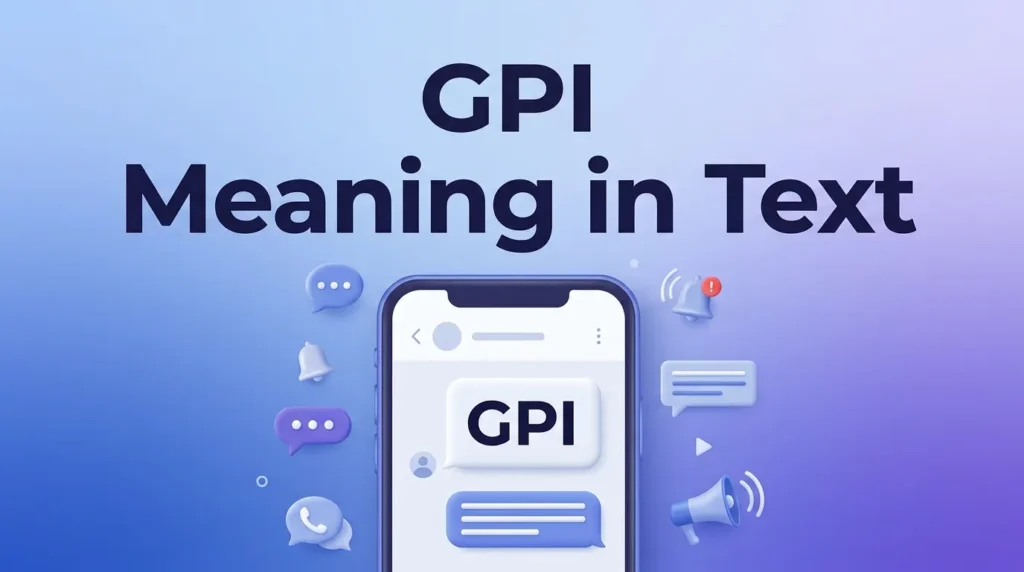

GPI usually means “Gracias Por Invitar,” a Spanish phrase meaning “Thanks for inviting me” or “Thanks for the invite.” In texting and social media, it is often used sarcastically when someone was not actually invited to a party, trip, dinner, meetup, or other activity. The tone is usually playful, teasing, or mildly complaining rather than genuinely thankful. The exact meaning can still depend on the surrounding conversation and relationship between the people involved.
Quick Answer
| Context | What GPI Most Likely Means | Typical Tone |
|---|---|---|
| Casual text | “Gracias Por Invitar” — “Thanks for inviting me” | Playful or sarcastic |
| Social media comment | “Thanks for the invite” | Usually teasing |
| Group chat | “Why wasn’t I invited?” | Friendly complaint |
| Photo or story | “Looks like you went without me” | Sarcastic |
| Genuine invitation | “Thanks for inviting me” | Appreciative |
| Professional document | Depends on the field | Usually not texting slang |
The important point is that GPI is Spanish internet shorthand, not a standard English texting acronym. In the slang sense, it comes from gracias por invitar. The Royal Spanish Academy (RAE) has described gpi as an informal electronic abbreviation rather than a conventional abbreviation in formal Spanish.
What Does GPI Mean in Text?
In text messages, GPI means “Gracias Por Invitar.” Literally, this means “Thanks for inviting me.”
However, the literal translation does not always tell you what the sender intends.
When a friend posts pictures from a restaurant, concert, vacation, party, or other event that you were not invited to, you might jokingly reply:
“GPI 😂”
Here, the sender is usually not actually thanking the person for an invitation. Instead, the message implies something like:
- “Thanks for leaving me out.”
- “I see you went without me.”
- “Why didn’t you invite me?”
- “Looks fun. Next time, invite me.”
- “Nice of you to remember me.”
This sarcastic use is the meaning most relevant to searches for “GPI meaning in text.” Spanish-language sources have specifically described gpi as a social-media expression used to playfully complain about being left out.
What Does GPI Stand For?
GPI = Gracias Por Invitar
Word by word:
- G = Gracias — thanks
- P = Por — for
- I = Invitar — inviting
A natural English translation is “Thanks for the invite.”
The Spanish phrase itself is ordinary language, but GPI as a three-letter form belongs mainly to informal digital communication. It should not be treated as a formal English acronym.
Is GPI an Acronym or Abbreviation?
Technically, calling GPI an “acronym” is not the most precise description.
The RAE has explained that gpi for gracias por invitar is an abbreviated form used in informal electronic communication, rather than a conventional abbreviation. Conventional Spanish abbreviations follow different orthographic conventions.
For everyday English-language explanations, however, calling GPI a text abbreviation or texting shorthand is easy for readers to understand.
GPI Meaning in Spanish
In Spanish, GPI means “gracias por invitar.”
The phrase can be used literally or sarcastically depending on the situation.
For example:
“GPI por la cena.”
In a joking social-media context, this can mean:
“Thanks for inviting me to dinner.”
The joke is that the person wasn’t invited.
This usage has been associated particularly with informal Spanish-language social media and messaging. A Spanish-language reference identifies GPI as internet slang for gracias por invitar, while Mexican media have described its sarcastic use when someone is excluded from an event, gathering, or trip.
Literal vs. Implied Meaning
| Form | Literal Meaning | Likely Implied Meaning |
|---|---|---|
| GPI | Thanks for inviting me | Often “Why didn’t you invite me?” |
| GPI 😂 | Thanks for the invite | “I’m joking about being left out.” |
| GPI 😭 | Thanks for inviting me | “I wish I had been there.” |
| GPI 😒 | Thanks for the invite | “I’m annoyed you left me out.” |
| GPI para la próxima | Thanks for inviting me next time | “Invite me next time.” |
The implied meaning comes from context, not from the three letters alone.
How Is GPI Used in Texting?
GPI is particularly useful when someone wants to make a short, playful comment about being excluded.
Imagine that three friends go to dinner and post photos in a group chat. Another friend sees the photos and writes:
“GPI 😂”
The sender is probably jokingly pointing out that they were not included.
Example 1: Restaurant
Friend: “We tried that new Italian place last night.”
You: “GPI 😂”
Meaning: “Thanks for inviting me!” — even though you weren’t invited.
Example 2: Vacation
Friend: “Best weekend ever! 🌴”
You: “GPI 😭”
Meaning: “Wow, thanks for inviting me. I wish I had been there.”
Example 3: Party
Friend: “Last night was so much fun!”
You: “GPI 😂”
Meaning: “Why didn’t you invite me?”
Example 4: Group Chat
Friend: “We’re going to the movies tonight.”
You: “GPI para la próxima.”
Meaning: “Thanks for the invite—remember me next time.”
The expression is usually most natural between friends or people who already have a casual relationship.
What Tone Does GPI Have?
GPI is usually informal and sarcastic. But the strength of the sarcasm depends on the relationship and the surrounding message.
It can range from a harmless joke to a genuine expression of disappointment.
Playful GPI
“GPI 😂”
The laughing emoji usually makes the comment feel lighthearted.
It can mean:
“Haha, I see you guys went without me.”
Mildly Annoyed GPI
“GPI 😒”
This can suggest:
“Okay… I noticed nobody invited me.”
The sender may still be joking, but there could be some real annoyance behind it.
Dramatic or Emotional GPI
“GPI 😭💔”
This is often exaggerated for humor.
It can mean:
“Everyone had fun without me and I’m pretending to be devastated.”
More Serious GPI
“GPI. I actually wanted to come.”
Here, the sender is no longer relying only on sarcasm. The second sentence makes the real feeling clear.
Beginner Tip: Don’t automatically assume GPI means the sender is angry. Look at the relationship, emojis, punctuation, and what happened immediately before the message.
How Do Emojis Change the Meaning of GPI?
Because GPI is often sarcastic, emojis can provide important clues.
| Message | Likely Tone |
|---|---|
| GPI 😂 | Clearly playful |
| GPI 🤣 | Stronger joking tone |
| GPI 😭 | Dramatic disappointment |
| GPI 😒 | Mild irritation |
| GPI 🙄 | Sarcastic annoyance |
| GPI 💔 | Feeling left out |
| GPI! | More emphasis |
| GPI… | May sound more disappointed |
| GPI lol | Usually playful |
These are contextual interpretations, not fixed rules. An emoji does not create a universal meaning.
For example, “GPI 😭” between close friends can be completely humorous, while the same message between acquaintances might suggest genuine disappointment.
Where Is GPI Used?
GPI is not tied to one particular social platform. It can appear in informal messages, comments, stories, and group conversations.
Spanish-language coverage has documented its use across platforms including WhatsApp, Facebook, TikTok, and other social-media settings.
GPI on WhatsApp
On WhatsApp, GPI may appear in:
- Private messages
- Group chats
- Replies to photos
- Status responses
- Conversations about plans
Example:
“Everyone went out last night? GPI 😂”
The sender is jokingly saying they should have been invited.
GPI on Instagram
On Instagram, GPI can work especially well as a short comment or story reply.
For example:
Friend: posts dinner photos
You: “GPI 😭”
This can communicate the whole idea of:
“You guys went to dinner without me?”
GPI on TikTok
A person might comment GPI on a TikTok showing friends traveling, eating, partying, or attending an event.
The exact meaning still depends on the video and the relationship between the commenters.
GPI on Facebook
The same expression can appear under posts showing outings, gatherings, celebrations, or trips.
There is no special Facebook-only definition. The slang meaning remains tied to gracias por invitar.
Does GPI Have a Different Meaning on Each Platform?
Not normally.
There is no reliable evidence that GPI has one special definition for Instagram, another for TikTok, and another for WhatsApp.
The context changes more than the platform does.
That is an important distinction because some online explanations incorrectly present every possible expansion as a platform-specific meaning.
How to Identify the Correct Meaning of GPI
If you are unsure what someone means by GPI, look at what surrounds it.
| Context Clue | Most Likely Interpretation |
|---|---|
| Friend posts party photos | “Thanks for inviting me” sarcastically |
| Someone posts a vacation | “Wish you had invited me” |
| Group chat discusses an outing | “Why wasn’t I included?” |
| Someone actually invited you | Genuine “thanks for inviting me” |
| Formal report or research paper | Probably a different GPI |
| Economics discussion | Could mean Genuine Progress Indicator |
| International affairs discussion | Could mean Global Peace Index |
| Medical/scientific context | Could refer to another technical term |
The first question should therefore be:
“Is this a casual conversation or a specialist context?”
If it is a casual Spanish-influenced text or social-media comment, gracias por invitar is the interpretation to consider first.
Is GPI Always Sarcastic?
No.
The sarcastic use is especially common in social-media contexts, but the literal phrase can also communicate genuine thanks.
For example:
“GPI por invitarme a tu cumpleaños. La pasé increíble.”
Here, the speaker actually attended the birthday party, so GPI can function as a genuine expression of thanks.
However, if someone comments:
“GPI 😂”
under photographs from an event they clearly did not attend, sarcasm is much more likely.
The distinction is simple:
Invited and attended → possibly genuine thanks.
Not invited and commenting afterward → usually playful sarcasm.
Common Misconceptions About GPI
| Common Assumption | What It Actually Means |
|---|---|
| GPI always means genuine thanks | It is often sarcastic |
| GPI is an English acronym | Its slang meaning comes from Spanish |
| GPI has one meaning everywhere | Context can change its meaning |
| GPI is a formal Spanish abbreviation | It is used mainly in informal electronic communication |
| GPI is always rude | Between friends, it is often playful |
| Every “GPI” means someone is angry | It can simply be teasing |
| GPI only works on WhatsApp | It can appear across informal social media |
| GPI always means “invite me” | It can literally express thanks when an invitation happened |
One especially important misconception is that every GPI expansion found online is an established texting meaning. Many acronym databases list unrelated technical and professional expansions, so context is essential.
Other Meanings of GPI
Outside Spanish texting slang, GPI can stand for several unrelated terms.
These should not be confused with the social-media expression.
Global Peace Index
In international affairs and research, GPI can mean Global Peace Index.
The Institute for Economics & Peace produces the Global Peace Index to measure peacefulness using qualitative and quantitative indicators across areas such as societal safety and security, ongoing conflict, and militarisation.
Example:
“The report examines changes in the GPI.”
Here, GPI has nothing to do with texting or invitations.
Genuine Progress Indicator
In economics and sustainability discussions, GPI can mean Genuine Progress Indicator.
The measure is designed to look beyond economic activity alone and consider factors such as inequality, non-market benefits, and environmental or social costs. The Maryland Department of Natural Resources describes GPI as a measure intended to assess sustainable economic welfare rather than economic activity alone.
Example:
“Researchers compared GDP with the GPI.”
This is a completely different meaning from Spanish texting slang.
Medical and Scientific Meanings
GPI can also occur in specialist medical and scientific terminology. For example, Wiktionary records GPI as an initialism for historical medical terminology and as an acronym for glycosylphosphatidylinositol.
These meanings are relevant only when the surrounding conversation is clearly medical or scientific.
Do not use a technical expansion simply because an acronym website lists it. The surrounding sentence should support that interpretation.
GPI vs. “Thanks for the Invite”
The closest English equivalent of slang GPI is:
“Thanks for the invite.”
But the tone can be different.
| Expression | Typical Meaning | Tone |
|---|---|---|
| GPI | “Thanks for inviting me” | Informal, often sarcastic |
| Thanks for the invite | Genuine thanks or sarcasm | Depends on context |
| Thanks for inviting me | Usually genuine | Polite |
| “Guess I wasn’t invited 😂” | Directly points out exclusion | Playful |
| “Next time, invite me!” | Explicit request | Friendly/direct |
GPI is shorter and carries a stronger internet-slang feel.
GPI vs. FOMO
GPI and FOMO can appear in similar situations, but they do not mean the same thing.
FOMO means “fear of missing out.” It describes the feeling that other people are enjoying something without you.
GPI, in its Spanish texting sense, is a shorthand comment meaning “thanks for inviting me,” often sarcastically when you were excluded.
For example:
“Everyone is at the concert and I have FOMO.”
This describes a feeling.
“Everyone went to the concert? GPI 😂”
This is a playful message directed toward the people who went.
How to Reply to GPI
If someone sends you GPI, your response should depend on whether they are joking or genuinely disappointed.
| Scenario | Possible Reply |
|---|---|
| Close friend joking | “😂 Next time!” |
| You genuinely forgot them | “Sorry! I should’ve invited you.” |
| You want to include them | “Come with us next time!” |
| They are actually upset | “I didn’t mean to leave you out.” |
| They cannot join anyway | “Haha, you would’ve been busy 😂” |
| You want to tease them back | “You never said you wanted to come 😂” |
You do not need to respond with another abbreviation. A simple sentence can be more natural.
Friendly Replies
“Haha sorry! Next time 😂”
“You’re definitely invited next time!”
“We missed you!”
If the Person Is Actually Upset
“Sorry, I honestly didn’t mean to exclude you.”
“I should have told you. My bad.”
The key is to read the tone before joking back.
Should You Use GPI Yourself?
GPI is generally suitable for casual conversations, especially when the people involved understand the Spanish slang.
It is not a good choice for:
- Formal emails
- Job applications
- Academic assignments
- Business reports
- Professional complaints
- Official communication
It can be appropriate in:
- Friendly texts
- Group chats
- Social-media comments
- Casual DMs
- Conversations with people familiar with Spanish internet slang
If the other person may not know the expression, writing “Thanks for the invite 😂” or “Next time, invite me!” is clearer.
Also Read: BSF Meaning in Text: Definition, Uses and Replies
Is GPI Rude?
Usually, GPI is not inherently rude. Its tone depends on context.
Among close friends, it can be a harmless joke.
Between acquaintances, it may sound like a mild complaint.
In a serious disagreement, the same expression could sound passive-aggressive.
If you are not sure how the other person will interpret it, use a clearer sentence instead.
Is GPI Used in Dating Conversations?
GPI can appear in dating or relationship conversations when one person notices that someone went somewhere without them.
For example:
“You went to that new café? GPI 😂”
This might mean:
“You could have invited me.”
It does not automatically have a romantic meaning.
Whether it sounds flirtatious depends on the relationship and conversation.
For example:
“Dinner without me? GPI 😉”
could be playful flirting between two people who already have that kind of relationship.
But:
“Everyone went without me. GPI.”
may simply be a complaint about being left out.
There is no special dating-app definition that should automatically be assumed.
Is GPI Used in Gaming?
GPI can also be used casually when friends discover that others played together without them.
For example:
“You guys ran three matches without me? GPI 😂”
The meaning is essentially:
“Thanks for inviting me.”
Again, this is contextual slang rather than a special gaming acronym.
If GPI appears in a technical gaming discussion, however, check the surrounding terminology before assuming it means gracias por invitar.
Does Capitalization Matter?
Usually, GPI, gpi, and Gpi refer to the same Spanish texting expression.
Capitalization generally does not create a separate meaning.
For example:
“GPI 😂”
and
“gpi 😂”
can communicate the same idea.
In informal digital communication, users often change capitalization simply for style.
The more important clues are context, punctuation, emojis, and what happened before the message.
Does Punctuation Change the Tone?
It can.
Compare:
GPI 😂
This feels playful.
GPI!
This has more emphasis.
GPI…
This may feel more disappointed or pointed.
GPI 🙄
This strongly suggests sarcasm or annoyance.
Punctuation is not a fixed code, so these interpretations are not universal. They simply show how surrounding signals can influence the tone.
Real-Life GPI Examples
Here are several examples showing how the expression works naturally.
Example 1: Dinner
Friend: “We went out for tacos last night.”
You: “GPI 😂”
Meaning: “Thanks for inviting me!”
Example 2: Beach Trip
Friend: “The beach was amazing today.”
You: “GPI 😭”
Meaning: “Wish I had been invited.”
Example 3: Birthday
Friend: “Thanks everyone for coming to my birthday!”
You: “GPI 😒”
Meaning: “I noticed I wasn’t invited.”
Example 4: Group Chat
Friend: “We’re going bowling Friday.”
You: “GPI para la próxima 😂”
Meaning: “Thanks for the invite—remember me next time.”
Example 5: Genuine Invitation
Friend: “Want to come to dinner with us?”
You: “Sí, GPI!”
Meaning: “Yes, thanks for inviting me.”
Example 6: Instagram Story
Friend posts: A picture from a concert.
You: “GPI 😂”
Meaning: “You went to the concert without me?”
Example 7: Vacation Photos
Friend: “Mexico was incredible!”
You: “GPI 😭”
Meaning: “Looks amazing. I wish you had invited me.”
Example 8: Gaming
Friend: “We finally beat the boss.”
You: “GPI 💀”
Meaning: “You guys played without me?”
Example 9: Genuine Thanks
Friend: “Thanks for coming to the party!”
You: “GPI! Had a great time.”
Meaning: Genuine appreciation for being invited.
Example 10: Light Teasing
Friend: “We’re getting coffee after work.”
You: “GPI?”
Meaning: “Am I invited?”
Here the question mark makes the message closer to a direct request for inclusion.
Why Is GPI Confusing?
GPI is confusing for several reasons.
First, its letters do not naturally reveal the Spanish phrase gracias por invitar to an English reader.
Second, the literal translation can be misleading. Someone seeing “thanks for inviting me” might assume the person was actually invited, while online GPI often means the opposite.
Third, GPI has unrelated meanings in professional fields. For example, GPI can refer to the Global Peace Index or Genuine Progress Indicator.
Finally, the same slang expression can be either genuine or sarcastic.
Beginner Tip
If you see GPI under a photo of an event that the sender did not attend, read it as:
“Thanks for inviting me!” = “Why didn’t you invite me?”
That interpretation will usually make the context clear.
Is GPI a Formal Word?
No.
GPI in the gracias por invitar sense is an informal digital expression. The RAE has specifically described it as a form used in informal electronic communication rather than a conventional abbreviation for general formal Spanish.
That means you should not normally use GPI in:
- Formal letters
- Academic writing
- Professional reports
- Official documents
- Business correspondence
Use the complete phrase or an appropriate standard expression instead.
Frequently Asked Questions
What does GPI mean in text?
GPI usually means “Gracias Por Invitar,” a Spanish phrase meaning “Thanks for inviting me.” In casual texting and social media, it is often used sarcastically when someone was not invited to an event, trip, dinner, or other activity. In that context, GPI can effectively mean “Why didn’t you invite me?” or “Thanks for leaving me out.”
What does GPI mean in English?
The literal English meaning of GPI is “Thanks for inviting me” or “Thanks for the invite.” However, when it appears as Spanish internet slang, the expression is frequently ironic. Someone may write GPI after seeing friends attend an event without them, using the apparent “thank you” as a playful complaint about being excluded.
Is GPI a Spanish word?
GPI is not a normal Spanish word; it is a shortened form of the phrase “gracias por invitar.” The RAE has described it as an informal electronic abbreviation rather than a conventional abbreviation used in standard written Spanish. It belongs mainly to casual digital communication rather than formal writing.
Is GPI sarcastic?
Often, yes. GPI is commonly used sarcastically when someone notices that friends went somewhere without inviting them. For example, replying “GPI 😂” to a friend’s vacation photo can mean “Thanks for inviting me,” while actually communicating “I wish you had invited me.” The relationship and surrounding emojis help determine whether the sarcasm is playful or more serious.
What does GPI mean on WhatsApp?
On WhatsApp, GPI usually means “gracias por invitar.” It can be used in a private message, group chat, status reply, or response to a photo. If someone uses it after discovering that friends met without them, the intended message is usually a playful “Thanks for inviting me” or “Why wasn’t I included?”
What does GPI mean on Instagram?
On Instagram, GPI usually carries the same Spanish slang meaning: “gracias por invitar.” A person may comment GPI under a photo or reply to a story showing an outing they were not invited to. The expression is generally playful or sarcastic rather than an actual thank-you. It is not a separate Instagram-specific acronym.
Is GPI rude?
Not necessarily. Among friends, GPI is often a lighthearted way to tease someone for leaving you out. However, it can sound passive-aggressive if the sender is genuinely upset or if the relationship is not close. If you receive GPI, check the conversation and emojis before assuming the person is angry.
What are the other meanings of GPI?
GPI has several unrelated meanings outside texting. Global Peace Index is used in international peace research, while Genuine Progress Indicator is used in economics and sustainability. GPI can also occur in medical and scientific terminology. These meanings should be identified from the subject of the surrounding text rather than assumed from the letters alone.
Conclusion
GPI in text most commonly means “Gracias Por Invitar,” or “Thanks for the invite.” In social-media comments and casual messages, it is frequently used sarcastically when someone was not invited to a party, trip, meal, or other activity.
The safest way to interpret GPI is to look at the context, relationship, emojis, punctuation, and whether the sender actually received an invitation. If the message appears in a technical or professional discussion, GPI may instead mean something completely different, such as Global Peace Index or Genuine Progress Indicator.
Meanigo’s language guides can help readers distinguish these context-dependent meanings instead of treating every acronym as having one universal definition.